Ask ten smiths what they burn and you will get ten answers, but if the shop runs a solid-fuel forge, the honest one is almost always the same: good blacksmith coal. Not the coal in a bag at the hardware store, not the stuff your neighbor shovels into a stove, and not the black rock that comes out of a landscaping pallet. Blacksmith coal is a specific thing, and once you have burned a bucket of the right kind you will never mistake it for the wrong kind again. I have run a coal forge for the heavy stock and forge welding side of my shop for years, right alongside a propane forge for the day to day, so I can tell you what the fuel actually does in the fire rather than what a spec sheet claims. This is the reference I wish someone had handed me when I was still guessing.
What blacksmith coal actually is
Coal is not one material. It is a family of rocks sorted by rank, which is really a measure of how far along the coal got in turning from ancient plant matter into carbon. From lowest to highest that ranking runs lignite, then sub-bituminous, then bituminous, then anthracite. Each rank behaves differently in a fire, and only one of them is what smiths mean when they say "blacksmith coal."
That one is bituminous, and specifically a low-sulfur, low-ash bituminous that bakes into coke as it heats. You will see it sold as smithing coal or blacksmithing coal, and sometimes as a metallurgical grade. What sets it apart is a middle amount of volatile matter, which are the gassy compounds baked off when the coal first heats, and a chemistry clean enough that it does not poison your steel or choke your fire with junk. Get that description right in your head and half the confusion around coal disappears.
Lignite is soft, wet, crumbly, and low in energy. It is a fine fuel for a power plant that burns tons an hour, and a poor one for a forge. Sub-bituminous is a step up but still not what you want. Anthracite sits at the other end, hard and nearly pure carbon, and it is the coal that heats a lot of houses. It is a genuinely different animal in the forge, which I will come back to. The sweet spot in the middle, bituminous smithing coal, is the fuel a coal forge is built around.
Why coking is the whole point
Here is the part nobody explained to me early on, and it is the single idea that makes coal make sense. Good smithing coal does not stay coal in the fire. It cokes.
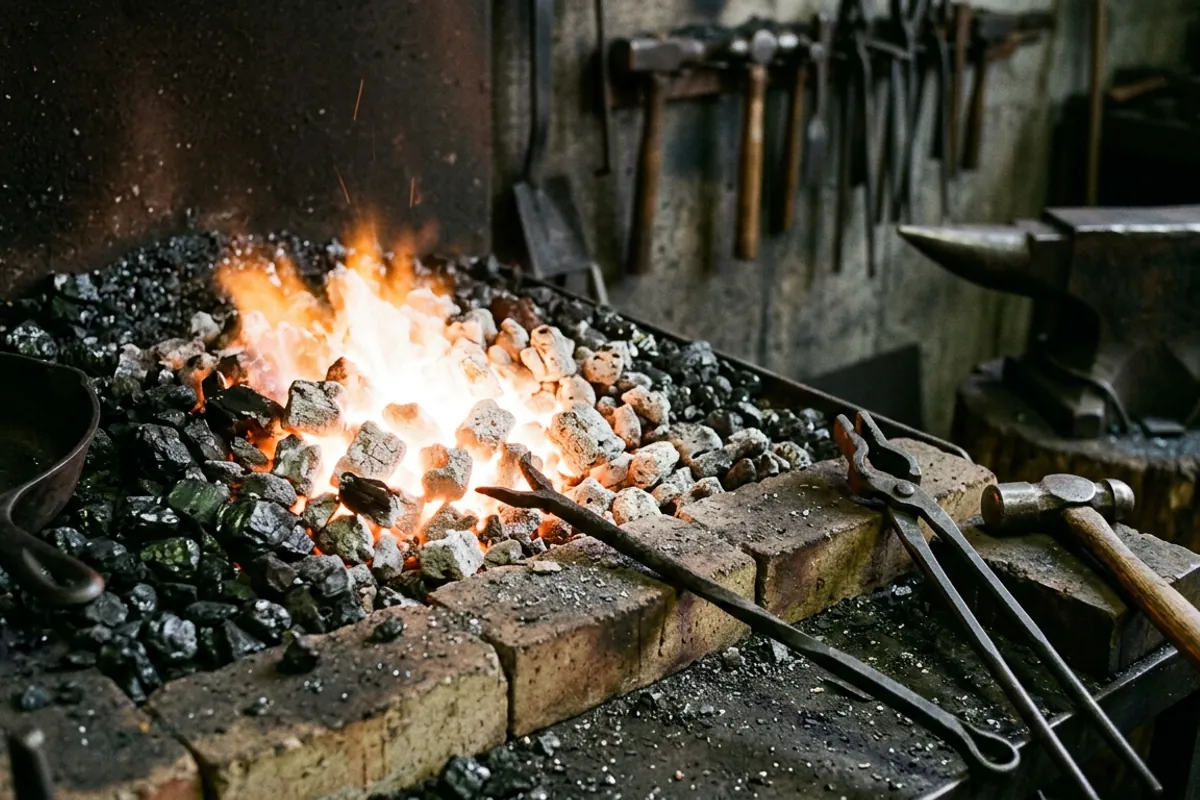
When you first pile fresh coal, which smiths call green coal, onto the edge of a fire, it heats and the volatile matter cooks out of it as smoke and gas. That yellow, oily smoke rolling off a coal forge is those volatiles leaving. What stays behind, once the smoke is spent, is coke: a light, gray, porous cinder that is almost pure carbon. Coke is the fuel that actually does your forging heat. It burns hotter, cleaner, and steadier than raw coal, and it burns close to smokeless.
So the way a coal fire really works is a cycle. You keep a mound of green coal banked around the outside of the fire where the heat is milder. It slowly cokes there. You rake that fresh coke into the heart of the fire as the center burns down, and you feed the hot core with clean coke while a fresh ring of green coal cooks at the edge. A smith managing a coal fire well is really managing coke: making it at the rim, spending it in the middle. This is why a coal that cokes well is worth paying for, and why a coal that will not coke is nearly useless no matter how cheap it is.
Anthracite is the reason to care about this. Anthracite does not coke, because it has almost no volatiles left to bake off. It also does not light easily and it needs a constant, strong blast of air to stay lit at all. Smiths do burn it, mostly in regions where bituminous is hard to get, but it wants a different fire management and a forge with a good blower. If someone hands you a bag of coal and it is hard, shiny, and reluctant to catch, you are probably looking at anthracite, and you should not judge blacksmith coal by it.
Grading coal: sulfur, ash, and clinker
Two numbers separate good smithing coal from the stuff that will frustrate you, and both come down to what is in the coal besides carbon.
The first is sulfur. Sulfur is bad news twice over. Burned, it comes off as sulfur dioxide, which stinks and is a lung irritant you do not want to stand in. Worse for the work, sulfur can migrate into hot steel and make it what old smiths called red-short or hot-short, meaning it cracks and crumbles when you forge it at a red heat. That is a real defect, not a superstition. Good smithing coal is sold low in sulfur, generally under about one percent, and the best of it is well below that. You cannot measure sulfur by eye, which is why buying coal sold specifically for smithing matters more than chasing a bargain on generic coal.
The second is ash, and its ugly cousin, clinker. Ash is the incombustible mineral left when coal burns. Some of that ash, under forge heat, fuses into a hard, glassy mass in the bottom of the fire. That mass is clinker. Clinker is the enemy of a good fire because it blocks the air coming up through your grate and smothers the heat from below. Every coal fire makes some clinker; the question is how much and how fast. Cleaner, lower-ash coal makes less of it and lets you go longer between digging it out. Part of tending a coal fire is reaching in with a poker, finding the clinker as a solid lump where the rest of the fire is loose, and lifting it out so the air can flow again.
You will also hear about coal being run of mine versus washed and sized. Washed coal has had a lot of its mineral junk cleaned out, which means less ash and clinker. Sized coal is screened to a consistent lump, usually nut to pea size for a forge, which lights and cokes more evenly than a bag that is half dust and half fist-sized chunks. Fine coal dust has its own use as a paste for banking a fire, but a whole bag of powder is hard to burn well.
Coal, coke, charcoal, and propane
It helps to know where coal sits among the fuels, because the choice is not just coal or nothing.
Bought coke is coal that has already been coked at an industrial scale, sold as ready-to-burn cinder. It lights harder than coal and gives off almost no smoke, which makes it attractive where smoke is a problem, but it wants a strong air blast and it does not build the neat banked fire that green coal does. Charcoal is the oldest smithing fuel there is, made from wood rather than dug from the ground, and it lights easily and burns clean but goes fast and burns a wide, shallow fire. I have written more about that fuel in its own right over in blacksmith charcoal, explained from the forge floor, and it is a genuinely good option, especially if you can make your own.
Then there is propane, which is the other forge in my shop. Gas gives you fast, even, hands-off heat and no fire to tend, which is exactly why it does most of my daily work. Coal gives you a concentrated, adjustable fire that can bury a lot of steel and reach forge-welding heat in a small, hot spot, plus the ability to heat just one part of a long bar. Neither is better in the abstract; they are different tools. I laid out that whole tradeoff in coal or propane: which first forge makes sense?, and if you are still deciding on your first forge that is the place to start rather than here. For a broader look at how all of this fits together, the forges topic hub gathers the fuel and forge guides in one place.
How much coal you need, and how to store it
New smiths always ask how much coal a day of forging eats, and the honest answer is less than you would guess if you tend the fire well, and a lot more than you would guess if you do not. A tended fire that you keep small and banked sips fuel. A neglected fire spread wide across the whole pot, blasted with full air the whole session, burns coal for no reason. Learning to keep a compact fire is the single biggest thing you can do to make a sack of coal last.
Blacksmith coal is usually sold by the bag in fifty pound sacks, or by the ton if you have somewhere to keep it and a way to move it. Buying in bulk is far cheaper per pound, but only if you can store it right. Coal keeps well; it is a rock. It does not rot or go stale. What you are protecting against is not decay but weather and mess. Keep it dry, because wet coal wastes heat boiling off water and is miserable to light. Keep it in a metal can, a covered bin, or a lidded drum rather than a paper sack that will tear and spill black dust across everything. And keep it out from underfoot, because coal dust tracks into a house on boots and does not come out of carpet.
One real caution worth naming: large piles of coal can, under the right conditions, heat and even ignite on their own through slow oxidation. That is a concern at the scale of a coal yard, not a couple of bags in a bin, but if you ever store coal by the ton, keep the pile out of the sun, do not pile it deep against a wooden wall, and do not stack fresh coal on top of coal that has already been sitting warm.
Running a coal fire without getting hurt
I do not treat the safety part of any guide as a footnote, and I will not here. A coal forge is an open fire putting out real hazards, and the fuel adds a couple that gas does not.
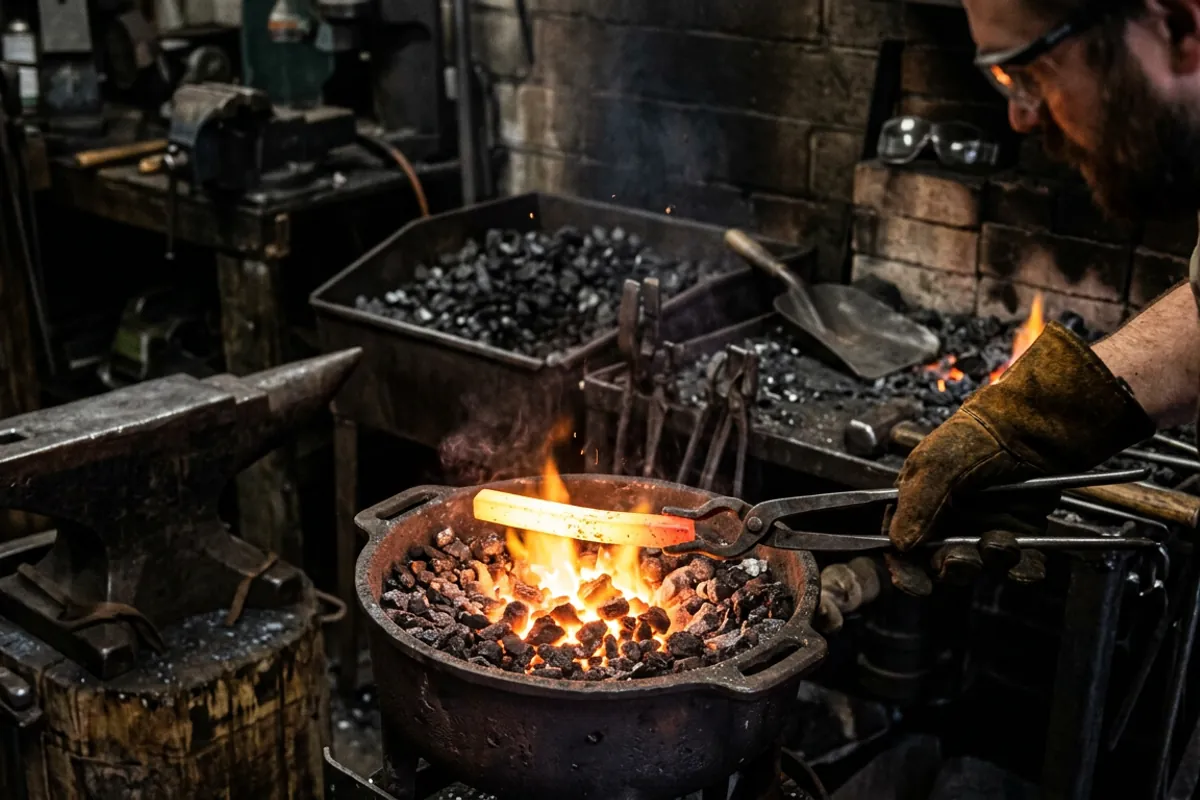
The one that kills people is carbon monoxide. Any fire that burns carbon can make carbon monoxide, and coal makes plenty, especially a smoky, oxygen-starved green-coal fire. Carbon monoxide has no smell and no color, it makes you groggy before you understand what is happening, and people have died from running a forge in a closed garage. Run a coal forge outdoors or under a real hood with a chimney that actually draws, cross-ventilate the space, and never, ever burn coal in a sealed room to stay warm. A cheap carbon monoxide alarm in the shop is money well spent.
The smoke itself is the second hazard. Green coal throws thick, sulfurous smoke until it cokes, and that smoke is an irritant you do not want to breathe or park your neighbors in. A good hood catches it. Positioning your fire and your body so the smoke goes up the chimney and not into your face is part of the craft.
Then there is everything an open fire and hot steel bring regardless of fuel. Coal fires can throw a spark or a small pop when a wet or gassy lump lets go, so your eyes are not optional. Wear eye protection rated to the ANSI Z87.1 impact standard whenever the forge is lit, and swap up to a proper face shield over those glasses for grinding and for anything involving quench oil. I lost my eyebrows early on to an oil flare-up I was standing too close to in a cotton shirt with no shield, and I kept my eyesight on luck alone. Do not run that experiment. Wear natural fibers, wool or cotton or leather, near the fire and skip the synthetics, because polyester melts onto skin instead of just burning. None of this is coal-specific, but a coal forge is exactly where a new smith first has an open flame at chest height, so it is where these habits have to start.
Buying your first coal without guessing
If you take one thing from all of this, make it this: do not buy generic coal and hope. Buy coal sold as blacksmith or smithing coal, from a supplier who sells to smiths, and you sidestep most of the sulfur, ash, and coking problems in one move, because reputable smithing coal is already screened for exactly those traits. A bag of stove anthracite or landscaping coal is a different product and will teach you the wrong lessons about what coal is supposed to do.
Buy a bag before you buy a ton. Every coal source burns a little differently, and the only real test is your own fire in your own forge. If a coal lights readily at the edge, cokes into light gray cinder without excessive smoke, holds a hot core, and does not fill your firepot with clinker after twenty minutes, you have found good coal and can commit to a larger amount. If it will not coke, chokes on clinker, or reeks of sulfur, move on regardless of price. I walked through the actual shopping side of this, brands and grades and where to source it, in the coal forge coal I would actually buy, and what to burn instead, and that is the companion to this explainer. Good coal is not expensive in the scheme of a shop, and burning the right fuel is the difference between fighting your fire all afternoon and forgetting it is even there.