I have verified ASINs and real sources. Writing the article now.
Note: the two curated VEVOR feed refs are both anvils, not forges, so neither genuinely belongs in a propane-forge guide; I'm correctly omitting the placeholder rather than forcing an off-topic card.
Here is the article:
If you gave me a tight budget and told me you wanted to be forging by the end of the month, a VEVOR propane forge is a defensible answer, and for a lot of new smiths it is the right one. The one I would point a beginner at is the single-burner kit, which is plenty of forge for knives, hooks, and small tool work, and I would only step up to the two-burner box if you already know you want to heat longer bar stock. That is the short version. The longer version is that these forges are cheap for a reason, they arrive needing work you were not warned about, and knowing that before the truck shows up is the difference between a good first year and a frustrating one.
I want to be straight about what this guide is and is not. I run a propane forge in my own shop, a coal forge next to it, and Bessie, my 148 lb Trenton, between them. I have strong opinions about how a gas forge should behave. But I have not run every VEVOR model down on my own bench, and I am not going to pretend otherwise. What follows leans on VEVOR's published specs, the reports owners leave on the retailer pages and the forums, and twenty-five years of knowing what a gas forge is supposed to do. Where the signal is thin, I will say so.
Where a VEVOR propane forge actually fits
VEVOR is a house brand that sells finished, ready-to-light gas forges at a price that undercuts the established forge makers by a wide margin. That is the whole pitch, and it is a real one. For a beginner who is not sure blacksmithing is going to stick, spending the least money that gets you a working forge is a sound decision. You can always sell it or hand it to the next beginner.
Where it fits: knives, small tools, hooks, bottle openers, S-hooks, drawer pulls, the whole world of small stock a new smith should be spending their first year on. A single-burner VEVOR will bring a knife blade to forging heat and hold it there. That is the job.
Where it does not fit: production work, long even heats on 3 foot bars, and forge welding out of the box without setup. It is also not the forge I would build a shop around for the next decade. If you already know you are in this for good, read my propane forge buying guide and my take on the gas forge field before you spend, because the step up to a name-brand forge buys you insulation and burners you will not be re-doing in a year. And if you have not settled the fuel question at all, my coal versus propane rundown is the place to start, because the forge you buy should follow that decision, not the other way around.
The lineup at a glance
VEVOR sells a confusing number of near-identical forges under slightly different titles, burner counts, and shapes. The two that matter for a beginner are the single-burner kit and the two-burner kit, both sold as complete kits with a hose, regulator, and a couple of firebricks. Here is how the published figures line up. These are manufacturer numbers, and I will get to why the temperature figure in particular deserves a raised eyebrow.
Scroll horizontally to see all columns.
| Model | Burners | Max temp (as listed) | Sold as | Coating included | Price tier |
|---|---|---|---|---|---|
| VEVOR single-burner kit | 1 | 2600 F | Complete kit, hose and regulator | No | Budget |
| VEVOR two-burner kit | 2 | 2600 F | Complete kit, hose and regulator | No | Budget |
Two columns there are worth your attention before anything else. The temperature figure is a burner-in-open-air number, not what your chamber holds under a real workload, and the "coating included" column says no on purpose. That last one is the single most important fact in this whole guide, and I have given it its own section below.
VEVOR's own product pages list the single-burner line at 80,000 BTU with a maximum of 2300 F to 1300 C on some listings, while the kit listings I am linking are titled at 2600 F (VEVOR single-burner spec page). When the same maker publishes two different top temperatures for what looks like the same class of forge, treat both as marketing ceilings, not shop reality. A forge that will comfortably reach welding heat is a forge you have tuned and insulated well, not one you unboxed an hour ago.
The single-burner kit
This is the one I would hand a beginner. A single atmospheric burner in a small chamber is the right amount of forge for the work a new smith should be doing, and less propane goes out the door per hour. It comes as a kit with the burner, a hose, a regulator, and firebricks, which means you are not sourcing fittings on day one. For knives and small stock it will get you to a bright orange forging heat without drama once the chamber is hot.
The honest tradeoffs: the steel shell is thin, the doors are thin, and owners report the door openings starting to burn back after a good deal of use. The chamber is small, which is a feature for heat economy and a limit when your stock gets longer than the box. And the burner runs rich out of the box for most people, so expect to spend time on the air and propane balance before it behaves. None of that is a dealbreaker at this price. It is just the price you are actually paying.
Check price on Amazon (paid link)
The two-burner kit
The two-burner box is the same idea with a longer chamber and a second burner, and it exists to heat longer bar and to bring a larger cross-section up faster. If you already know you want to forge tongs, longer tools, or anything where a 3 inch hot zone is a nuisance, this is the one to look at. It burns more propane, as any two-burner forge does, and the extra burner is a second thing to tune.
I would not default a first-timer to it. The single burner teaches you heat control on a smaller, cheaper-to-run box, and most beginners discover what they actually want to make before the chamber length starts to matter. But if your projects are already pointing at longer stock, the two-burner kit is a reasonable buy at a budget price. Just know that a longer chamber with more exposed wool is more insulation you need to treat, not less.
Check price on Amazon (paid link)
The part nobody puts on the box: the ceramic wool
Here is the thing that turns a lot of first-time VEVOR owners sour, and it is the most important paragraph in this guide. These forges are lined with ceramic fiber blanket, and it ships bare. Uncoated. That is a problem on two counts, and one of them is a health issue, not a performance one.
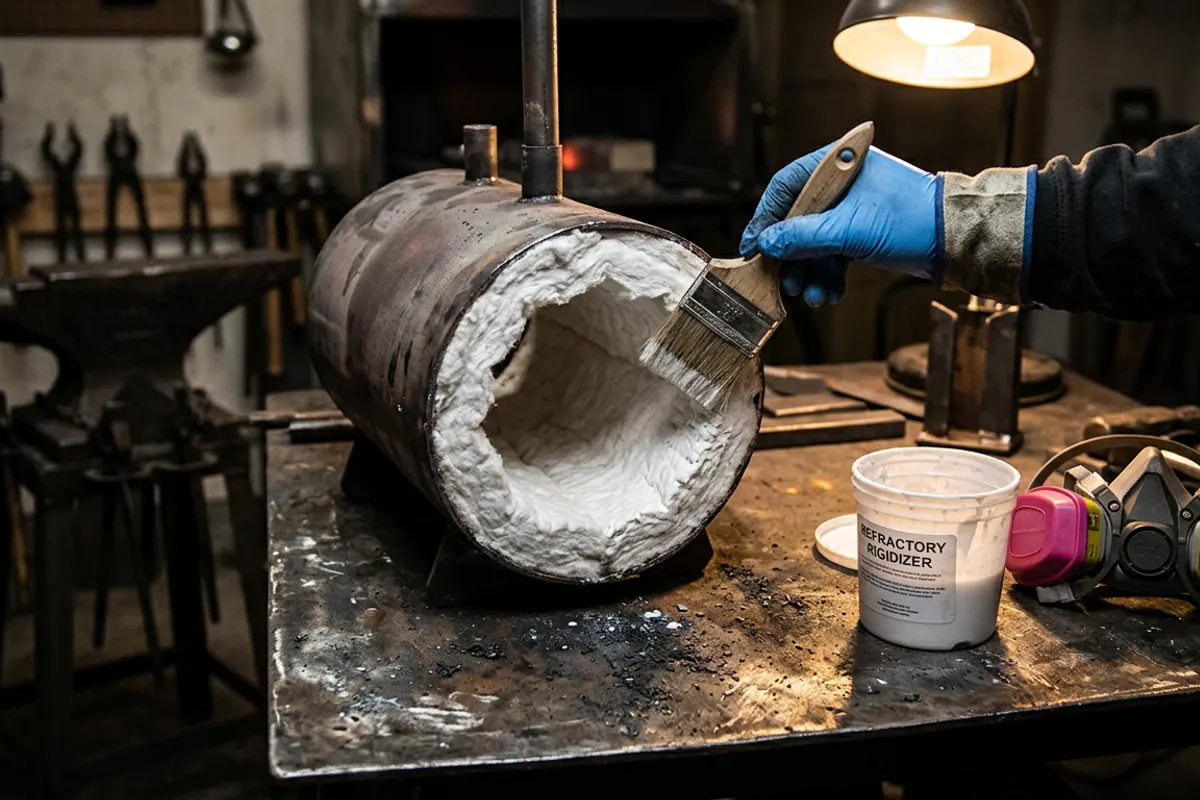
First, performance. Bare ceramic wool soaks heat and sheds fibers into the hot gas stream, and any coating you eventually brush on will crack and flake off soft, un-rigidized wool. The standard fix is to paint the blanket with a rigidizer, let it harden, then coat it with a refractory like Satanite or a product like ITC-100. Rigidizer stiffens the surface so the coating has something solid to grip, and the coating reflects heat back into the chamber and locks the fibers down. The forge people on the blade forums treat this as step one, before you ever light it. See the walk-throughs on Australian Blade Forums for how smiths actually do this on a new liner.
Second, and this is the part I will not soften: loose, hot ceramic fiber is a respiratory hazard. Refractory ceramic fiber is a recognized respiratory irritant, and after it has been heated hard it changes character and gets more dangerous to breathe, not less. The long thread on The Home Shop Machinist BBS lays out the concern plainly. Coating the wool is not only about making the forge run hotter. It is about keeping those fibers out of the air you breathe. Rigidize and coat the liner before first use, wear a proper respirator while you handle bare blanket, and do not run a bare-wool forge because it "works fine." It works fine right up until your lungs disagree.
I got careless once, early on, with oil that was too cold and a cotton shirt too close to a quench, and it cost me my eyebrows and nearly more than that. I am not interested in watching a new smith learn the wool lesson the same way. Treat the liner as assembly you finish, not a feature you got for free.
What owners say
VEVOR-specific owner signal is thin on the dedicated smithing forums, and I would rather tell you that than dress up retailer reviews as a forum consensus. Most of the detailed, named write-ups you find are about the class of budget import forge and the ceramic-wool prep it needs, rather than a specific VEVOR model run for years. That itself is a data point: these are new, cheap forges without a long track record on the boards.
What does come through consistently across retailer reviews and the general forum chatter is a coherent picture. The forges are easy to set up and heat steel well once the chamber is hot. The burners get you to forging temperature reasonably fast for the money. The recurring complaints are the ones I have already flagged: thin door steel that burns back over time, a burner that needs its air and fuel balance dialed in before it runs clean, and above all the bare, uncoated wool that people wish had shipped ready to run. On the fuel-behavior questions, general propane-forge experience holds regardless of brand, and my knife-making propane forge guide covers how a gas forge should behave once it is tuned.
The honest read: nothing in the owner reports contradicts what the price tag tells you. You are buying a functional budget forge that needs finishing work. Owners who did that work are mostly happy. Owners who expected a turnkey forge mostly are not.
Safety before you ever light it
Propane forges add a hazard coal does not, which is that they burn quietly and put out carbon monoxide. Run one in the open air or under a wide-open, well-ventilated roof, never in a closed garage. The flame at the door, the dragon's breath, is exhaust, and exhaust in a closed space is how people get hurt without smelling a thing.
The rest is the standard forge kit and it is not optional. Eye protection rated to ANSI Z87.1, and shaded lenses when you are staring into a bright chamber. Natural fibers next to the heat, wool or cotton, never synthetics that melt onto skin. Leather on your hands for handling hot stock, and tongs that actually fit the work so a piece does not slip. I put the full rundown in my blacksmith safety gear guide, and none of it is negotiable at any price point. A cheap forge does not earn cheap protection.
What I would tell a friend
Buy the single-burner kit if you are new and testing the water. It is enough forge for the work you should be doing this year, it sips less propane, and at this price it owes you nothing. Step up to the two-burner kit only if you already know your projects are pointing at longer stock. Skip the idea that either one is ready to run out of the box: budget the first evening to rigidize and coat the ceramic wool, wear a respirator while you do it, and think of that as part of the purchase price.
And keep the forge in perspective. It is one leg of the shop. The anvil under your hammer and the fuel you burn matter as much as the box that heats the steel, and a good used anvil will outlast three of these forges. Start cheap on the forge if you must, learn on it, and put the money you saved toward the tools that hold their value. If VEVOR is the brand that gets you forging this month instead of next year, that is a fine reason to buy one, as long as you go in knowing exactly what you bought.
For the wider picture, the forges topic hub collects the rest of what I have written on fuel, burners, and picking a first forge.