I have real, verified products and cited maker/forum sources. Writing the guide now.
Most forge dies are not something you buy in a box off Amazon, and the honest verdict up front is that most working smiths either make their own or buy them from a specialty press and hammer maker. If you own a hydraulic press or a power hammer and you are staring at the tooling question, start with two die shapes: flat dies and drawing dies, or a single combination die that puts both on one block. Cut them from mild steel first, learn what your machine wants, and buy or make fancier tooling once you know. Everything below leans on published maker specs and years of owner reports weighed against general shop experience, not a bench test. I run a coal forge and a propane forge and my anvil Bessie for hand work; I do not pretend to have run every press die on the market through its paces, and I will tell you plainly where the advice is owner consensus rather than mine.
That framing matters because forge dies are the one place in this hobby where the expensive answer and the right answer are usually not the same. A drawer full of hardened tool-steel dies looks impressive and moves less metal than a smith who understands one good pair of flats. Let me walk through what these things are, what they are made of, and where your money actually goes.
What forge dies actually are
A die is just the working face that meets your hot steel under a power hammer or a hydraulic press. The upper die bolts or keys into the ram, the lower die sits on the anvil or die block, and the shape ground into those two faces decides what the machine does to the bar between them. Swap the dies and the same machine goes from a general drawing tool to a fullering tool to a squaring jig. That is the whole idea: the press or hammer supplies the force, the dies supply the intent.
If you are still deciding on the machine itself, that decision comes first and it is a bigger one than the tooling. I have written separately about the blacksmith hydraulic press and the blacksmith power hammer, and the die question only makes sense once you know which of those is going in your shop, because press dies and hammer dies are not interchangeable. A press squeezes slowly and wants dies that guide steel; a hammer strikes fast and wants dies that survive impact. Read those two guides, and the Forges topic hub that ties the fuel-and-fire side together, before you spend a dollar on tooling.
The die shapes that earn their keep
There are a dozen specialty dies out there and most of them are for a job you do not have yet. Here is the short list that actually earns bench space.
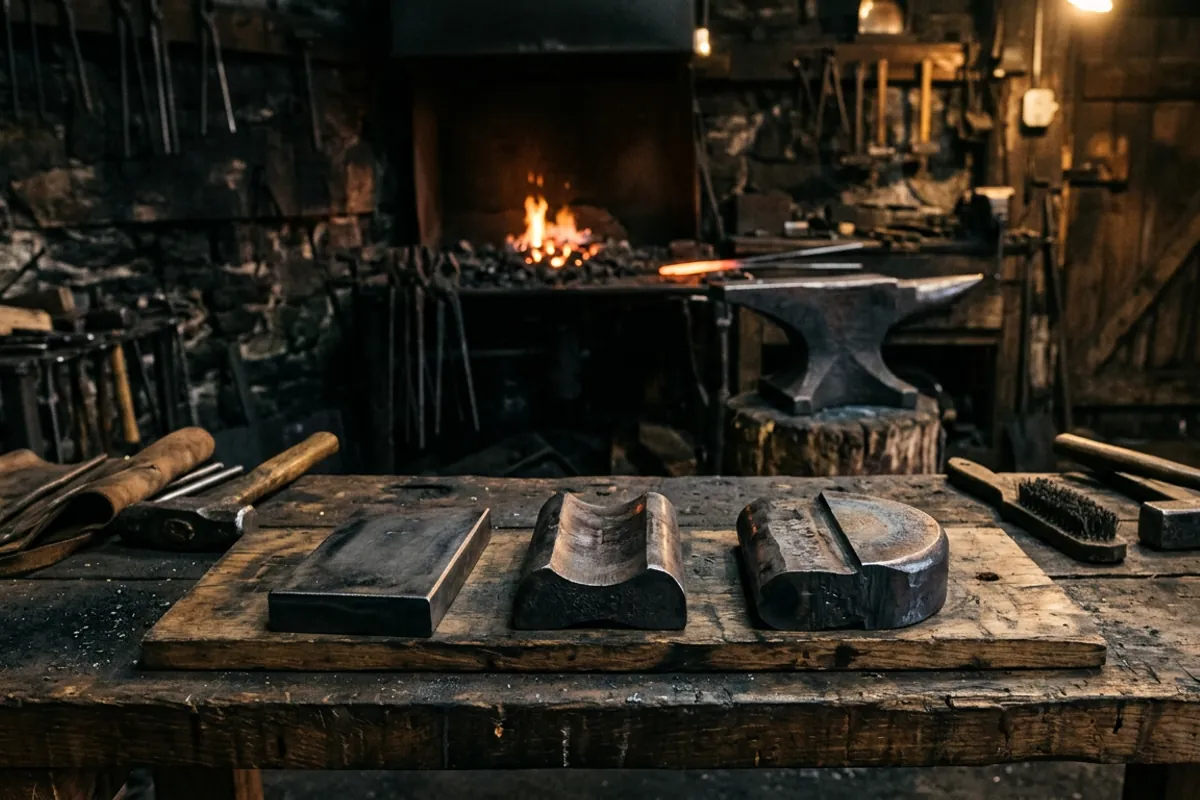
Flat dies. Every machine ships with a pair. They are flat rectangular faces with the edges broken so they do not cut your stock, and a huge amount of forging happens on them: planishing, setting shoulders, flattening tapers. If you buy nothing else, you already own these.
Drawing dies. The edges carry a real radius so force concentrates into a narrow band of contact and moves metal along the bar fast. This is the die that turns a fat billet into a long bar without beating on it for an hour. For anyone drawing out stock or knife billets, drawing dies are the first upgrade over flats.
Combination dies. Half the die face is flat, half is a drawing radius, so you get both without swapping tooling. Plenty of smiths on the forums run a combo die almost exclusively and call it the most versatile setup for general work. If you hate changing dies mid-heat, this is your die.
Fullering dies. A rounded ridge that isolates force to spread or neck down stock, the machine equivalent of a hand fuller. Useful, but a want, not a need, for most home shops.
Squaring dies. Angled or stepped faces that keep a bar square while you draw it, which matters a lot for pattern-welded work where a bar that keeps rolling into a diamond is a headache. A specialty die, worth it only if you are doing that work.
Here is how the common finished sets stack up, using figures the makers actually publish.
Scroll horizontally to see all columns.
| Die set | Shape | Material | Published size | Price tier |
|---|---|---|---|---|
| Straight flat set (Gilmore) | Flat | CR 1018 | 1 x 2.5 x 5 in | Budget |
| Drawing set (Gilmore) | Drawing | CR 1018 | 1 x 2.5 x 5 in | Mid |
| Combination set (Gilmore) | Flat + draw | CR 1018 | 1 x 2.5 x 4 in flat side | Mid |
| Squaring set (Gilmore) | Squaring | CR 1018 | top 1.5 in / bottom 2 in | Premium |
| Punch and stripper (Gilmore) | Punch | Punch H13 | Not published | Premium |
| Full width flat (Coal Iron) | Flat | Not published | Not published | Budget |
| Full width combo (Coal Iron) | Flat + draw | Not published | Not published | Premium |
Specs and prices above are from the Gilmore Presses die listing and the Coal Iron Works dies collection, read as published. Where a maker does not state a material or dimension, I have left it "not published" rather than guessing, because a die that does not fit your die block is scrap and you cannot fix a wrong number after the fact.
The steel question: mild, 4140, or H13
This is the argument that eats the most forum bandwidth, and the answer surprises people. The instinct is that dies should be hard tool steel. The experience says otherwise for a lot of press work.
Over on the BladeForums press-dies thread, Ed Caffrey, a smith who has worn out more dies than most of us will ever own, tells people not to waste money on anything past A36 hot-rolled mild steel for flat dies, because no matter what steel you use it deforms over time under heat and pressure. He says he tested D2, M2, and H13 and found plain mild steel held up about as well for a fraction of the cost. Graham Fredeen in the same thread agrees that mild steel dies held up about as well and are far easier to work with. The common practice is to treat flat dies as consumables: tack-weld a fresh A36 pad on when the face mushrooms, dress it, keep going.
That does not make hard tool steel pointless. It means you match the steel to the die's job. Faces that take real abuse from a small contact area, like punches and stripper dies, are where makers reach for H13, and Gilmore lists exactly that, Punch H13 steel, for its punching set. Drawing and squaring faces that see less brutal point loading get by fine in CR 1018. If you want to understand why a hardened die can chip while a soft one just slowly deforms, the metallurgy side of that is real science, and I would point you to Knife Steel Nerds for how hardness trades against toughness rather than trust a number somebody typed into a forum.
For a home shop the practical read is this: mild steel or 4140 for general flat and drawing dies, tool steel only where a maker who does this for a living uses tool steel. 4140 in the annealed condition machines and shapes well and takes more abuse than mild before it moves, which is why a lot of shop-made dies get cut from it.
Buy finished, or make your own
Here is where I land honestly. Amazon is not where quality finished forge dies come from. The good stuff, cut and ground to fit a specific die block, comes from specialty makers like Gilmore, Coal Iron Works, and Big Blu, and those are the links in the table above. What Amazon is genuinely good for is the raw material to make your own, which is what a large share of press and hammer owners end up doing anyway.
For most home dies I would start from annealed 4140 flat bar and cut, radius, and dress the faces to what my machine and my work want. A length of 4140 flat stock in 1/2 by 1 inch (paid link) is enough to fabricate spring swages, small fullers, and hardy-mounted tooling, and a wider 4140 flat bar in 1/4 by 2 inch (paid link) is handy for facing and shim work. This is the same instinct behind a lot of shop tooling: I have argued before that the DIY forge parts worth building beat the bought versions when the tolerances are yours to set, and dies are the clearest case of that. Making your own also teaches you what the die is doing, which is the difference between owning tools and using them.
If you are making dies that key into a bottom tool, a swage block covers a lot of the same shaped-cavity work by hand and is worth understanding alongside powered dies, because sometimes the answer to "I need a die for this" is "I already own the shape in the swage block."
The reference I would own before I cut a die
If you own a press and you are going to make tooling for it, do not wing it off forum screenshots. Randy McDaniel's Hydraulic Forging Press for the Blacksmith (paid link) is the standard reference, and a good chunk of it is specifically about tooling you can make to get the most out of the machine, with drawings and photos of the dies. For the price of one finished specialty die set you get the book that tells you how to make ten of them. I would put it on the bench before I cut my first die block. It is a knife maker's and blacksmith's book, not a general fabrication text, so the tooling advice is aimed at exactly the work we do.
Books are not gear I need to fake a test on, and this one has been the go-to press reference in the community for years. That is owner consensus and my own reading of the field, not a claim that I authored the tooling in it.
What owners say
For gear I have not personally run down in my own shop, which is most finished press dies, here is what the forums actually report. On the BladeForums press-dies thread, the strong consensus is that flat and drawing dies do the overwhelming majority of the work, that mild steel is good enough for flats and gets replaced as a consumable, and that squaring dies are the one specialty set pattern-welders call crucial. Nick Wheeler in that discussion runs a keystock thickness stop with his flat dies to get uniform billets, which is a cheap trick worth stealing.
On the power hammer side, the PowerHammers LLC tooling guide lays out the same hierarchy: flats come standard and do most jobs, drawing dies move metal fast, and convex and fullering dies are for smiths who already know they need controlled or isolated force. What you will not find, in either place, is anyone saying a beginner needs a wall of specialty dies. The honest signal is thin on exotic tooling for good reason: most owners never buy it.
Where the forum signal genuinely runs thin is hardness numbers on finished commercial dies. Makers like Gilmore and Coal Iron publish steel type and dimensions but not hardness, and I will not invent a figure to fill the gap. If hardness matters for your job, ask the maker directly before you buy.
Heat, hardness, and safety
Dies live in the most dangerous corner of the shop, so this is not the part to skim. A power hammer or press die is a closing set of steel faces with tons of force behind them and a hot bar in the middle. Keep your hands out of the die gap, full stop. Hold work with proper tongs, never fingers, and never reach in to reposition while the machine is live.
Wear eye protection rated to ANSI Z87.1 at the machine, and put a face shield over it when you are drawing scale-covered stock, because dies fling hot scale hard and fast. I lost my eyebrows early on to a quench flare-up standing too close in a cotton shirt with no shield, and I got my eyesight back by luck, not by anything I did right. Natural fibers near the fire, natural fibers at the machine; synthetics melt onto skin. If you want the full rundown, the blacksmith safety gear guide covers what matters and what to skip.
One more that is easy to forget: a mushroomed die face throws chips. When flat dies spread at the edges from use, dress them back before those edges start to peen off shards. A worn die is not just sloppy forging, it is a projectile hazard.
What I would tell a friend
Buy the machine right first, then keep the tooling boringly simple. Start with the flat dies your press or hammer came with, add one drawing die or a single combination die, and cut those from mild steel or annealed 4140 rather than paying tool-steel money for faces that will deform anyway. Buy H13 only where a serious maker uses H13, which in practice means punches, not flats. Get Randy McDaniel's book before you cut your first die block, because it will save you more than it costs on your second one.
The die to skip is the drawer full of specialty shapes you bought before you knew what your work needed. The one that matters most is the safety habit: hands out of the gap, Z87.1 on your eyes, a shield down when scale is flying, and worn faces dressed before they throw a chip. Get that right and forge dies are one of the more forgiving corners of this trade to learn by making your own.