Sources confirm both ASINs are live and matching, plus citable non-marketplace specs from Centaur Forge and the Wikipedia/I Forge Iron references. Writing the article.
A blacksmith swage block is one of those tools you can smith for years without, right up until the day you need to sink a bowl, form a spoon, or back up a bar you are punching, and suddenly nothing else in the shop will do the job. It is a heavy slab of cast iron, ductile iron, or steel, drilled and cast with a range of holes through the face and shaped depressions and half rounds around the four edges. You lay hot steel into a form and drive it down, and the block gives you a shape your anvil face never could. I have run mine next to Bessie, my 148 lb Trenton, for a long time, and the honest truth is that a swage block is a second-tier purchase, not a first one. But when the work calls for it, there is no clean substitute.
I want to be straight about what this guide is before you read another line. I own and use a swage block, so I can talk about what living with one is actually like: how you mount it, what the forms are good for, where a cheap one falls short. But I have not personally run down every model below on my own bench. The picks here lean on published specs from the makers, on what owners report on the forums, and on general shop experience with what makes a block worth owning. Where I am passing along secondhand consensus rather than my own hands, I will say so.
What a swage block actually does
Think of a swage block as an anvil's specialist cousin. Your anvil face is flat, its horn is a smooth curve, and between the two you can do most forging. What you cannot easily do is form a hemisphere, sink a ladle bowl, back up a bar over a square hole while you punch it, or run a length of stock down into a clean half round or hexagon. That is the swage block's whole job.
The face holds through-holes in graduated sizes, usually squares and rounds, so you can drop a punched or drifted bar into a hole that supports the metal around the opening while you work. The four side edges carry the forms: half rounds in a range of radii, vee notches, hemispherical bowls of increasing depth, and sometimes spoon and ladle patterns. You pair the block with a matching top tool, a spring swage or a hand swage, and the two halves shape the bar between them. As the Wikipedia entry on swage blocks puts it plainly, the holes back up heated bars while the shaped sides work with top swages to create specific cross sections, and that is exactly how it plays out at the forge.
For most beginners, the block is not on the critical path. You need an anvil, a hammer, tongs, and a forge first. A swage block earns its keep once you start doing hollow work, hardware, ladles, or armor, where sinking and dishing come up constantly.
How the field stacks up
Here is the field in one place. These are published figures from the makers and retailers where they publish them; where a maker does not state a material grade, I have said so rather than guess. The budget import blocks list their own dimensions and grade in the seller copy, which I treat as seller-reported, not maker-verified.
Scroll horizontally to see all columns.
| Swage block | Weight | Material | Notable features | Price tier |
|---|---|---|---|---|
| Centaur mini / Melton mini | 6.5 to 10 lb | Cast iron | Spoon and ladle bowls, benchtop | Budget |
| Import block, small | 50 lb | Ductile iron, seller lists 65-45-12 | Bowls, spoons, rivet dimples, half rounds, notches | Budget |
| Import block, larger | 66 lb | Ductile iron, seller lists 65-45-12 | Round and square holes, hex, half rounds | Budget to mid |
| Centaur Swage Block A | 125 lb | Cast, grade not published | Square holes 1/2 to 1-1/4 in, untapered | Premium |
| Centaur Swage Block B | 130 lb | Cast, grade not published | Tapered square holes | Premium |
Centaur Forge publishes the weights and hole sizes for its Swage Block A and Swage Block B, and notes both ship rough cast and may need cleaning before use. Their smaller mini swage block is a 6.5 lb cast iron benchtop piece for spoon and ladle work. Those pages are your best published-spec reference for the heavier end of the market.
Cast iron, ductile iron, or steel: what the material means
This is where new buyers get tangled, so let me lay it out the way I would at the club forge.
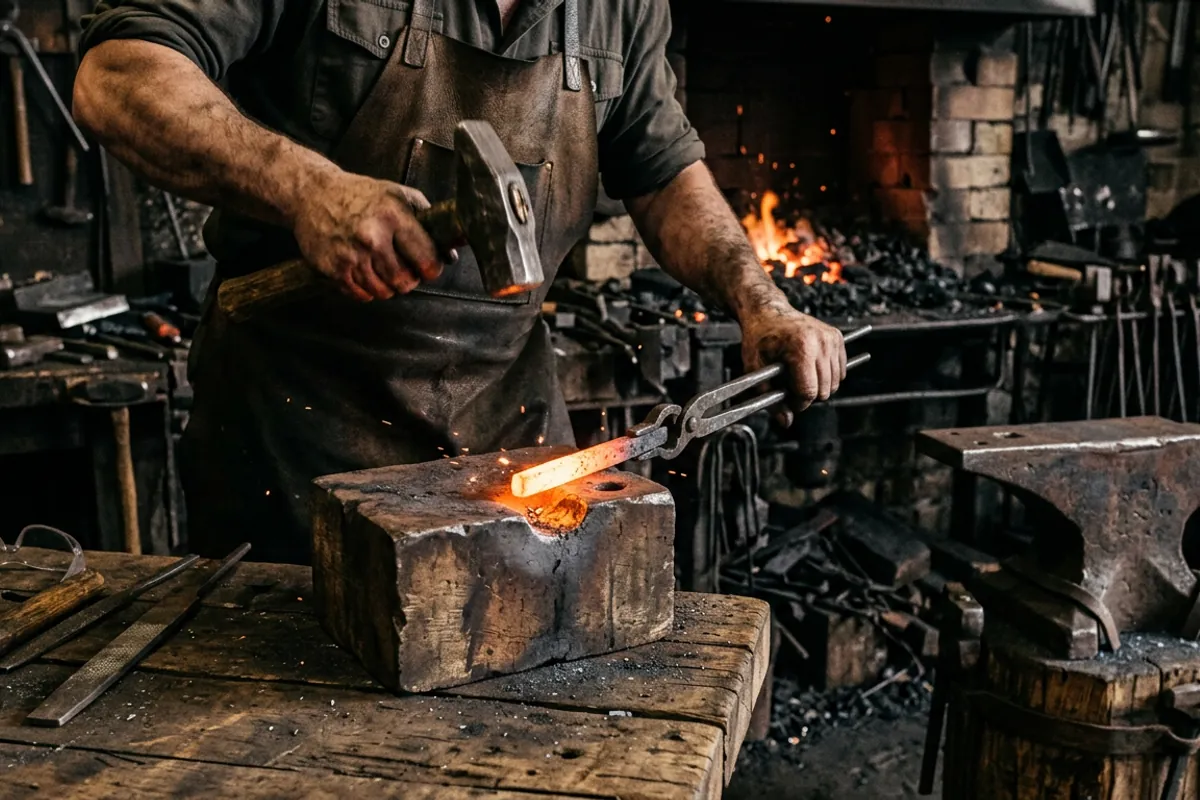
A traditional swage block is often gray cast iron, and that is fine for its intended use. A swage block is not an anvil. You are not hammering directly on its flat face expecting hard, bright rebound. You are laying hot, plastic steel into a form and driving it down into the shape. The block backs up the work; it does not have to be a hardened striking surface. Gray cast iron does that job and has for well over a century.
Ductile iron, which most of the modern import blocks advertise, is a real step up in one specific way: it is far less brittle than gray cast iron. The seller listings on the budget blocks call out grade 65-45-12 ductile iron, which is a common structural grade. The practical upshot is that ductile iron tolerates an accidental cold hammer blow or a knock in shipping better than gray iron, which can crack or chip if you abuse it. I would not treat that as a license to beat on it with cold steel, but it is a genuine advantage for a tool that gets dropped, shipped, and occasionally hit wrong.
Cast steel blocks exist and are the most durable of the three, but they are heavier to make, more expensive, and honestly overkill for the depression-and-forming work most of us do. The I Forge Iron crowd will tell you the same in the swage blocks subforum: for shaping work the material argument matters far less than it does on an anvil, and a sound cast block that is not cracked will outlast you. Where material really does matter is cracks. A cracked swage block is a hazard, because a chunk can let go under a hammer blow. Inspect any used or budget block for casting flaws before you trust it.
The small import blocks I would start with
If you are buying your first swage block and you are not made of money, this is the tier you are shopping in. These are the 50 to 66 lb ductile iron blocks that show up under a dozen seller names, almost certainly out of the same handful of foundries. They are not heirloom tools, but they are genuinely useful, and for the money they get most home smiths into dishing, bowl work, and light forming without a four-figure outlay.
The smaller ones run around 50 lb and pack four bowls, a couple of spoon depressions, rivet dimples, and half rounds with vee notches around the sides. That is a lot of capability in a block one person can still wrestle onto a bench. A representative 50 lb ductile iron block is here: Check price on Amazon (paid link).
Step up to the 66 lb version and you gain round and square through-holes, hex forms, and generally deeper and larger radii on the sides, at the cost of a block that is genuinely awkward for one person to move. If you already know you want the through-holes for punching and drifting support, the larger block is the better buy: Check price on Amazon (paid link).
Be honest with yourself about the tradeoffs on this tier. The castings are rough. The forms are often not perfectly true, the surfaces can be pitted, and you will likely spend an evening with a flap disc and a file cleaning up bowls and edges before the block gives you clean work. That is normal for budget cast tooling and not a defect to return over. What you are checking for on arrival is cracks, not cosmetics. Wear ANSI Z87.1 rated eye protection when you dress a new block with a grinder; cast iron throws hard, fast fragments, and I have picked enough of them out of shop walls to respect it.
The heavier blocks, and when they are worth it
The Centaur Forge blocks and their peers sit at the 125 to 130 lb range and are a different animal. More mass means the block sits dead still under heavy blows instead of walking across the bench, and the hole selection on Swage Block A runs a full set of square holes from 1/2 inch up to 1-1/4 inch, which is the kind of range you want if you are making hardware or tenons in volume. Swage Block B trades the untapered holes for tapered ones, which some smiths prefer for drifting.
At the other extreme, the little benchtop minis like the Centaur and the Melton blocks are not really swage blocks in the traditional sense. They are dedicated spoon and ladle formers, 6.5 to 10 lb, meant to clamp in a vise or sit on the bench. If bowl and spoon work is specifically what you are after and you do not need the through-holes, a mini is a cheap, precise way in, and it stores in a drawer. Pair one with a good bench setup and it earns its keep. If you have not sorted your holding and workholding yet, my blacksmith vise guide covers the vise you will want to clamp a small block into.
I would not steer a beginner to a 130 lb premium block as a first swage block. The import 50 or 66 lb tier does the same jobs well enough to learn on, and if you outgrow it you will know exactly which holes and forms you actually use, which makes the eventual upgrade a smarter buy.
Mounting and using one safely
A swage block that moves while you work is worse than no block at all. The traditional mount is a heavy wooden stand, a stump or a built-up timber cradle, that holds the block at a comfortable working height and lets you flip it to reach whichever face you need. Some smiths bolt a steel stand up. Either way, the goal is the same: the block sits solid, does not rock, and cannot slide off when you hit it off center.
For lighter forming you can lay the block flat on a stout bench, but back it with something that will not let it walk, and keep it low enough that you are driving down into the forms, not reaching up. When you use the through-holes to back up a bar you are punching or drifting, remember that the hot slug or punch can come through the bottom. Keep your body and feet clear of the underside, and keep a slack tub nearby.
The safety basics do not change because the tool is exotic. Eye protection rated to ANSI Z87.1 whenever you are striking or grinding. Natural fiber clothing near the forge, because synthetics melt into skin. Tongs on the hot bar, never bare hands near the heat. None of that is new if you have read my rundown of what blacksmithing safety gear actually matters, but a swage block adds one wrinkle worth naming: the forms concentrate force, and a cracked or poorly supported block under a hammer blow can throw a fragment. Inspect before you trust, and support it well.
What owners say
For the budget import blocks, owner signal on the forums is real but thin, and it is worth saying so. The recurring theme in the I Forge Iron swage blocks subforum and general tool threads is that the imported ductile iron blocks are usable and a fair value, but arrive rough and benefit from cleanup, and that buyers should inspect for casting flaws. That matches what you would expect from budget cast tooling and matches the one I have handled.
On material, the consensus across threads like the long-running cast versus forged discussions is consistent: the cast-versus-steel argument that matters so much for anvils matters far less for a swage block, because the block backs up work rather than serving as a hardened striking face. A sound casting is a sound casting. The complaint that comes up most is not material, it is trueness and finish on the cheap blocks, and cracks on abused used ones.
For the older American swage blocks that turn up used, owners consistently rate them highly, and they hold value. If you find a vintage block sound and cheap, the same buying instincts I use on old anvils apply, and my used anvil buying approach transfers almost directly: check for cracks, ring for a dead spot, and do not overpay for heavy scrap.
What I would tell a friend
Buy the swage block second, not first. Get your anvil, forge, hammer, and tongs sorted and log real hours before you spend on a specialist tool, and when you do buy one, match it to the work you actually do. If you want a general block to learn dishing, bowl, and forming work on, the 50 or 66 lb import ductile iron block is the honest value, and the 66 is the one I would pick if you want the through-holes. If you specifically want spoons and ladles, a small mini block in a vise is cheaper and better at that one job. Save the 125 to 130 lb premium blocks for when you know exactly which forms you reach for.
Whatever you buy, inspect it for cracks, mount it so it cannot move, and wear your Z87.1 eyes when you dress or strike it. If you are still building out the rest of the bench, my short list of blacksmithing tools that actually matter will keep you from buying a swage block before you own the things you use every single session, and you can find the rest of these shop-tool guides on the More from the shop hub.