Both ASINs verified live, and I have non-marketplace spec sources (Starrett, Jim Bode Tools, Hanes Supply) plus real forum threads. Writing the guide now.
Here is the article:
If you came here wanting a link to buy a blacksmith double caliper, I have to be honest with you up front: the tool you are picturing, the long forged bar with two separate gauges on it, is mostly an antique or something you forge yourself. It is not a thing you add to a cart. So this guide does two jobs. First, I will tell you what a real double caliper is and why smiths swore by them. Then I will point you at what you can actually buy today to do the same job, which is a spring caliper and divider set. If you want the short version, a decent three piece spring caliper set covers ninety percent of what a home smith needs for measuring hot stock, and the 8 inch DAJAVE set is a sane place to start.
Fair warning on how I am writing this. I own spring calipers and dividers and use them at the forge, so I can speak to those from the floor. I do not own a hundred year old forged double caliper, and I am not going to pretend I bench tested one. The picks below lean on published specs, the antique tool market, and what smiths report on the forums, weighed against my own shop experience.
What a blacksmith double caliper actually is
A true double caliper is one tool with two independent measuring ends. Picture a forged bar with a hanging loop, and at each end a set of caliper legs. You set one end to the thickness you want and the other end to the width you want. Then, while you are drawing a bar down under the hammer, you can check both dimensions without switching tools or hunting for a tape measure with a glowing bar in your tongs.
That is the whole genius of it. When you draw stock down, width and thickness both change at once, and you are trying to land on two numbers at the same time. A double caliper lets you lock in both targets and just keep checking against them as the steel moves. One dealer listing I found, an 18 inch blacksmith's double caliper from Jim Bode Tools, shows the classic form: a long forged handle so your hand stays back from the heat, hand cut and marked with the old owner's initials. The length is the point. You are reaching in to measure a hot workpiece, and every inch of handle is an inch your knuckles are away from a orange bar.
These were common shop tools for a reason. Before laser cut anything, a smith reproducing a part, or making a matched set of the same size, needed a fast way to hit a repeatable dimension. The double caliper was that way.
The honest reality: most true double calipers are antique or shop made
Here is where I have to be straight with you, because the whole point of this site is that I will not upsell you. Nobody is mass producing traditional forged double calipers for the general market. What you find are antiques, which run through specialty dealers and auction sites, and one off tools that smiths forge for themselves. On The Garage Journal and I Forge Iron, the double caliper threads are guys showing off a flea market find or a tool they made, not a product line you can order.
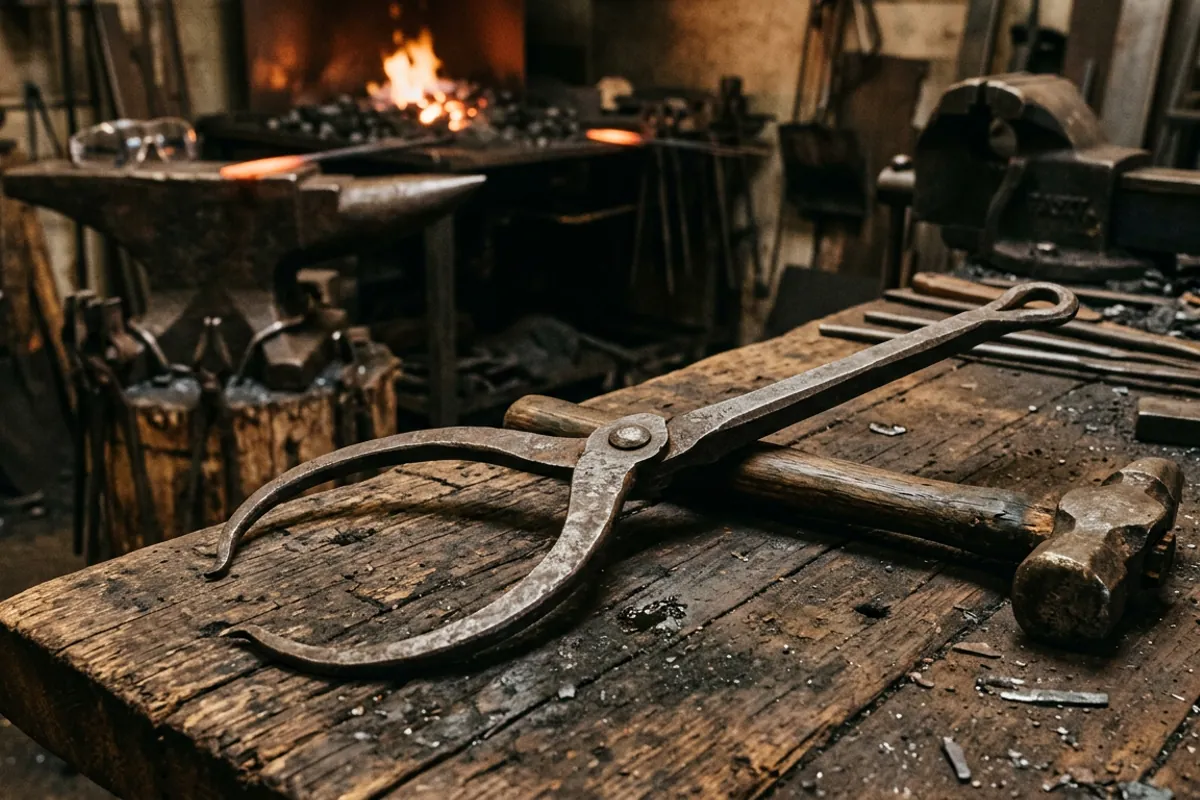
So you have three real options. You can hunt for an antique, which means paying collector money for a working tool and accepting the condition you get. You can forge your own, which is honestly a great intermediate project and I will come back to it. Or you can buy modern spring calipers and dividers, which are cheap, everywhere, and do the measuring job even if they are not one combined tool. For most people reading this, the third option is the answer, and it is what I would tell a weekend beginner to buy first.
If you go antique hunting, treat it like buying any old tool. Check that the legs still hold a setting, that the rivet or fulcrum is not sloppy, and that nothing is cracked at the loop or the joint. A caliper that will not hold its setting is a wall decoration, not a tool.
What to look for in a caliper you buy today
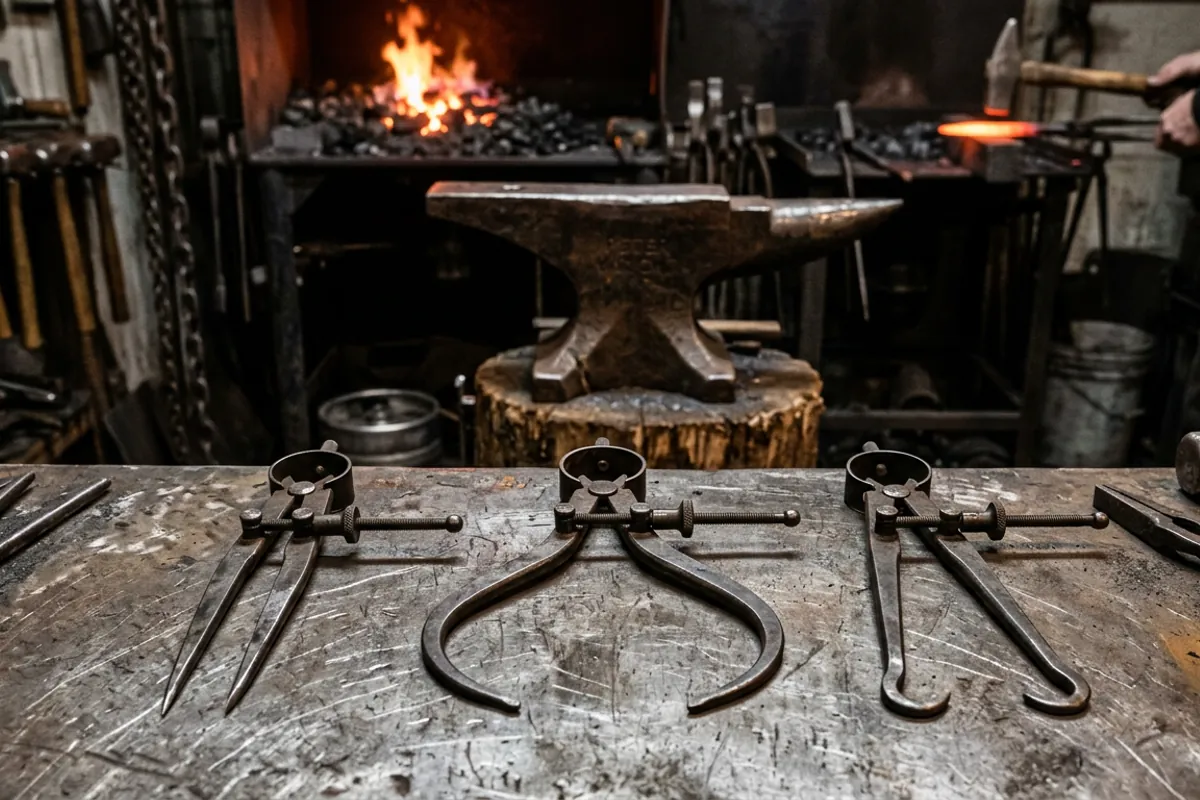
Since the practical buy is a spring caliper and divider set, here is what matters. A spring caliper is two curved legs joined at the top by a bow spring, with a threaded rod and nut across them. The spring pushes the legs apart, the nut pulls them together, and the friction of the spring against the nut is what holds your setting. Outside calipers have legs that curve in, for measuring thickness or diameter. Inside calipers curve out, for measuring a slot or bore. A divider has two straight pointed legs for scribing and stepping off equal spaces.
The things that separate a good one from junk are simple. You want a spring strong enough that the setting does not drift when you bump it, a fulcrum stud that is hardened so the joint does not wear loose, and a nut that adjusts smoothly. On the reference end of the market, Starrett publishes exactly these features on its toolmakers spring type calipers: a hardened fulcrum stud, a strong bow spring, and a centrally located adjustment for smooth action. That is the standard the cheap sets are imitating.
Here is how the field lays out. Specs are what the maker or a non marketplace retailer publishes; where a budget set does not publish a real material spec, I say so.
Scroll horizontally to see all columns.
| Tool | Type | Size | Material | Holds setting via |
|---|---|---|---|---|
| Antique forged double caliper | Two gauge, single bar | ~18 in handle | Wrought iron, forged | Friction joint |
| DAJAVE 3 piece set | Outside, inside, divider | 8 in | Carbon steel (not fully published) | Bow spring and nut |
| Safedeals365 3 piece set | Outside, inside, divider | 6 in / 150 mm | Steel (not fully published) | Bow spring and nut |
| Starrett Yankee spring caliper | Outside caliper | 6 in | High grade steel | Bow spring, quick nut, hardened stud |
For the antique length, see the Jim Bode listing; for the Starrett construction, Hanes Supply lists the 275 series as ground steel with a hardened fulcrum stud.
A three piece set to start with
For most home smiths, a three piece spring caliper set is the right first buy, because it covers outside, inside, and divider work in one cheap package. The 8 inch DAJAVE spring caliper and divider set (paid link) is the size I would reach for at the forge. The extra reach over a 6 inch set keeps your hand back from the heat, which is the same logic that made real double calipers long in the first place.
Understand what you are buying at this price. These are budget carbon steel tools. The springs are decent but not Starrett smooth, and the finish is rough. What they do fine is hold a setting long enough to check a hot bar, and at this money you can own the whole set and not baby them. That is exactly what you want around a forge, where tools get dropped, get scale on them, and occasionally get too close to the heat. I would rather grab a cheap caliper with a bar in the fire than a hundred dollar precision instrument I am afraid to scorch.
The move that gets you the double caliper function out of a set like this is to dedicate two of the tools. Set one outside caliper to your target thickness and leave it. Set the divider or a second caliper to your target width and leave that. Now you have two locked gauges, which is exactly what a double caliper gives you, just in two hands instead of one bar.
The cheaper set if you just want to try it
If you are not sure you will use calipers much and you want to spend as little as possible to find out, the 6 inch Safedeals365 spring divider caliper set (paid link) is about as cheap as this category gets. It is the same three piece idea, outside, inside, and divider, in the smaller 150 mm size. The listing notes a hardened fulcrum stud and a spring nut, which are the right features on paper.
The honest tradeoff is the 6 inch length. For layout work on cold stock at the bench it is fine. For reaching in to check a hot forging, I find 6 inches a little short for comfort, and you end up leaning your hand closer to the heat than I like. If your main use is measuring hot steel, spend the extra couple of dollars on the 8 inch set. If your use is scribing lines and stepping off holes on cold work, the 6 inch is plenty. Either way, wear your eye protection; a caliper leg that slips off hot scale can flick a chip, and you should have Z87.1 glasses on at the forge regardless.
The buy once option: Starrett
If you already know you love shop tools and you want one caliper that will outlast you, buy a Starrett Yankee spring caliper (paid link). This is the other end of the market from the cheap sets, and it earns it. The hardened fulcrum stud does not wear loose, the bow spring is genuinely smooth, and the quick adjusting nut lets you slide the legs open fast instead of spinning the nut down the whole rod. Starrett has been making these to the same pattern for generations, and the specs are published and consistent across their 275 and 277 series.
Would I put a premium caliper right next to the forge fire? Honestly, mine lives more at the bench and the layout table than in the scale and slag. If you buy one nice caliper, use it for the precise work and keep a cheap one for the dirty hot checking. That is not a knock on the Starrett. It is just how I treat any tool that costs real money in a shop full of ways to ruin it.
What owners say
For the traditional double caliper, the owner signal is thin and it is honest to say so. Because these are not a current product, the conversation on I Forge Iron and The Garage Journal is mostly appreciation of old examples and people sharing ones they forged. The consistent theme is that the value is in checking width and thickness at the same time while drawing down, and that the long handle to stay clear of the heat is the whole point. Nobody in those threads is reviewing a new one, because there are no new ones to review.
On the modern spring calipers, the owner consensus on the general blacksmithing caliper threads at I Forge Iron matches what I see in my own shop. The cheap import sets are widely called good enough for forge work, with the common complaints being rough springs, settings that can drift if the spring is weak, and finish that needs a little cleanup out of the box. The advice that comes up over and over is to buy cheap ones for the hot dirty measuring and save a good caliper for precision, which is exactly what I do. For the Starrett tools, the forum read is what you would expect: they cost more, they hold up, and people who own them do not complain about them.
I want to be careful here and not oversell secondhand reports as my own testing. I have run cheap spring calipers at my forge for years, so that part is mine. The double caliper praise is owner consensus and antique market observation, not a tool I have on the rack.
Making your own double caliper
Here is the part I am actually excited about. A double caliper is a genuinely good intermediate forging project, and building one teaches you more than buying one. You are forging matched legs, drawing out a long tapered handle, punching or drifting for the rivets, and making a joint that moves smoothly and holds friction. That is real skill practice, and at the end you have a working tool that does something no store bought item quite does.
If you want to work up to it, get comfortable drawing out and making clean tapers first. A good pair of tongs to hold the work and a solid grasp of the basic moves matter more than any measuring tool here. When you do build one, use a spring caliper you already own to set your target dimensions, forge to match, and you have effectively bootstrapped the old tool from the modern one. Match the handle length to your reach and your forge so your hand stays back from the heat, which is the same reason the antiques run long.
If you are still filling out the rest of your bench, calipers are a small piece of a starter tool list, and I would not stress over them until you have an anvil, a forge, a hammer, and tongs sorted. Measuring tools are the last thing that stops a beginner, not the first.
What I would tell a friend
Buy the 8 inch DAJAVE three piece set (paid link) and get on with it. Set one caliper to thickness, set the divider to width, and you have the double caliper function for the price of a fast food lunch. Skip the antique hunt unless you specifically want an old tool for its own sake, because you will pay collector money for something a five dollar caliper does at the forge. If you fall in love with the work and want a caliper for life, add a Starrett later and let the cheap ones take the abuse.
The one real safety note: keep your hand back from the heat and keep your glasses on. A short caliper pulls your knuckles toward an orange bar, and a leg slipping off scale can throw a chip. That is the whole argument for length, on the antiques and on what you buy today. For more from the bench, the rest of the shop guides live in More from the shop, and if you are still building out the basics, start with the tools that actually matter.