I have solid, verified material now. Writing the article.
Here's the article:
A blacksmith post leg vise is the one clamping tool in the shop that is built to be hit. That is the whole point of it, and it is the thing most people miss when they walk into the hardware store and buy a cast bench vise instead. The leg that runs from the moving jaw down to the floor is not decoration. It carries the shock of your hammer straight into the ground instead of into the mounting bolts, which is why a hundred year old leg vise will still hold a bar you are upsetting on hot while a shiny new bench vise cracks its casting the first time you lean on it. I have owned and rebuilt a couple over the years, and I put more trust in a rough old 5 inch leg vise than in almost anything with a swivel base.
Here is the honest framing before we go further: I am a hobby smith, not a dealer, and the leg vise market is almost entirely a used and antique one. So most of what follows leans on my own shop experience with how these tools behave, plus published specs from the couple of makers who still build them new, plus what the forums say when you go read the price and rehab threads. I will tell you which is which. No invented bench tests here.
Why a leg vise, and what the leg actually does
A machinist or bench vise is designed for holding while you file, saw, drill, or tap. It is a static-load tool. A leg vise is a shock-load tool. When you clamp a hot bar and start hammering, bending, or twisting it, all that force has to go somewhere. On a leg vise it travels down the leg into the floor. On a bench vise it goes into the bench and the bolts, and cast iron does not love that.
The build reflects it. A traditional leg vise is wrought iron or steel, not cast iron, with a large square-thread screw riding in a screwbox (the nut), a jaw spring that pushes the jaw back open when you loosen the screw, and a mounting bracket with wedges that clamps around the fixed leg. The reference write-up at beautifuliron.com lays the anatomy out well: the leg gives "extra stability and rigidity for the work while it is being pounded in the vise," and the mounting bracket can usually be shifted a couple of inches up or down to set your working height. That is the tool doing its job the way it was designed a century and a half ago.
If you only ever hold cold stock to file it, you do not strictly need a leg vise, and a good filing setup or bench vise will do. If you are going to bend, twist, punch, rivet, or hot-work at the vise, you want the leg. For the difference between a leg vise and the older screwless styles, I wrote up the blacksmith pole vise separately, and the general blacksmith vise buying guide covers the bench-mount options in more depth.
What size jaw to buy
Jaw width is how leg vises are sized, and it is the number that matters most. The old consensus, and it matches my experience, is to buy at least a 4 inch jaw and treat 5 inch as the sweet spot. Beautifuliron calls 5 inch "a nice intermediate size that will be used forever," and that is exactly right. A 4 inch will do real work but you will occasionally wish for more bite. A 5 inch handles almost anything a one-person shop throws at it. A 6 inch and up gets heavy, gets expensive, and gets rare.
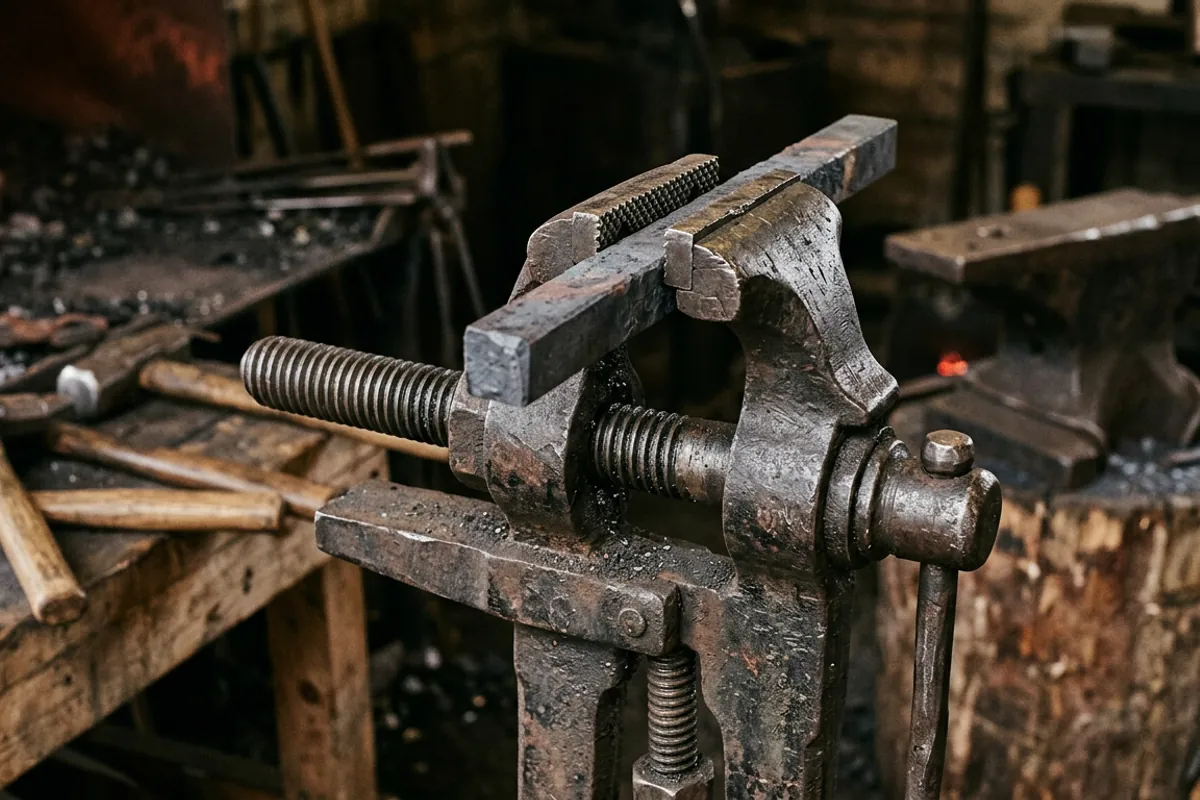
The weight tracks the jaw size. A 5 inch leg vise runs roughly 50 to 60 pounds; a 6 inch pushes 55 pounds and up in new production, and the big antique 6 to 8 inch vises can be a good deal heavier. Do not chase a monster unless you have a specific reason. For most home smiths the answer is a 4.5 or 5 inch vise, mounted solid, and you are done thinking about it for life.
The field at a glance
Here is the field, published specs only. The two Kanca models are the leg vises still made new, with figures from the retailer listing at Centaur Forge. The bench vises below the line are not leg vises at all; they are what you will actually find on Amazon when you search for one, and I have flagged them as such with the specs the makers and Harbor Freight publish.
Scroll horizontally to see all columns.
| Vise | Type | Jaw width | Weight | Material | Price tier |
|---|---|---|---|---|---|
| Kanca 5 in leg vise (LV5) | True leg vise | 5 in (5.5 in max open) | 52.9 lb | SAE 1323 steel, serrated jaws | Premium |
| Kanca 6 in leg vise (LV6) | True leg vise | 6 in | 55 lb | SAE 1323 steel, induction-hardened jaws | Premium |
| Central Machinery 6 in swivel vise | Bench vise with anvil | 6 in (6 in max open) | 28 lb | Cast iron, replaceable steel jaws | Budget |
| Kanca Kadett KAD-100 | Drop-forged bench vise | 4.5 in max open | Not published | Drop-forged steel | Mid |
| Kanca Castillo CAS-100 | Ductile iron bench vise | 5 in max open | Not published | Ductile iron, 77,000 PSI jaws | Mid |
Two things jump out. The real leg vises weigh nearly twice what the budget bench vise does, and they cost five or six times as much. That gap is the whole story of this tool, and it is why the used market exists.
Buying used is the normal way to buy one
New leg vises are a niche import item. Used ones are everywhere. The people who actually own leg vises overwhelmingly bought them at a farm auction, a flea market, an estate sale, or off a forum classifieds section, and paid a fraction of new-tool money. That is not a compromise, it is the sensible path. A wrought-iron leg vise from 1900 is often a better tool than anything built today, because it was forged, not cast, for exactly this abuse.
What to check before money changes hands, distilled from beautifuliron and the price threads on the forums:
- Screw and screwbox. Run the screw all the way in and out. It should turn without binding or grinding. A bent screw or a chewed-up box is the one defect you cannot easily fix, so walk away from it. Bent handles and bent legs, on the other hand, straighten fine.
- Jaws. They should close roughly even and full-length. Original serrations are a bonus, not a requirement. Bent or broken jaws are a hard pass.
- Spring. A missing jaw spring looks scary and is not. On BladeForums one member calls a spring-less vise "the best deal" because a replacement spring is a couple of dollars of material and an afternoon at the forge. Do not let a missing spring scare you off a good body.
- Mounting bracket. The wedge bracket is often flimsier than the rest of the tool and sometimes missing entirely. Brackets are the easiest part to fabricate or replace, so a missing one is a haggling point, not a dealbreaker.
On price: beautifuliron's author, buying at flea markets, paid roughly 12 to 60 dollars, though that write-up is old and those days are mostly gone. The more current read on BladeForums puts a clean 4.5 to 5 inch vise around 75 to 125 dollars in good working shape, with the big 6 to 8 inch vises jumping to several hundred and up. Anything in that 4 to 5 inch band, complete and working, at around a hundred dollars is a fair buy. If it needs a spring or a bracket, pay less and plan to make the part. Rehab is straightforward, and there are good step-by-step threads like the post vise rebuild on Practical Machinist if you want to see one taken apart before you commit. The antique blacksmith tools guide covers the general estate-sale hunting approach that finds these.
New leg vises: the Kanca option
If you want to buy new and be done, the realistic choice is Kanca, the Turkish maker, sold in the States through Centaur Forge and a few other blacksmith suppliers. The 5 inch (LV5) is listed at a 5 inch jaw with a 5.5 inch maximum opening, 52.9 pounds, SAE 1323 steel with serrated jaws, a 30 inch mounting height and 41.5 inches from leg tip to jaws, at 409 dollars. The 6 inch (LV6) steps up to a 6 inch jaw, 55 pounds, induction-hardened serrated jaws, same 30 inch mount, at 489 dollars, per Centaur Forge.
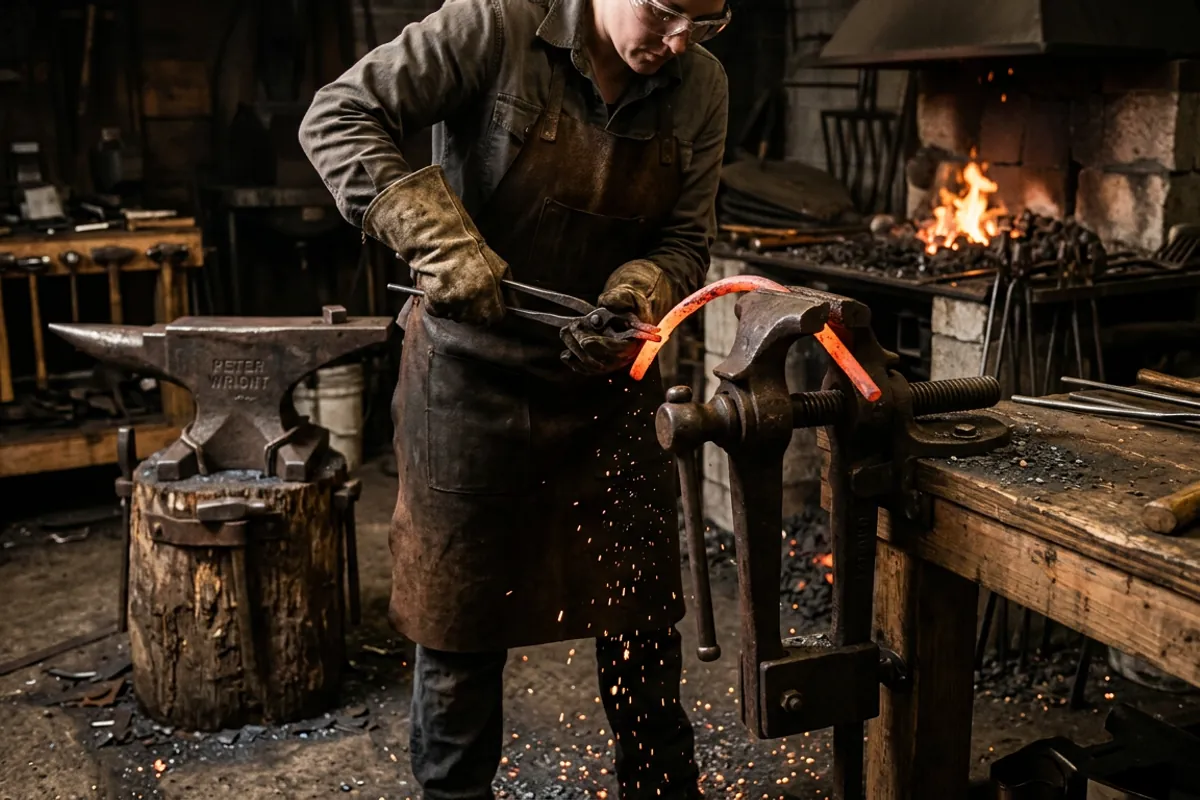
Those are real, forged leg vises with a proper leg, and they are the closest new tool to the old ones. The catch is simply the price: you can usually buy two or three decent used leg vises for the cost of one Kanca. I would only go new if the used market near you is dry, or you specifically want a warranty and a known steel spec. For most people, the used route wins. But if you value a clean new tool over a hunt, the Kanca is not a bad way to spend the money.
If you cannot find a leg vise, here is the bench-vise reality
This is the part nobody tells you straight, so I will. When you type "blacksmith post leg vise" into Amazon, you do not get leg vises. You get bench swivel vises, often with a small anvil cast into the back, and they are a genuinely different tool. They are cast iron or ductile iron, they bolt to a bench, and they have no leg. They are fine for holding work to file, saw, and assemble. They are not built to be hammered on hard, and no amount of product-title optimism changes that. Treat the little cast anvil on the back as a convenience for light tapping, not a real anvil, and never mistake one of these for a leg vise.
With that said clearly, if you need a vise on the bench today and a leg vise is not in reach, here is what those listings actually are, so you can buy with eyes open:
The Central Machinery 6 inch swivel vise with anvil is the budget standard. Cast iron, 6 inch jaws, a 6 inch opening, about 28 pounds, with a 360 degree swivel base and replaceable steel jaws, per Harbor Freight's own spec sheet. It is a serviceable hold-and-file vise for not much money, and that is all I would ask of it. Do not upset hot bar in it. Check price on Amazon (paid link).
If you want a step up in a bench vise, Kanca also makes drop-forged bench models, which is a real material upgrade over cast iron for anything that sees load. The Kadett KAD-100 is a drop-forged bench vise with a 4.5 inch maximum opening and a 360 degree swivel base. Drop-forged steel takes shock better than a casting, so of the bench options this is the one I would trust nearest to light forge work, though it is still not a leg vise. Check price on Amazon (paid link). Kanca's Castillo CAS-100 is their ductile-iron bench vise, 4 inch body with a 5 inch opening and jaws rated to 77,000 PSI, if you want a middle ground between the cheap casting and the forged model. Check price on Amazon (paid link).
Buy one of these to hold work. Buy a leg vise to hit. If you want to know what else deserves your first dollars, the beginner blacksmith getting started guide and the filing vise guide put the vise in context with the rest of the starter kit.
What owners say
For gear I have not run down in my own shop, I go read what the people who own it report, and I will tell you plainly where the signal is thin.
On the used leg vises, owner consensus is strong and consistent. The BladeForums price thread has experienced bladesmiths landing on 75 to 125 dollars for a clean 4.5 to 5 inch vise and treating condition of the screw as the make-or-break. Rehab threads on The Garage Journal and Practical Machinist repeat the same points I lean on: clean the screwbox thoroughly before you trust the tool, missing springs and brackets are cheap to replace, and a working vise in rough cosmetic shape beats a pretty incomplete one every time. Nobody who has used a real leg vise for hot work wants to go back to a bench vise for it.
On the new Kanca leg vises, owner signal is thinner. They are relatively recent imports and you do not see a large body of long-term reports the way you do for the century-old vises. The specs are published and the tool is a proper forged leg vise, so I have no reason to doubt it, but I would not pretend there is a deep well of a-decade-of-hard-use reviews. If you buy one, you are early enough that your report is worth writing up.
On the Amazon bench vises sold as blacksmith vises, the consensus is exactly what you would expect: fine for holding, disappointing for anyone who bought one expecting to forge on it. That is not a defect, it is a mismatch between the listing and the tool, and it is the single most common leg-vise-shopping mistake I see new smiths make.
Safety and mounting
A leg vise is a hitting tool, and hitting tools throw scale and sometimes break. When you are hammering hot stock in the vise, you get flying scale coming off at eye level, so wear rated eye protection. That means safety glasses or a face shield that actually meet the ANSI Z87.1 standard, not fashion sunglasses. I lost my eyebrows early on to a quench-oil flare-up because I stood too close in a cotton shirt with no shield, and I kept my eyesight by luck. Do not run on luck. Natural fibers near the forge, rated eye protection at the vise and the grinder, every time.
Mount it like you mean it. The leg has to actually reach the floor or a solid footing, and the bracket has to be bolted or clamped to a bench or post that will not walk when you lean into a bend. A leg vise that is bolted high with the leg dangling in the air has lost the one advantage it has over a bench vise, so set your working height by the bracket and let that leg carry load. Grease the screw and screwbox when you put a used one into service and once in a while after; a dry square thread wears fast and works hard.
What I would tell a friend
Buy a used 4.5 or 5 inch leg vise. That is the answer for almost everyone. Check that the screw runs clean, do not flinch at a missing spring or bracket, and expect to pay somewhere around a hundred dollars for a complete working one. If your local used market is dry and you want a new tool with a known steel spec, the Kanca 5 inch is a real forged leg vise and a fair way to spend the money, just know you are paying two to three times used prices for the convenience.
The one mistake to avoid: do not buy a cast bench "blacksmith vise" off a marketplace listing thinking it is a leg vise. It is a hold-and-file tool with a little anvil cast on the back, and it will let you down the first time you try to forge in it. Get a bench vise to hold work and a leg vise to hit, keep your eyes protected while you use either, and you will be set for the rest of your smithing life. More vise and tool guides live over in the More from the shop hub.