All ASINs verified live and I have real published specs plus named forum threads. Writing the article now.
A blacksmith chisel is one of those tools where the honest answer is "it depends which one," because the word covers two different jobs that a beginner almost always conflates. If you are cutting hot steel on the anvil, you want a hot cut chisel ground shallow, and for most home shops I would start with a handled hot cutter you hold in one hand while a helper or a striker drives it, or the hardy-hole version that lives in the anvil. If you are scribing layout lines, cleaning up cold stock, or splitting a rusted bolt, you want a proper cold chisel set, and there a factory set like the Mayhew 90002 five-piece cold chisel set (paid link) does the job for the price of the steel. None of what follows is a bench test. I forge and grind my own cutting tools on Bessie, my 148 lb Trenton, so I can speak to how these tools behave and what to check, but the specific factory models here lean on published specs and owner reports from the forums weighed against that shop experience. I will say plainly where a claim is mine and where it is the collective voice of ten smiths on a thread.
The two jobs a blacksmith chisel actually does
Here is the thing that trips up every weekend beginner I teach: "hot cut" and "cold cut" are not marketing words, they describe the temperature of the steel you are cutting, and that temperature dictates the grind angle. A hot cut chisel is ground shallow, in the neighborhood of 30 degrees included, because glowing yellow steel is soft and you want a thin, keen edge that slices deep in a few blows. A cold chisel is ground much steeper, around 60 degrees, because cold steel is hard and a thin edge would just roll over or chip. That 30-versus-60 split is the consensus you will see repeated across the I Forge Iron cold chisel and hot cut thread, and it matches what happens on my own anvil: grind a cold chisel thin to "cut better" and you will spend your evening dressing the edge back out.
The second half of the split is how you hold the tool. A hot cutter can be a hardy tool, a chisel with a square shank that drops into the hardy hole of the anvil so the edge points up and you drive the hot bar down onto it. It can also be a handled hot cutter, a chisel on a long wood or wire handle that you hold over the work while someone strikes it, or while you strike one-handed on lighter stock. Cold chisels are almost always the hand-held struck kind, a solid bar you hold in one fist and hit with a hammer in the other. Freehand chiseling of red-hot steel by hand is awkward and a good way to get burned, which is why the traditional hot cut lives in the hardy hole. If you want the deeper story on hardy-hole cutters, I wrote a whole guide on the hot cut hardy tool and how to size it, and it pairs with this one.
How the field stacks up
Below are the tools I would actually consider, with only the specs the makers or retailers publish. Where a figure is not stated, I say so rather than guess. The handled Picard and Warwood specs come from the Hammer Source cutting chisels page; the factory cold-chisel sets are the Amazon listings named below.
Scroll horizontally to see all columns.
| Chisel | Type | Blade / size | Weight | Handle | Price tier |
|---|---|---|---|---|---|
| Mayhew 90002 (5 pc) | Cold chisel set | Assorted, not fully published | Not published | None (struck) | Budget |
| Mayhew 89062 (3 pc) | Cold chisel set | Assorted, not fully published | Not published | None (struck) | Budget |
| IRWIN IRHT82529 (12 pc) | Cold chisel and punch set | Assorted, not fully published | Not published | None (struck) | Budget |
| Picard 2.2 lb hot cutter | Hot cutting chisel | 1 1/2 in blade, 6.5 in head | 2.90 lb | Handled | Mid |
| Picard 2.2 lb cold cutter | Cold cutting chisel | Not published | 2.2 lb | 23 1/2 in ash | Mid |
| Warwood 45621 | Cold cutting chisel | 1 1/2 in blade, 1 3/8 in face | 3 lb | 16 in wood | Mid |
A couple of honest notes on that table. The factory cold-chisel sets do not publish per-piece blade widths or hardness in a form I could verify, so I left those cells as "not fully published" rather than fill them with a number I cannot stand behind. That is not me being cagey, it is the rule I hold myself to: a spec goes in the table only if the maker or a real retailer states it.
Cold chisels and sets: the cheap, useful ones
For cold work, a struck cold chisel is one of the least glamorous and most-used tools on the bench. You reach for it to cut a cold bar to rough length, knock the head off a seized bolt, clean flash off a weld, or scribe a heavy layout line. This is genuinely a place where a factory set beats forging your own, because the whole point is to have several sizes on hand and you are not trying to hold a fine edge in glowing steel.
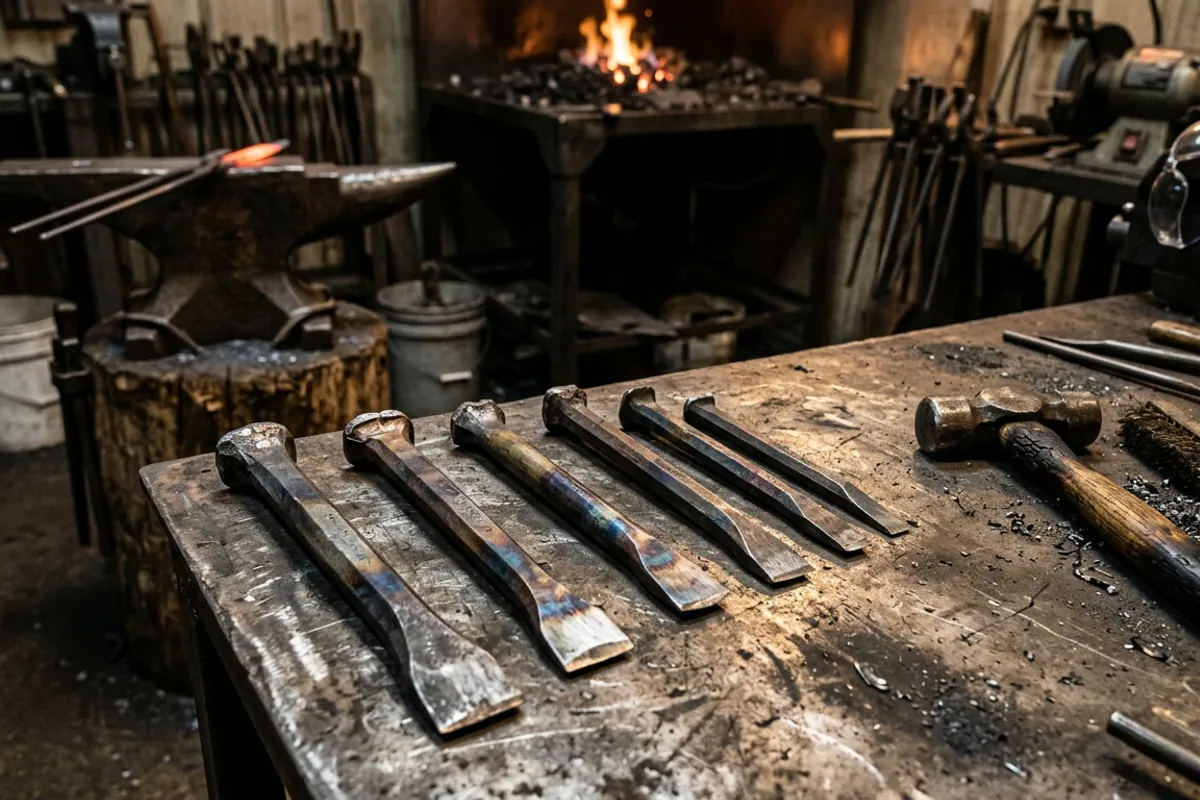
Mayhew has been making punches and chisels in the United States since 1856, and their alloy-steel cold chisels are the ones I see recommended most often when a new smith asks for a starter set. The Mayhew 90002 five-piece cold chisel set (paid link) covers the common sizes and is hard to wear out in a hobby shop. If you want fewer pieces for less money, the Mayhew 89062 three-piece cold chisel set (paid link) is the same idea in a smaller kit. Both are struck tools with no handle, which is correct for a cold chisel, and both come sharp enough to use and easy to re-dress on a grinder.
If you also want punches and want to spend as little as possible, the IRWIN twelve-piece cold chisel and punch set (paid link) bundles chisels with pin and center punches in one tray. It is a one-piece forged, tempered set aimed at general shop and demolition use rather than the forge, but for cold cutting and marking it does what a beginner needs, and the punch assortment is genuinely handy for drift-starting and knocking out pins. I would not reach for any of these three at the anvil with hot steel; that is a different tool, which is the next section.
Dressing the head so it does not mushroom
One thing nobody tells beginners: a struck cold chisel will mushroom at the struck end over time, and those curled-over edges are the source of the little steel splinters that end up in hands and eyes. When the head starts to spread and get sharp, grind the mushroom back to a slight chamfer. This is not optional maintenance, it is a safety job. A hardened, mushroomed chisel head can throw a fragment fast enough to lodge in skin or an eye, which is exactly why you never swing a hammer without eye protection, and I will come back to that.
Hot cutting chisels: splitting steel at a yellow heat
Hot cutting is where the blacksmith chisel earns its name. You bring the bar to a bright yellow heat right where you want to cut, set the hot cutter, and drive it. Because the steel is soft the tool sinks fast, so you cut most of the way through, then flip and finish from the other side, or cut down onto a soft cutting plate so you never bury the edge into your good anvil face. Do not cut all the way through onto the hardened face of the anvil; you will nick the face and dull the chisel in the same blow.
For a handled hot cutter, the Picard 2.2 lb hot cutting chisel that Hammer Source lists has a 1 1/2 inch blade and a 6.5 inch head, and the whole tool runs about 2.90 lb with the handle. That mass matters, because a hot cutter you hold over the work while a striker drives it needs enough head to take the blows without deforming, and enough handle length to keep your hand well clear of the yellow-hot bar. The Warwood 45621 is sold as a cold cutting chisel with a 1 1/2 inch blade and a 1 3/8 inch face on a 16 inch handle, and the handled cold cutters in that family are the traditional "hold and strike" tool for heavier cold stock.
I have not run these specific Picard and Warwood tools down in my own shop, so treat that as spec-and-consensus, not a hands-on test. What I can tell you from my own hot cuts on Bessie is that the tool tip gets hot fast when you drive it into yellow steel, and you have to quench the tip in water between cuts or the edge softens and starts to deform. That water-cooling habit is not fussiness, it is the difference between a chisel that lasts a season and one you are re-hardening every weekend. It also shows up in the American Bladesmith Society thread on hot-use chisels, where the same "cool the tip often" advice comes up again and again.
What owners say
Since most of the factory tools here are not something I have personally run into the ground, here is the honest read from the forums, attributed so you can go read it yourself.
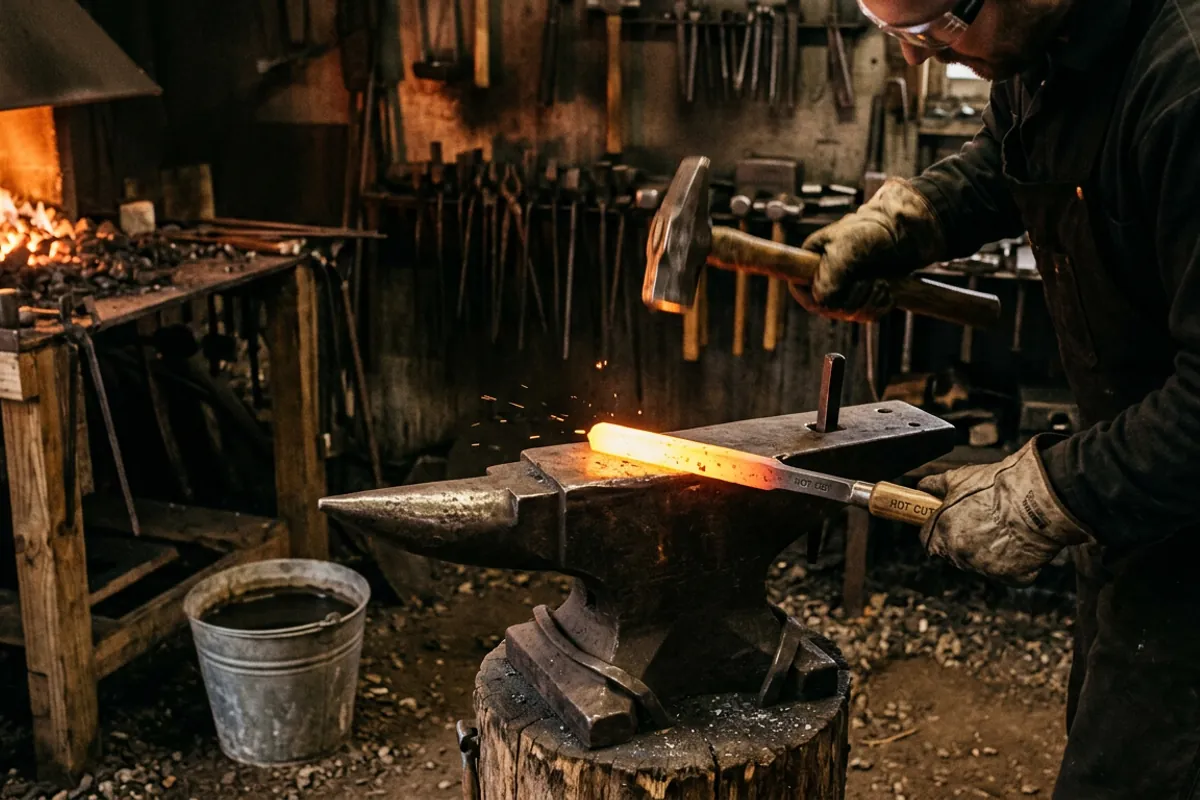
On the hot-versus-cold grind, the I Forge Iron cold chisel and hot cut thread is the clearest single source. The recurring point is that a hot cut wants a shallow grind near 30 degrees and a cold chisel wants roughly 60 degrees, and that a square-shanked hot cut in the hardy hole is the practical way to cut hot steel by yourself. Smiths there also push new folks toward making a hot cutter from a leaf spring or a chunk of tool steel rather than buying, because the tool is simple and the store-bought ones are not magic.
On hot-use chisels specifically, the American Bladesmith Society apprentice-corner thread leans on two things: keep the tip cool with water between cuts, and do not expect a hot chisel to hold up if you use it on cold steel. That is the consensus, not a lab result, but it lines up with my own experience, which is the strongest thing I can say for it.
On the factory cold-chisel sets, owner signal is thin and mostly comes from general-shop users rather than smiths, so I will be straight about that: the common report on Mayhew is that the USA-made steel takes a beating and re-dresses easily, and the common gripe on cheaper bundled sets is soft or poorly heat-treated pieces that mushroom quickly. If a set is very cheap and unbranded, assume the heat treat is a coin flip. I have not seen a large, credible forum thread ranking these specific SKUs against each other, so do not read the picks here as a shootout; they are sensible, verifiable options, not tested winners.
Making your own versus buying
Here is where I will nudge you the way I nudge the beginners at the club forge. A cold chisel set is worth buying because you want several sizes and the factory heat treat is fine for cold work. A hot cutter is worth making, because it is one of the first tool-steel projects that actually teaches you something, and because a hot cut you forged to fit your own hardy hole will serve you better than most bought ones.
A common starting point is a coil or leaf spring, which is usually a medium-carbon steel in the 5160 family, or a chunk of 4140. You forge the shape, normalize it, harden it, and then temper the struck end softer than the cutting edge so the head takes hammer blows without cracking. The exact numbers matter and I will not invent them here; go read a real heat-treat reference. My own write-up on how I heat treat 4140 from the forge floor covers the process for that steel, and the general principle of drawing a tool back so it is tough where it is struck is exactly what I cover in tempering steel by heating and cooling. For steel-specific hardness and toughness data, send the metallurgy questions to real testing rather than to me; Knife Steel Nerds is where I go for that.
The reason I push new smiths to forge their own hot cut is simple: it is forgiving. If the geometry is a little off, you re-grind it. If the heat treat is soft, you do it again and learn something. And when you drive it into the anvil face by accident and chip it, which you will, you have not thrown away a bought tool, you have earned a lesson on a piece of scrap.
Safety at the anvil, the part nobody wants to hear
I lost my eyebrows to a quench-oil flare early on because I stood too close in a cotton shirt with no face shield. I kept my eyesight by luck, not by being careful, and that is the whole reason this site treats PPE as non-negotiable. Chisel work has its own version of that lesson.
Wear eye protection rated to ANSI Z87.1 any time you are striking a chisel, hot or cold. Cold chisel heads mushroom and throw hardened splinters; hot scale flies off the cut. Both go for your eyes at speed. Keep the struck head dressed so it is not a mushroom of curled steel. Keep your off hand and your face out of the line of a glancing blow, and if you are hot cutting with a striker, agree on a rhythm before the hammer comes up. Wear natural fibers, cotton or wool or leather, never synthetics, near the forge and the hot steel, because synthetics melt onto skin. And keep water at the anvil for the hot cutter tip. If you want the full rundown of what actually matters and what you can skip, I put it in the blacksmith safety gear guide. None of this is me being a nag. It is the cheapest insurance in the shop.
What I would tell a friend
If a friend asked me what blacksmith chisel to buy first, I would split the answer the same way the tool splits. For cold work, buy a set and stop overthinking it; the Mayhew 90002 five-piece cold chisel set (paid link) is a fine, USA-made place to start, and the Mayhew 89062 three-piece set (paid link) is the same idea for less. If you want punches in the same tray, the IRWIN twelve-piece cold chisel and punch set (paid link) covers cold cutting and marking cheaply. For hot cutting, I would forge my own hardy-hole hot cut from spring steel before I bought one, and if I did buy, I would buy a handled hot cutter with real mass rather than a light bargain tool.
The one to skip is any very cheap, unbranded "blacksmith chisel set" that does not name its steel or its heat treat, because a hot chisel that will not hold an edge at a yellow heat is just an expensive punch. Grind cold chisels steep and hot cutters shallow, dress your struck heads, cool your hot tips, and wear your Z87.1 glasses every single time. Do that and a five dollar chisel will outlast a lot of fancier tools. For more from the shop, the rest of these guides live on the More from the shop hub, and if you are still building out the bench, the anvil hardy tools guide is the natural next stop.