I have enough verified material. Verified this session: Centaur Forge Kanca 5" ($409) and 6" ($489) leg vises with jaw specs, spaco.org post vise weights (35 to 75 lb), The Hobby-Machinist owner thread, and two live Amazon bench-vise ASINs (Yost 455 B015Z8J9F8, Yost HD550-C B0CZM46K9D). Drafting now.
Most people who type "blacksmith pole vise" into a search box are after what the rest of us call a post vise or a leg vise: the tall one with a single leg running down to the floor. It is the vise you can actually hammer on, and if I had to pick one for a beginner I would tell you to hunt down a used one with 4 to 5 inch jaws at a club meet or an estate sale, check the screw and spring before money changes hands, and mount it solid. New, from a real supplier, the Kanca 5 inch leg vise is the honest default. What follows leans on published specs, prices from the shops that actually sell these, and what owners report on the forums, weighed against years of standing at one. It is not a bench test of every model, and I will tell you plainly where I am passing along owner consensus instead of my own hands.
The important thing to understand up front is why this tool exists at all, because it changes what you should buy. A machinist bench vise is built to clamp and hold. A post vise is built to be beaten on. That single difference decides everything else.
What a pole vise actually is, and why the leg matters
A post vise has a fixed jaw and a moving jaw, same as any vise, but the moving jaw pivots on a pin near the bottom and a long steel leg runs from that pivot straight down to the floor or a footplate. When you clamp hot stock and hit it, the blow does not load the mounting bracket or the bench. It travels down the leg into the floor. That is the whole point. You can bend, draw, rivet, and upset against a post vise all day and it shrugs it off, where a cast bench vise would crack its slide or tear its base loose.
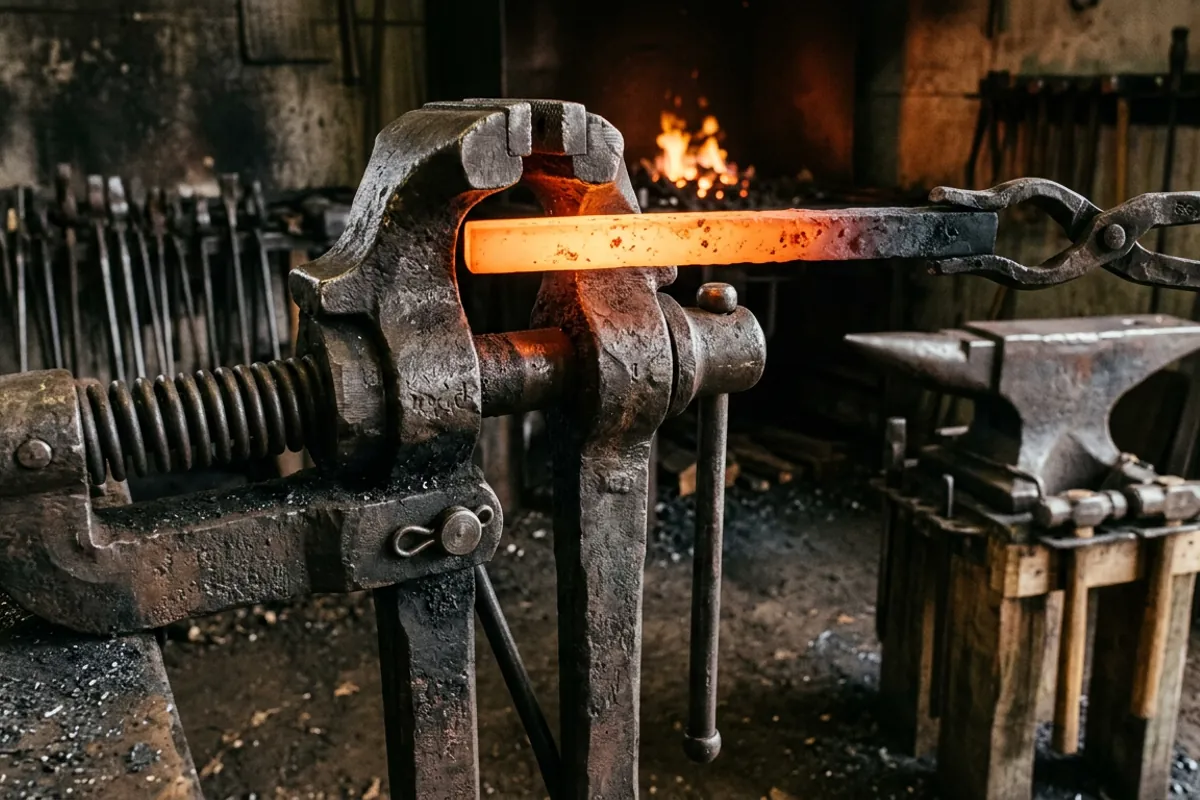
The mounting bracket bolts to a bench or a post, and a U shaped spring wraps behind the leg to push the jaws open when you back the screw off. The screw itself is big and coarse, sized to move fast rather than to hold micron tolerances. As the spaco.org write up on post vises puts it, the leg lets the load find the floor, and most usable examples run somewhere in the 35 to 75 pound range depending on jaw size (https://spaco.org/postvise.htm). Bigger is not automatically better here, but heavier usually means thicker jaws and a stouter screw.
If you have only ever used the cast vise on the corner of a workbench, this is a real upgrade for forge work, and it sits alongside the other tools I would tell a new smith to prioritize in the blacksmith vise buying guide.
The specs that matter before you buy
There are not many numbers to chase, which is refreshing. Jaw width is the headline spec, and it is usually 4, 5, or 6 inches. Weight follows jaw width. Beyond that you are checking condition, not comparing datasheets. Here is the field, published figures only, with "not published" where the maker does not state one.
Scroll horizontally to see all columns.
| Vise | Jaw width | Weight | Type | Where sold | Price tier |
|---|---|---|---|---|---|
| Typical used post vise | 4 to 5 in | 35 to 75 lb | Forged, floor leg | Meets, estate sales | Varies |
| Kanca 5 inch leg vise (LV5) | 5 in (125 mm) | Not published | New, floor leg | Centaur Forge, Blacksmith Depot | ~$409 |
| Kanca 6 inch leg vise (LV6) | 6 in (150 mm) | Not published | New, floor leg | Centaur Forge, Blacksmith Depot | ~$489 |
| Yost 455 combination vise | 5.5 in | Not published | Bench (fallback) | Amazon | Budget to mid |
| Yost HD550-C mechanics vise | 5.5 in | Not published | Bench with anvil face (fallback) | Amazon | Mid |
The Kanca jaw widths and prices come straight off the Centaur Forge leg vise page (https://www.centaurforge.com/Leg-Vises/products/139/). The used weight range is the spaco figure above. The two Yost jaw widths are the sizes in the manufacturer model names. I am deliberately not printing weights I cannot cite, because a made up number in a spec table is exactly the kind of thing that gets a reader to buy the wrong tool.
Buying a used post vise without getting a wall hanging
This is where most smiths get their first pole vise, and where most of the money gets wasted if you do not know what to look at. A post vise is a simple machine, so there are only a few things that kill one.
Check the screw first. Run the moving jaw all the way in and all the way out. It should turn smoothly the whole travel. A screw that binds, skips, or has a stripped section is the one repair that turns a $60 vise into a project. Forum consensus over on The Hobby-Machinist is that a bad screw can be welded up and recut, but that is real machine work most beginners are not set up for, so treat a damaged screw as a hard pass unless the price reflects it (https://www.hobby-machinist.com/threads/where-to-buy-a-quality-new-blacksmith-post-leg-vise.24782/).
Check the spring next. It is the U shaped leaf behind the leg. A missing or broken spring is common and, unlike the screw, it is an easy forge project, so a springless vise is a fair bargain rather than a dealbreaker. Just budget an evening to make one.
Then look at the jaws and the pivot. Light mushrooming on the jaw faces is normal and files flat. A cracked jaw or a sloppy, worn pivot pin is a bigger problem. Wobble at the pivot means the moving jaw will not track true under a hammer, and that is the difference between a tool and an anvil ornament. The good news is that the honest historical price of a used post vise was small, in the range spaco quotes, though I will be straight with you: at meets and online now you will usually pay more than that, and clean examples with good screws command real money.
Kanca 5 inch leg vise, the new default
If you would rather buy new than gamble on a rusty screw, the Kanca 5 inch is the one I would point you at first. Kanca is a Turkish drop forge that also makes a lot of the new anvils smiths are buying, and their leg vises are forged rather than cast, which is what you want in a tool you are going to hit. Centaur Forge lists the 5 inch (125 mm jaw) at $409 and the 6 inch (150 mm) at $489 (https://www.centaurforge.com/Leg-Vises/products/139/). Blacksmith Depot carries the same line.
The 5 inch is the size I would put in a one person home shop. It handles the stock most of us actually forge, it is not so heavy that moving it is a two person job, and the jaws are wide enough for real bending work. The tradeoff is honest: a new forged vise costs more than a used one you found in a barn, and old American vises from the good era have a following for a reason. But you know exactly what you are getting, the screw is fresh, and there is no rehab evening in front of you. I have not run this specific model down in my own shop, so that read is built on the published specs and on what owners report, not a bench test.
Kanca 6 inch leg vise, if you forge heavier
Step up to the 6 inch only if you know you need it. The extra inch of jaw and the heavier body suit a smith working larger stock, doing a lot of upsetting, or clamping wide pieces for straightening. At $489 it is not a big jump in money over the 5 inch, but it is a jump in weight and footprint, and for general hobby work the 5 inch does not leave you wanting. If you mostly forge bar under an inch and make hooks, tools, and small blades, the 6 inch is more vise than the work asks for. Buy the size your work needs, not the biggest one you can afford, the same logic I lay out for stock choices in the anvil buying guide.
When you cannot get a post vise: the heavy bench vise fallback
Sometimes there is no post vise to be had, or the shipping on a 60 pound tool eats the deal alive. When that happens, the forum answer is not a cheap cast "post vise" clone. It is a genuinely heavy bench vise mounted to a bench heavy enough to take a beating, used for holding rather than as an anvil substitute. The I Forge Iron thread on forging vises when you cannot get a leg vise lands in the same place: pick mass and steel over a light casting, and keep your heavy hammering on the anvil, not the vise (https://www.iforgeiron.com/topic/65010-best-forging-vise-when-you-can%E2%80%99t-get-a-legpost-vise/).
Be clear eyed about the limit. A bench vise is not a post vise. It has no leg feeding the blow to the floor, so hard hammering will eventually loosen it or crack the casting. What it does fine is clamp work for filing, sawing, riveting, and light bending. Two Yost combination vises come up again and again for exactly this fallback because the cast body has a flat anvil area behind the jaws and enough mass to hold.
Yost 455 combination vise
The 455 is a 5.5 inch combination bench and pipe vise with a swivel base and a small anvil face on the body. It is the budget to mid choice, the one I would hand someone who needs a solid holding vise today and will chase a real post vise later. It will hold your work for finishing tasks and take the occasional tap. Do not treat that anvil pad as a place to draw out stock. Check price on Amazon (paid link)
Yost HD550-C mechanics vise
If you want more mass in the same 5.5 inch jaw size, the HD550-C is the heavier casting with a larger anvil surface and a swivel base. It is the mid tier pick and the better long term holding vise of the two. Same rule applies: it is a holding tool with a convenient flat, not a substitute for hammering against a real leg. Check price on Amazon (paid link)
Neither of these is a pole vise and I will not pretend otherwise. They are the honest stopgap the forums point to when a post vise is genuinely out of reach, and I am passing that along as owner consensus rather than as my own test of these two castings.
Mounting it so it does not fight you
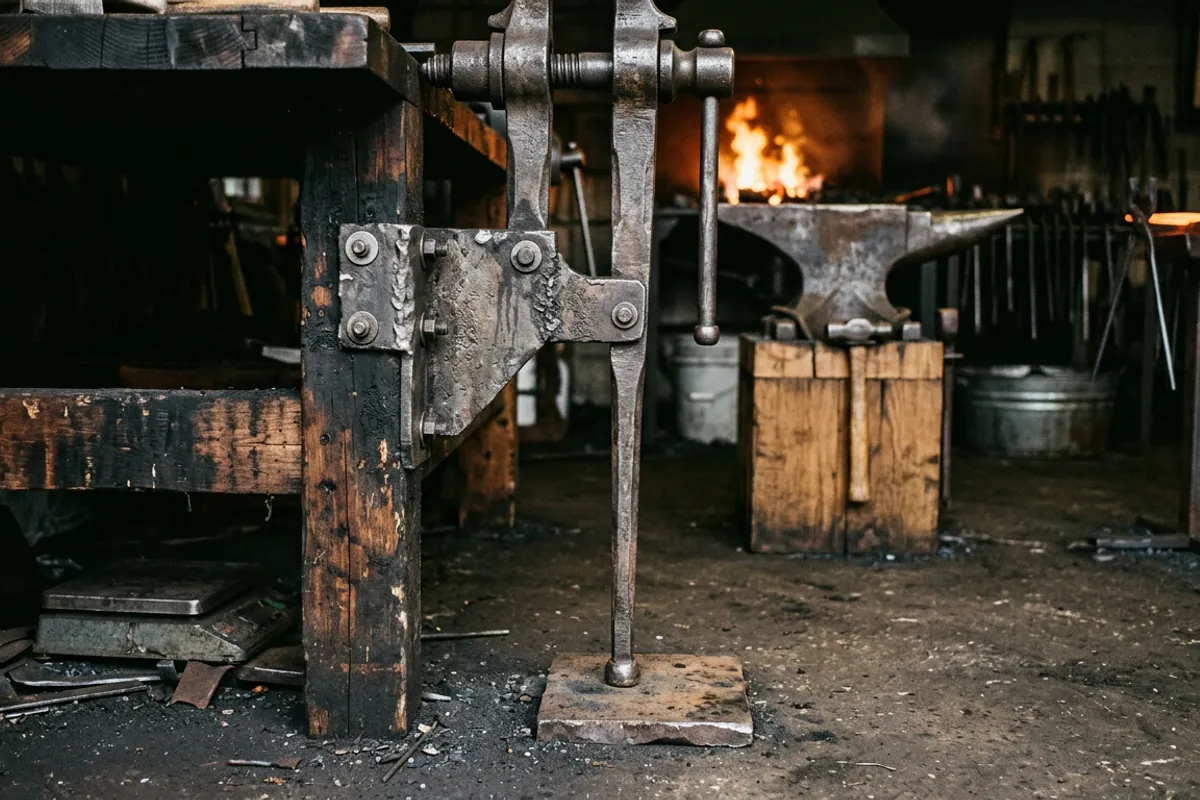
A post vise wants a solid mount more than it wants anything else. The traditional setup buries a post in the shop floor so you can walk all the way around the vise, and the spaco write up describes exactly that, along with the trick of using heavy flywheels as a movable base when you cannot sink a post (https://spaco.org/postvise.htm). Most of us bolt the bracket to a stout bench leg and let the vise leg rest on a footplate or the floor. What matters is that the leg actually bears on something solid, because a leg hanging in the air throws all the load right back onto the mounting bracket and defeats the whole design.
Mount it at a height where the jaws sit around your elbow when you stand at it. Too low and you stoop over every job. Give the swing of the moving jaw and the handle clearance so you are not barking your knuckles on the bench edge every time you open it.
Two safety notes I will not soften. First, hot metal in a vise is still hot metal, and it does not glow once it drops below a red you can see in shop light. A bar that looks gray can still take your skin off, so handle everything coming out of the jaws with tongs until you know it is cold. Second, wear your eye protection. Filing, wire brushing, and grinding at the vise all throw debris straight at your face, and rated safety glasses to ANSI Z87.1 are the standard for a reason. I lost my eyebrows to a quench flare early on and kept my eyesight by luck, and I do not treat eye protection as optional for anyone. The rest of what belongs on you at the forge is in the blacksmith safety gear guide.
What owners say
Owner signal on new post vises is thinner than it is for anvils, so I will be honest about where it is solid and where it is not. On The Hobby-Machinist, the practical advice for buying is consistent: check the screw above all, expect to find your best deals used through meets, Craigslist, and Facebook rather than at a store, and know that new options are limited to a couple of specialty suppliers like Centaur Forge and Blacksmith Depot (https://www.hobby-machinist.com/threads/where-to-buy-a-quality-new-blacksmith-post-leg-vise.24782/). That thread also notes new 4 inch vises running around $700 from Blacksmith Depot, which is the reality of buying forged and new.
On the fallback question, the I Forge Iron discussion of forging vises lands where you would expect from a room full of smiths: a cheap cast "post vise" is a trap, and if you cannot get a real leg vise you are better off with a heavy holding vise and keeping your hammering on the anvil (https://www.iforgeiron.com/topic/65010-best-forging-vise-when-you-can%E2%80%99t-get-a-legpost-vise/). What I did not find was a deep bench of owner reviews on the specific Kanca models the way there is for anvils, so treat my read on those as spec and reputation based, not a chorus of owners. For the smaller holding tools some beginners reach for first, I get into the tradeoffs in the filing vise buying guide.
What I would tell a friend
Buy a used post vise with 4 to 5 inch jaws if you can find a clean one, and let the screw make the decision: smooth full travel, buy it, worry about the spring later because that is an easy forge fix. If you would rather not gamble, the Kanca 5 inch from Centaur Forge or Blacksmith Depot is the honest new default at around $409, and step to the 6 inch only if your work genuinely calls for it. If a real pole vise is simply not available to you, a heavy Yost bench vise will hold your work for finishing while you keep hunting, but do not fool yourself that it is the same tool. Mount whatever you buy dead solid with the leg bearing on something real, keep tongs on anything that came out of the fire, and wear your Z87.1 glasses at the vise. For the rest of the tools that go around it, start from the More from the shop hub and build out from there.