Now I have what I need. Let me write the article.
===ARTICLE===
If you want a blacksmith mandrel to true up rings and bend clean curves, and you do not already own a floor cone, the honest starting point is a small hardy-hole cone that drops into your anvil or clamps in a vise. That is the tool I would hand a beginner first, and for most home shops it is the only mandrel you will ever actually need. The big floor cones you see in old catalogs are wonderful, and they are also scarce and heavy and priced like it. Everything below leans on published specs and what owners report on the forums, weighed against years of forming rings over an anvil horn. It is not a bench test of each cone, and I will tell you plainly where I am reading spec sheets rather than swinging a hammer.
A mandrel is one of those tools you do not miss until the day you weld up a ring and it comes out looking like a potato. Then you understand why every old shop had a cone standing in the corner. The good news for a home smith is that the small end of this tool is cheap, simple, and nearly impossible to wear out.
What a blacksmith mandrel actually does
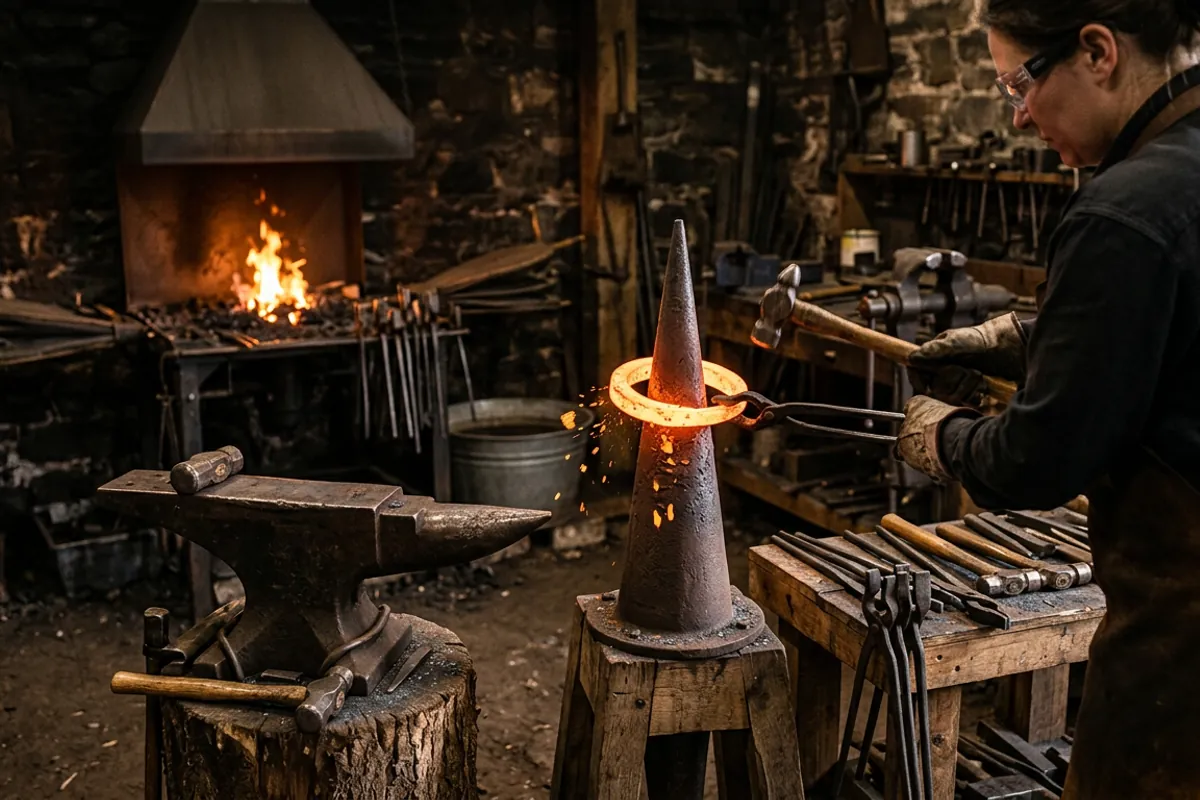
A mandrel is a tapered steel cone you hammer hot metal around to make it round. That is the whole job. You forge or weld a ring, drop it over the cone while it is still at a working heat, and tap it down the taper until it seats all the way around with no daylight showing under it. The old test still holds: if you can see light between the ring and the cone anywhere, it is not round yet, so you rotate and tap until the gap closes.
The taper is the point. Because the cone gets wider as it goes down, one tool sizes a whole range of rings. Push a ring farther down for a bigger diameter, keep it near the tip for a small one. You can open a ring up by driving it down the cone, and you can true a slightly-off circle by working it around the taper. It is the same principle as the round horn on your anvil, but a cone gives you a full 360 degrees of contact and a much more consistent circle. Collars, rings for hooks and racks, pot hangers, the eyes on certain tools, chain links, barrel bands, all of it gets rounded on a cone.
If you have never used one, the anvil horn does most of this already, and for a beginner it is where you learn to bend. A mandrel is the upgrade you reach for when the horn's taper is wrong for the ring you are making or when you need a true circle instead of a close one. I cover the horn and the rest of the anvil in the anvil buying guide if you are still sorting out your first one.
The three kinds of mandrel, and which you need
There are really three tools sharing the name, and they are not interchangeable in price or purpose.
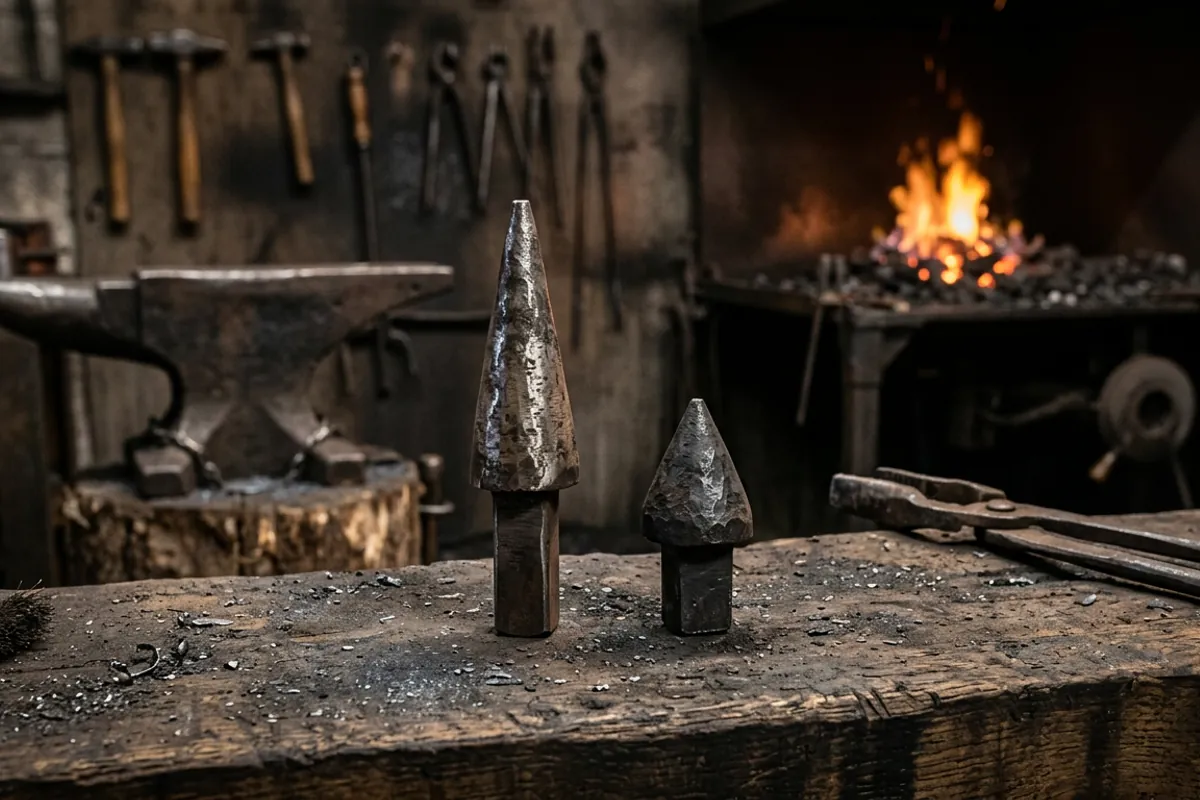
The hardy-hole cone is a small cone on a square shank that seats in your anvil's hardy hole or clamps in a vise. It is cheap, it stores in a drawer, and it handles the ring sizes a home shop actually makes. This is the one I recommend to almost everyone.
The bench or mini mandrel is a slightly larger cast cone, still on a shank, that gives you more taper and a bigger base diameter without turning into a floor fixture. Think of it as the middle tier.
The floor cone mandrel is the big one: a cast iron or cast steel cone that stands on the floor, often 30 to 48 inches tall, and weighs enough that you do not move it casually. It is a beautiful tool for anyone bending large hoops, wagon tires, or barrel bands all day. For a hobby shop it is usually more cone than the work calls for, and as I will get into, you basically cannot buy one new anymore.
For sizing the hardy end of these, the anvil hardy tools guide and the hardie tools for anvils guide walk through matching shank to hole so a tool sits tight and does not rattle.
Where the picks stand
Here are the published figures for the mandrels worth talking about, so you can scan the field before reading the detail. Where a maker does not state a number, it says so.
Scroll horizontally to see all columns.
| Mandrel | Type | Material | Shank / base | Overall length | Price tier |
|---|---|---|---|---|---|
| 13.31 in hardy cone (1018) | Hardy hole / vise | 1018 steel, wax coat | 1 in x 3 in shank, base ~4 in dia | 13.31 in | Budget |
| 9.25 in hardy cone | Hardy hole / vise | Not published | 1 in x 3 in shank, ~2 in base | 9.25 in | Budget |
| Centaur mini-mandrel cone | Bench / shank | Rough cast steel | 1 in shank x 5 in, 4.5 in base | 16 in tall | Mid |
| Floor cone mandrel | Floor standing | Cast iron (typical) | Freestanding base | 30 to 48 in typical | Used market only |
Specs for the first hardy cone are from the Amazon listing detail; the 9.25 in cone figures are published by Caliburn Tools; the mini-mandrel figures are from Centaur Forge. Hardness is not published on any of these, so I am not going to invent one.
The hardy-hole cone I would start a beginner on
The larger of the two budget cones, the 1018 steel one at 13.31 inches overall, is the one I would buy first. The listing puts the cone itself at roughly 10 inches with a base near 4 inches in diameter tapering down to about a quarter inch at the tip, on a 3 inch square shank sized for a 1 inch hardy hole. That range of diameters covers the great majority of rings a home shop makes, from a small hook eye up to a decent-sized ring for a rack or a hanger.
Two things I like about it on paper. It is solid 1018 steel rather than a hollow casting, so it takes hammer blows over the taper without the ring-a-cracked-casting worry, and the square shank means it works two ways: drop it in the hardy hole when you want it at anvil height, or clamp the shank in a leg vise when you want it lower or out at the bench. The wax coating is just shipping rust prevention, and it will cook off the first time hot steel touches it, which is normal and nothing to worry about.
The honest tradeoff is that this is a fairly small cone. If you regularly make rings larger than the base diameter, you will run out of taper and be back to the anvil horn or wishing for a floor cone. For its price, which sits well under a hundred dollars, it is hard to argue with as a first mandrel.
Check price on Amazon (paid link)
The smaller hardy cone, when bench space is tight
The second budget option is a shorter cone, 9.25 inches overall on the same 1 inch by 3 inch shank, with about a 2 inch base. Caliburn Tools publishes those dimensions, and it is the same basic idea as the first pick in a smaller package.
This is the one to consider if you mostly make small rings, chain links, and hook eyes, or if your hardy hole and vise are both cramped and you want the least tool that does the job. It seats the same way, in the hardy hole or a vise, and it stores in a coffee can. The catch is obvious from the numbers: a 2 inch base means small rings only. Drive anything much bigger down it and there is no more taper to work with. I would only pick this over the larger cone if the work is genuinely small or the price gap is real, because the bigger cone does everything this one does and more.
Check price on Amazon (paid link)
The bench mandrel, when a hardy cone is not enough
If you have outgrown a small hardy cone but do not want a floor fixture, the middle tier is a cast bench mandrel like the Centaur mini-mandrel cone. Centaur publishes it at 16 inches tall with a 4.5 inch base and a 1 inch shank 5 inches long, in rough cast steel. That extra height and base diameter buys you a lot more usable ring range than the little hardy cones, while still seating in an anvil or a holder.
I have not run this one down in my own shop, so I am going on the published spec and the general read that Centaur's cast tooling is honest, usable stuff that often wants a little cleanup out of the box, which matches their own "rough cast" description. At its price, into the low three figures, it is the sensible step up before you start hunting the used market for a floor cone. If you are building out tooling generally, I put the mandrel in the same tier as a small swage block: not a day-one purchase, but a real capability boost once your rings and curves outgrow the horn.
Centaur does not sell this on Amazon, so there is no amazon: link to give you here. Buy it direct from the maker if you want it, and check the current spec on their page before you order in case they revise the casting.
The floor cone mandrel, and why you probably can't buy one new
The floor cone is the tool everyone romanticizes, and for good reason. A big cast cone standing on the floor lets you true large hoops and bands in a way no hardy cone can touch. Most old ones are cast iron, frequently 30 to 48 inches tall, and some are hollow with a slot down one side so tongs gripping the hot ring have clearance.
Here is the reality, straight from the people who own them. On I Forge Iron, smiths discussing what floor cones fetch these days describe them as scarcer than hen's teeth and price them accordingly, with figures around 200 dollars for a 36 inch solid casting and up toward 500 dollars for larger floor cones changing hands. In the floor model cone mandrel thread, the same story repeats: they are tough to find, they are heavy to move, and when a good one comes up locally people jump on it.
So my honest advice is do not go looking for a floor cone as your first mandrel. Buy a hardy cone now, and keep an eye on estate sales, farm auctions, and the used market for a floor cone if your work genuinely grows into one. Because they are cast iron, inspect a used one hard for cracks before you hand over money, the same way you would check an antique anvil for damage. A cracked casting is a lawn ornament, not a tool.
What owners say
For the small hardy cones, owner signal is thin and worth being honest about. These are inexpensive imported tools that show up under a dozen near-identical listings, so you will not find deep forum reviews of one specific model. The general consensus on cheap hardy cones is that they do the job for ring work as long as you understand what they are: a solid or lightly-cast cone for small to medium rings, not a precision instrument. Buyers on the marketplace listings report them arriving usable, sometimes wanting a quick wire-brush and a knock-down of casting flash before they seat cleanly. That matches how I would expect a budget hardy tool to behave.
Where the forums are rich is on cones as a category. Across the I Forge Iron mandrels section the recurring theme is that a cone earns its keep the moment you start making rings in any number, and that the trueness test, hammering the ring around until no daylight shows, is the technique that actually matters more than the cone's brand. The other consistent note is that many smiths simply forge their own cone from a chunk of heavy round stock rather than buy one, which tells you this is not a tool anyone treats as precious. If you have the stock and the time, a shop-made cone is a legitimate project.
I will not dress any of that up as a hands-on review of a specific model I do not own. The picks above are specs and owner-category consensus weighed against a lot of hours forming rings on an anvil horn and a shop cone.
Safety around a mandrel
A mandrel looks tame, and it mostly is, but there are two real hazards. The first is the hot ring itself. You are working glowing steel around a cone, often with the ring wanting to spring or flip, so keep good tongs on it and keep your free hand out of the line the ring will jump if it lets go. The second is the hardy shank. A cone standing tall in a hardy hole is a spike at chest or face height when you lean in, so be deliberate about where your body is, and pull the cone when you are done rather than leaving it standing where you will turn into it.
Wear your eye protection, rated ANSI Z87.1, every time you are moving hot metal around this tool. Scale flakes off a ring the instant you tap it, and it comes off toward your face when you are bent over a cone. Natural fibers only near the forge, cotton or wool, never synthetics that melt to skin. None of that is specific to a mandrel, it is just forge discipline, but a cone puts your face close to the work in a way that makes it matter. I learned the eye-and-face lesson the hard way years ago with a quench flare, and I will not soften it: the gear is not optional.
What I would tell a friend
Buy the larger hardy-hole cone. For a home shop, the 13.31 inch 1018 cone that seats in your hardy hole or a vise does everything you will ask a mandrel to do for well under a hundred dollars, and it will outlast you. Skip the tiny 9.25 inch cone unless your work is genuinely small or the price gap is real, because the bigger cone covers its whole range and then some. Step up to a cast bench mandrel like the Centaur mini only when your rings outgrow the little cone, and treat a floor cone as a lucky used-market find, not a thing you order new.
Whatever you buy, the tool is the easy part. Learn the daylight test, keep hot rings under control with proper tongs, keep your face out of the scale, and a cheap cone will turn out truer rings than an expensive one in careless hands. For more on rounding out a first shop, the More from the shop hub collects the rest of the tooling guides, and the dedicated blacksmith cone guide goes deeper on cones specifically if you want it.