If you have the patience to wait for the right one, antique anvils are still the best value in a home shop, and the pick is boring: a 150 to 200 pound wrought bodied anvil from a known maker (Peter Wright, Trenton, Hay Budden, Fisher and Norris) with a flat face, edges that are chipped but not blown out, and rebound you can feel in your wrist. Buy it local, test it before you pay, and pay for face condition rather than the name stamped on the side. My own anvil, Bessie, is a 148 pound Trenton I bought off a farm sale years after I started out hammering on a cut length of railroad track clamped to a stump, and she is the tool I measure every other anvil against.
Here is the honest framing before we go further. I own one antique anvil and I have swung on plenty of others at club forges and hammer ins, but I have not run down every maker in this guide, and nobody can bench test a hundred year old tool that exists in a thousand different conditions. Where I am passing along what other owners report, I say so and I link it. The new anvil figures are published maker and retailer specs, cited. The small gear in here is what I actually throw in the truck when I go look at an anvil, and it is cheap enough that skipping it is false economy.
What you are actually buying when you buy an antique anvil
Most good antiques are two pieces of metal. The body is wrought iron, which is soft, tough, and cheap to forge into a shape. Forge welded on top of it is a plate of high carbon steel, hardened, and that plate is the anvil. Everything else is mass to hold the plate still. Fisher and Norris and Vulcan did it differently: a cast iron body with a steel face plate set into the mold, which is why those anvils are famously quiet and why owners keep warning each other about how thin that plate really is.
Once you understand that, buying gets simple. You are buying a hardened plate and the mass under it. A worn out plate on a beautiful body is a doorstop with a horn. A rough looking body with a flat, ringing, springy face is a shop anvil for the rest of your life. Everything else, the maker, the patina, the collector value, is downstream of that. If you are shopping the used market generally, my what to look for in an anvil for sale walkthrough covers the negotiation side, and the rest of the anvils topic hub covers weight and mounting.
The thing to avoid outright is the cast iron anvil shaped object. Cast iron has no rebound, no toughness at the edges, and it breaks instead of bending. You will know it by a dull thud, a ball bearing that dies where it lands, visible mold seams and grinder marks, and a price that seems too good.
How the field compares, old against new
Scroll horizontally to see all columns.
| Anvil | Weight marking | Construction | Face | Hardy / pritchel | Hardness |
|---|---|---|---|---|---|
| Peter Wright (English antique) | English hundredweight stamp | Wrought body, forge welded steel face | Varies by pattern | Varies, often 1 in or smaller | Not published |
| Trenton or Hay Budden (US antique) | Stamped in pounds | Wrought body, forge welded steel top plate | Varies by pattern | Varies | Not published |
| Fisher and Norris (US antique) | Stamped in pounds | Cast iron body, steel face plate cast in | Varies by pattern | Varies | Not published |
| Vulcan (US antique) | Stamped in pounds | Cast iron body, thin steel face | Varies by pattern | Varies | Not published |
| TFS 100 lb single horn (new) | 100 lb | Cast and heat treated | 4 x 14 in | 1 in / 0.5 in | 52 HRC |
| VEVOR 132 lb single horn (new) | 132 lb | Steel, quench treated | About 26 x 7.3 in overall top | 1.375 in / 1.375 in | 55 HRC |
The TFS figures come from Professional Farrier Supply's published spec list, and the VEVOR figures from FactoryPure's listing of the maker's specs. Notice what the antique rows say. Nobody was publishing hardness numbers and face dimensions in 1905 the way a modern maker does, and the honest answer for a specific old anvil is that you measure it yourself with a tape and a ball bearing. Anyone quoting you a Rockwell number for a Peter Wright without testing that exact anvil is guessing.
The rebound test, and the cheap tool that makes it honest
The published version of this test is on anvilfire's testing anvils for rebound and hardness page: drop a steel ball of about 1/2 to 1 inch from 10 inches onto the face, and a really hard anvil returns the ball roughly 75 to 90 percent of the drop height. That is the number to keep in your head. It is not a hardness tester, it is a go or no go check on whether the plate under your hammer is still hard.
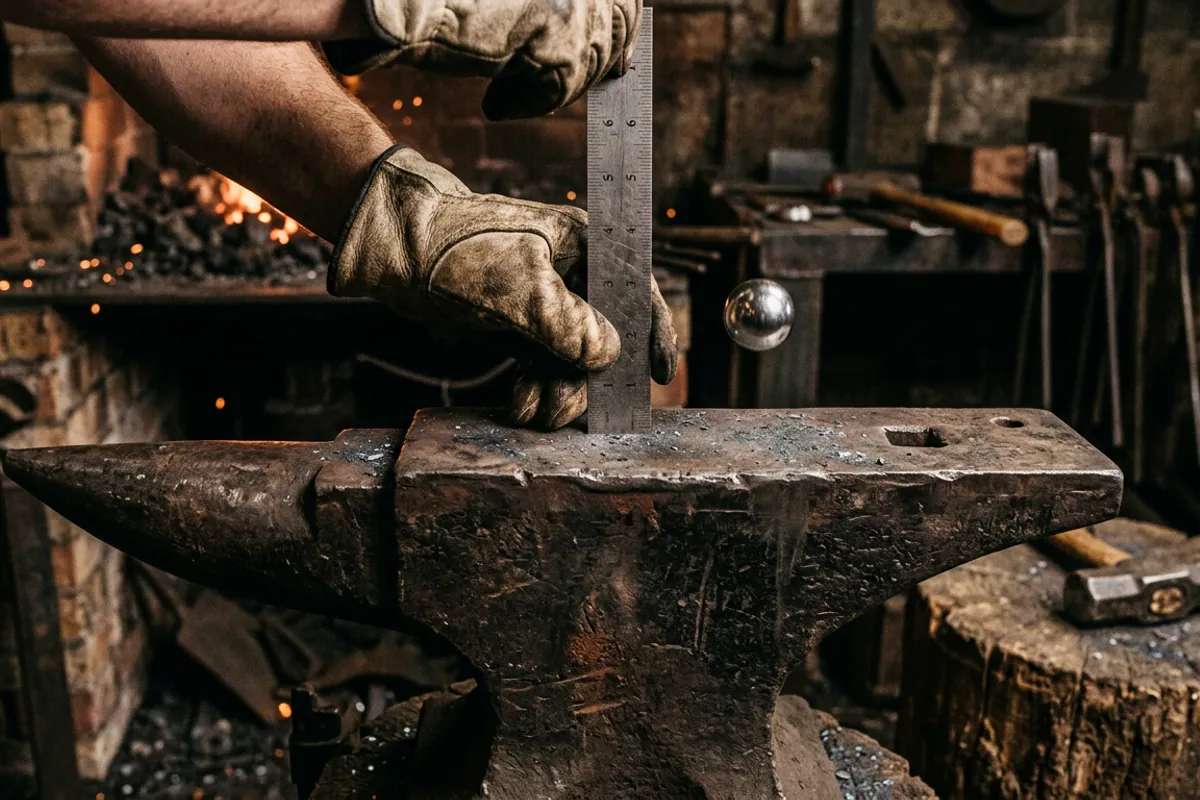
Do it the same way every time or the answer is worthless. Hold a steel rule vertically on the face, drop the ball from the 10 inch mark with your fingers rather than a toss, and watch where the top of the bounce lands against the rule. Test the middle of the face, then over the waist, then out on the heel. Rebound falls off as you get away from the mass under the face, and a heel that goes dead tells you where not to do heavy work. A ball that comes back a third of the way, anywhere on the face, means the plate is gone or was never there.
A single 1 inch chrome steel ball costs less than lunch and lives in my truck door pocket: Check price on Amazon (paid link). Bring a small hammer too, and tap your way around the whole face listening for the change from ring to thud, which is how you find a plate that has come unwelded from the body in a patch.
Reading the stamps and the marks
English anvils were weighed on a balance beam and stamped in the hundredweight system, which throws off every new buyer. The left figure is hundredweights at 112 pounds each, the middle is quarter hundredweights at 28 pounds each, and the right is plain pounds, added together. Arc and Hammer's reading anvil weight markings breakdown gives the examples: 1 0 16 is 128 pounds, 2 1 3 is 255 pounds. The middle figure never exceeds 3 and the right one never exceeds 28, which is how you resolve a worn stamp. American makers, Trenton included, stamped the weight in pounds, which is why Bessie just says 148.
For maker marks, the reference everyone eventually buys is Richard Postman's Anvils in America. It is the book the identification threads point at, it goes deep on American makers and serial numbers, and copies float around at prices that swing wildly by edition and printing: Check price on Amazon (paid link). If you are not ready to spend book money, post good photos of the side, the front foot and the base to a forum. The KnifeDogs anvil ID threads and the regulars at I Forge Iron will usually name a maker from the shape of the feet alone.
What I check before money changes hands
Face flatness. Lay a straightedge across and along the face and look for daylight. A little sway is normal and workable, and a deeply dished face means you fight it every time you straighten long stock. A face someone has ground or milled flat is a face with less hardened plate left on it than it started with, so ask.
Edges. Chips at the front edge are the most common thing you will see and they do not scare me. Radiused, dinged edges still do good work, and you can always dress a short section of one edge lightly. What scares me is edge damage with cracks running back into the plate, which propagate.
Plate integrity. Tap and listen, then rebound test in three or four spots. Dead patches mean delamination and a plate that will eventually peel.
Repairs. Look for weld beads along the edges, a torched or drilled out hardy hole, and heat colors near the face. Old bad welds and heat that has soaked into the plate are much harder to live with than honest wear.
Weight against price. Decide your working weight before you go so a bargain does not talk you into an anvil that is too light. My anvil weight guide lays out why 150 pounds and up is where general work gets pleasant, and why a 100 pound anvil is still a real anvil if it is bolted down hard.
Say it out loud to yourself before you lift: you are about to pick up 150 pounds of awkward steel with no good handholds. Get a second person or a hoist, keep it low, keep fingers out from under it, and wear boots. I have seen more injuries at anvil handoffs than at anvils.
Hearing protection, because a good antique rings
Trentons ring like a bell, and a lot of English anvils are worse. That ring is not charm, it is a repeated high level noise right at ear height for hours at a stretch, and hearing loss does not grow back. I wear muffs at the anvil, and the 3M Peltor X5A is the highest rated over the head muff I know of at NRR 31 as published by 3M: Check price on Amazon (paid link). Damping helps too, with a chain draped over the heel or strong magnets stuck under the horn, and a solid stump mount that couples the base to wood kills more ring than any gadget.
While you are protecting your head, the eye protection is not optional either. Hardened faces and hardened hammers throw chips, and old chipped edges throw more. ANSI Z87.1 rated safety glasses, always, and a face shield over them for grinding. More on the whole kit in blacksmith safety gear.
Cleaning it up without wrecking it
Rust on an antique anvil is cosmetic. Take it off the face and the horn with a knotted wire cup brush on an angle grinder, which is fast and does not remove steel the way an abrasive disc does: Check price on Amazon (paid link). Then oil the face or wax it and put it to work. Working the anvil keeps the face clean better than anything in a can.
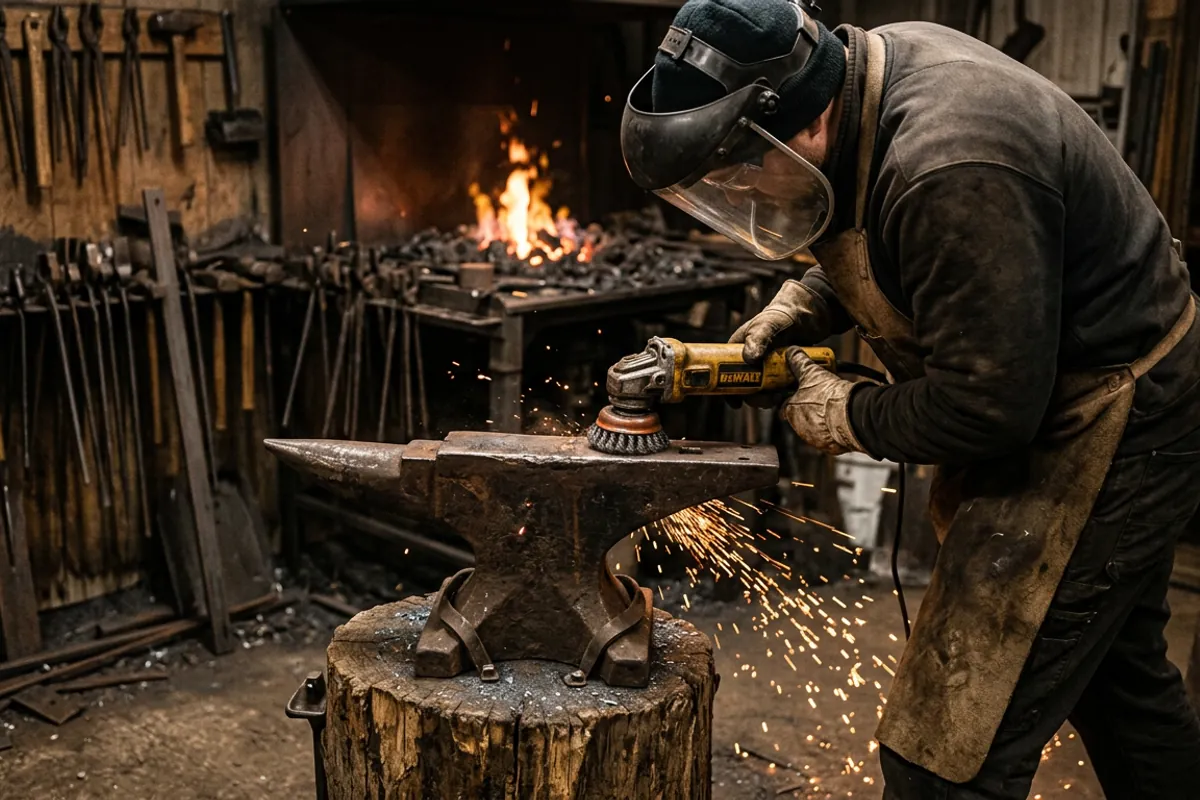
Now the do nots, and I mean these. Do not grind or mill the face to make it pretty. Smiths in the Practical Machinist Fisher anvil threads keep repeating the same warning about Fishers in particular, that the hardened plate is thinner than it looks and people have ground straight through it. Do not weld the edges freehand because you saw it on a video. The heat you put into that plate can ruin the hardness you paid for, wrought iron does not weld like mild steel, and there is a reason experienced smiths follow a specific preheat and rod procedure. If the anvil needs a repair, find someone who has actually done that repair.
Two more safety notes on cleanup. Wire cup brushes shed wires at high speed, so that is a face shield job over your Z87.1 glasses, sleeves down. And the paint on a hundred year old tool is paint of unknown composition, so do not dry sand or dry grind it in a closed shop. Wear a respirator, work outside, and do not eat with those hands. I learned my respect for shop hazards the hard way, quenching a blade in oil that was too cold while standing too close in a cotton shirt with no face shield. The flare took my eyebrows and I kept my eyesight on luck alone.
If you strike out, the new anvils that make sense
The antique market is thin in a lot of regions and it can take a year of watching auctions to find a good 150 pounder at a fair price. If you would rather forge this month, buy new and stop apologizing for it. A cast and heat treated farrier style anvil like the TFS 100 pound single horn gives you published numbers you can hold the maker to, 4 by 14 inch face, 1 inch hardy, 52 HRC per the retailer spec sheet above, which is more than you know about most old anvils on Craigslist.
At the budget end, the VEVOR single horn is the one that shows up in beginner shops constantly. It is a lot of mass for the money with 55 HRC published, the edges and horn need dressing out of the box, and it is not a Trenton. It is a working surface that lets you learn.

I have written up the tradeoffs in detail in my VEVOR anvil guide, and if you are choosing your very first anvil across every budget, start with the best anvils for beginners.
What owners say
On the rebound test itself, the I Forge Iron threads are worth reading before you trust your own numbers. The discussion in some thoughts on rebound and the ball bearing test and the follow up on ball bearings for testing makes two points repeatedly: ball size and drop height have to be consistent for the percentage to mean anything, and results over 100 percent are measurement error rather than a magic anvil. Over on BladeForums, the ball bearing anvil rebound test thread runs the same argument from the knifemaking side, with owners noting that rebound tells you about the face where the ball landed and nothing about hidden cracks.
On makers, the consensus in threads like Peter Wright or Hay Budden is that both are good anvils and condition decides between two specific examples, not the brand. Fisher owners describe a nearly dead sound with lively rebound and are happy about the quiet, with the thin plate caveat above. Vulcans get the most mixed reports of the common American antiques, generally described as cast iron bodied with a thin face, quiet, and worth less per pound than a wrought bodied anvil.
Where owner signal gets thin is price. Ask ten smiths what a fair dollar per pound is and you get ten answers keyed to their region and the year they last bought, and I am not going to invent a number that would be wrong in half the country. Watch completed local sales for a couple of months and you will know your own market better than any guide can tell you.
What I would tell a friend
Buy the antique if you can test it in person: 150 pounds or more, flat face, tight plate, 75 percent rebound or better, from any of the known makers. Skip anything cast iron, anything with a face someone has already ground on, and anything you have to buy sight unseen from a photo. If the wait is killing your motivation, buy a new anvil with published specs and get to work, because an anvil you are hammering on beats a better anvil you are still shopping for.
The note that matters most: an anvil is 150 pounds of steel you will lift, bolt down, and hit with a hammer for decades. Move it with help, mount it dead solid, and wear the glasses and the muffs every single time. For where the anvil fits in the rest of a starter shop, see the blacksmithing tools that actually matter.