Both of my hardy tool guides close on the same line: let the specialty stakes wait until a project asks for one. That was honest advice and I stand by it, but it left a question hanging, which is what you buy when the project finally does ask. Here is the short answer. For nearly every home shop, the right stake anvil is a used one, a bick iron or a T stake off a farm auction table or a tinsmith's estate, bought for less than a good hammer costs and checked for a sound shank and an uncracked base before money moves. The new made field above the cheap import hardy sets is small, and I will name every piece of it I could actually verify. None of what follows is a bench test. I have run stakes in my own shop and I know what the shapes do, but the specific new made pieces below are published specs and owner reports weighed against that shop experience, and I will tell you which is which as I go.
What a stake anvil is, and what it does that a big anvil cannot
A stake anvil is a working surface on a shank or a spike that gets its mass from something else: a stump, a bench, a stake plate, a vise, or the hardy hole of your main anvil. That is the whole idea. It is not a small anvil. It is a shape you can get to a place your anvil cannot reach.
Bessie is my 148 lb Trenton and she has done the great majority of my forging for years, but her horn is her horn. When a job needs a beak thinner than that horn, or a surface I can get down inside a scoop, a cup, a length of pipe, or a rolled edge, no amount of good technique gets me there. That is the entire argument for this family of tools. It is about access.
So do not shop this by diameter range. Shop it by shape and by what it lets you reach. The Kellogg and Sons blacksmith shop blog, which is one working smith writing about his own collection rather than a catalog trying to sell you something, puts the economics of it plainly: a T shaped anvil that fits into a hole in the bench or stump is much cheaper to make than one with a massive iron base, and the pieces are used to bend small coils, fit inside a hollow object, or finish small forgings. He also makes the historical point that pre-1800 English anvils were fairly solid and rectangular with small horns and a short heel, which is exactly why a supplementary stake was standard shop equipment then and less so now. His large one is all wrought iron with no steel face, weighs around 180 lbs, and he dates it to the 18th century or earlier. He calls stakes as useful as pockets in a pair of pants, which is about right.
If you are trying to sort out how a bickern differs from a cone mandrel, I worked through that in the cone mandrel guide and I am not going to run it again here. The rest of the anvil library lives on the anvils hub.
The shapes worth knowing by name
Stake names are a dialect. Learn ten of them and used listings stop being a guessing game. Anvilfire keeps the most complete list of stake types and names I know of, and these are the ones that come up most in a blacksmith's shop rather than a tinsmith's.
Bickerns and bick irons
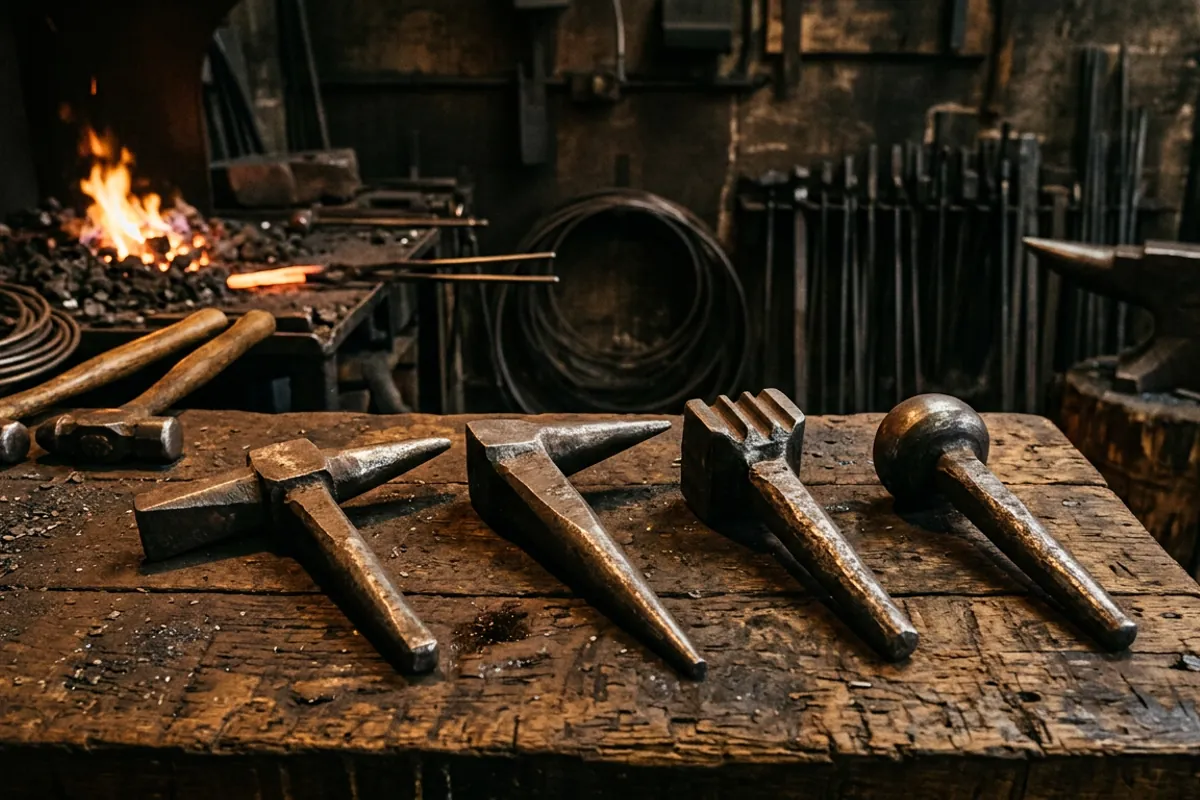
A bickern is a horn on a shank. It sits in a hardy hole, a vise, or its own base, and it gives you a beak that is slimmer, longer, or a different taper than the horn on your anvil. This is the shape most blacksmiths mean when they say stake anvil, and it is the shape most worth owning first.
T stakes, beakhorn and blowhorn
Anvilfire defines the T stake as a general term for any letter T shaped stake, and the two workhorse variants are the beakhorn, with one large conical end and one narrow square or flat topped end, and the blowhorn, a standardized shape with a large half funnel and a cylindrical taper that came out of brass instrument making. Also in the T family: the conductor, a large T stake with cylindrical arms of different sizes, and the brazier, a T stake with two short cylindrical arms.
Creasing, seaming, hatchet and bottom
These are the seam and edge shapes. Creasing stakes are grooved for creases and wire edges. Seaming stakes have cylindrical arms with short raised ends for working seams in pipe or ducting. The hatchet stake is straight or half moon with a narrow wedge shaped edge for corner work, and the bottom stake is a chisel like shape with a slightly curved surface for bottom corner seams in vessels.
Raising, mushroom, ball and spoon
The hollow form shapes. A mushroom is hemispherical for raising and planishing, a ball is a sphere on a shank for any curved surface work, and a spoon stake has an ovoid surface for spoon bowls and similar curves. Anvilfire notes that stakes are primarily for cold working thin plate or sheet metal, and that matters for what you buy and how hard you hit it.
The new made field at a glance
I am not going to dress this up as a five product roundup, because the field does not have five products worth ranking. New made blacksmith scale stakes come from a handful of shops, most of them do not publish specs, and nobody in this class publishes a hardness figure at all. I searched for it. Zero hits for HRC, Rockwell or hardness across the makers in this category, so treat any hardness number you see quoted for a stake or bickern as somebody's guess rather than a spec.
Scroll horizontally to see all columns.
| Piece | Class | Published weight | Material | How it mounts | Price as listed |
|---|---|---|---|---|---|
| Perun bickern | Bickern | 25 kg | Not published | Conical pivot with square cross section in the base | 559 euro incl. tax, 455 euro excl. |
| Picard tinker stake anvil, flat face and round pointy horn | Beakhorn style tinker stake | 4000 g, 5500 g, 8500 g | Forged | Tapered shank, stake holder or stump | 571.30 to 1,074.65 US dollars |
| Picard tinsmith fretting anvil | Fretting stake | Not published | Not published | Tapered shank | 625.16 US dollars |
| Pieh Tool bick iron | Bick iron | Not published | Not published | Hardy hole | Not published |
| Peddinghaus blowhorn anvil | Blowhorn stake | Not published | Not published | Stake plate or holder | Not published |
| Iron Mountain double horn bick, Dixon style | Double horn bick | Not published | Not published | Stake plate | Not published |
| Mini raising stake, jewelry scale | Raising stake | Not published | Hardened steel, mirror polish | Mini stake holder in a vise | 23.25 US dollars |
Perun publishes exactly one bickern, at 25 kg, 559 euro including tax and 455 euro excluding. Note what it does not publish: no material. Cast steel shows up on adjacent products on that site, not on this one, so I am not going to tell you what this piece is made of. The base is the interesting part. Perun describes a conical pivot with square cross section in the base of the anvil that serves to adjust the anvil to the stump or to the swage block, which is a nice bit of design if you already own a swage block. The dimensions are printed on the page as 490 long by 425 high with no units given at all. Millimetres is the obvious reading, which would put it around 19 inches long and 17 inches tall, but I am telling you that is my reading of an unlabeled figure rather than a published fact.
The Picard tinker stakes at Blacksmith Source are the clearest published specs in the whole category: forged, in 4000 g, 5500 g and 8500 g, listed at 571.30, 862.59 and 1,074.65 US dollars respectively when I checked. Prices move, so read that as a tier rather than a quote. That tier is the real news here. A serious new made stake is hammer money plus anvil money, not accessory money.
Pieh Tool's forming stakes page is the broadest catalog I found, carrying Pieh Legacy stakes, Iron Mountain Forge pieces in Pexto and Dixon patterns, and Peddinghaus blowhorn, bordering and creasing anvils. It does not publish weights or prices in the listing view, so the table says not published and stays that way.
Kayne and Son's Blacksmiths Depot also sells bickerns and stake plates, and their catalog is worth your time. Every one of their product pages refused to load for me, though, so I will name them as a source and quote nothing. Search snippets are not verification.
Mounting a stake, and the one place it does not go
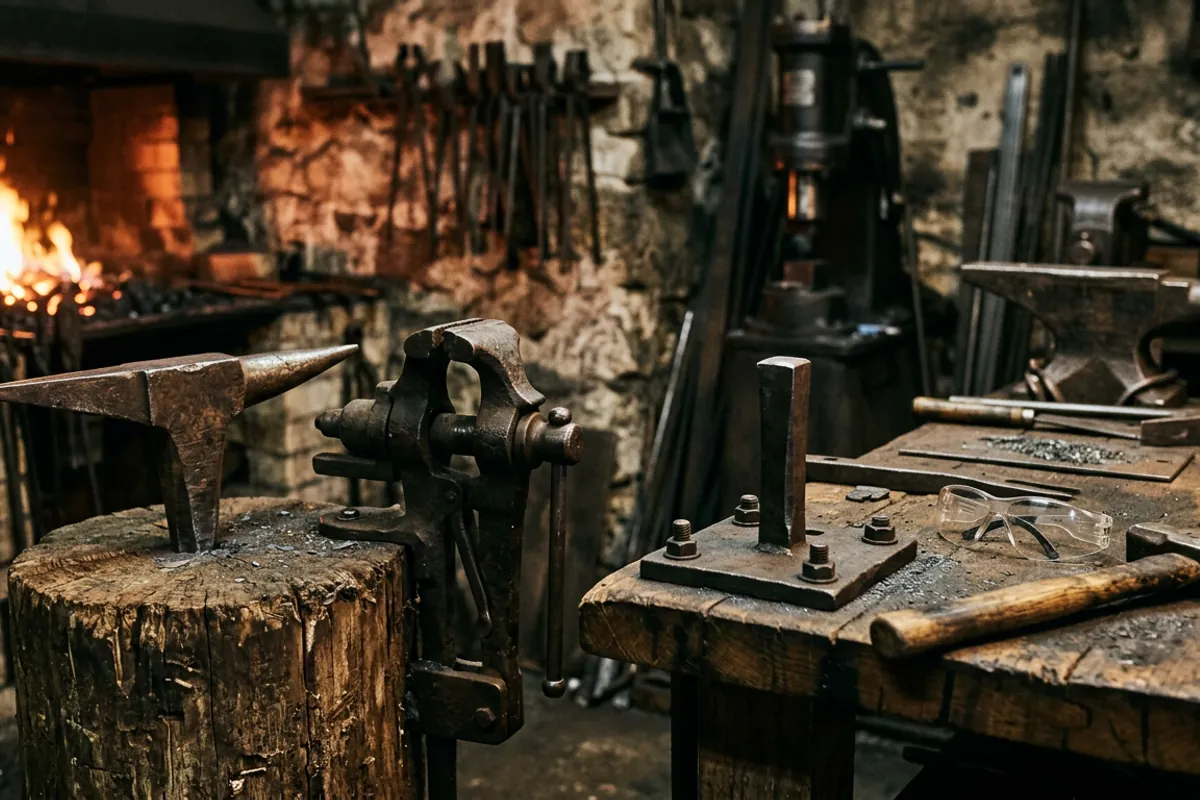
This is where people break anvils, so read it twice. The hole itself, its sizes and what a shank may do to it, is covered in the pritchel hole reference, and I am not going to re-run it here. The part that is specific to stakes is this: a sheet metal stake with a tapered shank does not belong in a hardy hole at all. Anvilfire's guidance on hardy hole sizes and fits is blunt about it, and the reason is that a taper wedges. Those stakes belong in a stake holder, a stake plate, or a heavy wood block. The same page warns about the large unwieldy production stakes whose small shanks merely look anvil-ready, and about tools with overhang, the bick and beak shapes, which should be used lightly whatever they are seated in.
That comes down to four honest mounting options.
Hardy hole. Only for tools built with a proper square hardy shank sized to your hole. Measure the hole before you order. Older anvils came in fairly even sizes up to 1 inch, meaning 5/8, 3/4 and 7/8, while anything over an inch tends to be an odd size no commercial hardy tool was ever made to fit. Modern anvils from makers like Peddinghaus and Nimba have drilled and broached holes at 1 inch. Posters on the I Forge Iron thread Tools won't fit into hardy report the other half of that problem, which is a tool that fits cold, heats up during heavy use, swells, and sticks. That is a reason to keep the fit slightly loose rather than snug.
Stump or heavy wood block. The traditional home for a tapered shank, and still the best one. Anvilfire notes that old stakes typically carry a taper of 10 to 14 degrees, which is exactly the geometry that wedges in a hardy hole and seats beautifully in wood. Bore the hole, drive the stake, done. Same logic as a good anvil stand: the mass and the height do the work.
Post vise. The most flexible option in a small shop, and the one I reach for. A post vise will hold a tapered shank, a square shank, or a shop made one without complaint, and you can set the height by how deep you clamp.
Stake plate or holder. A cast plate with tapered holes, bolted to a heavy bench. This is what a tin shop used and it is still the right answer if you own more than two or three stakes.
Two safety notes that are not negotiable. Most stake work is cold work on sheet, and cold hammering throws chips, so ANSI Z87.1 rated eye protection goes on before the hammer comes off the rack, every time. And a tall stake with a long overhanging beak will whip and can launch out of a loose seat under a heavy blow. Seat it hard, keep it low, and hit an overhanging beak lightly, exactly as anvilfire says.
Buying used without bringing home a paperweight
Nobody publishes a damage guide for stakes. What follows is owner consensus, the checks smiths repeat to each other at hammer ins and on the forums, plus what I put my own hands on when one turns up on a table. Treat it as consensus, not as a lab result.
Start at the shank or the spike, because on a stake the shank is half the tool. A shank that is mushroomed over, split, bent, or carrying a welded repair is a shank that will not seat square, and a stake that does not seat square walks under the hammer. Then look at the base and the column on anything with a cast base. Hairline cracks like to hide at the junction of column and base and around the boss, and a cracked cast base is not worth hauling home.
Look hard at the beak. The common damage is somebody taking an angle grinder to a dinged horn and leaving it lumpy or off center. A beak you cannot roll a smooth even curve on is decoration. Same for the working face on anything you plan to planish against: sheet metal shows every pit and every chew mark you hammer over.
On material, a file tells you more than a ring test does, because a light stake seated in a stump will not ring like an anvil anyway. A file that skates says hard, a file that bites easily says soft. That matters because plenty of cheap modern stakes are cast iron, and cast iron is fine for gentle cold forming and wrong for hot steel or heavy blows. The same instincts you would use on antique blacksmith tools or a used anvil apply here, with the shank added to the checklist.
Last thing: do not turn your nose up at shop made. A spike welded to a block of steel is a real stake and always has been. Judge it on the steel and the weld, not on the pedigree.
The small stakes worth buying new
Amazon does not sell a blacksmith scale bickern. I looked. What it sells well is the light gauge end of the family, the jewelry and silversmith scale stakes for repousse, raising small vessels, spoon bowls, and copper work. That is a genuine slot and worth filling cheaply, as long as you understand these are cold working tools for thin stock and nothing else. If you want blacksmith scale, you are going to Perun, Pieh Tool, Picard through Blacksmith Source, Kayne, or the used market.
I am also going to steer you off the multi piece import hardy sets that bundle a creasing stake. Those are already covered in the anvil hardy tools guide and the hardie tools guide, and this article starts above them on purpose.
A holder first, if you already own stakes. A miniature stake holder is designed to clamp in a bench vise and hold a mini stake steady, which is precisely the mounting anvilfire tells you to use instead of your hardy hole. Note that no stake comes with it, and mini holders are cut for the common mini stake shanks rather than every brand, so do not assume a premium brand stake will drop in. Check price on Amazon (paid link)
One raising stake, if you know the shape you need. Jets publishes the specs on this pattern as hardened steel with a mirror polish, just under 3 inches long at 23.25 US dollars, which tells you both what it is and what it is not. Mirror polish matters more than it sounds like it should, because every mark on the stake prints into the sheet. Check price on Amazon (paid link)
The ten piece set, if you are starting from nothing. A kit of mini forming stakes with a wood stand and a stake vise gets you the convex, concave, shell, doming, beak, cone and raising shapes in one go, which is the sensible way to find out which two you actually use before you spend real money on a full size version of them. Check price on Amazon (paid link)
What owners say
Owner signal on this category is thin, and I would rather say that than manufacture a consensus. Stakes do not generate the review volume anvils and hammers do, and most of what exists is smiths showing each other their collections rather than reviewing anything.
The BladeForums thread Stake anvil? is the clearest owner to owner statement of the use case I found: stakes earn their keep on small work and on shapes that need multiple angles and curves, they are portable by design, and not all of them are small. The point about portability is the one worth keeping. A stake could be knocked out of a stump and carried to the next place a smith set up, which is why so many survive with beaten shank ends.
The I Forge Iron thread Show me your bick or stake anvils is the closest thing to a visual field guide for the used market, and it is worth scrolling before you go shopping. What comes through in that kind of thread is variety: block stakes made from square stock with a spike welded on sit right next to 18th century wrought pieces, and both of them work.
I am reporting these as owner reports read secondhand, not as anything I put on a bench.
What I would tell a friend
Buy used. A sound used bick iron or T stake will cost you a fraction of the 571 to 1,074 US dollar tier the new made forged stakes sit in, and there is nothing wrong with an old one that has a straight shank, an uncracked base, and a true beak. If you want new and blacksmith scale, Perun's 25 kg bickern and the Picard tinker stakes are the two with published figures you can actually check, and Pieh Tool has the broadest catalog even though it publishes almost nothing. If all you need is a small forming shape for cold sheet, spend twenty odd dollars on a mini stake and a holder and stop there.
The thing I would not let a friend get wrong: never wedge a tapered shank stake into your hardy hole. It can stick, and it can crack the anvil, and an anvil is a lot more expensive than a stake plate or a drilled stump. Mount it in wood, a plate, a holder, or a vise, hit anything with overhang lightly, and put your safety glasses on before you start.