Somebody asks me about it every few months, usually while we are both standing over a used anvil at a swap meet: what is that little round hole near the heel for? That is the pritchel hole, and its job has almost nothing to do with the square hole sitting beside it. This is the reference I have wanted on this site for a while, because most of what gets repeated about the pritchel hole is either shop practice presented as specification, or a number somebody measured on their own anvil and then published as if it were a standard. There is no standard. What follows is what is actually documented, what is common practice, and where those two get quietly mixed together.
What the pritchel hole actually is
The cleanest definition I can point at comes from the anvilfire glossary. It states that the small round hole found in London pattern and American pattern anvils is used for the punching operation, and that it is called the pritchel hole. It also notes that many farriers' anvils had two pritchel holes. That is the definition, and I would keep it that narrow.
I mention the source specifically because of a small mess in how this gets cited. People routinely credit anvilfire's hardy holes FAQ for defining the pritchel hole. That page does not define it. It mentions pritchel holes twice, both times in the context of edge radii, and it is otherwise about hardy holes. If you want the definition attributed correctly, it is the glossary, not the FAQ. That distinction matters here because the FAQ is where nearly all the real dimensional data lives, and the glossary is where the pritchel hole gets named, and treating them as one page is how people end up quoting hardy hole numbers as if they described the round hole.
The name itself is usually traced to the farrier's pritchel, the punch used to open the nail holes in a horseshoe. I have never seen that etymology in a source I would stand behind, so treat it as shop lore rather than fact. The function is documented. The name story is what smiths tell each other.
Why the hole is there, and what happens under the punch
Punching a hole through hot stock is not one motion, it is three, and the pritchel hole only matters for the last one.
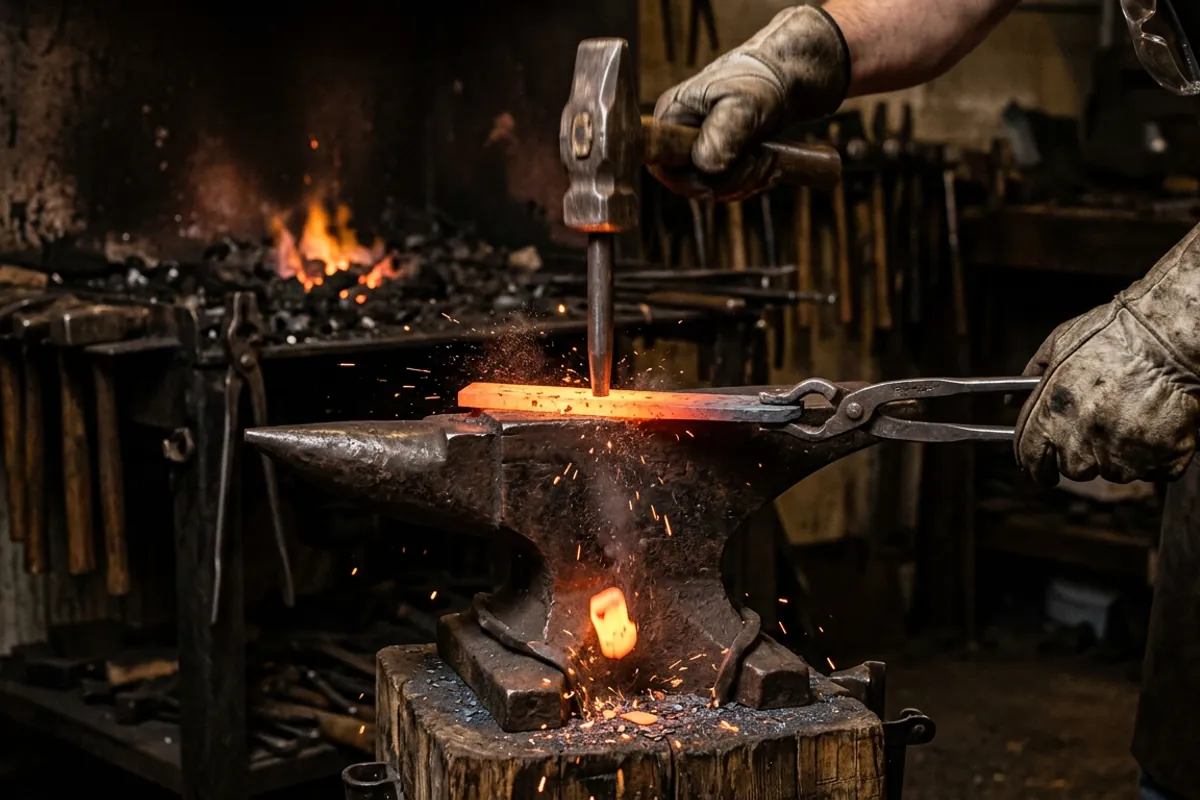
I set the bar on the anvil face and drive the punch down until I can see the dark shadow of it on the far side of the stock. Then I flip the piece over and punch back from that shadow, still working on the solid face. The face supports the metal, and the punch cools against it, which is the point. Somewhere in there I am dunking the punch in water every few blows and, if I am being tidy about it, dropping a pinch of coal dust in the hole so the punch does not stick.
Only then does the piece move over the pritchel hole. The last blow drives the slug free, and it needs somewhere to fall. That is the entire job of the hole: clearance for the slug and for the tip of the punch, so I am not driving a punch point into a hardened anvil face and so the slug is not being smeared flat against it. AnvilTalk's anvil hardy tools guide already states the second half of the function, that the pritchel also serves as a bolster when you drift holes, and that is right. A pritchel hole is small, though, so for anything wider than the hole itself I use a separate bolster plate rather than trying to make the anvil do it.
Two safety notes that are not optional. The slug comes out hot and falls straight down, so I keep my boots and my legs out from under the heel and I do not let a bucket of quench oil or a coil of anything flammable live under the anvil. And punching throws scale hard, which means ANSI Z87.1 rated eye protection on your face, not on your forehead, plus natural fiber clothing rather than synthetics that melt. The rest of my thinking on that lives in the blacksmith safety gear guide.
The pritchel sizes you actually find, and why there is no standard
Here is the part that most articles get wrong by being confident. The anvilfire page that everybody cites for anvil hole dimensions gives no pritchel hole dimensions at all. None. So if you see a sentence like "the pritchel hole is 3/8 inch," understand that it is not a specification anyone published, it is somebody describing their own anvil.
What you can do honestly is look at what real anvils actually ship with. Pulling the figures from the anvils covered elsewhere on this site:
- NC Tool Cavalry: 3/8 inch
- NC Tool Standard: 1/2 inch
- VEVOR 66 lb: 5/8 inch
- Kanca Bladesmith: 3/4 inch
- VEVOR 132 lb: 1.1 inch
Five anvils, five different pritchel holes, and a spread of nearly three to one. Two of those are from the same maker in the same product line. That is the whole argument in one list. You will commonly hear the typical range given as 3/8 inch to 1 inch, and those catalogue figures sit roughly inside it, but that is an observed pattern in current production, not a rule, and the largest anvil on that short list already runs past it.
The practical consequence is that any round shanked tool you buy for the pritchel hole is a tool bought for your anvil specifically, not for anvils in general. Measure yours. Mine are written on an index card taped to the anvil stand, because I have proven to myself more than once that I will not remember them at a swap meet.
The hardy hole beside it, and the numbers that are documented
The square hole is the hardy hole and the round one is the pritchel hole. That is already established on this site rather than something I need to correct, and the anvil hardy tools guide says it plainly, so I will not belabor it. What is worth putting next to the pritchel figures above is that the hardy hole has real documented history, and it tells the same story about standardization.
From the anvilfire hardy holes FAQ: early hardy holes were about 1/2 inch square. Sizes ran 5/8, 3/4, 7/8, up to 1 inch, with odd sizes above that. Until the modern era almost every size of anvil had a different hardy hole size, and there was no standard at all. A Kohlswa 25 mm hole works out to 0.9843 inch, which is close to 1 inch without being it. Peddinghaus and Nimba both standardized on 1 inch.
That same source is also worth quoting on what the hardy hole is for, because it is more modest than the version you usually hear. Most bottom tools only need the shank so that they do not bounce off the anvil while in use. That is it. The shank keeps the tool where you put it.
Edge radii are documented too, and they are smaller than people expect. The radius around the hole is usually more than 1/16 inch and less than 1/8 inch, running 1/8 inch to 3/16 inch on large anvils with large hardy holes. If you are dressing a beaten up anvil, that is the target, and it is easy to overshoot into a funnel that no longer supports a shank.
Fit, tolerance, and the number that keeps getting misquoted
There is a plus or minus 0.005 inch figure that circulates as though it were the hardy hole tolerance. It is not. In the original it is a hedged observation about tool shanks, not about holes, and the same source says of the hole itself that he does not believe there is a fit allowance at all. Nobody is machining anvil holes to a spec sheet.
Meanwhile the hardie tools reference on this site publishes a different figure entirely: Blacksmiths Depot drop forged shanks at about plus or minus 0.04 inch. That is roughly eight times looser, and it is not a contradiction to be averaged away. They are two different makers' shanks, measured by two different people, and neither one describes the hole. Keep them separate in your head and quote each to its own source.
What this means at the anvil is simple. Fit is empirical. You take the tool to the anvil, or you take a caliper reading and accept that a shank cut a few thousandths under is the safe direction to be wrong. The buying workflow for that, matching shanks to a specific anvil, belongs to the two guides above rather than to this page.
What smiths actually put in the pritchel hole
Beyond punching, the pritchel hole picks up two secondary uses. Both are genuine, both are worth knowing, and I want to be clear that neither is in the anvilfire material. They are smith practice.
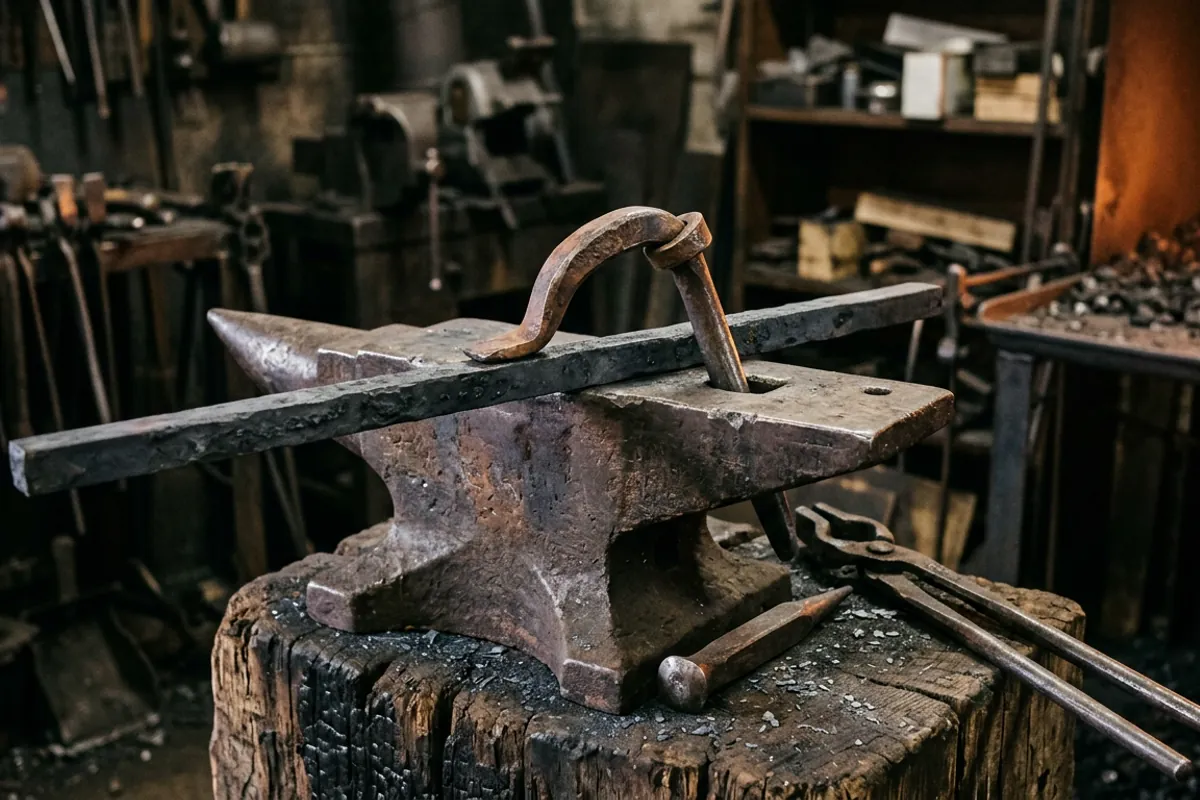
The first is the holdfast. A holdfast is a bent bar that drops into the hole, and when you tap the top of it the shank cants inside the hole and jams against the walls at two points. It grips by friction, not by clamping, which is why a rap on the back of it releases the thing and why a holdfast that is a sloppy fit in the hole never holds at all. It is one of those tools that feels like a trick the first time it works.
The second is round shanked bottom tooling. Small bending forks, scrolling jigs, guides, that sort of thing. Again, this is practice rather than published function, and it comes with a limit I would take seriously: the pritchel hole is small, it sits near the heel where the anvil has the least mass behind it, and it is not a second hardy hole. Anything you are going to lean on with real leverage goes in the hardy hole or in a separate stand.
Farriers' anvils and the second pritchel hole
The glossary notes that many farriers' anvils had two pritchel holes, and if you handle enough of them you will find them. Farrier patterns differ from the general purpose London pattern in several ways, and the extra hole is one of the visible ones. The reason usually given is convenience, a second place to punch over and somewhere to park a tool without giving up the first hole, but I will flag that as the usual account rather than something documented alongside the glossary entry. If you want the rest of what makes those patterns different, the farrier anvil guide covers the shape and who it suits.
The failures that start at these holes
This is the section I would read twice if you are buying used, because the holes are where anvils break.
Tight or tapered hardy shanks occasionally get stuck and break off in the anvil. When that happens, about the only way to get one out is with a cutting torch, which is a bad afternoon and a worse thing to do to a hardened face. Tapered shanks may also cause the heel of the anvil to break off outright. The heel is the thinnest, least supported part of the whole tool, and both holes live in it. A tapered shank driven in acts as a wedge, and a wedge in a casting with a hole through it is exactly how you would split one on purpose.
The specific version of this that catches people is sheet metal stakes. Do not use sheet metal stakes with tapered shanks in hardy holes. They can wedge into the anvil, becoming stuck or even breaking the anvil. Those stakes belong in a stake holder, a stake plate, or mounted in a heavy wood block, which is what they were made for. Related: large unwieldy stake tools with very small shanks that look like they could be used in an anvil should not be. And any tool with overhang, the bick and beak tools that stick out well past the hole, should be used lightly, because every blow on the far end of one is a lever working on the heel.
None of that applies only to expensive anvils. It applies harder to cheap ones, where there is less material and less certainty about what the body is made of.
Reading a worn pritchel hole on a used anvil
When I look at a used anvil, the holes tell me a good deal about how the previous owner treated it.
I look at the underside of the heel first, not the top. Cracks radiating out from either hole, or a hairline running from the hardy hole toward the pritchel, is a walk away. So is any repair weld around the holes, because that tells me somebody already had this conversation with themselves and lost.
On the face, a pritchel hole that has gone oval or dished has been punched over hard for years, which is honest wear and not usually a dealbreaker. Mushroomed metal rolled over the rim of the hardy hole is also common and can be dressed back to that documented radius, more than 1/16 inch and less than 1/8 inch on ordinary anvils. What I will not accept is a stub of a broken shank still in the hardy hole, presented as though it is a minor issue. It is not minor. See above regarding cutting torches.
Ring and rebound still matter more than any of this, and the general condition checklist lives in the used anvil buying guide. The holes are just the part everybody forgets to inspect.
What I would actually do with all this
Measure your own anvil, write the two numbers down, and stop trusting any published pritchel dimension as a specification, because at least for the sources I trust, one was never published. Buy round shanked tooling for the hole you have. Punch over the face until the last blow, then move over the pritchel. Keep tapered shanks and sheet metal stakes out of the hardy hole entirely. Wear the eye protection every single time, because scale from a punching operation comes off fast and travels farther than you would guess.
Bessie, my 148 lb Trenton, has both holes and I have used them for most of twenty-five years without doing damage to either, which is less about skill than about never once driving a wedge into that heel. The rest of the anvil material is collected in anvils, and if you are shopping for tooling to go in either hole, start with the two guides linked above rather than with a size you read somewhere.