Search for the black smith and you get a strange mix of results: medieval woodcuts, tourist demonstrations, knife makers grinding bevels, and a lot of stock photos of sparks. The word has drifted into decoration. What it actually names is a specific, still living craft: heating iron or steel until it moves, and moving it with hammer blows against an anvil until it is the shape you wanted. I have been doing that in a home shop for about twenty-five years, starting self taught on a cut length of railroad track clamped to a stump, and this piece is my attempt to explain the trade plainly to someone who is curious and does not want to be sold anything. There are no product picks here. Just what the work is, what the words mean, and where people get hurt.
Where the name comes from
The "black" in blacksmith is the metal, not the man. Smiths were named for what they worked. A whitesmith worked the white metals, tin and pewter, and did finish work on iron that left it bright. A coppersmith worked copper, a goldsmith gold. A blacksmith worked the black metal, iron and steel, which grows a dark scale of oxide the moment it comes out of the fire. Anybody who has forged for an afternoon knows that black. It is on your hands, in your nose, on every horizontal surface in the shop, and it flakes off the work with each blow.
"Smith" itself comes from an old word meaning to strike or to work. So the black smith is, quite literally, the one who strikes the black metal. The two word spelling shows up constantly in searches and is not wrong so much as archaic; the trade settled on one word a long time ago, and you will see it written blacksmith on every club sign and supplier catalog you meet. I use both here because both bring people to the same question.
One more piece of vocabulary, since it causes trouble: a smithy is the building, and a smith is the person. The forge is the fire, or the appliance holding the fire, depending on who you are talking to. Nobody in the craft will correct you harshly over this, but knowing it saves confusion when you read older texts.
What the work actually is
Forging is shaping metal by force while it is hot enough to move without cracking. That is the whole idea. You are not melting anything. Steel melts somewhere around 2500 degrees Fahrenheit and no home forge is designed to take you there on purpose. You are heating it into a plastic range where it behaves a little like very stiff clay, then rearranging it with the hammer.
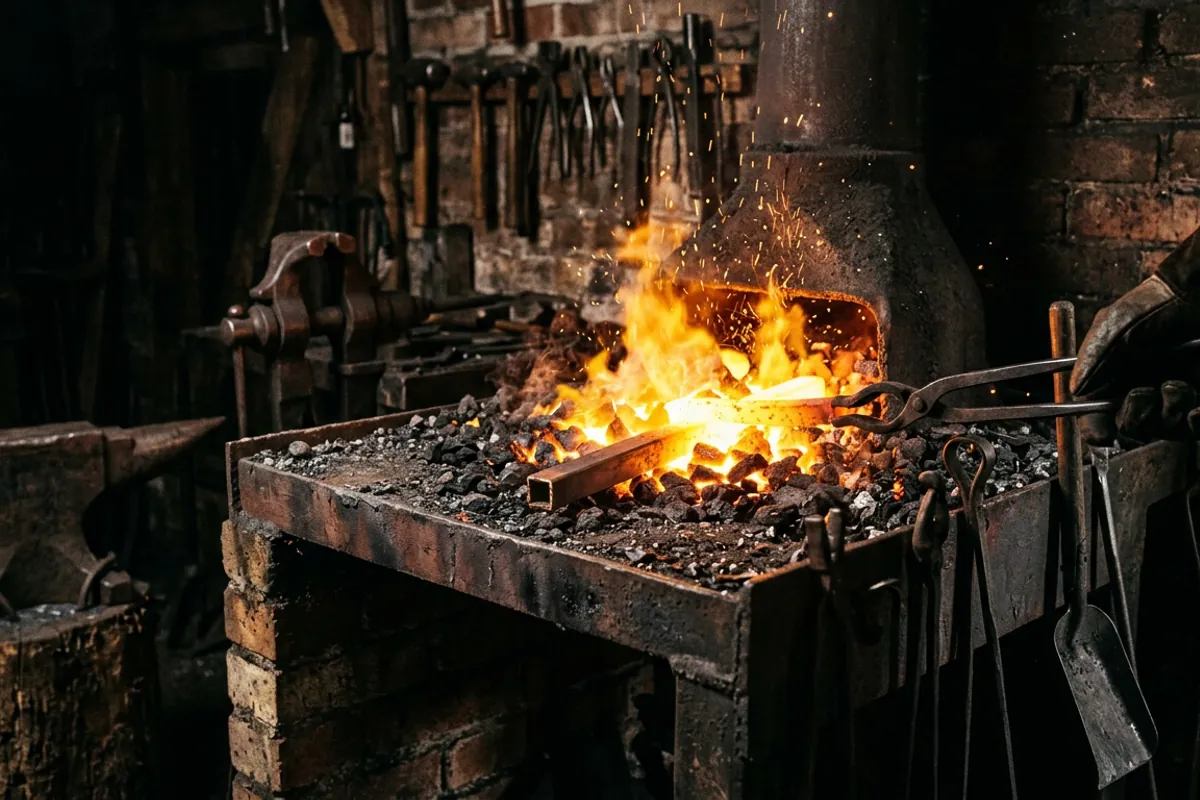
The critical difference from most other metalwork is that forging moves material rather than removing it. When you grind or mill a shape, you cut away everything that is not the part. When you forge, the material you started with is the material you end with, pushed around. That is why a forged part can have grain flow that follows its shape, and why a smith thinks in volumes: if I make this section longer and thinner, that steel has to come from somewhere, and it comes from thickness or width.
Day to day, a working hobby smith like me makes hooks, brackets, fire tools, hardware, tongs, punches, chisels, the occasional knife, and a great many practice pieces that end up in the scrap bucket. Working smiths who do it for money mostly do architectural ironwork, restoration, custom hardware, tooling for other trades, and repair. A short honest description of the day to day is in my piece on blacksmith shops, explained from the floor of one, and if you want the historical version, what a medieval blacksmith actually did all day covers the part the woodcuts leave out.
The fire, and what heat does to steel
You read the fire by color, and you learn color by burning things. Steel that is barely glowing dull red is too cold to forge and will crack or refuse to move; keep hitting it there and you can open splits along the edges. Bright orange to yellow is the working range for most carbon steel. Sparking white is burning, and burned steel is scrap. There is no fixing it, no forging it back, no polishing it out. It has oxidized internally and it will fall apart.
Two temperature landmarks are genuinely useful and genuinely checkable. Steel loses its magnetism at the Curie point, right around 1414 degrees Fahrenheit for pure iron, which is why a cheap magnet is the classic shop reference for finding roughly critical temperature on plain carbon steel. And steel needs to be hot enough to weld, close to white and throwing sparks, before two pieces will actually fuse under the hammer. Everything else about heat treatment involves alloy specific numbers I am not going to invent for you. For real, measured heat treat data by steel type, Knife Steel Nerds is the place; they run actual metallurgical testing and publish it, which is more than most of the internet does.
Fuel matters less than beginners expect and more than veterans admit. I run both. A coal forge for heavy stock and forge welding, because I can get a small, fiercely hot spot exactly where I want it and pile fuel around big work. A propane forge for fast, even heat and most day to day work, because I can light it and be forging in a few minutes with no fire tending. If you are picking a first fire, I laid out the honest tradeoffs in coal or propane: which first forge makes sense.
The six moves that make up almost everything
Nearly every forged object is a combination of a small number of operations. Learn these and you can read any piece of ironwork and reverse engineer how it was made.
Drawing out makes the steel longer and thinner. You hit it, or you hit it over the horn or the far edge of the anvil to move metal faster, then you flatten the result on the face. This is the most common move in the shop by a wide margin.
Upsetting is the opposite: making a section shorter and thicker by driving the steel back into itself, usually by heating just the end and striking it on the face or bouncing the hot end down onto the anvil. It is slow, it fights you, and it is how you get a bulge where you need extra material.
Bending is exactly what it says, done over the horn, over the edge, or in a vise. Hot bends are smooth; cold bends in thick stock are how you crack things.
Punching and drifting make holes. You drive a punch most of the way through from one side, flip, punch through the mark on the other side, then open and shape the hole to size with a tapered drift. The hardy hole and the pritchel hole in the anvil are there to give the slug somewhere to go.
Twisting is decorative and structural, done hot, usually with the stock clamped in a vise and a wrench on the free end. Even heat is everything; a cold spot means the twist bunches everywhere else.
Forge welding joins two pieces by bringing both to welding heat, protecting the surfaces from oxide with flux or a clean reducing fire, and striking them together. It is the move that separates comfortable smiths from frustrated ones, and it takes most people a lot of failed attempts. It took me a whole winter.
The tools that do the work
The tool list is short and stubbornly unchanged. A fire. Something heavy to hit against. Something to hit with. Something to hold hot steel. That is a working shop, and everything else is convenience.
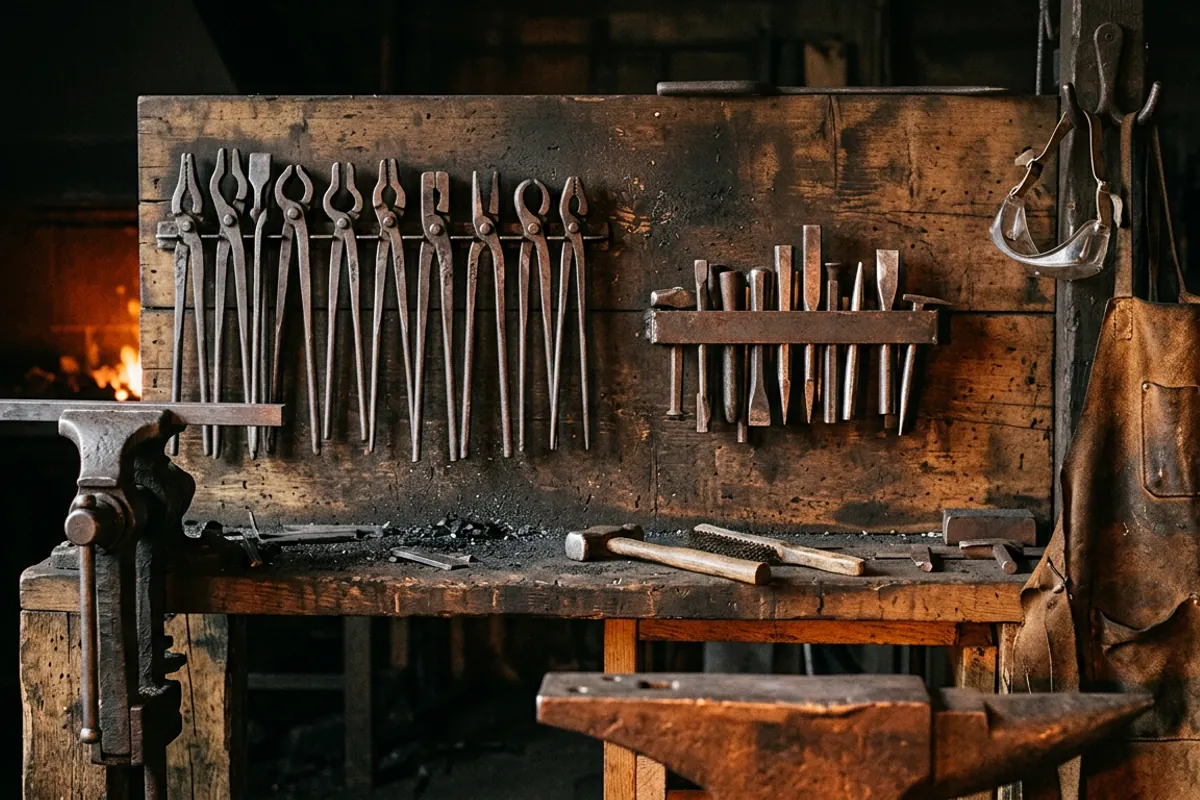
The anvil is the one people obsess over, with some reason. Its job is to return your hammer energy to the work instead of absorbing it, which is why hardened face material and mass both matter. Mine is a 148 pound Trenton I call Bessie, and she is the yardstick I measure every other anvil against. She is enough anvil for anything I have ever needed to do in a home shop. The anatomy is worth knowing: the face is the flat working surface, the horn is the cone for bending and drawing, the hardy hole is the square socket that holds bottom tools, and the pritchel hole is the smaller round hole for punching. What weight actually makes sense for a beginner is its own argument, and I made mine in what size anvil do you actually need.
The hammer should be lighter than beginners think. Most people are best served starting somewhere around two to two and a half pounds and learning to let the tool do the work, because elbow and shoulder injuries from swinging too much hammer are common and slow to heal. Tongs need to fit the stock; a tong that does not grip properly will launch hot steel across your shop, and that is not a hypothetical. A post vise, a wire brush, and a way to cut stock round out the list. If you want the full starter breakdown, the black smith tools you actually need to start is the honest short version.
Heat treating, where good work gets ruined
Forging shapes the steel. Heat treating decides whether it is any good. These are separate operations and separate skills, and plenty of beautifully forged blades and chisels have been ruined in the last twenty minutes of work.
The short version for plain carbon steel: you normalize to relieve the stress and refine the grain the forging put in, you harden by heating to critical and quenching in the medium the steel calls for, and you temper by reheating to a lower temperature to trade some hardness back for toughness. Straight out of the quench, a hardened carbon steel blade is glass. Drop it and it can shatter. Temper it and it becomes a tool.
The critical thing to understand is that every one of those steps has alloy specific numbers: soak temperature, quench medium, quench speed, tempering temperature and time. Those numbers are published by steel manufacturers and tested independently, and they are not interchangeable between steels. Guessing gets you a soft blade or a cracked one. I have written up what the tempering stage actually looks and behaves like in tempering of metal, explained from the forge floor, and for the underlying science and real test data I send people to Knife Steel Nerds rather than repeating numbers I did not measure.
Safety, said straight
I will not soften this part.
Hot steel does not look hot. A bar at 800 degrees Fahrenheit in a bright shop looks exactly like a bar at room temperature, and every smith I know has grabbed one. Treat every piece of metal in the shop as hot until you personally watched it cool.
Wear eye protection rated ANSI Z87.1, always, not just at the grinder. Scale flies off the work under the hammer, and it flies hot. Wear natural fibers, cotton, wool, or leather, and keep synthetics away from heat. Synthetic fabric melts and sticks to skin instead of burning away, which turns a survivable burn into a serious one.
Ventilate. Both fuels produce carbon monoxide, which you cannot see or smell, and a propane forge in a closed garage is genuinely dangerous. Never, ever forge or heat galvanized steel. The zinc coating vaporizes and causes metal fume fever, and it can be much worse than that. Strip the coating or use different stock.
The quench tank is where I got my own lesson. Early on I quenched a blade in oil that was too cold, standing too close, in a cotton shirt with no face shield. The oil flared up in my face and took my eyebrows. I kept my eyesight by luck and nothing else. Warm your quench oil to the range the oil calls for, keep a lid within arm's reach that fits the tank, keep water away from oil, and stand off to the side rather than over it. That night is why this site treats PPE as mandatory rather than optional, and I have written up the full kit in blacksmith safety gear: what matters and what to skip.
Blacksmith, bladesmith, farrier: who does what
These get used interchangeably online and they should not be.
A blacksmith works iron and steel by forging, broadly. That is the parent category.
A bladesmith forges blades specifically, which means the heat treat and the grinding skills carry as much weight as the forging. Plenty of excellent knife makers do not forge at all; they do stock removal, cutting the blade from bar stock and heat treating it. That is a legitimate craft, just not a forging one.
A farrier makes and fits horseshoes and trims hooves. Historically the village smith often did both, which is where the confusion comes from, but modern farriery is its own licensed or certified trade in many places and involves a lot of equine anatomy that has nothing to do with the anvil.
A welder joins metal by melting it, usually with an arc or a gas flame. A blacksmith can weld, and most modern shops have a welder in the corner, but arc welding and forge welding are different operations with different failure modes.
A fabricator cuts, bends, and joins stock, mostly cold, mostly to drawings. Enormous overlap in the finished product, very little overlap in the technique.
What happened to the trade, and what survived
The blacksmith was once general infrastructure. If your community needed a hinge, a plow point, a chain, a tool, or a repair to any of those, a smith made it. What killed that role was not one invention but a sequence: cheap rolled and drawn stock, interchangeable manufactured parts, the internal combustion engine replacing the horse, and welding replacing forge joinery for structural work.
What survived is the part machines are bad at. One off work. Repairs to things nobody stocks parts for. Architectural pieces where the hand of the maker is the point. Restoration on historic buildings. Custom tooling. And the enormous hobby side, which is bigger now than it has been in a century, largely because information got easy and used equipment got findable.
The craft did not shrink into a museum. It moved sideways into a niche where it is genuinely the right method, and it kept every one of its old techniques because those techniques still work. A hammer, a fire, and a heavy chunk of steel do today exactly what they did five hundred years ago. If you want a slower walk through the whole picture, blacksmithing, explained plainly by a smith who still lights the forge covers it, and there is more general shop material in the more from the shop hub.
If you want to be the black smith in your neighborhood
Start smaller than you want to. The failure mode I see most in the beginners I teach on weekends is buying a full shop before making a single hook, then feeling obligated to justify the spend. A heavy chunk of steel, a hammer, a pair of tongs that fit your stock, eye protection, and any fire that gets steel to orange will teach you more in a month than another thousand dollars of equipment will.
Make the same thing fifty times. Hooks, tapers, right angle bends. Repetition is what turns hammer control from a conscious act into something your arm does while you think about the shape. Nothing else does that.
Find other smiths. There are regional blacksmithing associations across most of the country, and a Saturday at a club forge with someone watching your hammer angle is worth a hundred videos. A stranger correcting your grip in person will save you a year.
And read your steel before you commit to it. Mystery scrap is fine for practice and unreliable for anything that needs to hold an edge or take a load, because you cannot heat treat what you cannot identify. When you are ready to buy known stock, the steel selector tool will point you at reasonable choices.
The trade rewards patience over money. That is genuinely the whole secret, and it is also why nobody can sell it to you.