Ask ten people to name a famous blacksmith and most of them stall right out. It is one of the oldest trades there is, it forged the tools every other trade leaned on, and yet the smiths who actually did the work mostly lived and died with no name attached to their iron. That gap has always interested me. I have spent about twenty-five years at this, started self-taught on a length of railroad track clamped to a stump, and I hand these same questions back to weekend beginners in my shop all the time: who were the famous ones, and were any of them real? So this is a reference piece, owner to owner, on the blacksmiths whose names actually stuck, why so few of them did, and what the ones out of myth and the ones out of history turn out to share.
What "famous" even means in a trade this old
Blacksmithing was never a fame trade. For most of human history a smith was infrastructure. Every village had one, the way every village had a well, and nobody wrote down the name of the well. The colonial smith shoeing horses and mending plows, the medieval smith making nails by the bucket, the shop that kept a farm running, those people were essential and anonymous in the same breath. I dug into that ordinary working life in my piece on what a colonial blacksmith actually did, at what a colonial blacksmith actually did, from the forge floor, and the medieval version at what a medieval blacksmith actually did all day. Read either one and you will notice how rarely a name survives.
So when a blacksmith does become famous, it happens for one of a few reasons. He made something so good it outlived him and someone recorded who made it. He taught a generation who kept his name alive. Or he stepped past pure smithing into art, and the art world, which is very good at attaching names to objects, attached his. The word "master" gets thrown around loosely here too, and it is worth knowing that it means something specific in the old guild sense and almost nothing as a modern self-applied label. I sorted that out separately in what a master blacksmith actually is, and who gets to say it. Fame and mastery are not the same thing. Plenty of the best smiths who ever lived are names nobody knows.
The smith-gods who ran the first forges
Before there was a famous human blacksmith, there was a divine one, and nearly every old culture put a smith in among its gods. That tells you how the work was regarded. Fire, metal, and the ability to turn dirt-dug ore into weapons and tools looked close enough to magic that people gave it to a deity.
The Greeks had Hephaestus, god of fire and the forge, who made the armor of the gods and, in the story most people half remember, the shield of Achilles. The Romans took him over as Vulcan, which is where we get "volcano," a mountain imagined as his chimney. What stops me every time is that Hephaestus is lame. He is the one crippled god on Olympus, thrown off the mountain and left with a bad leg, and yet he is the maker everyone depends on. You see the same wound in other traditions, and some scholars have noticed the pattern and guessed at everything from arsenic poisoning in early bronze work to a cultural habit of keeping the skilled smith close by taking his mobility. I would not state any of that as fact. But the recurring image of the lamed smith who is too valuable to lose is real, and it says something about how these workers were both prized and controlled.
The forge god shows up because the fire itself demanded respect, and it still does. I learned that the hard way, quenching a blade in oil that was too cold, standing too near in a cotton shirt with no face shield, and the flare took my eyebrows and nearly my eyesight. The old cultures wrapped the fire in a god for a reason. Ours is ANSI Z87.1 eye protection and natural fibers instead of synthetics near heat, but the lesson underneath is the same one Hephaestus was carrying on that bad leg.
Wayland, Ilmarinen, and the smiths of legend
Below the gods sit the legendary human smiths, and these are the ones I find more interesting, because they are drawn like real workers with real grievances.
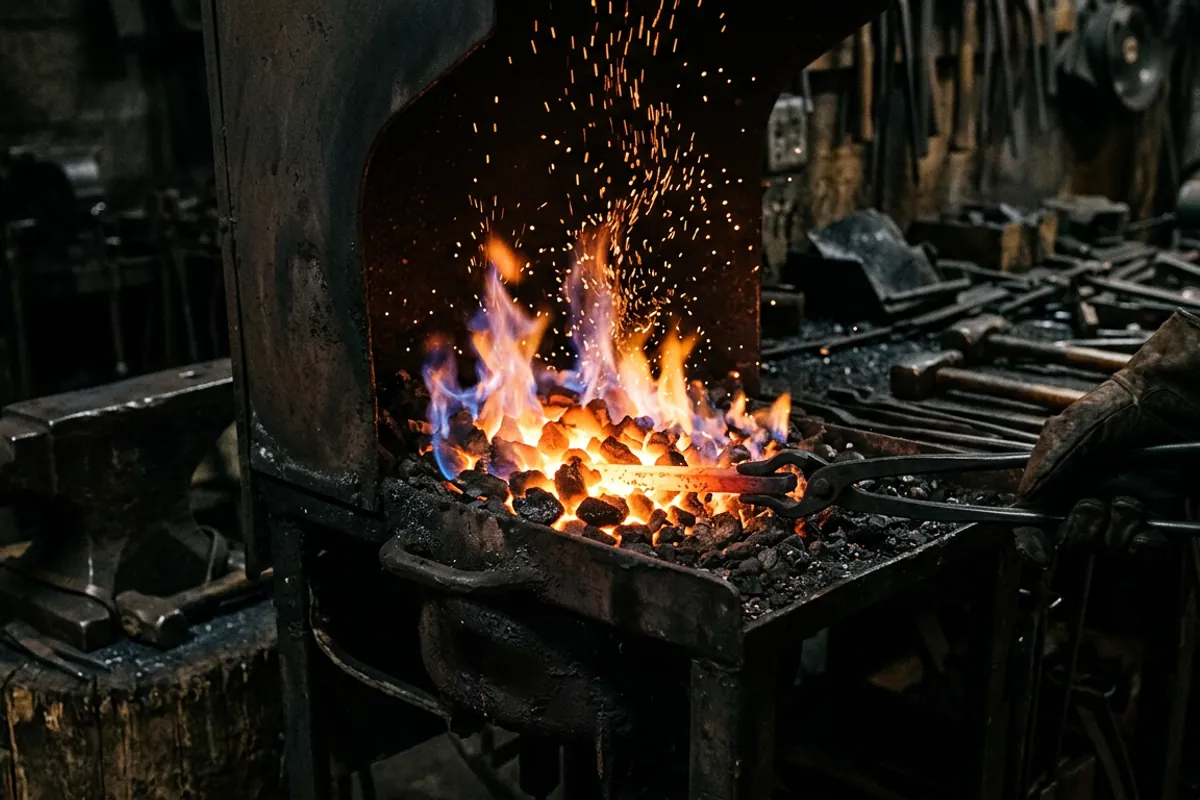
Wayland the Smith, called Volund in the Norse and Weland in the Old English, is the sharpest of them. In the story a king captures him for his skill, hamstrings him so he cannot run off, and puts him to work making treasure. Wayland takes a long, cold revenge and finally escapes by flying. There is a real neolithic burial mound in England still called Wayland's Smithy, named for him thousands of years after whatever he was. Notice the lameness again, deliberately inflicted this time, and the same idea underneath it: a smith this good is worth crippling to keep.
The Finns had Ilmarinen in the Kalevala, the smith who was said to have forged the dome of the sky itself and then the Sampo, a mysterious mill of endless fortune that drives half the epic. The Irish had Goibniu, the smith of the Tuatha De Danann, who forged weapons alongside a carpenter and a metalworker and brewed an ale that kept the gods from aging. His Welsh cousin was Gofannon.
What runs through all of them is that the smith is the maker of the thing that decides the story. The magic sword, the unbreakable armor, the mill of plenty, the sky. Nobody wrote legends about the guy who made the sword, unless the sword mattered, and then the maker got wrapped in as much myth as the blade. That is the oldest form of a famous blacksmith: not a person, but a reputation big enough to need a god-sized frame.
Tubal-Cain and the smith at the beginning
There is one more old name worth knowing because it turns up constantly in smithing circles and in the fraternal lodges that borrowed it. Tubal-Cain appears in Genesis, described as the forger of every cutting instrument of bronze and iron. He is put right at the start of the human story, a few generations in, as the first metalworker.
I bring him up not to preach but because it fits the pattern. The moment a culture starts writing down its own origins, it reaches for a smith almost immediately, because metal tools are where a lot of human capability actually begins. Whether you read that account as history, as memory, or as story, the instinct in it is the same one that produced Hephaestus and Goibniu: the person who first bent metal to a purpose deserved a name at the beginning of things. For most of the anonymous smiths who came after, that early borrowed fame was the only kind they would ever get.
The named masters who left iron behind
Now to real, documented people, because the modern era finally started keeping records, and a handful of smiths earned lasting names on the strength of what they built.
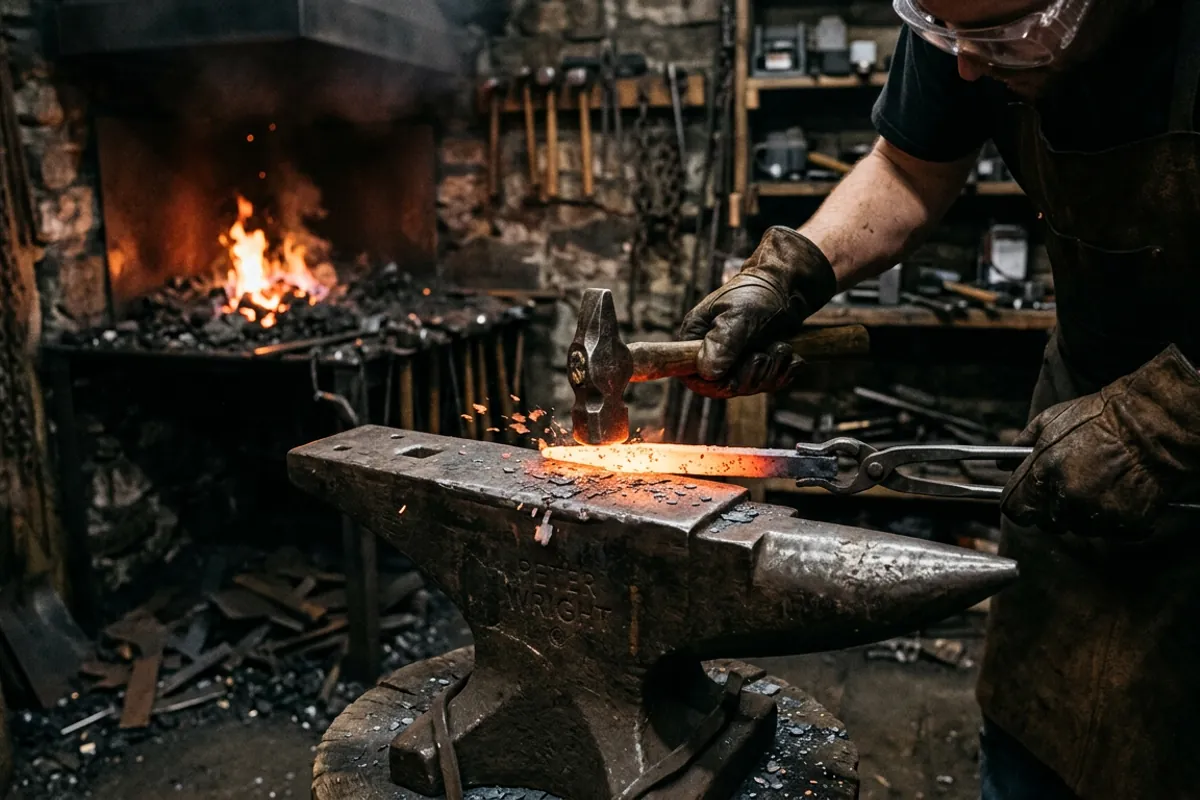
Samuel Yellin is the one I would start with. He worked in Philadelphia in the early twentieth century and became the architectural ironworker of his era, the man banks and cathedrals and universities called when they wanted gates, grilles, and railings that looked forged by hand because they were. At its height his shop employed a large crew of smiths, not a lone genius but a working operation. What I like about Yellin is that by many accounts he refused the grand titles and preferred to be called simply a metalworker. His iron is still bolted to buildings you can walk up to today, which is exactly how a smith becomes famous the honest way.
Francis Whitaker apprenticed under Yellin as a young man and carried that lineage across the whole twentieth century, living into the late 1990s. He is often called the dean of American blacksmiths, less for any single gate than for teaching. He was a driving force in the American revival of the craft and in the schools and the association that pulled hobby and artist smiths together. A lot of the reason blacksmithing did not simply die out in the industrial age is that people like Whitaker kept handing it forward.
Philip Simmons belongs right beside them. Working in Charleston, South Carolina, he spent a lifetime making ornamental wrought iron, gates and window grilles you can still find around that city, and he learned the trade from an older formerly enslaved smith. Late in his life he was recognized with a National Heritage Fellowship, among the first the country handed out, and his work reached the Smithsonian. He is proof that fame in this trade does not require art-gallery abstraction. Sometimes it is just decades of gates so good the city grew attached to them.
The living names the craft argues about
Come into the present and the picture changes, because now there are cameras and there is the internet, and fame arrives faster and gets debated harder. I do not know any of these people, so take this as the consensus you would hear if you asked around a club forge, not as anything I have tested myself.
Uri Hofi, an Israeli master smith, is a name almost every serious hobby smith runs into, mainly through the ergonomic hammering technique and hammer design tied to his name. The idea was to move the hammer in a way that spares your elbow and shoulder over a lifetime of forging, and enough smiths adopted it that "the Hofi method" became shorthand. Whether it suits your body is a personal thing, but the influence is real.
Tom Joyce is the name that gets brought up when someone insists a blacksmith can be a fine artist on the level of any sculptor. He received a MacArthur Fellowship, the grant people call the genius grant, which is not a thing that had happened to a working smith before in most people's memory. And then there is the new-media kind of fame. Alec Steele, a British smith working in the United States, has been watched by more people through a screen than any old master ever reached in a lifetime, and that has pulled a whole generation toward the anvil. Ask ten smiths what they think of any of these three and you will get an argument, which is its own kind of proof that the names landed.
What every famous blacksmith actually shares
Line them all up, the smith-gods, the legends, the documented masters, and the living names, and a couple of things run straight through.
The first is that the fame almost never came from the forging alone. It came from what the iron did next. Yellin's gates outlived him on the sides of buildings. Whitaker's students carried his name. Wayland's revenge made the story worth retelling. Nobody is famous for having good hammer control in private. They are famous because the work left the shop and did something in the world.
The second is that the ordinary smith, the one who never got a name, is the ground all of this stands on. Every legend is exaggerated from a real trade that thousands of anonymous people kept alive, and the modern masters all learned from someone who learned from someone, back and back into that anonymous crowd. When I stand at Bessie, my 148 pound Trenton, running the coal forge for heavy stock or the propane forge for the everyday work, I am doing the same motions those unnamed thousands did. That is the honest reason to care about the famous ones. They are not a separate species. They are what the ordinary trade looks like when the object survives, the teaching lands, or the camera happens to be running. If you want to wander further into the history and the odd corners of this craft, most of it lives over in more from the shop, and almost all of it traces back to the same anonymous forge fire the legends were built on.