Ask ten people to picture a medieval smith and you get ten versions of the same painting: a hooded figure beating a glowing sword flat in a stone room, sparks flying everywhere, no eye protection, an anvil that looks like it came out of a cartoon. Parts of that picture are closer to right than you would guess. Most of it is wrong in ways that matter, and the wrong parts are the ones that make people misunderstand what the job actually was. I have been at this about twenty-five years as a hobby smith. I am not a historian and I am not going to pretend to be one. What I can give you is the part a person who swings a hammer notices when they read the record: how the material behaved, why the shop was laid out the way it was, and which of those old constraints still show up in my shop on a Saturday morning.
If you want the broader picture of the trade and its place in a village, I wrote that up separately in medieval blacksmith. This one is about the work itself.
What people mean when they say medieval smith
The medieval period in Europe covers roughly a thousand years, from about 500 to about 1500. That is an absurd span to lump under one job title. A smith working a bloomery-fed shop in the ninth century and a guild armourer in a fifteenth century city had about as much in common as a farrier and a machinist do now. They both hit hot iron. That is most of the overlap.
"Smith" is also broader than "blacksmith." Blacksmiths worked the black metal, iron and steel, and did the hot forging. Whitesmiths did the cold finishing work, filing and polishing and light assembly. Then the trade splits again in the towns: cutlers, bladesmiths, locksmiths, armourers, farriers, nailers, lorimers who made bits and spurs, and plain village smiths who did whatever came through the door. In a city with a guild structure, which took hold across much of Europe from around the twelfth century onward, those were separate trades with separate apprenticeships and separate rules about who could sell what. In a village, one shop did all of it badly enough to get by and well enough to keep the plows running.
So when somebody says medieval smith, ask what century and what town. The answer changes the shop.
The iron they had to work with
This is the single biggest difference between then and now, and everything else follows from it.
For most of the medieval period, iron came out of a bloomery. A bloomery does not melt iron. It reduces iron ore in a charcoal fire at temperatures below iron's melting point, and what you pull out is a bloom: a hot, spongy mass of iron mixed through with slag. The smith consolidates that bloom under the hammer, driving out slag, folding and welding it back on itself until it becomes usable bar. That consolidation work was not artistry. It was the price of admission.
The result is wrought iron: low in carbon, threaded with slag stringers that give it a visible grain like wood. It forge welds beautifully, which is why medieval work is full of welded joints where we would use a bolt or a fillet weld. It also tears along the grain if you work it wrong, and its carbon content varies from one part of a bloom to another, so a smith could not assume that two bars from the same batch would harden the same way.
Steel, meaning iron with enough carbon to harden, was the expensive part. Some came out of the bloom already carburized by luck of the fire. Some was made deliberately by packing iron in charcoal and holding it hot for hours, letting carbon migrate in from the surface. That process is slow and it only gives you a shallow case, which is exactly why so much medieval toolwork is an iron body with a steel edge forge welded onto it. An axe, a chisel, a plow share: iron for the bulk, a strip of hard steel where it cuts. That was not decoration. Steel was too dear to waste on the parts that only need to hold shape.
Pattern welding, the twisted and stacked bar construction you see in early medieval sword blades, belongs mostly to the earlier end of the period and thins out later as more consistent steel became available. It gets talked about as a mystical technique. It is better understood as a working answer to inconsistent material, with a decorative payoff the smiths clearly enjoyed. If you want to go deeper into what those old blades actually tested at, that is a question for archaeometallurgy papers and for people who do real testing. On the modern side, Knife Steel Nerds is where I send anybody who wants hardness and toughness numbers instead of opinions.
Fire, fuel, and air
Charcoal was the fuel for most of the period. It burns clean, it carries almost no sulfur, and it is light and fast. It is also enormously bulky and it eats through a fire faster than mineral coal does, so a medieval shop went through it in volume and somebody upstream spent their life burning wood into charcoal to supply it.
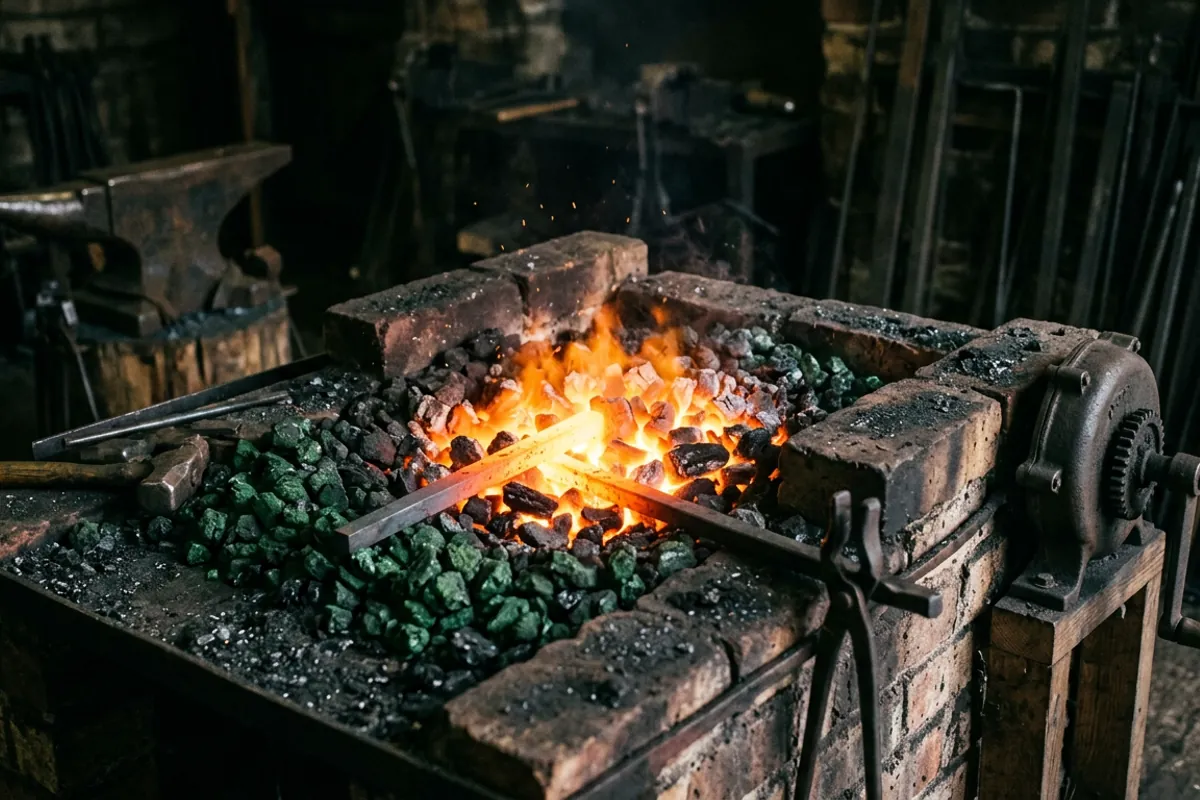
Mineral coal came into use in some regions later in the period, and it brought a problem with it: sulfur. Sulfur in the fire gets into hot iron and makes it hot short, meaning it crumbles and tears at forging heat instead of moving. Coking, which drives the sulfur off before the fuel ever reaches the work, came along after the medieval period. Smiths in coal country before then learned to bank the fire, keep the work out of the raw green coal, and burn the coal down to coke in the fire itself. That is still how a coal fire is run. Every time I bank green coal around the edges of my fire and pull coked fuel into the middle, I am doing a medieval smith's chore for a medieval reason.
Air came from bellows, worked by hand or by an apprentice or, in the later centuries, by a water wheel. Water power is the quiet revolution of the period. Water-driven bellows meant hotter, steadier fires and bigger blooms. Water-driven trip hammers meant a smith could consolidate a bloom or draw heavy bar without three strong people on sledges. That is a productivity jump on the same scale as the difference between a hand-cranked blower and a modern gas forge.
I run both fuels now, coal for heavy stock and forge welding and propane for most days, and the tradeoffs have barely changed in character. I laid out how I think about it in coal or propane.
One thing that has not changed at all: solid fuel makes carbon monoxide, and carbon monoxide kills people who cannot smell it. Medieval smithies were open-sided, half-roofed, drafty buildings. That was not charm. That was ventilation. If you are running charcoal or coal in a closed garage because it looks right, you are copying the wrong part of the picture.
The anvil under the hammer
Here is where the cartoon really breaks down. The anvil most of us own, a long body with a conical horn on one end, a flat face, a square hardy hole and a round pritchel hole, is a comparatively modern arrangement. That London pattern layout settles into its familiar form around the nineteenth century. It is a fantastic general purpose tool and it is not what a smith in 1200 was standing over.
Medieval anvils, judging by what survives and by manuscript illustration, ran a lot smaller and a lot blockier. Many were essentially a squared block of iron with a hardened face, sometimes with a spike underneath so it could be driven into a stump or a heavy timber. Horns show up in later medieval depictions. The two-hole face does not, in the form we use it. Portable smiths and traveling repair men worked off anvils small enough to carry, and one of the best glimpses we have of an early kit is the tool chest pulled out of a bog at Mastermyr on Gotland, a Viking Age find that includes hammers, tongs, files, punches and small anvils together in one box.
Small anvils work because mass is only one part of the equation. What matters is how much of your hammer blow comes back into the work instead of going into the floor. A modest anvil bedded solidly on a heavy stump, sitting on packed dirt, returns a startling amount. Bessie, my 148 pound Trenton, is bigger than a lot of what those smiths used, and she is not a big anvil by modern hobby standards. That should tell you something about how much anvil a person actually needs, which is a subject I get asked about constantly and wrote out in what size anvil do you actually need.
The rest of the kit
Strip away the horn and the pritchel hole and the medieval smith's toolset is startlingly familiar. Hammers of a few weights. Tongs, many pairs, most of them made in-house to fit one particular job or one particular stock size. Punches and drifts. Chisels, hot and cold. Swages and fullers. Files, which were expensive and were treated accordingly. A hardy or a set of stakes for cutting and forming. A trough of water at the side.
The tongs point at something worth understanding. A medieval shop made its own tooling as a matter of course, because tools were a thing you forged on a slow afternoon rather than a thing you bought. That habit is worth stealing. The fastest way to get better at forging is to make your own tongs, punches and hold-downs, because those jobs teach drawing out, punching, riveting and fitting all at once, and if the result is ugly you are the only customer.
Heat treatment was color work. Judge the forging heat by the color of the steel in a dim shop, quench, then temper by watching the oxide colors run across polished steel and stopping them where you want. It is the same physics we use. What the old smith did not have was a way to know what alloy was in his hand, and that uncertainty is the reason so much traditional heat treat advice is written as ritual. When the material varies, the procedure that worked last time gets repeated exactly, and eventually somebody writes it down as law.
The dimness is not a stylistic choice either. You cannot read steel color in bright light. My coal forge lives in the darkest corner of my shop for exactly the reason a medieval smithy had small windows. If you are laying out a shop, that is one of the genuinely old lessons worth applying, and I go through the rest of it in blacksmith shops, explained from the floor of one.
What the work actually was
Almost none of it was swords.
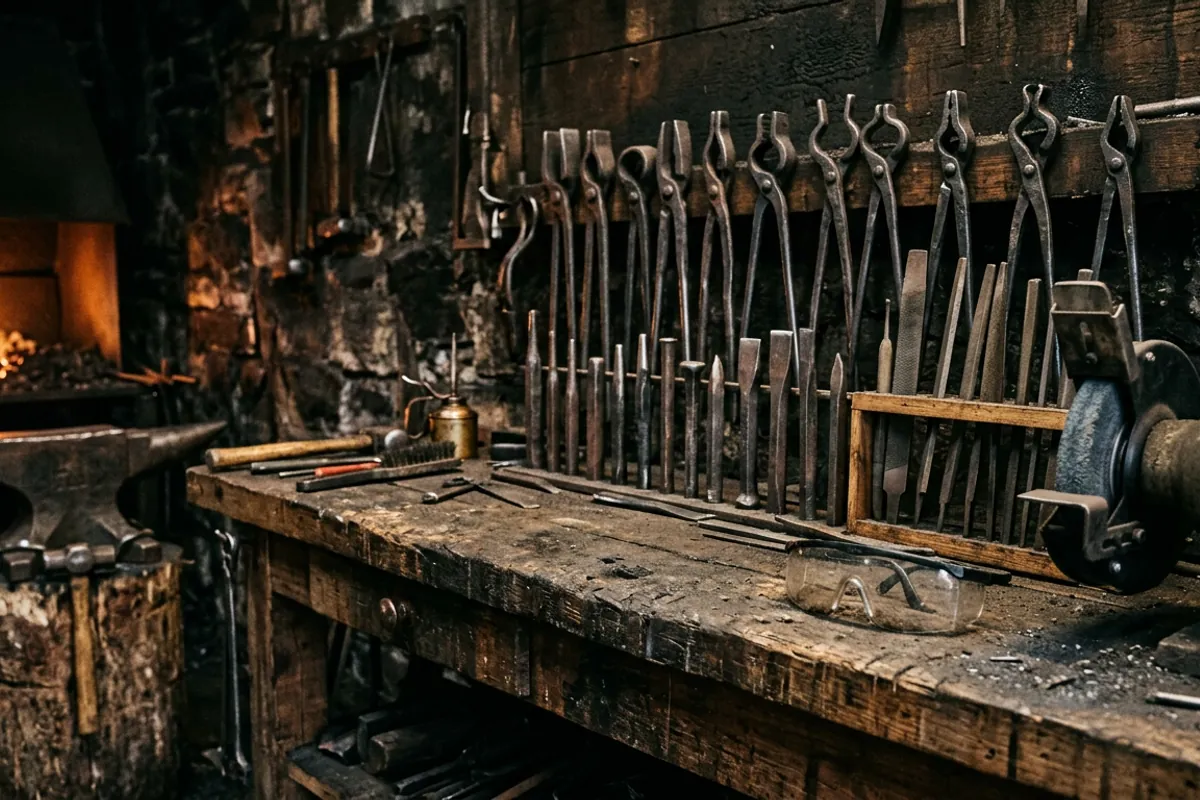
The bread and butter of a village smith was agricultural and architectural iron and, above all, repair. Plow parts, harrow teeth, sickles and scythes, chains, hooks, hinges, straps, latches, hasps, cauldron bails, cart fittings, horseshoes and the nails to hold them. Nails alone were an entire trade in some places, made by the thousand from drawn rod. When the iron in a tool wore out or broke, it came back to the shop to be welded, upset, redrawn and put back into service, because material was expensive relative to labor in a way that is hard for us to feel now. We throw away steel that a medieval shop would have reforged three times.
The specialists in the towns are where the glamorous work sits. Armourers raising helmet bowls and dishing breastplates, bladesmiths grinding and hardening, locksmiths building wards and springs. That work is genuinely extraordinary, and the surviving pieces will humble anybody who has tried to raise a bowl from flat sheet. But a smith who made only swords would have starved in most of Europe for most of the period. The trade was, overwhelmingly, keeping ordinary iron things working.
What still applies in a home shop
Strip out the material science and a surprising amount carries over intact.
Fire management is still the skill that separates people who make things from people who burn things. A deep, clean, reducing fire and patience about heats will do more for your work than any tool purchase. Working hot and letting the steel move, rather than beating on cooling stock, is the same lesson it always was. Making your own tooling still teaches faster than buying it. Bedding your anvil solidly still matters more than buying a heavier one, and if you are shopping, the honest walkthrough is in how to buy an anvil without wasting your money.
What does not carry over is material assumption. Medieval technique developed around wrought iron and shallow-cased steel. Modern mild steel is a different animal, and modern alloy steels are a different animal again, with heat treat specs that are published and testable. When somebody tells you a traditional method beats a measured one, ask what was measured. The old smiths were extremely good at getting results out of unpredictable material. They were not working from data they did not have.
Where the romance gets people hurt
I will say this part flatly, because it is the reason I bother writing about history at all.
People see the old pictures and conclude that the safety equipment is optional or somehow inauthentic. It is not. Medieval smiths lost eyes, lost hearing, breathed smoke for forty years and paid for it. Their working lives were often short and frequently damaged. Copying their protective gear is copying their injuries.
Wear eye protection rated to ANSI Z87.1, and wear it for grinding and wire brushing as much as for forging, because the grinder is what actually blinds people. Wear natural fibers. Cotton or wool or leather chars; synthetics melt onto skin and keep burning. I learned that lesson the hard way early on, quenching a blade in oil that was too cold while standing too close in a cotton shirt with no face shield. The oil flared, took my eyebrows, and I kept my eyesight by luck rather than sense. Nothing about that was traditional. It was just stupid, and I got away with it.
Ventilate. Solid fuel makes carbon monoxide and hot galvanized coating makes zinc fumes, neither of which announces itself in time. Know what your scrap is before it goes in the fire. The medieval smithy was open to the weather for a reason.
The rest of what I actually wear and what I think is a waste of money is in blacksmith safety gear.
Reading it honestly
The single most useful shift, if you want to understand the medieval smith rather than the picture of him, is to stop thinking of him as an artisan and start thinking of him as infrastructure. He was the reason the plow ran and the door shut and the horse stayed shod. The technique was in service of that, not the other way around.
That is also the most useful way to think about your own shop. The historical stuff is fascinating and I read plenty of it, but the tools on my wall exist because they solve problems. Every one of them has a medieval ancestor that existed for the same reason. If you want more of this kind of thing, the rest sits under More from the shop, and the practical gear writing is all in All guides.