Half of what stops a new smith is not the hammer, it is the language. You watch somebody say he upset the end, cut a scarf, took a welding heat and drifted the eye, and you cannot tell whether that was four operations or one. The blacksmithing terms are not hard on their own. There are just a lot of them, and most are old words that nobody bothered to modernize. This is the blacksmith glossary I wish somebody had handed me about twenty-five years ago, when I was still beating on a length of railroad track clamped to a stump and guessing what half the forum posts meant.
One line per term, grouped by where you will actually run into it. Where AnvilTalk has a full article on a term, the term links to it, because a glossary line tells you what a word means and an article tells you what to buy or how to do it. Where I am handing you a published definition, I say whose it is. Where no published definition was worth quoting, I say the word as smiths use it, and you should read that as shop usage rather than gospel.
Where these definitions come from
Most of the sourced lines below come from three places. The anvilfire glossary is the old reference standard for anvil and process words, and it is blunt in a way I like. ABANA's Controlled Hand Forging series is a teaching curriculum, so its definitions are written for somebody standing at an anvil rather than for a dictionary. Merriam-Webster is useful for a handful of words that made it into general English, and it carries first known use dates that are worth knowing. For the historical trade language I used Kauffman's Metalworking Trades in Early America, 1995, in the excerpt Penn State hosts. The cast iron carbon figure comes from the University of Cambridge materials group, with a supporting note from the Metal Casting Institute.
What I will not do here is invent an etymology or a number. If a word has a murky origin, I say so. And for anything that turns into real metallurgy, alloy behavior, hardness, edge retention, I send you to actual testing. Knife Steel Nerds is the place I point people, and no glossary line replaces it.
Anvil parts and the words for them
- Face. The word as smiths use it: the flat working top of the anvil, the surface you do most forging on. ABANA's series notes that the horn, unlike the face, is of a soft material, which tells you where the hardness is supposed to be.
- Horn. ABANA's series says the horn should be free of dents, nicks, and chips, and that it is soft compared to the face. It is for bending and drawing curves, not for taking full hammer blows against a hard tool.
- Bick. anvilfire traces it from beak, or bick and iron, or beak iron, and defines it as a slender stake anvil, or a single or double horned tool made to fit an anvil. ABANA's series also uses bick as another name for the anvil's horn, so you will hear both.
- Step and cutting table. anvilfire lists the step and cutting table together as one feature of the English and American pattern, and ABANA's series calls the table the surface between the horn and the face. I treat them as the same spot because both sources put them there. It is softer than the face, and it is where you cut so you do not chisel into your own hardened surface.
- Heel. The word as smiths use it: the end of the anvil opposite the horn, past the hardy hole. It is the springiest part of the body, which is why heavy work belongs over the waist.
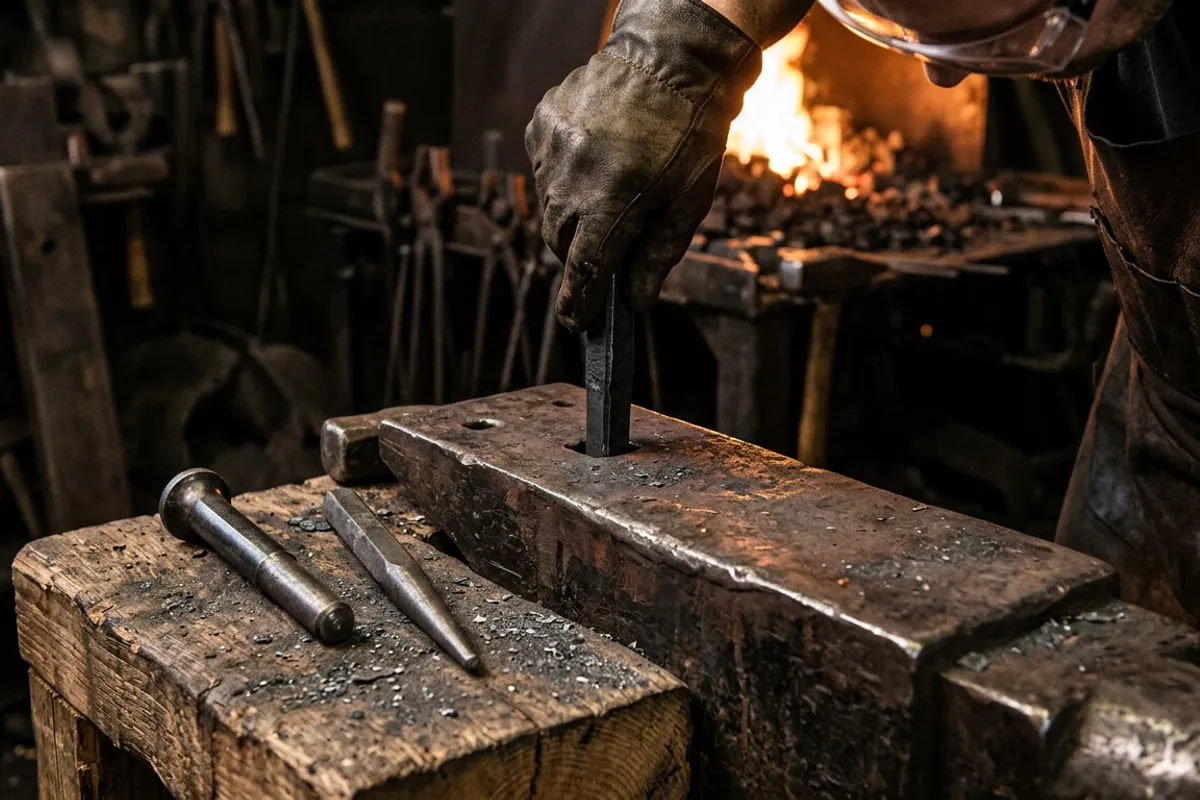
- Hardy hole. The square hole through the anvil. anvilfire points out that the hole is named after the tool, and that other tools which fit the hole are mistakenly called hardy, or hardie, tools.
- Pritchel hole. anvilfire calls it the small round hole in London and American pattern anvils, used for the farrier's punching operation, and notes that many farriers' anvils had two of them. That entry spells it pritchell.
- Pritchel. The tool, not the hole. anvilfire: the slender rectangular punch used by farriers to hot punch the nail hole in a horseshoe.
- ASO. anvilfire's acronym for Anvil Shaped Object, a junk anvil made of weak brittle cast iron or un heat treated material. If somebody in a forum thread calls a listing an ASO, that is what they mean, and they are usually right.
- Rebound. anvilfire describes rebound as a test of the face hardness, and says that on a really hard anvil the ball will bounce about 75 to 90 percent of the distance dropped. ABANA's series puts it in shop language: the hammer should seem to leap off the anvil when bounced on the face. It is the single most useful thing you can do to a used anvil before money changes hands.
The tools that live in the anvil
This is where the blacksmithing terminology gets tangled, because one word covers a tool, a hole, and a whole family of accessories.
- Hardy. So, what is a hardy? anvilfire defines it as a short square shanked chisel that fits in the square hardy hole of an anvil, and says hardy is an old English term of uncertain origin. Strictly, the hardy is the cutter. Everything else with a square shank is a hardie tool, and anvilfire says calling those hardies is a mistake that stuck.
- Hot cut hardy. ABANA's series gives it a cutting edge of about 25 to 30 degrees, because hot steel parts easily and a thin edge does the work.
- Cold cut hardy. ABANA's series gives it a cutting edge of about 60 degrees. The blunter angle is what keeps the edge alive against cold stock.
- Bottom tool. The word as smiths use it: anything that sits in the hardy hole and takes the blow from underneath while the hammer or a top tool works the other side.
- Swage. Merriam-Webster defines it as a tool used by metalworkers for shaping their work by holding it on the work or the work on it and striking with a hammer or sledge, first known use circa 1812, from Middle French souage, meaning an ornamental border. That definition is worth reading twice, because it covers both the top swage and the bottom swage in one sentence.
- Swage block. The word as smiths use it: a heavy block, usually cast, with shaped depressions around the edges and holes through the middle, used as a bottom tool for forming.
- Fuller. Merriam-Webster has it as a blacksmithing hammer for grooving and spreading iron, first known use 1587. Today most shops use the word for a matched pair, top and bottom, but the dictionary sense is the hammer.
- Flatter. The word as smiths use it: a top tool with a broad flat face, struck with a sledge or a heavy hammer to smooth a surface that your hammer has left uneven.
- Set hammer. The word as smiths use it: a small square faced top tool used to set a shoulder or a corner cleanly, where a hammer face would round it over.
- Drift. Merriam-Webster's noun sense is something, such as a tool, driven down upon or forced into a body. In common shop usage, and I am labeling it as usage, a drift is a tapered tool driven through a punched hole to size and shape it. ABANA's series forges a square punch and square drift used to produce a 3/8 inch square hole, and a round drift alongside it. An axe eye drift is the same idea in a much bigger, fussier shape.
- Hot punching. ABANA's series defines it as creating holes or recesses in bars or plate by driving punches into or through hot material. Note the word hot. Punching cold is how you split a punch.
- Punch steel. The word as smiths use it: the bar you make punches and hot cuts from, which is a real decision rather than scrap roulette. S7 is the one I keep on the rack for it.
- Peen. anvilfire defines it as the rounded small end of a hammer opposite the face, which may be round, a ball peen, or a straight wedge shape, and states that the current accepted spelling is peen. You will still see pein and pane in old books.
What the fire is called
- Coal. anvilfire: an organic mineral product resulting from the accumulation of organic material in peat bogs millions of years ago. What matters at the forge is what burns out of it.
- Coke. ABANA's series calls it soft coal that has had the bulk of its impurities burned out, and describes its appearance as puffy. In a coal fire you are making coke at the edges and burning it in the middle.
- Clinker. ABANA's series: the hard, gritty, often glassy mass that congeals in the bottom of the fire-pit. Merriam-Webster's matching sense is stony matter fused together. It smothers your air and it will ruin a weld heat if you leave it sitting there.
- Firepot. ABANA's guidance for a coal forge is a fire pot at least three to four inches deep, with a device to break the clinker as well as an ash dump. If you are building or buying, that line is a specification, not a suggestion.
- Tuyere. anvilfire calls it the nozzle end of a pipe or tube that blows air onto a forge or furnace fire. Merriam-Webster has it as a nozzle through which an air blast is delivered to a forge or blast furnace, first known use 1781, from French tuyere, from tuyau, meaning pipe. Pronounce it however your club does, everyone spells it wrong anyway.
- Scale. anvilfire describes it as the dark blue black grey oxide that forms on the surface of iron, steel or stainless when heated to forging temperatures, and says it is essentially magnetic oxide of iron, Fe3O4. ABANA's series is blunter about the consequence: the gray scale that forms on a bar when heated is the enemy of the forge weld.
- Heat. The word as smiths use it, as a noun: one trip from the fire to the anvil and back. Smiths count work in heats, as in three heats to draw that taper. Color judgment belongs in its own article, not in a glossary line.
The verbs for moving metal
- Drawing out. ABANA's series says drawing, drawing out, or drawing down means to reduce the cross sectional area of a bar. Kauffman describes the same operation from the other end, increasing its length, or width, by using a cross-pein hammer, at the same time decreasing its other dimension. Nothing is added, it is moved.
- Upset. Here is what does upset mean in blacksmithing, from three directions. anvilfire: in forging, to increase section and reduce length by hammering or pressing on the end of a bar. ABANA's series: upsetting increases the cross sectional area by deforming existing material instead of adding material. Merriam-Webster's forging sense, first known use 1677, is to thicken and shorten something, such as a heated bar of iron, by hammering on the end. Kauffman sums it up in five words, upsetting was the opposite of drawing out.
- Shoulder. ABANA's series: an abrupt change in width and/or thickness of a bar, normally made by decreasing one dimension by drawing down, although it may be formed by upsetting.
- Faggot weld. The word as smiths use it: folding a bar back on itself and welding it to itself. Usage varies by shop and by century, so ask what somebody means before you copy their process.
- Jump weld. The word as smiths use it: welding the end of one bar onto the side or face of another, making a T rather than a lap.
- Sweat weld. The word as smiths use it, and used loosely: bringing two mating surfaces to heat with flux and joining them face to face under light pressure instead of drawing the joint out.
Forge welding words
Forge welding has its own dialect, and it is the one place where getting a word wrong costs you real material. If you want the process rather than the vocabulary, how to forge weld is the walkthrough.
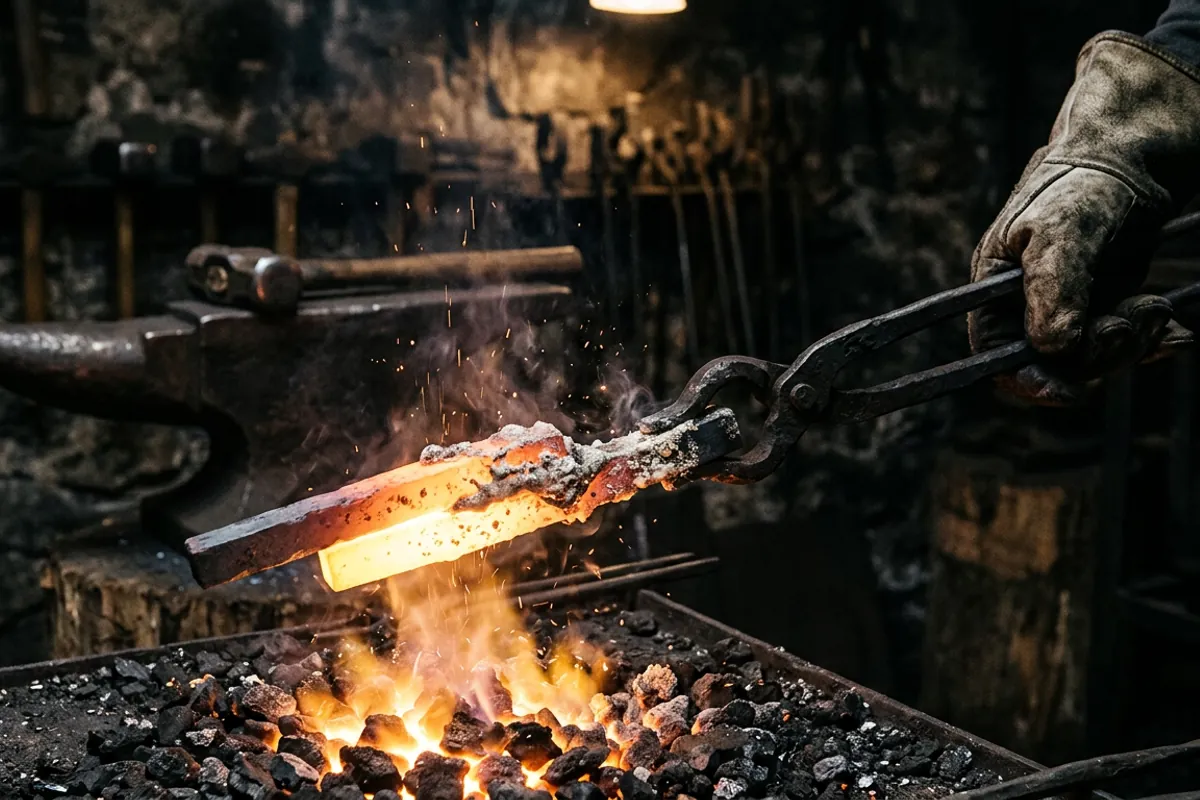
- Forge weld. ABANA's series: fusing two or more bars together by bringing them to a high heat in a forge, and applying pressure to the area being fused by hammer blows.
- Flux. anvilfire calls it a chemical that dissolves metal oxides for the joining of the metals by soldering, brazing or welding. ABANA's series says it reduces oxidation and lowers the melting temperature of the scale, then adds the sentence every beginner needs tattooed somewhere, flux is not glue, or a bonding agent.
- Borax. anvilfire lists it as sodium tetraborate, used as a flux for brazing and welding, and used as forge welding flux by blacksmiths. It is the common shop flux for a reason; see forge welding flux.
- Scarf. anvilfire: a scarf for forge welding is generally an upset and two tapered ends that overlap at the joint, and the upset is there to provide extra metal for finishing to shape so that the joint is not smaller than the surrounding metal. ABANA's series describes it as preparing a portion, often the end of a bar, by tapering to a thin edge which can be blended into the mating material. Kauffman's version is the plainest, scarfing means tapering the ends or edges of parts before welding.
- Welding heat. ABANA's series says the color of the bars should be yellow to yellow/white when removed from the fire. Kauffman records three older names for the range, snowball heat, which refers to white heat and is used to weld iron, full-welding heat, not quite as hot as snowball, and low or light-welding heat.
Two safety notes I will not soften, because forge welding is where beginners get burned. Flux at welding heat throws sparks and molten borax that stick to whatever they land on, so eye protection rated ANSI Z87.1 goes on before the bar comes out, and natural fibers go on your body instead of synthetics that melt into skin. And do not lean over the anvil at the moment of the first blow.
Heat treat words
- Anneal. anvilfire's entry says ferrous metals are annealed by heating to just above nonmagnetic or the A3 point, then cooled slowly, to modify the crystal structure. Merriam-Webster's general sense, first known use 1664, is to heat and then cool a material, such as steel or glass, usually for softening and making less brittle, and the word traces back to an Old English verb meaning to set on fire.
- Normalize. anvilfire: slow cooling in air after forging while still at a red heat, which gives stresses time to relax but is not the equivalent of annealing. ABANA's series describes normalized as air cooled until room temperature from a red heat. Those two words get swapped constantly and they are not the same operation.
- Nonmagnetic. The word as smiths use it: the point at which a magnet stops sticking to heated steel, which is why a cheap magnet lives near my forge. What the magnet test does and does not tell you is a whole article.
- Quenchant. anvilfire: liquid or gas used to cool a metal in heat treating, and it lists water, brine, oil and air as common ones. Quench is the verb for using one.
- Temper. anvilfire defines tempering as the reheating of steel to some temperature below the hardening temperature after hardening, in order to reduce the brittleness, which also reduces the hardness. It gives the tempering range for steel as from 350°F (177°C) to as high as 1350°F (732°C). If you want the operation rather than the definition, see tempering by heating and cooling.
- Temper color. anvilfire: colors produced by the oxidation of clean steel, used to indicate temperatures during the tempering process, with the warning that standard temper color charts are only applicable to plain carbon steel. I am not printing a color chart here, and if you are working an alloy steel, get the numbers from real testing rather than from a color.
The metal on the rack
- Mild steel. anvilfire's line is specific, mild steel contains 0.18 to 0.20% carbon. That is why it will not harden in a quench no matter how much you want it to.
- High carbon steel. The word as smiths use it: bar with enough carbon to harden in a quench, which is what you want for edges, punches and springs. The actual behavior of any given alloy is a testing question, not a vocabulary question.
- Wrought iron. anvilfire: pure iron crystals with thin layers of siliceous slag, resulting in graininess similar to wood, and the lack of carbon makes wrought iron unhardenable but very ductile. If somebody sells you a wrought iron gate made last year, they mean the style, not the metal.
- Cast iron. The University of Cambridge materials group states that cast irons typically contain 2 to 4 wt% of carbon, and the Metal Casting Institute notes that the carbon content in gray iron is about ten times higher than common steel. That carbon is exactly why a cast iron anvil is an ASO.
- Mystery steel. The word as smiths use it: unknown scrap of unknown alloy, usually free, usually more expensive than it looks once you count the ruined heat treat.
The terms I would learn first
If you only take ten words off this page, take these: face, horn, hardy hole, pritchel hole, scale, heat, draw, upset, scarf, quench. Those ten cover most of what gets said around a beginner class in a weekend, and everything else in this blacksmith glossary attaches to them. The rest of the blacksmithing terms arrive on their own schedule, usually the first time you need one.
Two habits make the vocabulary stick faster than reading does. First, say the word out loud while you do the operation, because upsetting is an abstraction until you have watched a bar get shorter and fatter under your own hammer. Second, when somebody uses a term you do not know, ask right then. Nobody at a club forge has ever thought less of a beginner for asking what a scarf is. They have thought plenty about the beginner who nodded, guessed, and wrecked the stock.
I keep this page updated as terms come up in the workshops I teach, so if you hit a word that is not here, it is a gap on my end rather than a word you should already know. If you are still building the shop around the vocabulary, start at the getting started hub, because knowing what a hardy is matters a lot less than owning an anvil with a face worth hitting.