The colonial blacksmith is one of those figures everybody thinks they know and almost nobody has right. You picture a bearded man in a leather apron hammering a horseshoe by a roaring fire, and you are not wrong exactly, but you are missing about ninety percent of what the job actually was. I have been at a forge for about twenty-five years, self-taught off a length of railroad track before I ever owned a real anvil, and the deeper I got into the craft the more I came to respect what those early American smiths pulled off with a fraction of the tools I take for granted. So this is a plain, owner-to-owner look at what a colonial blacksmith really did, what he worked with, and why so much of what he knew still matters at my forge today.
I want to be straight with you up front: I am a hobby smith, not a historian, and I did not live in 1750. What I can do is read the work through the tools, because the tools do not lie. When you have spent years drawing out tapers and punching holes and forge welding by eye, you can look at surviving colonial ironwork and understand the sequence of hammer blows that made it. That is the lens I am using here. Where I am passing along the consensus of historians and living-history smiths rather than something I know from my own floor, I will say so.
What a colonial blacksmith actually was
Start with the word "colonial." We are talking roughly the 1600s through the late 1700s in the American colonies, before industry and interchangeable parts changed everything. In that world the blacksmith was not a specialist doing one thing. He was closer to the town's hardware store, repair shop, and manufacturing plant rolled into one man and maybe an apprentice or two. If it was made of iron and somebody in the settlement needed it, the smith either made it or fixed it.
That is the first thing people get wrong. The Hollywood smith bangs out swords and horseshoes. The real colonial smith spent most of his days on nails, hinges, latches, hooks, chain links, hoes, axes, froes, cooking cranes, pot hooks, wagon fittings, plow points, and a thousand other unglamorous items that a growing settlement burned through. He shod horses and oxen, yes, but farriery was one line of a long ledger, not the whole trade. In a lot of places the blacksmith and the farrier were the same person simply because there was nobody else to do it.
He also was not necessarily making steel tools the way you might assume. Good steel was expensive and hard to come by in the colonies. Most of what the smith worked was wrought iron, which is a different animal from the mild steel bar I buy today, and I will come back to that because it changes everything about how the work felt in the hand.
Iron and steel in a world before the steel mill
This is the part that reframed the whole trade for me once I understood it. Modern smiths reach for a rack of mild steel and a bin of known alloy stock. The colonial smith did not have that. His everyday material was wrought iron: iron with a low carbon content shot through with fibrous strands of glassy slag. It forges beautifully, welds like it wants to, and resists rust better than mild steel, but it is fibrous and it splits along the grain if you abuse it. Every colonial smith learned to read that grain the way I read a heat.
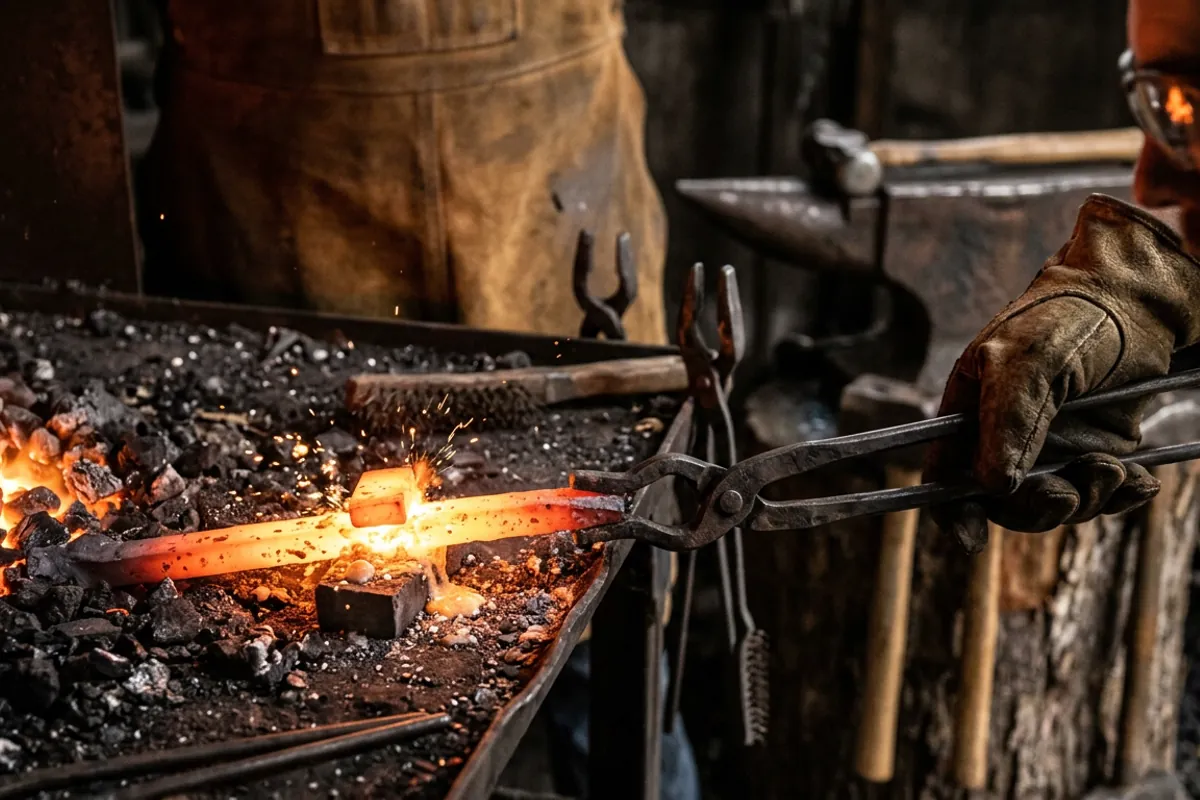
Steel, the stuff that will actually harden and hold an edge, was scarce and precious. It came from Europe in limited quantities, and the smith treated it accordingly. When he made an axe or a chisel or a knife, he did not make the whole tool out of steel. He forge welded a small bit of steel onto a wrought iron body, so the cutting edge was hard where it mattered and the tough iron carried the rest. That steeling of edges was a core skill, and it is a genuinely hard forge weld to pull off clean. I have done plenty of forge welding on my coal forge over the years, and joining two different materials with different working temperatures is fussy work even now with good flux and a controllable fire.
Because steel was so dear, heat treating it correctly was not optional, it was the difference between a tool that worked and wasted material you could not replace. The smith hardened by quenching and tempered by watching the oxide colors run across polished steel, straw to blue, exactly the way I still do it. If you want the real metallurgy behind why that works, the color-to-temperature relationship and what is happening in the steel, that is a question for real testing rather than tradition, and folks like Knife Steel Nerds have done the actual science on it. I lean on their published work rather than repeating shop lore as fact. I have written up how I approach the process at my own forge in my pieces on tempering of metal and what annealing steel actually does, and the fundamentals have not changed in two hundred and fifty years.
The colonial shop and its tools
If you walked into a colonial smithy you would recognize most of it instantly, and that is the thing that gets me every time. The core kit has barely changed. There was a forge, and in that era it was a coal or charcoal fire in a masonry or brick hearth with a great leather bellows worked by hand or by an apprentice to force air through the fuel. There was an anvil, mounted on a section of tree trunk set into the dirt floor to soak up the blow. There were hammers, tongs, punches, chisels, swages, and a hardy. There was a slack tub of water at hand for quenching and cooling.
The forge fuel matters. Early on a lot of shops burned charcoal, because that is what was available before coal supply chains developed, and charcoal forging has its own rhythm. I have run charcoal fires and I will tell you they are hungry and they burn clean but you go through fuel fast. As coal became available it took over for a lot of work because it lasts longer and gets hotter for welding. If you want to understand the tradeoff between fuels the way a colonial smith would have felt it, I laid it all out in coal or propane, which first forge makes sense, and while propane obviously was not a colonial option, the coal-versus-charcoal logic in there is the same conversation those smiths were having.
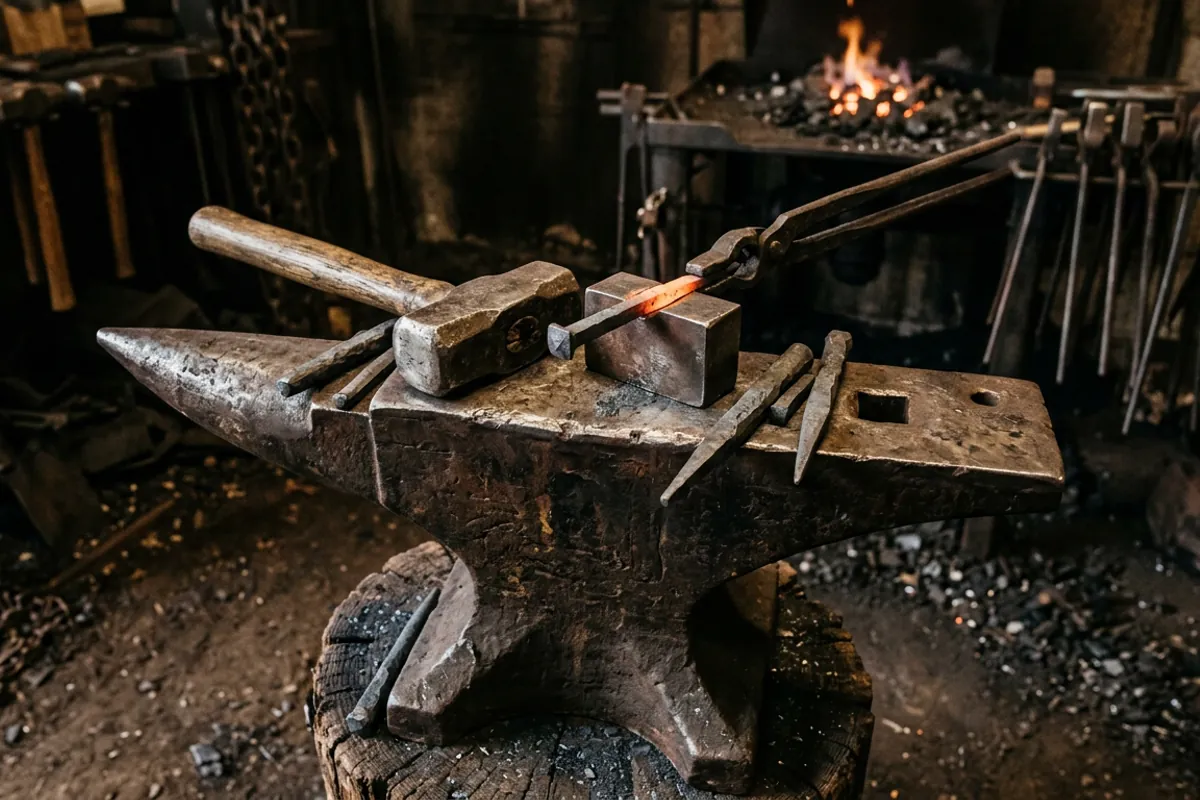
The anvil is where I feel the most kinship. A colonial anvil had a horn for bending curves, a flat face for drawing and flattening, a hardy hole to hold cutoff tools and bending forks, and often a pritchel hole for punching. My Bessie, a 148 lb Trenton, has exactly those features, and if I set her next to a good eighteenth century anvil the family resemblance is obvious. The London pattern anvil most of us use took its recognizable shape in that broad era. The big difference is that a colonial smith's anvil was a serious investment, often imported, and a smith might work his whole career on one anvil the way I expect to work mine on Bessie for the rest of mine. If you want the long version of what all those features do and why anvil weight matters, I covered it in what size anvil do you actually need.
The one tool nearly every colonial smith made a lot of, and the one that tells you the most about the era, is the nail. Before machine-cut nails, every nail was forged one at a time by hand from nail rod, tapered on four sides and headed over a nail header. It was tedious, repetitive work, and it was often the job handed to apprentices and to the smith on slow days as a way to keep hands busy and stock turning into money. When you hear that old houses were sometimes burned down just to recover the nails, that is not a myth, it is a measure of how much hand labor sat in every single fastener.
The daily rhythm of the work
The romantic picture is a smith making one beautiful thing. The real rhythm was closer to a busy repair counter. A farmer came in with a broken hoe, somebody needed a wagon tire reset, a horse threw a shoe, the tavern wanted a new set of pot hooks, and in between all of that the smith forged nails and stockpiled hinges and latches so he had inventory to sell. He worked long days by the light of the fire, and he did it standing over heat in wool and leather because natural fibers do not melt onto your skin the way synthetics do. That last point is not a costume detail, it is safety, and it is exactly why I still wear cotton and leather at my forge and keep synthetics far away from the fire.
He also repaired far more than he built new, because iron was valuable and nothing got thrown away. A worn tool got re-steeled. A broken link got forge welded back together. A bent share got straightened and re-hardened. This repair-first mindset is worth carrying into a modern shop, honestly. A lot of what I teach weekend beginners is really about not wasting material, and the colonial smith was the original expert at that out of pure necessity.
If you want a broader sense of how a working shop is laid out and why, past the colonial framing, I wrote about that in blacksmith shops, explained from the floor of one, and a lot of the logic of tool placement and fire management traces straight back to these early shops.
The smith's place in the community
The colonial blacksmith held a spot in town life that is hard to picture now because no single trade covers that much ground anymore. He was infrastructure. A settlement could not really grow without one, because you needed iron tools to clear land and farm it, iron fittings to build with, and iron hardware to keep wagons and mills and doors working. The smith often knew everyone, because everyone eventually needed him.
The trade passed down through apprenticeship. A boy went to a smith for years, hauled coal and worked the bellows and forged endless nails, and slowly learned to read heat and hammer control by doing it ten thousand times. There was no book that would teach it and no shortcut, which is a thing I understand in my bones as someone who learned self-taught the slow, mistake-ridden way. The knowledge lived in hands and got handed hand to hand. That word master, incidentally, meant something specific in that structure, a smith who had come up through apprentice and journeyman and run his own shop, and I dug into how that title has shifted over time in what a master blacksmith actually is.
What the colonial smith still teaches me
I am not going to pretend I would trade my propane forge and my angle grinder to go back to a hand bellows and a charcoal fire. Modern tools are better and I use them. But the colonial blacksmith mastered fundamentals that no amount of new equipment lets you skip, and every one of them still shows up in my shop.
Reading heat by eye, because they had no pyrometer and neither do I most days. Hammer control, because a clean taper is a clean taper whether it is 1750 or now. Forge welding, still the skill that separates smiths who can join iron from smiths who can only bend it. Working with the grain of the material instead of against it. And getting a hard edge onto a tough body, which is exactly what I am doing every time I heat treat a blade. The colonial smith did all of that with less, under more pressure, for people who genuinely could not do without him.
That is the respect the figure earns once you get past the costume. Not the picturesque man by the fire, but the deeply skilled generalist who kept a whole settlement in working iron with a fire, an anvil, a hammer, and a lifetime of practice. If you are just getting into this craft and you want to understand where all of it came from, spend some time with these early smiths. Then come back to the rest of the shop over in more from the shop, because a lot of what I write about is just this same old knowledge with better fuel and safety glasses.