I get this question a couple of times a season, usually from a woman standing at the edge of the club forge watching the rest of us bang away, and it is almost always some version of the same thing: can a female blacksmith really do this work, or is it built for big strong guys? The honest answer, after about twenty-five years at the anvil and a lot of weekend beginners through my shop, is that the forge does not know or care what you are. It responds to hot steel, an accurate hammer, and a smith who understands what the metal is doing. Strength helps at the margins. It is nowhere near the top of the list of things that make someone good at this. Below is the whole honest picture, owner to owner, without the cheerleading and without pretending the physical side does not exist.
The craft does not care about your sex, but physics has opinions
Blacksmithing is moving metal that has been heated until it is soft. That is the whole game. When steel is at a bright forging heat it moves under the hammer with far less force than people imagine, and a huge share of beginner frustration comes from hitting cold or cooling steel, not from being too weak. The metal, not your body, is the limiting factor most of the time.
Where physics does have an opinion is in the averages. On the whole, men carry more upper body and grip strength than women, and there is no point pretending otherwise. But averages describe populations, not the person holding the hammer. Plenty of the women I have taught out-forged men in the same class inside a few sessions because they listened to the steel instead of fighting it. And plenty of big guys wear themselves out in twenty minutes by swinging a heavy hammer like a sledge because they are relying on muscle to cover for bad technique. The craft rewards the person who works with the heat, and that is a skill anyone can build.
If you want the plain-language version of what the work actually involves before you commit a weekend to it, I laid it out in what being a black smith actually involves. None of it is gated behind a particular body.
Where strength actually shows up, and where it does not
Let me be specific, because "you don't need to be strong" is a half-truth that sets people up to be surprised. Strength shows up in a few real places.
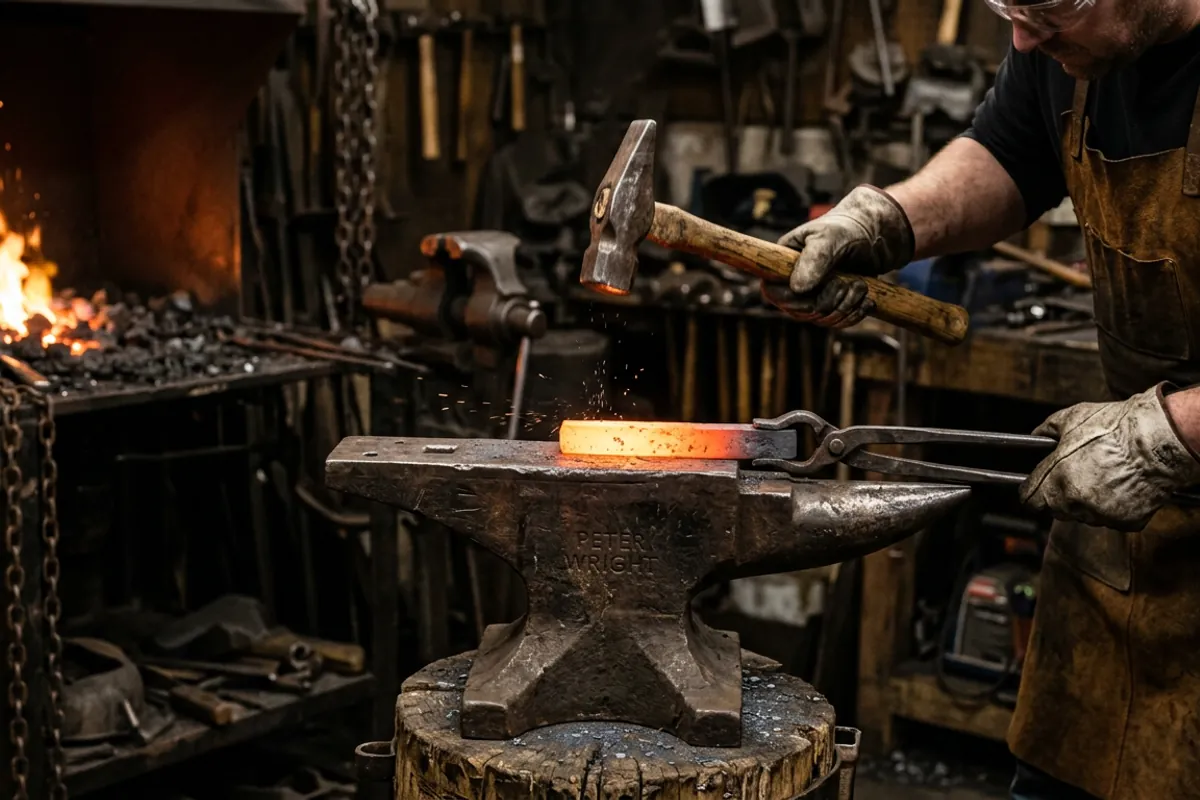
The first is stamina, not raw power. A forging session is a couple of hours of repeated, controlled hammer blows, and it is your forearms, grip, and shoulders that fatigue first. That is a conditioning thing, and it comes with hours at the anvil the same way it comes for anybody. Nobody, of any size, starts out with forge endurance. You build it.
The second is heavy stock and heavy tools. Wrestling a bar of two inch square stock, drawing out thick material by hand, or swinging a striking sledge for forge welding genuinely takes muscle. So does lifting an anvil, moving a full swage block, or manhandling a length of coil spring. This is where a smaller smith feels the difference most honestly.
But here is the part the "you have to be strong" crowd leaves out: almost every one of those heavy jobs has a tool that removes the strength requirement. A power hammer or a hydraulic press moves heavy stock so your body does not have to. A post vise, a leg vise, or a good pair of tongs holds work you could never grip by hand. A striker, or a treadle hammer, does the heavy hitting. The whole history of the trade is smiths building machines and jigs so that one person can do the work of three. Reaching for those tools is not cheating. It is blacksmithing. A smaller person who learns to leverage tools will out-produce a strong person who insists on doing everything by arm.
Why hammer control beats hammer weight
If I could teach one thing to every beginner, it would be this: a hammer you can place exactly where you want, blow after blow, beats a heavier hammer you can barely steer. Control is the skill. Weight is just a number.
New smiths, especially the ones worried they are not strong enough, tend to grab the heaviest hammer on the rack thinking mass will do the work. It does the opposite. A hammer that is too heavy for you wanders, lands off the intended spot, tires you out in minutes, and teaches your body sloppy mechanics that are hard to unlearn. A hammer that is right for you lets you hit the same square inch a hundred times in a row, and that accuracy is what actually moves metal efficiently. Ten accurate medium blows do more useful forging than thirty tired wild ones.
Most experienced smiths will tell you to start a beginner on something in the range of about 1.5 pounds to 2.5 pounds, and to err toward the lighter end if the heavier one throws off your control. That advice is not softened for women. It is the same thing I tell a big guy who is muscling his work. If you are picking a first hammer, I went through the honest tradeoffs in the blacksmith hammer I would hand a beginner, and the short version is: buy the one you can drive accurately for an hour, not the one that looks impressive.
The other half of control is your body, not your arm. Good hammer technique uses a relaxed grip, a loose wrist, and the natural fall of the hammer, letting gravity and a little arm do most of the work while the wrist aims. Smiths who forge into their sixties and seventies do it because they let the tool fall instead of forcing it. That mechanic favors nobody by sex, and it is the great equalizer at the anvil.
Sizing the shop to the smith
This is the practical heart of the whole question, and it is where I see people go wrong. A shop that has been set up for a six foot two smith will feel awful to someone a foot shorter, and a beginner who does not know that will blame themselves instead of the setup. The fix is simple: fit the shop to the smith.
Start with anvil height. The old rule of thumb, and it holds up, is that the face of the anvil should sit at about your knuckle height when you stand next to it with your arm hanging relaxed. Too high and you cannot get over your work or land a square blow. Too low and you wreck your back leaning down all day. This is entirely adjustable. You cut the stand or stump to your height, or you shim it up. There is no reason to accept an anvil set for someone else's body. If you are still choosing an anvil, weight and size matter less than people think for hand work, and I walked through it in what size anvil do you actually need.
Tongs are the next thing. Ill-fitting tongs are a strength tax you should not be paying: if the jaws do not match your stock, you end up clamping down with grip you do not have to spare, and hot work can twist loose, which is a burn or worse waiting to happen. Tongs that actually fit the bar hold it with light pressure, so your hand stays fresh and the work stays put. Get the reins to a length you can squeeze comfortably, and do not be afraid to reforge the jaws to fit your stock. I covered fit over flash in the blacksmith tongs I would buy first.
The same logic runs through the whole shop. Set the forge opening at a height you can feed stock into without hunching. Keep a stool for filing and finish work. Use a helper, a hoist, or a hand truck to move the anvil and heavy stock rather than your back. None of this is a concession. Every good smith I know has bent their shop around their own body, injuries, and habits. Doing it deliberately from the start just means you skip the years of aches that teach it the hard way.
Long hair, loose clothing, and the safety that applies to everyone
Safety at the forge is identical for every smith, but a couple of hazards come up more often for people with long hair, so it is worth saying plainly rather than politely. This is the one part of the article where I will not soften anything.
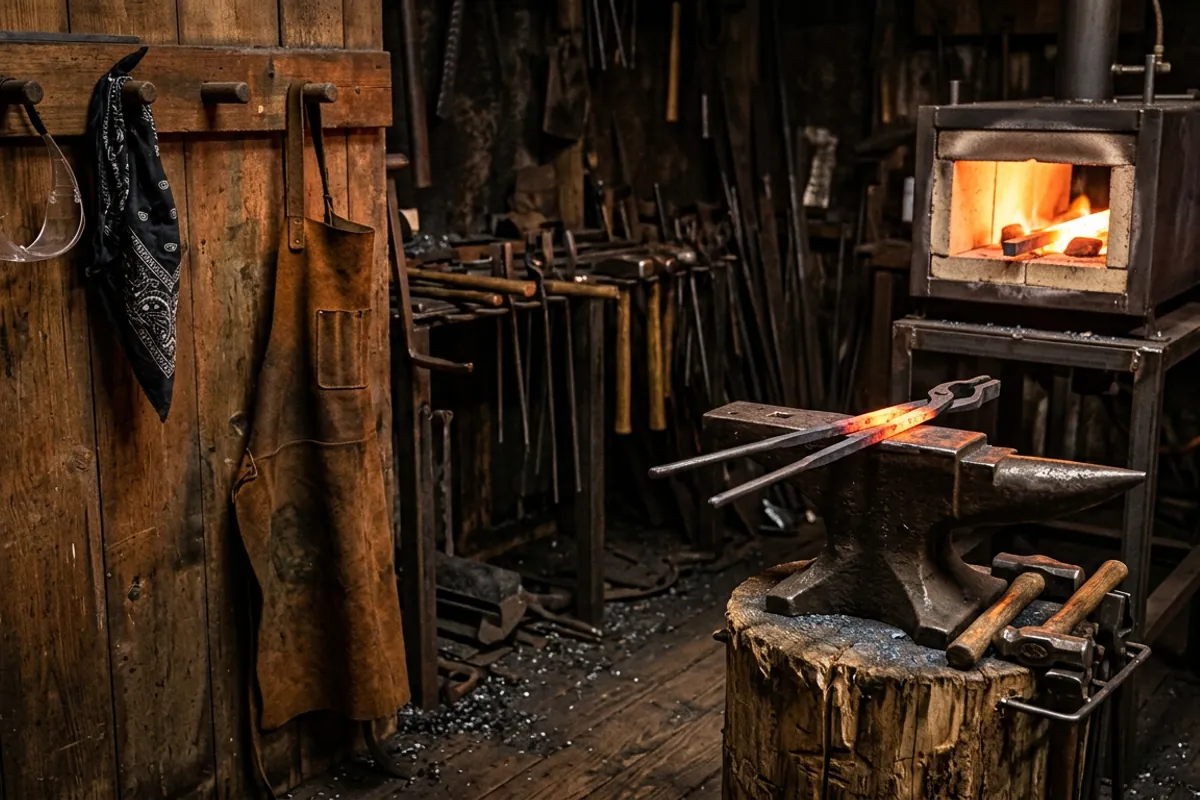
Long hair near a forge, a grinder, or an open flame gets tied back and tucked under a cap or a bandana, full stop. Loose hair finds sparks, finds spinning wheels, and finds the forge mouth, and by the time you smell it burning it is already bad. This is not a lecture aimed at women. I have watched guys with ponytails learn the same lesson. Anyone with hair past their collar deals with it before the forge is lit.
Clothing is the same story for everyone. Natural fibers only near heat: cotton, wool, leather. Synthetics melt onto skin when a scale or a spark lands, and a melted synthetic burn is far worse than a cotton one. No loose sleeves, no dangling scarves, no frayed cuffs that catch a spark and smolder. An apron in leather or heavy cotton earns its keep.
Eye protection is not optional, ever. Safety glasses rated to ANSI Z87.1, worn at the anvil and absolutely at the grinder, where a thrown fragment moves faster than you can blink. I lost my eyebrows early on to a quench oil flare because I stood too close in a cotton shirt with no face shield, and I kept my eyesight by pure luck. I do not tell that story to be dramatic. I tell it so nobody repeats it. The full rundown of what actually matters and what is marketing is in blacksmith safety gear, and it applies the same to every person who lights a forge.
Women have always been at the forge
There is a myth that the forge is some ancient men-only club, and it is worth knocking down because it discourages people who belong there. Women have worked metal for as long as metal has been worked. Through both World Wars, when the men were gone, women ran forges, foundries, machine shops, and farrier work across whole countries, and the tools did not suddenly become too heavy. In the living history and modern craft world today, plenty of women smith full time, teach, run schools, and hold their own in forging competitions that the whole country watches on television.
I am not going to hand you a list of names and dates I cannot personally verify, because inventing history is exactly the kind of thing this site does not do. If you want the honest version of who the standout smiths of the past really were and how much of the legend is real, I dug into that in the famous blacksmiths worth knowing. The point that matters here is simpler: the idea that this is a new or borrowed hobby for a woman is just wrong. The craft has always had women in it. It has them now in growing numbers, and the club forges I have seen are better for it.
Finding a forge, a teacher, and a club
The single best move for any new smith, and I mean any, is to get in front of an experienced one before you buy a pile of gear. A weekend class or an open forge night at a local blacksmithing club teaches you more in a day than a month of videos, because someone stands next to you and fixes your grip, your stance, and your heat in real time. It also lets you swing a few hammers and stand at a few anvils before you spend money, which is how you learn what fits your body.
I will be straight about the social side, because women ask me about it. Most club forges skew older and male right now, simply because of who took up the hobby decades ago. In my experience the reception is overwhelmingly welcoming: the community is small, everyone remembers being a clueless beginner, and a person who shows up wanting to learn is a person we are glad to see. If a particular shop ever feels otherwise, that is a bad shop, not the craft, and there are others. Do not let one sour room decide the whole thing for you.
When you are ready to build out your own corner of the garage, start small and buy in the order you will actually use things. I laid out that order in what a beginner blacksmith actually needs to start and in blacksmithing for beginners, and neither list changes based on who is reading it. Anvil, forge, hammer, tongs, hot cut, and a way to hold work. Fit each to your body as it comes into the shop.
What people get wrong about the female blacksmith
The biggest mistake, and it comes from both directions, is treating the female blacksmith as a special category with its own rules. She is a smith. The steel behaves the same, the safety is the same, the technique is the same, and the tools are the same tools set to a different height. The only honest adjustments are the ones any good smith makes for their own size and reach, and those are adjustments, not handicaps.
The second mistake is thinking strength is the entry ticket. It is not. Judgment about heat, an accurate hammer, patience, and a shop set up to leverage tools instead of muscle will carry you far past raw power. I have watched strong beginners quit in frustration and lighter beginners quietly get good, and the difference was never the size of the arm. It was whether they learned to read the metal.
The last mistake is waiting until you feel qualified. Nobody feels qualified at the start. I began self-taught on a length of railroad track clamped to a stump, made every dumb mistake worth making, and turned it into a real skill over years. That path is open to anyone willing to light the forge and put in the hours. If you want to keep reading around the craft before you commit, the rest of the odds and ends I write up live over at more from the shop. Pick a hammer you can steer, set the anvil to your knuckles, tie your hair back, and get to work.