Blacksmith villages are one of those phrases that sounds like a place on a map, and once in a while it is one, but what most people are really asking about is older and more interesting than a signpost. For most of human history a blacksmith village was not a special kind of village at all. It was just a village, because a village that could not repair its own iron did not last long. The smith was the one shop everybody needed, and the forge was where the whole settlement came when metal broke, wore out, or had to be made from scratch. I have spent about twenty-five years at a forge in a home shop in the upper Midwest, self-taught off a length of railroad track before I ever owned a real anvil, and the more I learn about how the old village smith actually worked, the more I recognize my own bench in it. This is a plain reference to what a blacksmith village was, what went on inside the smithy, and what that history still teaches a hobby smith lighting a forge today.
What "blacksmith village" actually means
The term gets used three ways, and it helps to separate them before we go further.
The first is the historical reality: for centuries almost every village of any size had a resident smith, so "the blacksmith village" is really shorthand for the ordinary settlement organized around the fact that one person there could work iron. The forge was infrastructure, the way a well or a mill was.
The second is the reconstructed or preserved kind you can visit now. Living-history sites and open-air museums keep a working smithy running so you can stand a few feet from a real fire and watch a smith move hot steel. Those are the closest thing most of us get to seeing the old trade in its own setting, and I will come back to them.
The third is a name. There are real places called some version of Blacksmith or Smithville or Ferriere, and street names like Smith Lane turn up all over the English-speaking world, because a working forge left its mark on the map. That last one is trivia. The first two are worth your time.
For the rest of this piece I mean the historical role and the living version of it. If you want the day-to-day of the person who ran that forge, I wrote separately about what a medieval blacksmith actually did all day and what a medieval smith actually did all day, and this reference sits alongside those.
Why the forge sat where it did
Walk any preserved village and notice where the smithy is. It is almost never tucked at the edge. It sits near the center, on the through road, close to where people and animals already passed. That placement is not sentiment. It is logistics.
A forge is heavy work that pulls the whole community to it. A farmer with a cracked plowshare, a wagon with a loose iron tire, a horse throwing a shoe, all of that has to come to the fire, because the fire cannot come to them. Put the smith on the main road and the customer is already halfway there. A smith set off in a far corner makes every repair a longer walk, and in a working village walking distance was real cost.
There was a harder reason too. A forge is an open fire burning hot enough to bring steel to a yellow heat, throwing sparks and scale, often under a roof of timber and thatch in the old days. That is a fire risk to everything around it. So the smithy tended to sit a little apart from the barns and hay, on bare or beaten ground, frequently near water. Water was for the slack tub to quench and cool work, for hardening, and for the plain fact that if a forge shop is going to burn anything down it may as well be near something to fight it with. That instinct is not medieval quaintness. I keep water in the shop today for the same two reasons, and I learned the hard way what a fire can do near a forge: early on I quenched a blade in oil that was too cold, standing too close in a cotton shirt with no face shield, and the oil flared and took my eyebrows. I kept my eyesight by luck. The old smiths respected forge fire because it punished carelessness, and nothing about that has changed.
What came through the smithy door
The single biggest thing to understand about a blacksmith village is that the smith was a generalist, not a specialist. We think of a modern maker as picking a lane, knives or ornamental work or farrier work. The village smith could not afford a lane. He made and fixed whatever the village ran on.
That meant an enormous spread of ordinary iron. Nails, hinges, latches, and hasps. Hooks, brackets, and the fittings that held buildings and gates together. Chain and rings. Kitchen gear, from pot hooks to trivets to fire tools. Farm iron was the backbone of it, plow parts, harrow teeth, sickle and scythe blades, the iron reinforcement on wooden tools. Wagon and cart work, especially the iron tires that were shrunk hot onto wooden wheels. And in many villages, though not all, the shoeing of horses and oxen, which is really a specialty of its own, farriery, that some smiths did and some left to a dedicated farrier.
Blades were part of it but a smaller part than the movies suggest. A village smith made and repaired knives and edge tools because a village needs to cut things, but a great deal of the trade was blunt, structural, unglamorous iron. The romance of the sword belongs mostly to specialist bladesmiths and to a much smaller slice of history than a fantasy village implies. If knife and blade work is what draws you, I cover the honest version of that craft in knife making, explained from the first bar of steel and blade smithing, explained from bar stock to finished edge, and it is worth seeing how much precision a real edge takes before you decide the village smith spent his days on swords.
Repair mattered as much as making. Iron was too valuable to throw away, so the smith rebuilt, reforged, and re-welded broken tools far more than a hobbyist does today. A worn tool came back to the fire and left as a working tool again. That reuse is one of the quiet skills the old trade demanded and the modern buyer never learns, because we can order a new bar of steel whenever we want one.
The tools that ran the shop
Strip away the centuries and the core kit of a village smithy is the same kit I use now, which is one of the things I find genuinely remarkable about this craft.
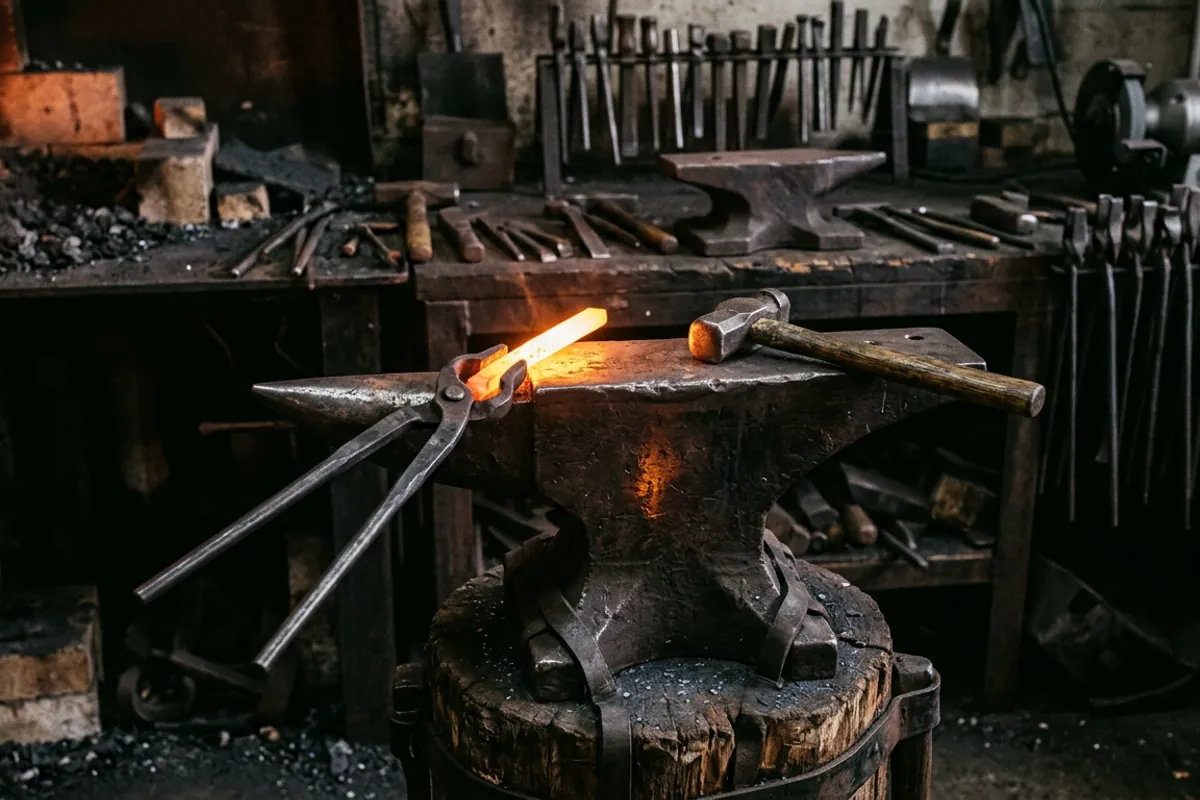
At the heart of it is the anvil. The village anvil was a serious mass of iron and steel with a flat face for the bulk of the work, a horn for curves and rings, and holes in the face for holding tools. Mine is Bessie, a 148 lb Trenton, and she has the same anatomy the old ones had: a face, a horn, a hardy hole for shanked tools, and a smaller pritchel hole. The old shops leaned toward heavier anvils than a first-time buyer usually reaches for, because a village anvil earned its keep all day and wanted mass under the hammer. If you are working out what mass you actually need, I go through it in what size anvil do you actually need.
Around the anvil sat the same family of tools. A forge and bellows to make and control the heat. Hammers, from a general cross or straight pein up through heavier sledges for two-person work. Tongs in a dozen shapes, because a tong that fits the stock is the difference between control and a burn. Punches, chisels, drifts, swages, and a swage block for shaping. A vise, a slack tub, and a hardy that dropped into the anvil for cutting. None of that would be foreign to a smith walking into my shop today. The materials of the anvil and the fuel have improved, the geometry of the work has not.
That continuity is exactly why studying the old shop is not just nostalgia. The village smithy was a solved problem. Generations refined the layout, the tool set, and the workflow until it was efficient, and a modern home shop that ignores that history usually ends up reinventing it badly. I laid out my own bench closer to the old pattern the longer I worked, not further from it. If you want the modern floor plan version of the same idea, I wrote blacksmith shops, explained from the floor of one.
Coal, charcoal, and the fire the village fed
The one part of the old shop that has genuinely changed is the fuel, and it is worth being precise about it because a lot of romantic writing gets it wrong.
For most of the village smith's history the fire was solid fuel. In many places and periods that meant charcoal, made from wood in a slow burn, before mineral coal was widely available or affordable. Later, where good smithing coal could be had, smiths moved to it because it packs more heat into less volume and, once coked down, burns cleaner and hotter for forge work. A village near a coal supply had an easier time of it than one relying on charcoal, which took real labor and a lot of wood to produce.
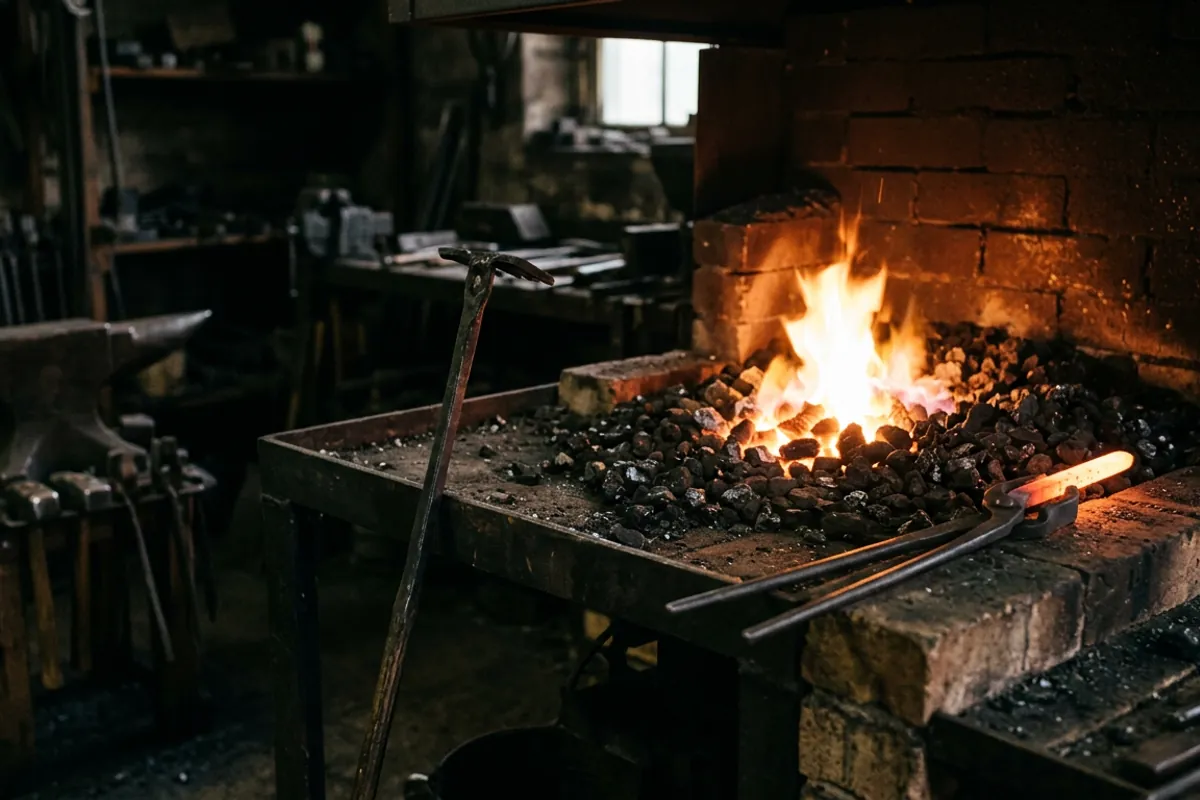
Both fuels behave differently, and I run both a coal forge and a propane forge in my own shop, so I can speak to the solid-fuel side from years of it. Coal wants managing. You build a fire, you coke the fresh coal at the edges, you keep a clean sweet spot, and you learn to read the fire by color and smell. That skill was the daily background hum of a village smithy, and it does not come from a manual. Charcoal is more forgiving to light but burns fast and hungry, so a charcoal fire eats fuel and wants constant feeding. The old smith fed his fire the way I feed a coal fire now, one small addition at a time, keeping the heart of it clean.
Propane, the fast even heat I do most of my daily work on, is entirely modern and would have been unimaginable in the old village. It is worth naming that difference honestly rather than pretending the ancients had our conveniences. If you are choosing your own first fire, I laid out the real tradeoffs in coal or propane, which first forge makes sense, and much of what makes coal harder is exactly the fire-tending skill the village smith took for granted.
The smith's place in the village economy
A blacksmith village was held together by more than iron. The smith was an economic node.
Because the forge was where people already gathered to wait on their repairs, the smithy doubled as a place where news moved and business got done. The smith often extended credit across a season, fixing a farmer's tools in spring and settling up after harvest, which made him a small link in the local money supply. He traded work for goods as often as coin. And because the trade needed strength, an apprentice or two, and years of training, the smithy was also a school. The knowledge passed hand to hand, watching the fire, holding the work, taking the first easy jobs while the master took the hard ones.
That social weight is why "the blacksmith" shows up so heavily in old surnames, place names, and folklore across so many cultures. It was not that smiths were magical, though plenty of stories treat them that way. It was that the whole settlement depended on one shop and one skill, and a dependency that total leaves a long shadow. For a broader plain-language take on what the trade is and has always involved, I wrote what the black smith actually is, and what the work involves.
Seeing a blacksmith village today
You cannot visit a working medieval village, but you can get remarkably close. Living-history sites and open-air museums keep functioning smithies as part of a reconstructed village, staffed by smiths who work in period style so visitors can watch real hot iron move. Ask ten smiths where they first caught the bug and a fair number will point at exactly this, standing at the rope line of a museum forge as a kid and never quite getting over it.
If you go, watch for the real things rather than the show. Notice how the smith reads the fire and pulls the work at a color, not a clock. Notice the economy of motion, the way an experienced hand wastes no blows. Notice the safety, or the lack of it, and be honest with yourself about the difference between a demonstration and a modern shop. A costumed demonstrator in linen at a slow charcoal fire is one thing. You, at your own forge, are another, and you owe yourself proper eye protection rated to ANSI Z87.1 and natural fibers over synthetics near heat, no matter how the reenactor is dressed. The old smiths took real injuries we do not have to repeat. Learn the craft from the village, not the risks.
The other honest thing to say is that these demonstrations compress the trade. A visitor sees a smith make a hook or a nail in a few minutes and comes away thinking that is the job. The village smith's real day was long, repetitive, physical, and mostly repair, and the hook was the easy part. Keep that in mind and the visit teaches you more.
What the village smith teaches a home smith now
I keep coming back to how little the core of this has changed. My propane forge and my angle grinder would baffle a village smith, but hand him Bessie and a hammer and a set of tongs and he would be at work inside a minute, because the fundamental problem, moving hot metal under a hammer against a mass of steel, is the same problem it always was.
The village smith teaches three things that outlast any gear list. First, that mass and a good fire matter more than a fancy tool, which is why I tell beginners to spend on the anvil and the forge before anything else. Second, that repair is a skill, and a smith who can only make new things from clean bar has learned half the trade. Third, that the fire is dangerous and demands respect, a lesson the old shops paid for and so did I.
If you are just starting, the best thing you can take from the blacksmith village is its priorities. It did not chase novelty. It ran a proven set of tools hard, kept the fire clean, and fixed more than it made. That is a good template for a home shop. For more in this vein, the rest of the reference and gear writing lives under more from the shop, and if you want the practical starting kit that follows straight from this history, I laid it out in the black smith tools you actually need to start.