Type "hoffman blacksmithing" into a search bar and you get a small toolmaking shop that makes hand forged blacksmith hammers, plus a pile of forum threads where smiths argue about whether a hammer is worth that kind of money. I get asked about it every few months by someone at the club forge who has been staring at a wishlist page for a week. So let me be straight with you before you read another word: I do not own one of their hammers. I have handled hand forged hammers from small makers, I have hung and rehung a lot of handles, and I have listened to a great many smiths talk about what they bought and whether they regret it. That is the level of authority I am writing at here, and I am not going to dress it up as anything else.
What I can do is teach you the thing underneath the search. Because the real question is almost never "is this specific brand good." It is "what does a hand forged hammer from a one person shop actually give me that a hardware store hammer does not, and am I at a point where I would feel the difference." That question has a real answer, and it applies to every small hammer maker, not just this one.
What people actually mean when they search hoffman blacksmithing
Hoffman Blacksmithing is a small shop known mainly for hand forged blacksmithing hammers. That is the honest summary, and I am going to stop there on specifics. I am not going to quote you a catalog, a price, a steel, or a lead time, because a one person shop changes all three of the first and the fourth constantly, and a number I invent is worse for you than no number at all. If you want current offerings, go read what the maker publishes and take that over anything a stranger on a blog wrote a year ago.
What matters more is the category. When smiths type that search, they are usually one of three people.
The first is a beginner three months in whose big box cross peen is beating up their elbow, and who has decided the hammer is the problem. Sometimes it is. Usually it is technique, and a nicer hammer will not fix it.
The second is a smith two or three years in who has finally figured out what their hand wants and is ready to buy the tool that matches it. This person is the right customer for a small maker, and they usually stay happy.
The third is somebody who saw a photo of a beautiful hammer and wants one. No shame in that. Just know which of the three you are before you spend the money.
Hoffman Blacksmithing and Hofi hammers are not the same thing
This trips up more people than anything else in the topic, and it is purely a spelling problem.
Uri Hofi is an Israeli smith whose name is attached to a well known hammer style and, more importantly, to a whole approach to hammer technique. The teaching around it emphasizes a relaxed grip, letting the hammer's own weight do the work, and driving the blow with your body rather than clenching and muscling it. A lot of smiths with sore elbows credit that instruction with keeping them at the anvil. The hammer shape that goes with it is distinctive, and it gets copied widely.
Hoffman is a different word and a different shop. If somebody tells you to get a "Hofi hammer" and you go searching for hoffman blacksmithing, you will end up looking at an unrelated maker's tools. Both may be excellent. They are not the same recommendation.
The useful part of the confusion is this: the Hofi material is mostly about how you swing, and the small maker material is mostly about what you swing. Of those two, the swing matters more. A smith with good mechanics and a cheap hammer will outwork and outlast a smith with bad mechanics and an expensive one.
What hand forged actually means on a hammer head
Most hammers you can buy in a store are drop forged. A billet of steel gets squeezed between dies under a big hammer or press, coming out to shape in a couple of blows, and then a whole batch gets heat treated together. It is a good process. It is why a serviceable hammer costs what a tank of gas costs.
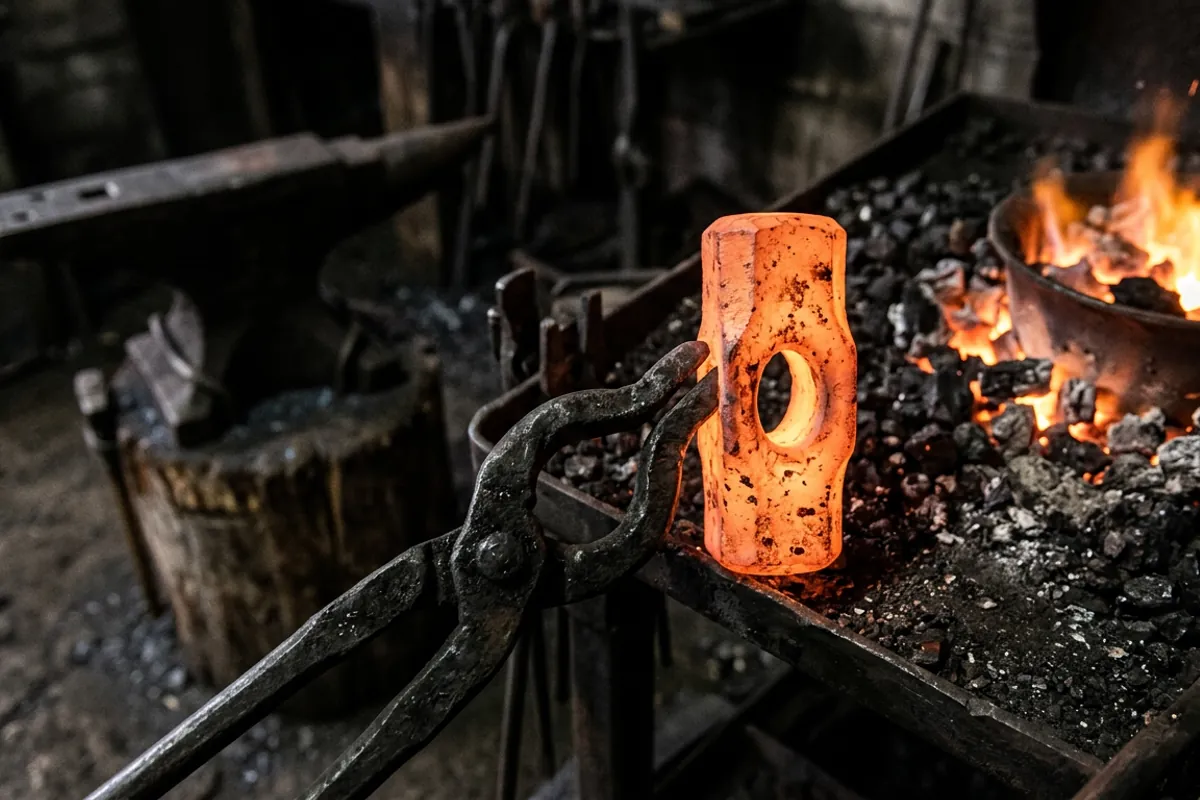
Hand forged, in the small shop sense, means somebody forged that head individually, usually under a power hammer or press with hand tooling, drifted the eye, dressed the faces, and heat treated it in small numbers. If you want to understand what that work looks like from the inside, the general shape of it is covered in my walkthrough of what a blacksmith actually does and in the blacksmith hammer buying guide.
Here is what that individual attention buys, when the maker is good:
Face geometry. A hammer face is not flat. A good one has a slight crown, a gentle dome across the striking surface, and the edges are broken to a radius rather than left sharp. The crown lets you move metal without leaving half moon dents every time your blow lands a hair off square. The broken edge stops the hammer from cutting a line into your workpiece. Mass produced hammers often have flat faces and sharp edges, and the first thing experienced smiths do with a cheap hammer is dress those edges themselves.
Weight distribution. Where the mass sits relative to the eye changes how the hammer feels in the swing. Two hammers can weigh the same on a scale and feel a pound apart in the hand. A maker who forges each head can put the mass where they want it.
The eye and the handle. A properly drifted eye is waisted, narrower in the middle than at either end, so a wedged handle physically cannot pull through. Small makers usually hang their own handles and thin them down until the handle flexes. That flex absorbs shock that would otherwise land in your wrist.
Individual heat treat. Small batches mean the maker can actually control the result rather than accepting the spread of a production run.
Why the hammer shows up in your elbow
Blacksmith's elbow is real, it is a tendon problem, and it ends more hobby smithing careers than any dramatic injury does. Three things drive it: a hammer that is too heavy for your current conditioning, a handle too fat to hold loosely, and a death grip.
The consensus you will hear from almost any experienced smith is to start lighter than you think. Something in the neighborhood of 2 to 3 pounds handles general work for most people, and plenty of very productive smiths spend all day under 3 pounds. Beginners routinely buy 4 pounds because it sounds serious, then wonder why their accuracy falls apart after twenty minutes and their arm aches for two days.
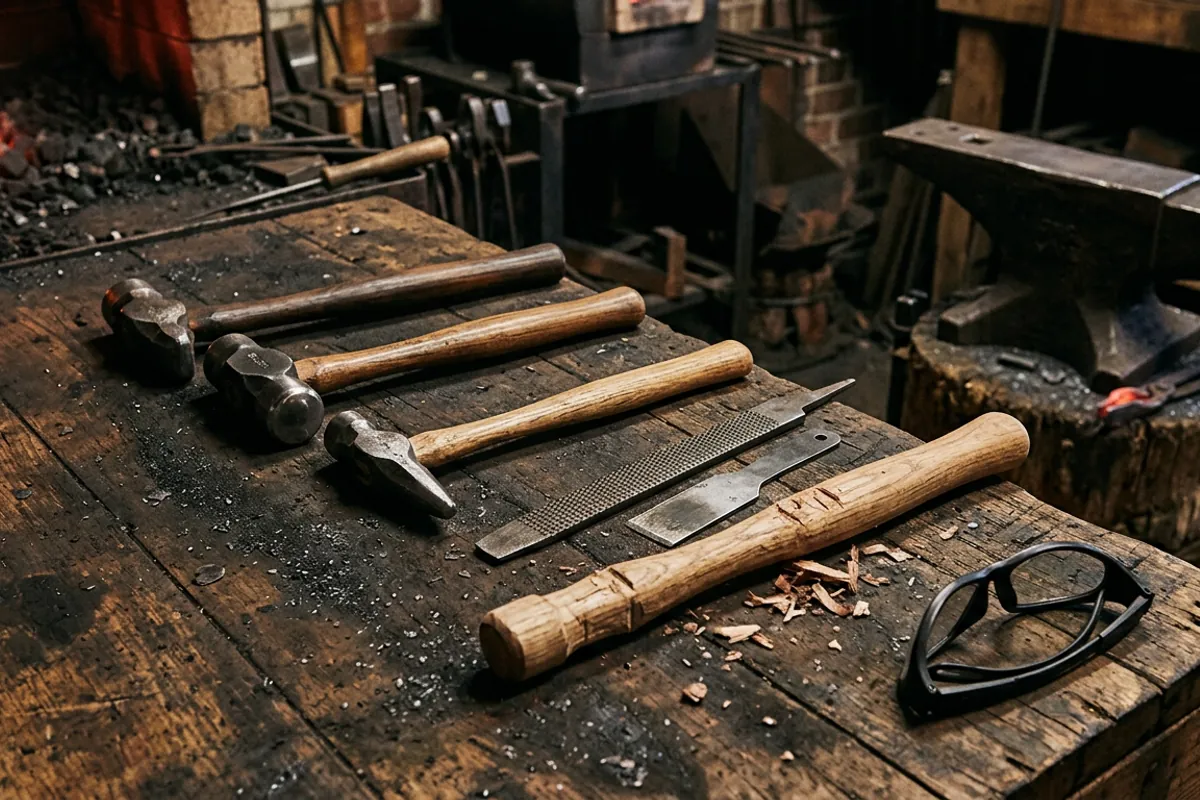
The handle matters as much as the head. Fat handles force you to squeeze, and squeezing transmits every bit of shock straight up your arm. Thinning a handle with a rasp and a card scraper costs you an evening and nothing else, and it is the single cheapest upgrade available to a new smith. That is the kind of work I would do to a cheap hammer long before I would order an expensive one.
How to judge a hammer from any small maker
Since I cannot honestly review a tool I do not own, here is the checklist I would use on any hand forged hammer, from any shop, including one you buy secondhand at a hammer in.
Look at the faces first. You want a visible crown, edges radiused all the way around with no sharp corners, and no grinder chatter or deep scratches left in the striking surface. Anything on that face gets printed into your hot steel.
Look at the eye. It should be clean and symmetrical, waisted through the middle, with no cracks radiating from the corners. Cracks at the eye are where hammer heads fail, and they fail by throwing the head.
Check the handle fit. The wood should fill the eye completely with the wedge seated flush. Any gap, any movement when you rap the handle butt on a bench, and the hammer goes on the shelf until it is rehung.
Ask what the maker will tell you. A serious hammer maker will happily say what steel they use and how they heat treat it. If they publish a hardness, good. If they dodge the question entirely, note that. Nobody making a good tool is shy about how they make it.
Then swing it. Hold it loosely, tap the face of your anvil a few times, and pay attention to whether the hammer wants to return to level on its own. A well balanced hammer does a lot of the work of finding square for you.
For the metallurgy behind any of that, hardness ranges, toughness, what a given steel does at a given tempering temperature, do not take my word or a marketing page's word. Go read Knife Steel Nerds, which actually runs tests, and read my plain language piece on tempering of metal for the working smith's version of the same ideas.
What buying from a one person shop is really like
If you have only ever bought tools from retailers, this part surprises people, so set your expectations correctly.
Stock comes in batches, not continuously. Small makers forge a run, list it, and it sells out. Some run a waitlist, some do announced drops, some take orders with a lead time measured in months. None of that is a warning sign. It is just what happens when the entire production capacity of the company is one person with two arms.
Communication is slow, because the person answering your email is the same person standing at the power hammer. Give it a week before you follow up.
Returns policies are usually narrower than a big retailer's, and shipping a heavy steel object is not cheap.
The upside is that these tools hold value remarkably well. A good hand forged hammer bought used at a hammer in or through a club is often nearly as good as new and costs less, and if you buy one and decide the shape is wrong for you, you will generally get most of your money back selling it on. That is not true of a hardware store hammer, which is worth roughly nothing the moment you own it.
Where a boutique hammer belongs in a shop, and where it does not
I would not make a hand forged hammer a beginner's first purchase, and I say that as someone who owns nice tools and likes them.
Here is the reason. For your first six months to a year, you do not yet know what your hand wants. You do not know whether you prefer a rounding hammer or a cross peen for drawing, whether you want your peen oriented one way or another, whether you are a 2 pound smith or a 3 pound smith. A cheap hammer that you dress yourself teaches you all of that for the price of a pizza. Then you buy the expensive one, and you buy the right expensive one.
Spend the early money where it actually limits you. That is a solid anvil and a forge that holds heat, and I go through the ordering of it in the tools you actually need to start and in the anvil weight guide. Bessie, my 148 pound Trenton, does more for my work every single day than any hammer upgrade ever has. A heavy, well supported anvil returns energy to the work. A pretty hammer swung at a light anvil bouncing on a wobbly stand is wasted money.
The place a small maker's hammer genuinely earns its keep is when you are forging for hours at a stretch and small differences compound. At that point, the face geometry and the balance and the thin handle add up to less fatigue and fewer marks to clean up, and you feel it by the end of the day. That is a real upgrade. It is just a second or third year upgrade.
Care, safety, and the things that ruin a good hammer
Whatever you end up buying, these rules apply, and a couple of them are safety rules rather than preferences.
Never strike a hardened face against another hardened face. Not hammer against hammer, not hammer against the hardened face of an anvil with no work between them, not hammer against a hardened struck tool. Hardened steel meeting hardened steel throws chips at speeds you cannot react to. Struck tools like chisels and punches have deliberately soft heads for exactly this reason. If yours has mushroomed over into a ragged rim, grind that rim off before you hit it again, because a mushroomed head sheds shrapnel sideways.
Wear eye protection rated ANSI Z87.1, every time, no exceptions. Not fashion sunglasses, not readers. I have my eyesight today because of luck rather than judgment. Early on I quenched a blade in oil that was too cold, standing too close in a cotton shirt with no face shield, and the oil flared and took my eyebrows off. I am not softening that story to sound approachable. Cheap glasses that meet a real standard are the highest return purchase in the entire shop, and the rest of the kit is covered in my safety gear writeup.
Check the handle before every session. Rap the butt of the handle on the bench and look for any movement at the head. Wood shrinks in dry winter air. A head that comes loose in mid swing is a projectile.
Do not dress a hardened hammer face on a dry grinder without watching the heat. If the steel colors, you have drawn the temper and softened the face. Go slow, keep it cool, dip it often.
Do not beat on cold steel. Hitting steel below forging heat marks your hammer face, marks your anvil, and puts every bit of the shock back into your arm. If the color is gone, the piece goes back in the fire.
Keep it dry and lightly oiled. A wipe of oil on the head after a session in a damp shop is all it takes. Rust pits on a face print into your work forever.
What I would tell a smith asking about hoffman blacksmithing
If you are new, buy a cheap hammer in the 2 to 3 pound range, spend an evening rounding its edges and thinning its handle, and put the rest of the money into your anvil and your fire. Come back to boutique hammers in a year, when you can articulate exactly what you want a hammer to do differently. You will make a better choice and you will actually feel the difference.
If you have been at this a while and your hands know what they want, buying from a small maker is a reasonable thing to do with your money. Judge the tool on the checklist above rather than on photographs, be patient about lead times, and understand that you are buying somebody's individual work rather than a product line. That is the whole appeal, and it is also why it costs what it costs.
And if you take one thing from all of this, take the technique point. The Hofi material, the club forge instruction, the weekend beginners I teach, they all converge on the same lesson: a loose grip and a hammer you can control beat a heavy hammer and a tight fist every time. That lesson is free. More writing in this vein lives on the More from the shop hub, and if you are still working out your first kit, start with the starter tool list.