Hearing protection for blacksmithing is the cheapest piece of safety gear in the shop and the one I see skipped most often, which is backwards. Eye protection has an obvious failure mode: a chip goes in your eye and you know that second that you made a mistake. Noise does not work like that. You forge for four hours, your ears ring on the drive home, the ringing fades by morning, and nothing about that day tells you it cost you anything. Twenty-five years of that is how a lot of old smiths end up asking you to repeat yourself. This is a reference article, not a shopping list. I want to lay out what the actual published limits say, what the number printed on a hearing protector means and does not mean, and where the honest gaps in the data are, because there is one big gap in this topic that nobody seems willing to say out loud.
Why noise is the injury you never feel happening
Every other hazard at the forge gives you feedback. Hot steel burns and you drop it. Scale in the eye hurts immediately. A tong grip that is not seated lets go of the work and you learn on the spot. Noise gives you nothing but a little ringing and some muffled hearing after a long session, and both of those fade enough that it is easy to file the day under "fine."
I am not going to make a medical claim about what is happening in your ear, because I am a hobby smith and not an audiologist. What I will say is what the safety literature consistently treats as true and what I have written before in the blacksmith safety gear guide: noise induced hearing loss accumulates slowly and does not come back. That puts it in the same category as carbon monoxide in a forge, which is the other hazard in this shop that does its work while you feel fine. Both of them are managed by rules and habits set in advance, not by paying attention and reacting, because there is nothing to react to until it is late.
That is why this topic gets a reference treatment instead of a gear roundup. The decision that matters is not which protector you own. It is whether you put it on before the first heat, every time, including the five minute jobs.
How loud is an anvil, honestly
Here is where I have to be straight with you, because "how loud is an anvil" is the question everybody actually types in and the honest answer is uncomfortable.
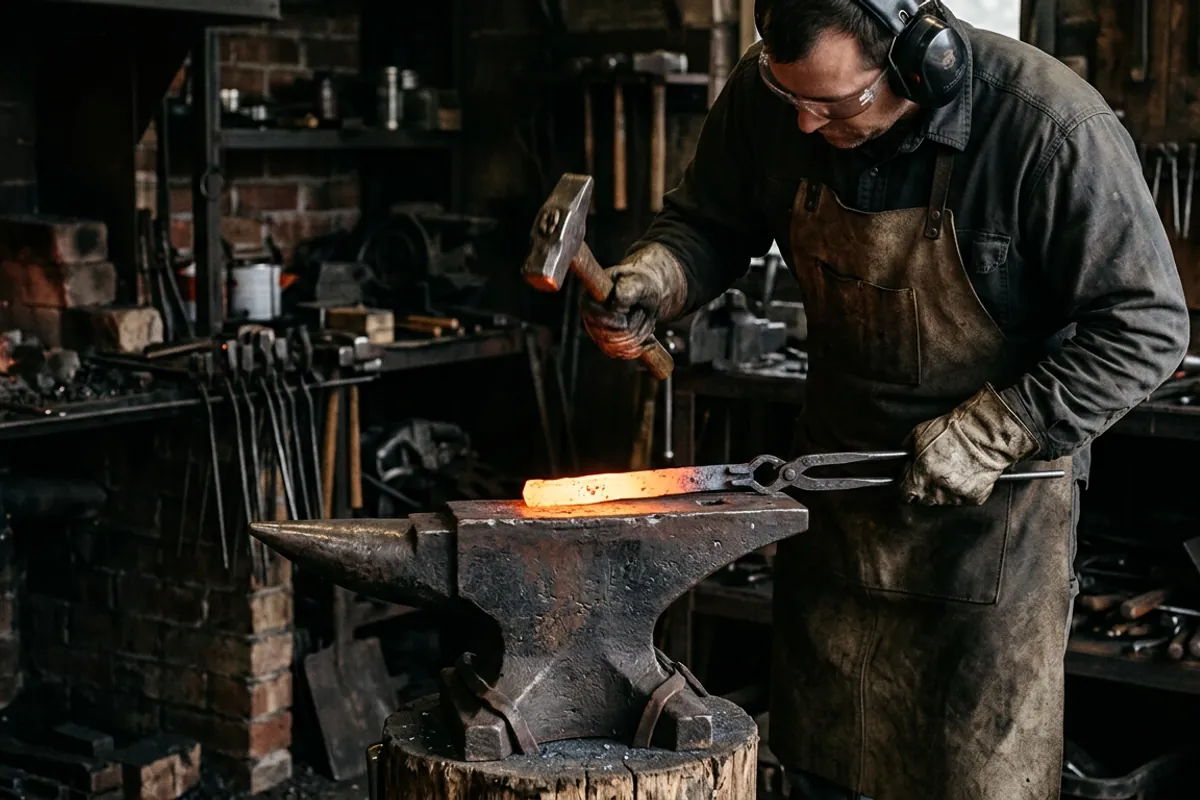
I went looking for a real, published, measured sound level for a hand hammer striking a hobby anvil. I could not find one I would put my name on. There are numbers floating around forums and trade press, and some of them are probably in the right neighborhood, but I could not get to a primary source I could read and verify, so I am not going to print them. Printing an unverified decibel figure in a safety article is exactly the kind of thing that gets repeated for the next ten years by people who assume somebody checked. Nobody checked. If you find a real measurement study of hand hammer work on a hobby anvil, that is genuinely useful information and I would like to see it.
What I can give you is verified and it is from an industrial setting. A NIOSH Health Hazard Evaluation at a hammer forge company found that workers at or near the hammers had full-shift time-weighted average noise exposures above 100 decibels, A-weighted. Impact noise at the hammers reached up to 148 decibels. And 82 percent of the workers evaluated had experienced a significant threshold shift, which is the audiometric way of saying their hearing had measurably changed.
Read that carefully, because the temptation is to either dismiss it or over apply it. Those are production power hammers running a full shift, not you and a two pound hammer on a Saturday. Your exposure is lower and shorter. But the shape of the hazard is the same, and if you run a power hammer or a treadle hammer in a home shop, you are closer to that data than you are comfortable being. The one thing that industrial number tells every hobby smith is that hitting steel with steel is not a marginal noise source. It is a serious one, and the people who do it for a living lose hearing over it.
I treat unknown as loud. That is the only defensible position when the measurement does not exist. For the steel questions I do not have data on I point people at Knife Steel Nerds, because somebody there actually ran the test. I wish there were an equivalent for anvil noise. There is not, so I wear protection and assume the worst.
The exposure limits a home shop should borrow
The two American bodies that publish noise limits are OSHA, which writes enforceable workplace rules, and NIOSH, which does the research and makes recommendations. Neither one regulates your garage. Both are the best reference a home shop has, so borrow them.
OSHA's rule lives in 29 CFR 1910.95. Its action level, the point where a workplace has to start doing something about noise, is an 8-hour time-weighted average sound level (TWA) of 85 decibels measured on the A scale (slow response). Its permissible exposure table, Table G-16, then runs a ladder of level against allowed duration:
90 dBA for 8 hours. 95 dBA for 4 hours. 100 dBA for 2 hours. 105 dBA for 1 hour. 110 dBA for 30 minutes. 115 dBA for 15 minutes or less.
Separately, the rule states that exposure to impulsive or impact noise should not exceed 140 dB peak sound pressure level. I think that line deserves attention from smiths specifically. The regulator wrote a separate ceiling for impact noise because impact noise is its own problem, and hammer on steel is impact noise by definition. An averaging measurement flatters a shop full of short sharp events.
NIOSH does not agree with OSHA, and the disagreement is worth understanding. The NIOSH recommended exposure limit for occupational noise exposure is 85 A-weighted decibels over an eight-hour shift, which is 5 dB stricter than OSHA's permissible level. More importantly, the two bodies use different exchange rates. Read down OSHA's table and every 5 dB increase halves the allowed time. NIOSH recommends that for each 3 dBA increase in noise level, you cut the exposure duration by half. The NIOSH ladder gets short much faster.
Why the gap matters in practice: NIOSH's 1998 criteria document put numbers on it. Over a 40-year working lifetime, the excess risk of occupational hearing loss is 8 percent at the 85 dBA REL, against 25 percent at the 90 dBA OSHA permissible level. Five decibels of daily average is the difference between roughly one in twelve and one in four. That is not a rounding difference between two agencies squabbling. That is the whole argument for using the stricter number when you get to choose, and in a home shop you always get to choose.
So the working rule I use: treat 85 dBA over eight hours as the line, use the 3 dB halving when reasoning about louder work, and treat anything with an impact in it as its own category rather than something to average away.
What the NRR on the box actually means
The number printed on a hearing protector is the Noise Reduction Rating, and it exists because the EPA requires it. The labeling rule at 40 CFR 211.204-1 specifies what has to appear: the words "Noise Reduction Rating", the rating in decibels, the statement that "The range of Noise Reduction Ratings for existing hearing protectors is approximately 0 to 30 (higher numbers denote greater effectiveness)", and the qualifier "(When used as directed.)"
That last parenthesis is doing enormous work and almost nobody reads it.
Here is the part that trips up every smith I have explained this to. An NRR of 30 does not mean the world gets 30 dB quieter when you put them on. It is a laboratory derived rating produced under laboratory fitting conditions, and NIOSH is explicit that real world performance falls short of the label. NIOSH recommends derating the manufacturer's labeled NRR before you trust it, and the derate depends on the type of protector: earmuffs are credited with 75 percent of the labeled NRR, formable earplugs with 50 percent, and all other earplugs with 30 percent.
Sit with that spread for a second. The same printed number on two different kinds of protector is worth wildly different amounts in a real shop, and the foam type most people buy in a bag of fifty and jam in half seated loses half its label under the NIOSH derate, with muffs keeping more and every other plug type keeping less. The rating is not a lie, it is a measurement of what the device can do when it is fitted perfectly. The derate is an admission of what people actually do.
Practical translation: fit is not a comfort issue, it is the performance. A protector with a mediocre rating that you seat properly and wear the entire session beats a high rated one you wear half the time or wear badly. Nothing on the label survives being worn wrong.
Muffs and plugs at a forge, and the tradeoffs that are specific to us
Ask ten smiths about the best ear protection for forging and you will get muffs, plugs, and both at once, and all three answers have something behind them.
Muffs are what most smiths reach for, and the NIOSH derating is kindest to them. They go on and come off in one motion, which matters more than it sounds like, because the protector you can put on in a second is the one you actually use for the short jobs. They also sit against your head, which is a real consideration in a hot shop in July, and they interact with the rest of your gear. A muff that fights your face shield or your safety glasses temples is a muff that gets left on the bench. Whatever you use has to coexist with ANSI Z87.1 rated eye protection, because eye protection is not the thing you trade away.
Plugs disappear under a shield or a welding helmet and stay comfortable longer in heat, and they carry the harsher derate for a reason: the difference between a plug rolled down and properly seated and a plug pushed at the ear canal is enormous, and only one of those feels like anything. If you use plugs, learn the seating method for the type you have and actually do it every time.
Doubling up is a real practice in genuinely loud industrial work. It is not additive arithmetic and I am not going to invent a formula for what it gets you. What it is good for is compensating for the fact that neither one alone will be fitted perfectly.
The forge specific considerations I would think about are simpler than the product comparison. Anything you wear near the fire should be sensible around heat, in the same way I do not want synthetics against my skin at the forge. You need to still hear enough to be safe, because the shop has moving equipment and other people in it. And it has to live where you will grab it, which for me means hanging by the door with the glasses, not in a drawer.
Quieting the shop is a separate job from protecting your ears
Smiths love this topic because it feels like a fix you can build. Chain draped over the waist, silicone caulk under the feet, sand in the stand, a magnet on the side. Some of these do change how an anvil rings, and I have written about what a stand does to noise and stability in the anvil stand guide, in the section on ring, noise, and the safety side of a stand. Go read that rather than have me restate it here.
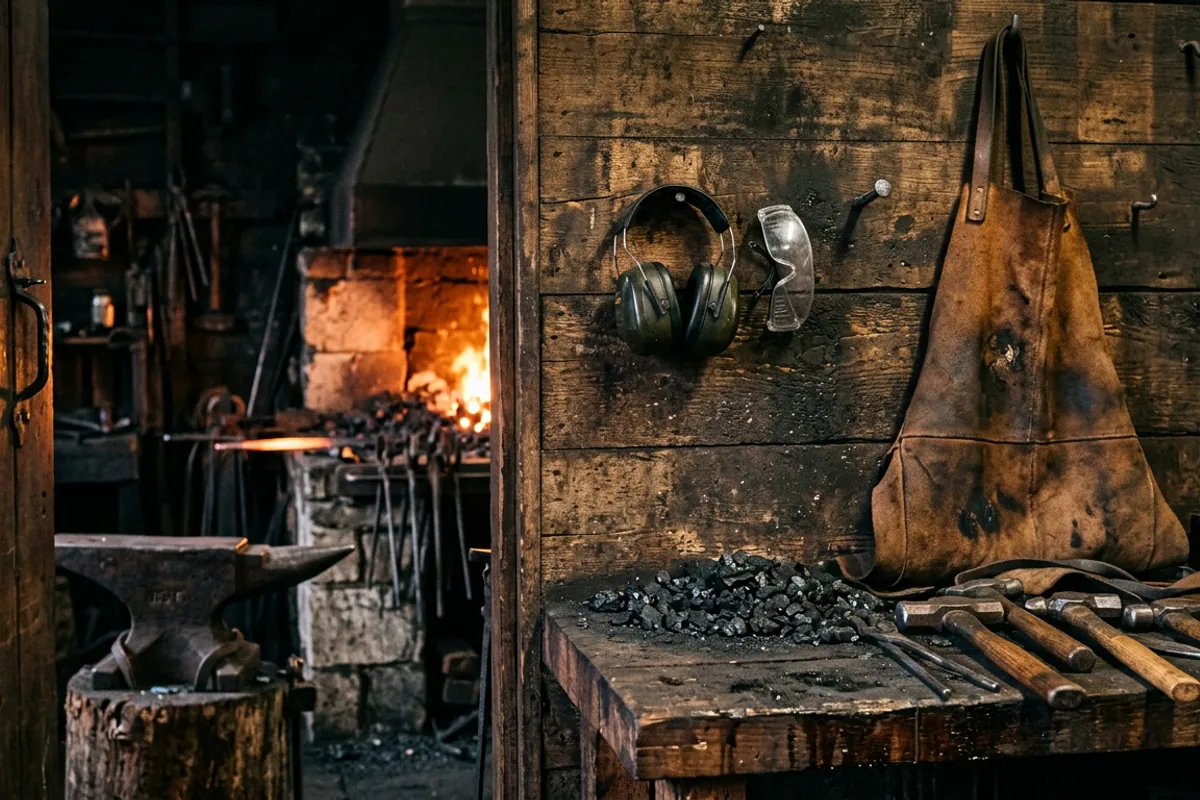
What I will say plainly is the part people want to skip. Damping the ring is not a substitute for hearing protection, and I have never seen a measurement that says it is. Changing the character of a sound and reducing your dose to a safe level are different claims, and only one of them has anybody's data behind it. A quieter anvil is nicer to work next to. It is not permission to take the muffs off.
The same logic applies to the rest of the noise in the shop. A grinder running for an hour, a shop vac, a blower, an angle grinder on a weld: those are steady sources that stack onto the impact noise from the hammer to make up your day. Hearing dose is cumulative across everything, not just the loud part you were thinking about.
What this actually looks like as a habit
Everything above collapses into a short routine, and the routine is the whole article.
Protection goes on before the first heat, not after the noise starts bothering you, because by then you have taken the exposure. It hangs with the eye protection so putting on one prompts the other. It stays on for the five minute job, since those are the ones that get skipped and there are more of them than you think.
I plan for the loud days rather than enduring them. If I am going to run long sessions of heavy hammer work, I break it up instead of doing four straight hours, which is just the NIOSH exchange rate applied with a clock instead of a meter. And when someone else is in the shop, they get protection too, which includes the weekend beginners I teach. A visitor standing ten feet away watching you draw out a bar is taking an exposure they did not choose and probably did not think about.
If your ears ring after a session or things sound muffled on the drive home, treat that as information about the session, not as a normal cost of forging. Change something the next time: shorter runs, better fit, protection on earlier.
If you are just setting up a shop, this belongs in the first round of gear, not the second. Everything else in the safety and PPE hub covers a hazard you will feel the day it bites you. This one is the exception, and that is exactly why it gets skipped. Buy the protection before the anvil is even off the truck, hang it where you will see it, and make putting it on as automatic as putting on your glasses.