Somebody asks me some version of this question at nearly every weekend class I run: what makes a master blacksmith, and how do you know if the person teaching you is one? It is a fair question, and the honest answer surprises people. In most of North America, the term "master blacksmith" is not a license, not a certification, and not a protected title. There is no board, no exam you must pass, and nobody who can take it away from you. Anyone can print it on a business card tomorrow. That does not mean the title is meaningless, because the thing it originally described was very real, and there are still a couple of organizations that test people hard before they hand out a rating. But it does mean you have to know what you are looking at.
I have been at this about twenty five years, self taught off a length of railroad track before I ever owned a proper anvil, and I do not call myself a master. I am an experienced hobby smith who has made most of the mistakes worth making. What follows is what the title actually means, where it came from, what gets tested when anything gets tested at all, and how to judge the claim when you meet it.
Where the title actually came from
The apprentice, journeyman, master ladder is a guild structure, and it was an economic arrangement before it was a skill measure. A boy went to a smith as an apprentice, bound for a term of years, fed and housed and taught in exchange for labor. When his term ended he became a journeyman, which comes from the French for day, because a journeyman was a smith who worked for daily wages. He could hire out to any shop. In parts of Europe he was expected to travel between towns for a period, picking up regional methods, which is where the German tradition of the wandering years comes from.
Master was the next rung, and it was not simply "very good at forging." A master was a guild member who could open a shop in that town, take his own apprentices, and trade under his own mark. Getting there generally meant producing a piece for the guild to judge, sometimes called a masterpiece in the literal sense, and it also meant the guild agreeing to admit you at all. Guilds limited membership on purpose, because the number of shops in a town controlled everybody's income. Plenty of excellent smiths stayed journeymen their whole lives because there was no room at the top in their town, or because they could not afford the fees, or because they were not a member's son.
That is worth sitting with. The historical master title was part skill, part capital, part local politics. If you want the fuller picture of how these shops actually operated day to day, I have written about that in what a medieval blacksmith actually did all day and about how a shop fit into the community around it in what a blacksmith village really was.
Who can call themselves a master blacksmith today
In the United States and Canada, anyone. The trade has no licensing body. There is no state board of blacksmithing, no continuing education requirement, no title protection. The Artist Blacksmith's Association of North America is a membership organization for smiths, and membership is not a rank. Paying dues does not make you a journeyman or a master, and the organization does not present it that way. Regional guilds and clubs are the same: they are places to meet smiths, share a shop, and learn, not credentialing bodies.
Europe is genuinely different in places. Germany still runs a formal master craftsman qualification inside its skilled trades system, and in the metalworking trades it is an examined credential tied to the legal right to run a shop and train apprentices. That is a real qualification with a real exam behind it, and when a German smith says master, it may well mean that specific thing. Various European heritage ironwork bodies also run graded schemes. If somebody cites one of those, the right move is to ask which body and which grade, then check with that body. Every organization that grades smiths publishes its own standards, and those standards get revised. Take the organization's word over mine or anyone else's.
The practical takeaway: in North America the word is usually self applied, and that is not automatically a lie. Plenty of smiths who use it have thirty or forty years and a serious body of work behind them. It just is not evidence by itself.
The one North American ladder that actually tests you
The exception most people have heard of is the American Bladesmith Society. The ABS runs a rating ladder of apprentice, journeyman smith, and master smith, and unlike a membership card, the upper ratings are earned by passing a test in front of judges.
The performance test is the part people know. A candidate forges a test blade and puts it through a sequence in front of a judge: cutting a free hanging one inch manila rope, chopping through a two by four, then shaving hair off the arm to show the edge survived the chopping, and finally bending the blade 90 degrees in a vise. That last part is the one that fails people. It is not a hardness test or a toughness test on its own, it is both at once, and a blade heat treated for one at the expense of the other does not get through. On top of the performance blade, a candidate presents a set of knives to be judged on fit, finish, and craftsmanship. The master smith rating raises the bar again, including pattern welded work in the presentation.
I am deliberately not quoting you the exact knife counts, layer counts, or the minimum time you must hold one rating before testing for the next. Those are set by the ABS, they have been revised over the years, and a blog repeating a stale number is exactly how bad information spreads. If you are thinking about testing, get the current requirements from the ABS directly.
Two honest limits on that ladder. First, it is a bladesmithing rating. It says nothing about architectural ironwork, tooling, repair work, or the traditional joinery side of the trade, and there is no equivalent tested rating covering general blacksmithing in North America. Second, plenty of superb smiths have never tested and never will, because the test costs time and money and does not help them sell what they make. An untested smith is not an unskilled smith.
What mastery actually looks like at the anvil
Set the titles aside and watch someone work. The tells are consistent, and once you know them you can spot the difference between a smith with ten years and one with twenty five in about five minutes.
Heat control. A skilled smith works the steel in the right heat range for the operation and stops when the color drops out of range, instead of hammering cold steel because the piece is nearly there. Watching someone chase a shape into black heat tells you a lot. So does watching someone burn stock in a forge they are not paying attention to.
Hammer accuracy over hammer force. The blows land where they were aimed, the same distance apart, and the face of the hammer meets the work flat when it should. Force is easy to buy with a heavier hammer. Accuracy is only bought with repetitions. I go into what that means for choosing a hammer in the blacksmith hammer I would hand a beginner.
Planning the sequence. Experienced smiths do the operations in an order that does not paint them into a corner: punch before you draw out, work the difficult end while there is still stock to hold, leave the finish surface until last. Beginners do the fun part first and then discover they have nothing left to grip.
Getting more done per heat. This is the single biggest visible difference between an intermediate smith and a very good one. It is not speed for its own sake. It is knowing what the next three moves are before the piece comes out of the fire, so the heat gets used instead of watched.
Forge welding on demand. A smith who can set a fire, get a clean weld to take on the first try, and do it repeatedly in front of students has crossed a real line. Forge welding punishes sloppy fire management, and coal and gas each demand different habits, which I get into in coal or propane.
Recovery. Everybody makes mistakes. The difference is that a very experienced smith notices the error two seconds after it happens and has a fix, rather than finishing the piece and hoping nobody looks closely.
Consistency. Making one good hook proves very little. Making twelve matching hooks proves control.
Tool making is the honest dividing line
Here is the test I actually trust, and it has nothing to do with a rating. Ask a smith what tools in the shop they made themselves.
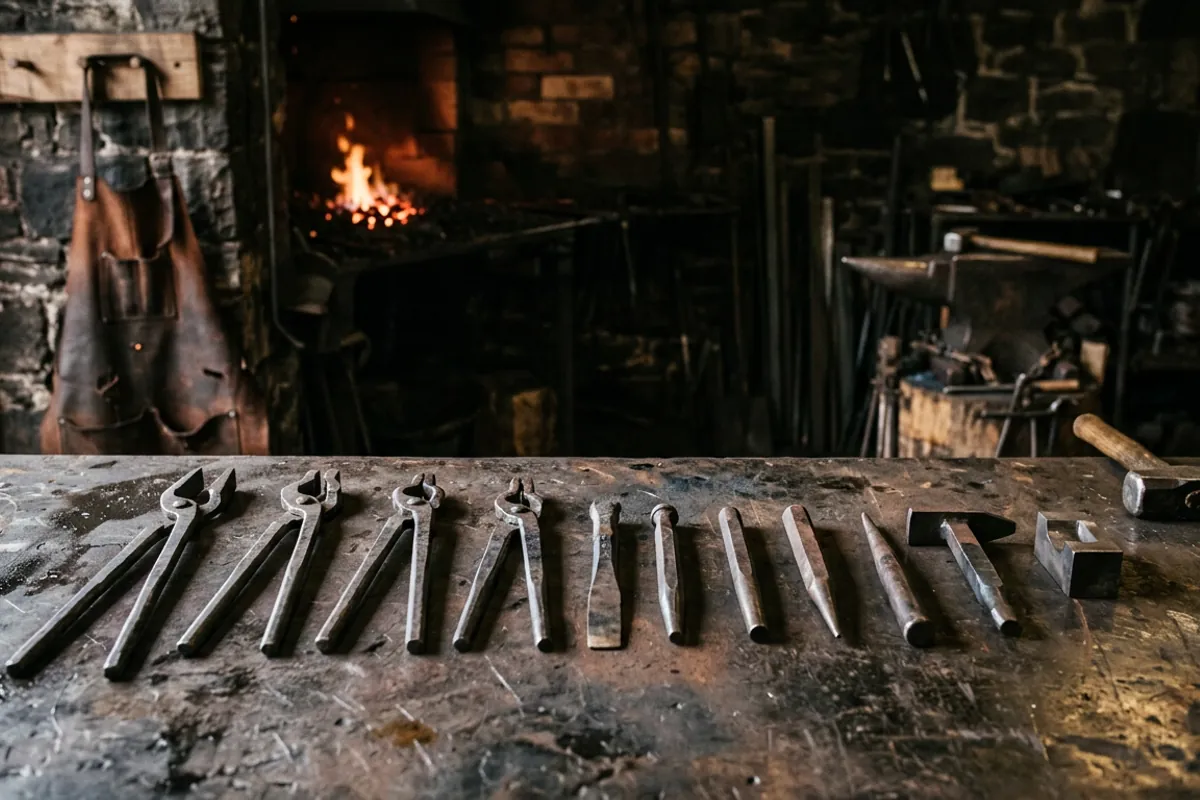
The trade is built on the idea that a smith makes the tooling the job needs. Tongs sized to the stock in hand, punches and drifts for a particular hole, hardy tools, top tools, bending forks, a spring fuller. Somebody who has been smithing seriously for years has a wall of tools they made, most of them a little ugly and all of them fit for purpose. Somebody who has only ever bought tools has been doing a narrower version of the work, however long they have been doing it.
Tongs are the clearest example, because a beginner buys a pair or two and an experienced smith owns twenty pairs and made most of them. If you are still at the buying stage, that is completely normal, and I would rather you buy a good first pair than fight bad ones. I covered how to pick them in the blacksmith tongs I would buy first, and the broader short list of what actually needs to be in the shop in the black smith tools you actually need to start.
Heat treating is where big claims get tested
Forging shape is a skill you can see. Heat treating is a skill you mostly cannot see, and that is exactly why loud claims collect there. Anyone can say their blades are hardened to a specific number. Very few hobby smiths own a hardness tester, and fewer still run controlled comparisons.
My rule is simple: when a metallurgy question gets genuinely deep, it goes to people who actually test. Knife Steel Nerds publishes real experimental work on steel composition, hardening, tempering, and toughness, with the methods laid out. If someone tells you a quench temperature, a soak time, or a toughness claim that contradicts published testing, the testing wins. A smith with forty years at the anvil can still be repeating something wrong that they were told in 1988. Experience is worth a great deal for process and judgment, and much less as a substitute for measurement.
The basics are learnable and worth learning properly: normalize, harden in the medium the steel calls for, temper promptly, and understand why a blade that survives a 90 degree bend is a different animal from one that shatters. I walk through the tempering side in tempering of metal, explained from the forge floor.
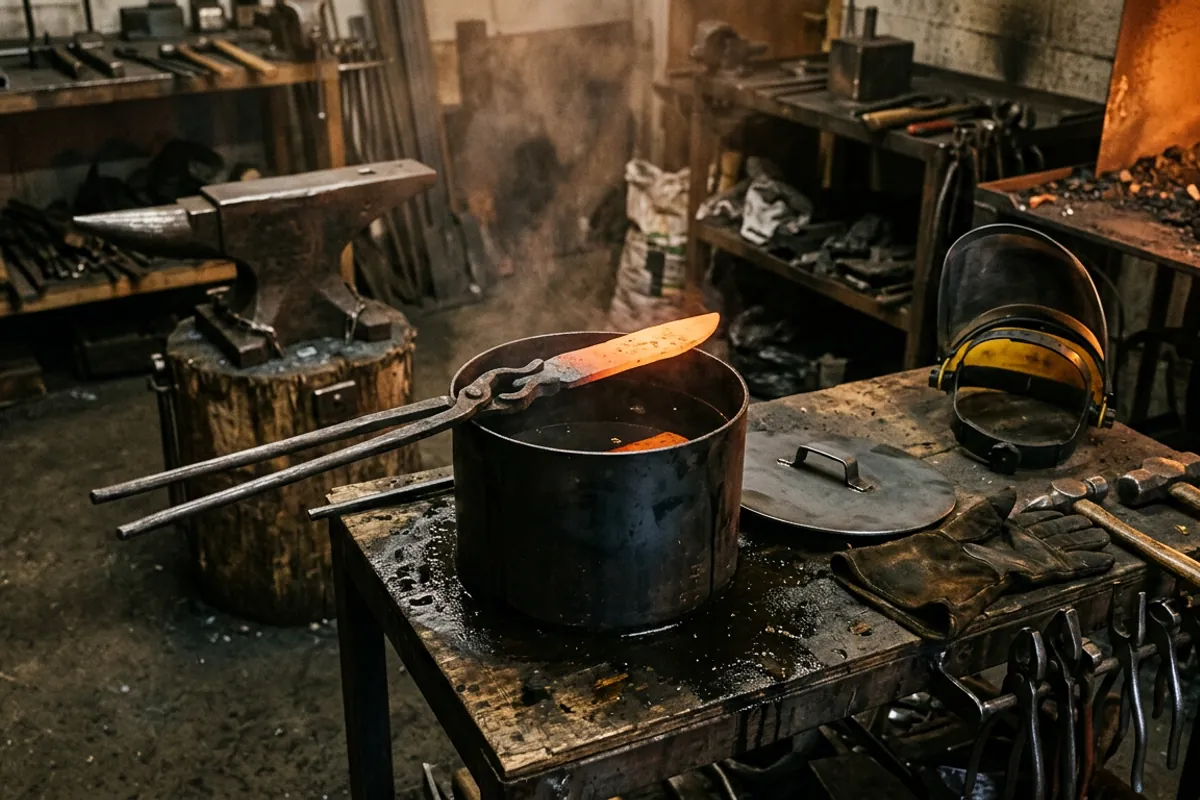
Safety belongs in this section, because heat treat is where people get hurt. Early on I quenched a blade in oil that was too cold, standing too close, wearing a cotton shirt and no face shield. The oil flared, took my eyebrows, and I kept my eyesight on luck alone. Warm your quench oil the way your process calls for, keep a lid within reach to smother a flare, stand out of the plume, and wear eye protection rated to ANSI Z87.1. Natural fibers only near heat, because synthetics melt into skin. No level of skill makes that optional, and any smith who tells you the gear is for beginners is telling you something about their judgment. More on the gear that earns its place in blacksmith safety gear.
How long it really takes
People want a number, and the number they usually reach for is ten thousand hours. I would not lean on it. What matters is hours of deliberate work, not calendar years, and the two get confused constantly.
Do the arithmetic on a hobby schedule. Six hours at the forge every Saturday, forty weekends a year, is around 240 hours annually. Ten years of that is 2,400 hours, which is roughly one year of full time work at a trade. I have twenty five years, and if you added up my actual hours at the anvil they would not come close to what a production smith logs in five. That is why I write as an experienced hobby smith and not as a master of anything.
There is also a difference between practicing and repeating. Forging your hundredth identical leaf teaches you very little. Forging something you have never made, badly, then figuring out why it went wrong, teaches you a lot. The smiths I know who improved fastest kept a scrap pile of failures and could tell you what each one taught them.
How to read a master blacksmith claim
When you meet the title, you are not trying to catch a liar. You are trying to figure out what the person can actually teach you. A few things I look for.
A body of work, not a portfolio of photos. Ask what they made last month, and for whom. Working smiths answer instantly and in boring detail.
Specific, reproducible instruction. A good teacher gives you the heat, the tool, the sequence, and the reason. Vague mysticism about feeling the steel, offered instead of a method, is a poor sign.
Willingness to be corrected. The best smith I ever took a class from opened by saying he had been wrong about a heat treat method for a decade and had changed his mind after seeing test data.
A named rating, if a rating is claimed. If someone says master smith, ask which organization. A real answer is one word long. Hesitation or "it's a traditional title" is fine and honest as far as it goes, but then it is a self description and should be read as one.
Failures they will talk about. Anyone who has never cracked a blade, burned a billet, or ruined a commission has not done enough of the work.
The red flags are the mirror image: titles stacked up with no issuing body, hard numbers with no measurement behind them, safety treated as optional for the experienced, and a strong push toward whatever product they happen to sell.
Whether any of this should matter to you
If you are starting out, the honest answer is that it should barely matter at all. The title tells you nothing about whether a person is a good teacher, and it tells you nothing about whether the anvil you are about to buy is a good anvil. Judge instruction by what you can do after the class that you could not do before, and judge gear on its own terms. If you are still working out what to stand at, I would start with what size anvil do you actually need rather than with anyone's credentials.
Where the ladder is genuinely useful is as a map of your own progress. Apprentice, journeyman, master describes a real arc: learning the moves under supervision, then working independently and reliably, then being able to solve unfamiliar problems and teach the solution to someone else. You can hold yourself to that without any organization involved. Can you make the tool the job needs? Can you do it again tomorrow the same way? Can you explain to a beginner why it works? That is the substance. The word is just the word.
For a smith with a specific goal, testing can be worth it. If you want to sell high end knives, an ABS rating is recognized by buyers and it will genuinely make you better on the way to earning it, because the test does not care how good your photos are. If you want to make gate hardware and fire pokers on weekends, it will do nothing for you that another two hundred hours at the anvil would not do better.
Twenty five years in, what I actually care about is whether the piece came out right and whether the person I taught this weekend goes home with all their eyebrows. If you want more of the background and history side of the trade, there is a shelf of it in more from the shop, and the wider picture of how these shops are set up lives in blacksmith shops, explained from the floor of one.