Ask ten people what a blacksmith does and you get ten cartoons: a shower of sparks, a leather apron, a big hammer, maybe a horseshoe. Blacksmith working is both simpler and harder than any of that. It is the craft of heating steel until it will move, then moving it where you want with a hammer against an anvil, one controlled blow at a time. I have been at it for about twenty-five years. I started self-taught on a cut length of railroad track clamped to a stump, made every beginner mistake worth making, and I still light the forge most weekends. This is the plain version of what the work actually is, written owner to owner, so a beginner can see the shape of the craft before spending a dime on it.
What blacksmith working actually is
At its core, blacksmithing is hot forging of iron and steel. Forging means you shape metal by squeezing it, hammer against anvil, while it is soft enough to move. That is a different thing from the other ways people make metal parts. Machining removes metal with a cutter until a shape is left. Casting pours molten metal into a mold and lets it freeze into shape. Fabrication cuts flat and round stock and welds the pieces together. Forging does none of that. You take one piece of steel and you push its mass around, thicker here, thinner there, bent this way, without adding or subtracting much material at all.
That distinction matters because it explains why the work feels the way it does. You are not carving. You are persuading. The steel came out of the mill as a bar, and every hammer blow spends a little of your energy nudging that bar toward a hook, a leaf, a blade, a bracket. The whole job is a loop you repeat until the part is done: heat the steel, move it while it is hot, put it back in the fire when it cools, move it again. Most of a working session is that loop, over and over, with a hundred small decisions stacked inside it. If you want the broader picture of the craft and where it fits, I wrote a plain overview in what blacksmithing really is, and this piece drills into the working part of it.
Worth saying up front what a blacksmith is not, because the words get muddy. A farrier shoes horses and does a lot of specialized forge work for that one job. A bladesmith is a blacksmith who has gone deep on knives and heat treat. A fabricator or welder joins cold steel. There is overlap, and plenty of smiths do more than one, but blacksmith working in the traditional sense is the hot forging part.
Heat is the whole game
If you take one thing from this, take this: the heat is the work, and the hammer just finishes the sentence. Cold steel does not move under a hand hammer. Hot steel moves like stiff clay, and the hotter it is, within limits, the easier it moves. Every mistake a beginner makes with the hammer is usually really a mistake with the heat.
Steel has a forging window, a range of temperature where it is soft enough to work and not so hot that you ruin it. You learn to read that window by color, in a shop dim enough to see it. Mild steel forges well when it glows a bright orange to a yellow, roughly in the neighborhood of 1500 to 2200 degrees, though you very quickly stop thinking in numbers and start thinking in color. When the steel drops to a dull red, quit hitting it and put it back in the fire. Keep hammering cold steel and you are just beating grain structure with no payoff, and with higher carbon steel you can crack it.
The other end of the window matters just as much. Push steel past its forging heat toward white and throwing-sparks hot, and you start burning it, which means literally oxidizing the metal and destroying the grain. That is why you keep the forge honest and pull the work when it is ready, not when you happen to look up. I dig into the way color tracks temperature in reading heated steel, because it is the single skill that gates every other skill.
One honest limit on what I will tell you here: the exact temperatures for hardening and tempering a given steel are a metallurgy question, not a forge-color question, and the color of forging heat has nothing to do with the color of tempering heat. When you get to heat treat, go to real testing. I send people to Knife Steel Nerds for the actual numbers, because guessing there gets you a blade that chips or bends.
The core moves you repeat forever
Almost everything a blacksmith makes comes out of a small handful of basic operations, mixed and repeated. Learn these and you can read how nearly any forged object was made.
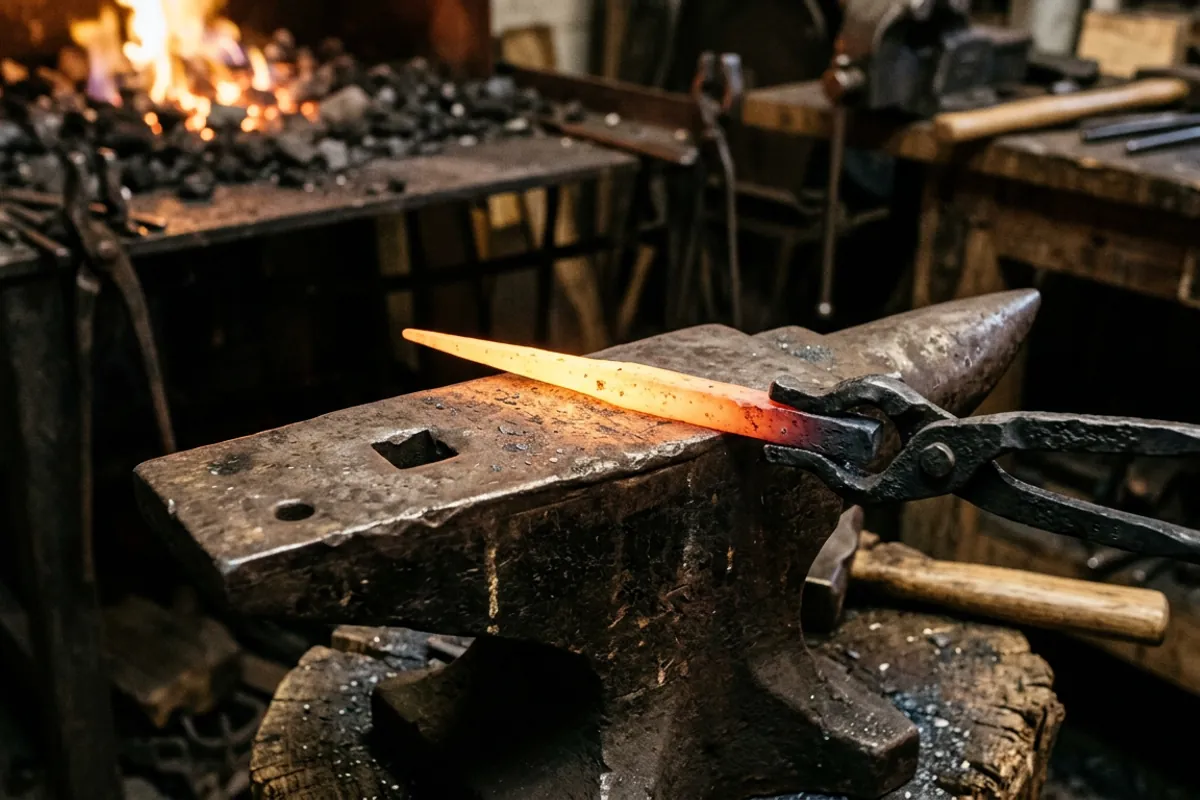
Drawing out is making steel longer and thinner. You hit it, it spreads under the hammer, and the bar gets narrower and stretches. Most of the time you spend at the anvil is drawing out. Tapering a point, thinning a tang, stretching a bar into a spike, all drawing out.
Upsetting is the opposite: making steel shorter and fatter. You heat the spot you want to thicken and drive the bar down onto the anvil face or the end into the metal, and the mass bunches up. Upsetting is harder than it sounds because the steel wants to bend instead of bunch, so you keep it short, hot, and straight.
Bending is what it sounds like, curving the bar over the horn of the anvil, in a vise, or around a jig. Hot bends are clean and controlled; the horn exists to give you a range of curves to bend against.
Punching and drifting put holes through steel without drilling. You punch a slit or a hole with a punch, then drive a drift through it to open it to the shape and size you want, an axe eye, a hammer eye, the eye of a hook. Done hot, the metal moves out of the way rather than being cut out, so you lose almost no material.
Cutting hot steel is done with chisels and with the hardy, a cutting tool that stands up in the square hole of the anvil. You nick the bar most of the way through hot, then break it, rather than sawing cold.
Wrap fullering and spreading in there too, using a rounded tool or the edge of the anvil to isolate mass or move it sideways, and you have the vocabulary. A leaf, a bottle opener, a set of tongs, a knife: all of it is these moves, chosen in the right order.
The tools that actually do the working
You can start with startlingly little, but four things do the real work.
The anvil is the other half of every hammer blow. It is not just a heavy block. A good anvil has a hardened steel face that returns your energy back up into the hammer, a horn for bending curves, a flat face for most work, a square hardy hole that holds cutting and forming tools, and a round pritchel hole for punching over. Bessie, my anvil, is a 148 pound Trenton, and she is the tool I have put the most hours on and the one I measure every other anvil against. Mass matters because a heavy anvil sits still and gives energy back, while a light one bounces and steals your work. For general blacksmith working, most people land somewhere in the 100 to 200 pound range, and I laid out how to think about that in the anvil weight guide.
The hammer is your hand on the steel. A cross pein in the 2 to 3 pound range covers most work, and if you are new, start at the light end. Beginners reach for a heavy hammer thinking it does more, then wreck their elbow in a month. Control beats mass every time; the heat is doing the moving, remember, and you are steering.
Tongs hold hot steel so your hand stays out of the fire. They need to fit the stock, gripping it so it does not spin or fly. Ill-fitting tongs are dangerous and maddening, and beginners underestimate how much a good matched pair changes the work.
The forge is where the heat comes from, and it is the tool everything else waits on.
Coal or propane, and why the fuel shapes the work
I run two forges and have for years, and the fuel changes how the work feels. A propane forge lights with a valve and a striker, comes up to an even heat fast, and heats a whole zone of the steel at once. It is clean, it is repeatable, and it is most of my day-to-day work. A coal forge takes tending, builds a hotter and more concentrated fire, lets you heat just one spot on a long bar, and is the fire I reach for on heavy stock and forge welding. Coal also makes smoke and demands real ventilation, which propane does not the same way.
Neither is the right answer for everyone, and I would not tell a brand new smith the choice is obvious. It depends on your space, your ventilation, your patience, and what you want to make. I put the honest tradeoffs side by side in coal or propane for a first forge, and the short version is that both are legitimate, and the fuel is a personal fit, not a hierarchy.
Forge welding, the skill that separates
Forge welding is joining two pieces of steel with heat and pressure alone, no filler, no arc. You bring both pieces up to a bright yellow, close to white, use flux to keep the surfaces clean of scale, and set the weld with the first light blows before it can cool. Done right the two bars become one, and you cannot find the seam. Done wrong you get a cold shut that looks joined and lets go later.
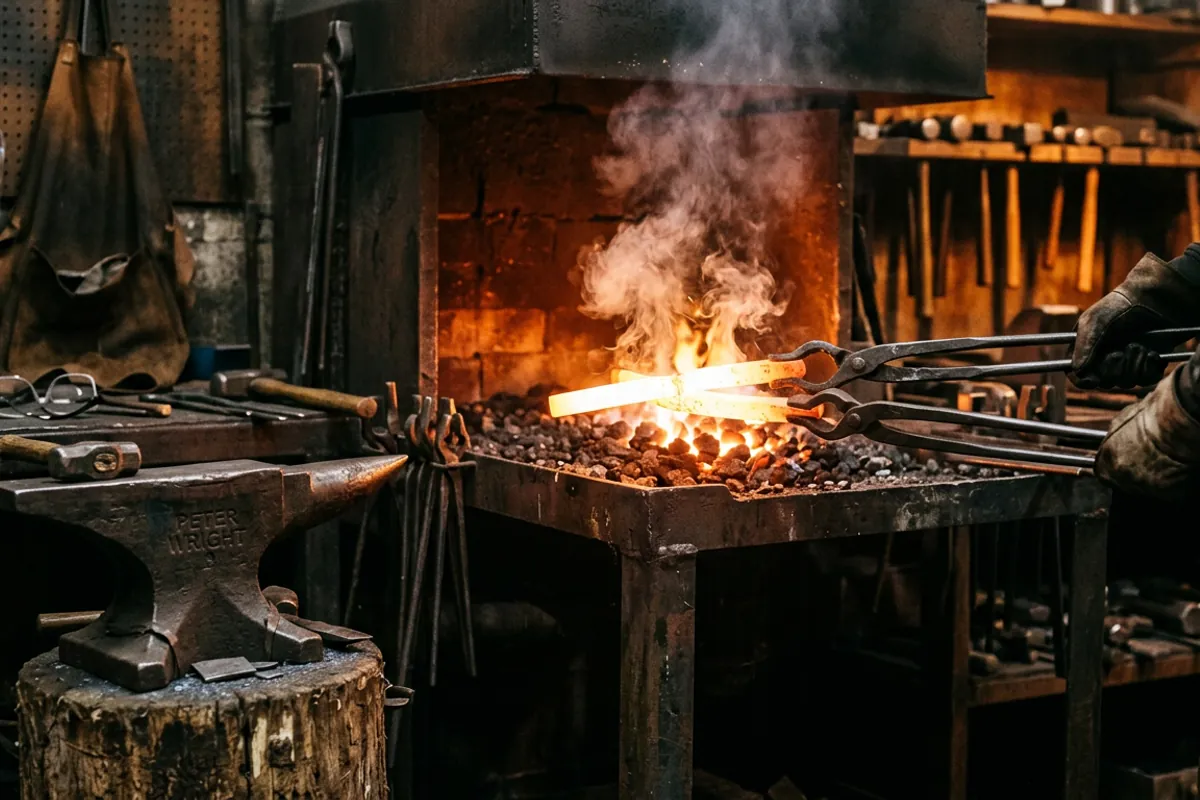
I will be straight: this is the skill that humbles people. It took me a lot of ruined heats and a coal fire I trusted to get consistent at it, and I still treat every weld with respect. The heat window is narrow, the timing is tight, and everything has to be ready before the steel comes out of the fire. Ask ten smiths and most will tell you their first dozen forge welds failed, and that matches my own start. It is worth learning, but it is not a first-week move, and anyone who tells you it is easy is selling something.
Working safely, because the forge does not forgive
This site is safety-serious for a reason I earned. Early on I quenched a blade in oil that was too cold, standing too close in a cotton shirt with no face shield, and the oil flared and took my eyebrows. I kept my eyesight by luck alone. Luck is not a safety plan.
Wear eye protection rated to ANSI Z87.1 whenever you are at the forge or the grinder, not sometimes. Hot scale flies off the work, and the grinder throws steel and abrasive at your face all day. Dress in natural fibers, cotton, wool, leather, because synthetics melt onto skin when they catch, and near this kind of heat that is a real and ugly injury. Keep bare skin covered against radiant heat and flying scale. Run real ventilation, especially with a coal fire, because coal smoke and carbon monoxide are not something you tough out. Protect your hearing at the power hammer and grinder. And respect the quench: know your oil, keep your face back, and never lean over it in something that will burn.
None of this is optional gear you add later when you are advanced. It is the price of admission. I laid out what actually matters and what you can skip in blacksmith safety gear, and I would read that before your first heat, not after your first burn.
What a working session actually looks like
A real session has a rhythm. You light the fire and let it settle while you lay out stock and tools within reach, because fumbling for tongs with hot steel in the fire is how mistakes happen. Then you work in heats. You pull a piece at forging color, get maybe fifteen to thirty seconds of good working time before it drops out of the window, make your blows count, and put it back. The fire is always working for you while your hands rest, and a good smith is never standing idle waiting on nothing.
Between heats you plan the next few blows. Blacksmith working is less about strength than about sequence: knowing what to move first, because once you thin a section it is a chore to thicken it again, and once you bend a piece it changes how everything after it reaches the anvil. Beginners swing hard and think loud. Experienced smiths hit where it counts and let the heat and the anvil do the work.
You also quit before you think you need to. Tired hands miss, and a missed blow on hot steel is how you fold a mark into the work or bark your knuckles. When your accuracy goes, the session is over, no matter how much fire is left in the forge.
What blacksmith working is not
Let me kill a few myths, because they set beginners up to be discouraged. It is not brute force; a small person with good timing outworks a big one who just swings hard. It is not fast; a simple hook is a pleasant hour, and a knife is a project, not an afternoon. It is not one heroic blow that reveals a finished sword out of a glowing bar, the way movies love to show. It is patient, repeated, ordinary work, a hundred small correct decisions, and the satisfaction is in the accumulation, not in any single dramatic moment.
That is the honest shape of it. Heat the steel, read the color, move the mass with control, keep yourself whole while you do it, and repeat until the part is done. If that sounds like something you would enjoy on a quiet weekend, you probably will, and there is a lot more from the shop over on the More from the shop hub when you are ready to go deeper on any one piece of it.