Heated steel is the whole job. Everything a blacksmith does happens in the window between a cold gray bar and a bright bar glowing on the anvil, and learning to read that heat is the difference between moving metal cleanly and burning it into a shower of sparks. I have spent about twenty-five years watching color climb up a piece of steel in my shop, and the more I learn the more I respect how much is going on inside that bar while it just sits there getting brighter. This is a plain explainer of what heated steel actually is: what the colors mean, what the metal is doing at each stage, where the useful heats are, and where you cross a line you cannot walk back. No product pitches here, just the physics as it shows up on the forge floor.
If you want the sister pieces on what to do with that heat once you have it, I keep the whole reference shelf on the steel and metallurgy hub, and this article leans on the same ideas covered in heat treatment of metals and annealing steel.
What is actually happening when steel heats up
Steel is iron with a little carbon in it, plus whatever alloying elements the mill added. At room temperature the iron atoms sit in a tidy repeating grid called a crystal lattice. When you push heat into that bar, you are pouring energy into those atoms and they start vibrating harder in place. That vibration is what your tongs feel as warmth and what your eyes eventually read as glow.
Three things happen as the temperature climbs, and they matter to a smith in this order. First, the steel gets softer and easier to move under the hammer. Second, at a specific temperature the crystal structure itself rearranges into a different, more open arrangement. Third, if you keep going past where you have any business being, the metal starts to break down and burn. Cold steel work-hardens and fights you. Hot steel flows. The whole craft lives in getting the bar into the right part of that range and keeping it there while you work.
The glow you see is real physics called incandescence. Anything hot enough radiates light, and the color of that light tracks the temperature closely enough that smiths have read heat by eye for centuries. That is the single most important skill in this trade, and it is worth understanding what each color is telling you.
Reading the colors of heated steel
The color of heated steel is a temperature gauge you already own. It is not perfectly precise and it lies to you in bright light, which is why an experienced smith works in a dim shop and judges color in shade. But the sequence is reliable and worth memorizing.
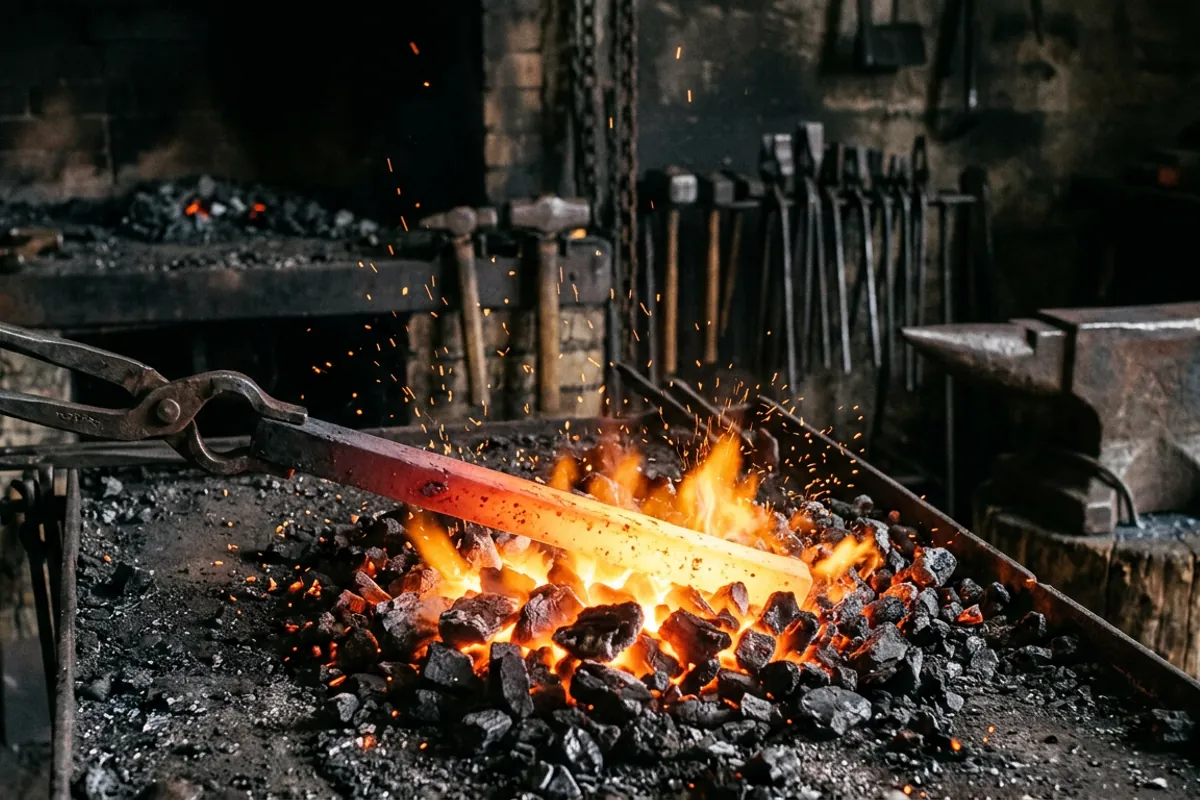
Steel first shows visible color around a dull blood red, somewhere near 900 degrees Fahrenheit, and even that only shows up if you cut the shop lights. From there it climbs through a dark cherry red, a medium cherry, a bright cherry, then into orange around 1700 degrees, then a bright orange, then yellow up around 1900 to 2000 degrees, and finally a glaring white with sparks starting to leave the surface above roughly 2400 degrees. Those numbers are the commonly published ranges smiths and heat-treaters use, and they are close enough to work by, but treat them as landmarks and not laboratory readings.
Here is the catch, and it is a big one. Do not confuse these incandescent glow colors with temper colors. Temper colors are the thin oxide tints, straw and bronze and blue, that appear on clean polished steel down in the 400 to 600 degree range when you are drawing a temper. Those are a different phenomenon entirely, they show on the surface film rather than as a glow, and I cover them in the piece on how to temper steel by heating and cooling. Glow color tells you the bulk temperature of hot steel. Oxide color tells you a much lower surface temperature on cool steel. Mixing them up is a classic beginner trap.
One more honest note on reading color: your eyes adapt. Judge the same steel in the same lighting every time, ideally with your back to the window and the forge in shade. Two smiths in two different shops will call the same heat by slightly different names, and that is fine as long as each one is consistent with their own forge.
The critical temperature and why steel changes at heat
There is a temperature where heated steel does something you cannot see by color alone but which sits at the center of all heat treating. It is called the critical temperature, or the upper critical, and for plain and low-alloy carbon steels it lands somewhere in the neighborhood of 1400 to 1500 degrees Fahrenheit depending on the exact carbon and alloy content.
Below that point the iron is in a form called ferrite, and the carbon is locked up in a compound. At the critical temperature the crystal lattice reshuffles into a new arrangement called austenite, and the carbon dissolves into it and spreads out evenly, the way sugar dissolves into hot coffee. This new structure is the launch pad for everything. If you cool austenite slowly you get soft steel. If you cool it fast, you trap the carbon in place and get hard, brittle steel. That fast cool is the quench, and that is the whole reason a blade can be hardened at all.
You can actually sense the critical point if you watch closely. As steel passes up through it, the change absorbs energy and the surface seems to pause or briefly darken while the rest keeps heating, an effect called decalescence. On the way down it releases that energy and the steel flushes brighter for a moment, called recalescence. Old-timers hardened simple carbon steel by heating past that flush and quenching the moment it reappeared. It is a real, watchable event, and seeing it once tells you more than any chart.
There is also the non-magnetic trick worth knowing. Steel loses its magnetism at the Curie point, which for many carbon steels sits very close to the critical temperature. Touch a magnet to the hot bar, and when it stops sticking you are in the right neighborhood to harden. It is a rough guide, not a substitute for knowing your specific steel, but it is a cheap and honest check that has hardened a lot of good blades.
Where the useful heats live for forging and heat treating
Not every heat is for the same job, and part of learning heated steel is learning which color goes with which task.
Forging heat. For actually moving metal under the hammer, you want the steel up in the bright orange to yellow range, roughly 1800 to 2100 degrees for most carbon steels. Up there the metal is soft and flows well and you get the most work done per heat. Work it too cold, down in the low reds, and you are pounding on steel that no longer wants to move. That is not just wasted effort. Forging plain steel below a certain temperature can crack it, and with some alloy steels there is a real cold-shortness range you learn to stay above.
Welding heat. Forge welding needs the steel hotter still, up near white and throwing sparks, because you are getting two surfaces molten enough at the interface to fuse. That is the top of the useful range and it lives right next to the cliff, which is exactly why forge welding is a skill that takes practice to land without burning the work.
Hardening heat. For hardening you heat to just above that critical temperature, hold long enough for the structure to convert fully, then quench. The whole point is to reach austenite cleanly without overheating, because getting hotter than you need buys you nothing but trouble.
Annealing and normalizing heat. To soften steel for filing or drilling, or to refine the grain, you again heat above critical but then cool slowly or in still air rather than quenching. The temperature target is similar, the cooling is what changes. I walk through that in detail in annealing steel.
The important idea is that a single bar might pass through all of these ranges in one session, and knowing which color you are aiming for at each step is what separates deliberate work from hoping.
What heat does to the surface: scale and decarburization
Heated steel does not just glow, it reacts with the air around it, and two of those reactions cost you material.
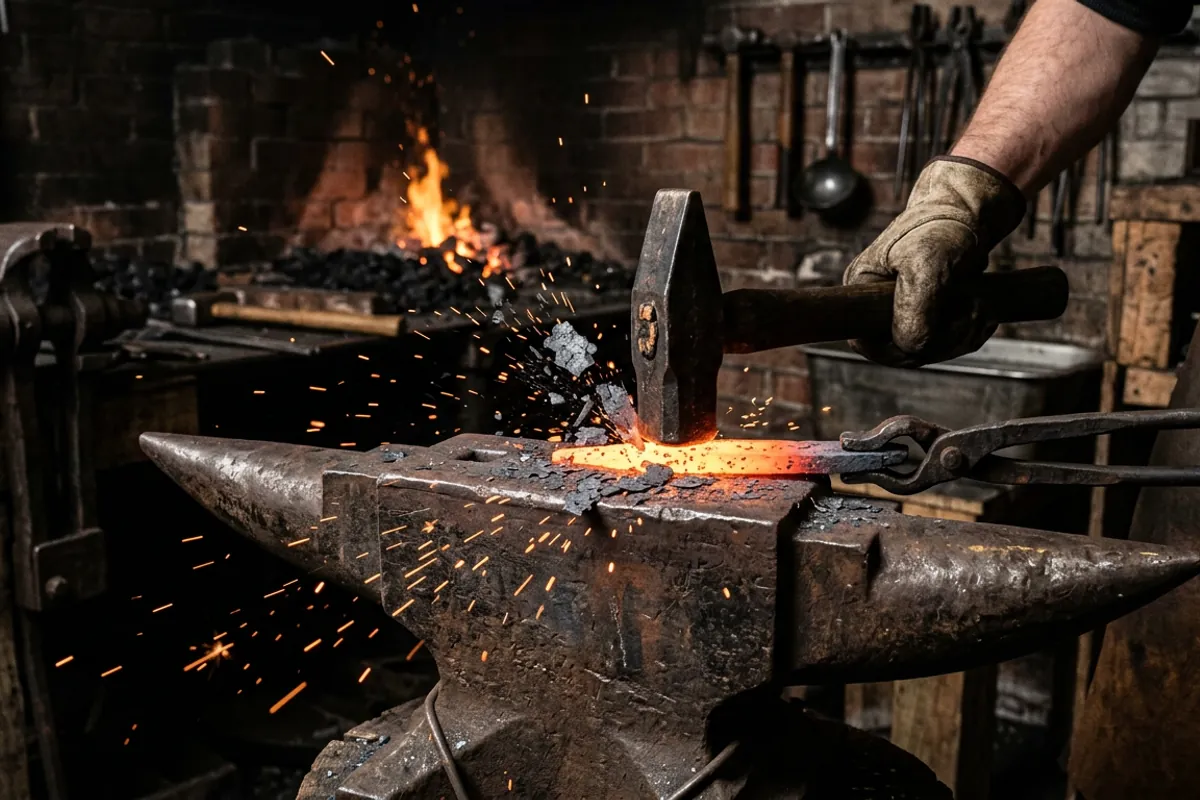
The first is scale, the flaky gray-black crust that forms on hot steel and flies off under the hammer. That is iron oxidizing, literally rusting fast because heat speeds the reaction. Every bit of scale that falls off is steel you have lost off the surface of your workpiece. A little is unavoidable in an open forge. A lot means you are running the steel too hot or leaving it in the fire too long between hammer blows.
The second reaction is quieter and worse for bladesmiths: decarburization. At forging and hardening heats, carbon near the surface of the steel burns out into the atmosphere. Since carbon is what lets the steel harden, a decarburized skin is a soft skin, and on a blade that means an edge that will not take a proper hardness until you grind past the affected layer. This is one reason smiths leave grinding stock on a blade and do not forge a finished edge to zero thickness. The outermost material has often given up some of its carbon to the fire.
Both problems get worse the hotter you run and the longer you soak. That is a practical argument for efficiency: get the steel to heat, do your work, and get it back in the fire rather than parking a bar at yellow heat while you decide what to do next.
Overheating and burning: the heats you cannot undo
There is a top end to heated steel, and crossing it is one of the few mistakes in this craft you genuinely cannot hammer back out.
Push carbon steel up into a glaring white and hold it there and the grain inside grows coarse. Coarse grain makes for weaker, more brittle steel, and while a bad overheat can sometimes be corrected by normalizing and reforging, it is real damage to the internal structure. Keep going and the steel starts to burn. Burnt steel throws heavy bright sparks, the surface looks wet or sparkly, and what is happening is that the metal is oxidizing at the grain boundaries deep into the bar. Burnt steel is scrap. You cannot forge it back to sound metal, you cannot heat treat it into something trustworthy, and a blade made from burnt stock can fail. The only cure is to cut off the burnt section and lose it.
This is why the old advice to work steel in the yellow-orange range and treat white heat with respect is not fussiness. The margin between a good forge-welding heat and a ruined bar is narrow, and it is measured in seconds of inattention when your fire is hot. Watch the sparks. A few stray sparks at welding heat are normal. A fountain of them means you have gone too far.
For the deeper metallurgy of exactly how time and temperature trade off against grain size and hardness, that is genuinely testable science, and I send people to Knife Steel Nerds rather than making up numbers. They run the real experiments. What I can tell you from the floor is that the visible signs, the coarse sparkle and the heavy sparks, show up before the steel is fully gone, so if you learn to see them you can pull back in time.
Working heated steel safely
Everything above assumes you go home with your eyebrows, and I say that as a man who once did not. Early on I quenched a blade in oil that was too cold, standing too close in a cotton shirt with no face shield, and the oil flared and took my eyebrows off. I kept my eyesight by luck alone. Heated steel is not casually dangerous, it is seriously dangerous, and the habits are not optional.
Wear real eye protection rated to ANSI Z87.1. Scale flies off hot steel with force, sparks come off the grinder, and a chip of hot metal in the eye is a life-changing injury that a five dollar pair of safety glasses prevents. Wear natural fibers, cotton or wool or leather, near the forge. Synthetics melt and stick to skin when they catch, and around heated steel they will catch. Keep a clear space and know that a bar which stopped glowing an hour ago can still be hot enough to brand you, because heated steel loses its visible color long before it loses its heat. Black steel burns just as badly as orange steel, and it does not warn you.
Assume the floor around your anvil is littered with hot scale, because it is. Assume anything on the forge or the anvil is hot until you have personally seen it go cold. And treat the quench tank with the same respect I learned the hard way: right oil, right temperature, face and body out of the flare path, and never a synthetic shirt. The full rundown of what to wear and what to skip lives in the blacksmith safety gear writeup. Read it before your first fire, not after your first burn.
Heated steel is the most useful and least forgiving material in the shop. Learn to read its color, respect its critical point, keep it out of the burning range, and never let its glow fool you into thinking a cold-looking bar is safe to grab. Get those four things right and the rest of blacksmithing is just practice.