If you have spent any time reading spec sheets for stainless bar stock, or you have ever sent parts out to a commercial heat treater, you have probably run into a line like AMS 2759/3. It looks like a part number, it is written in that cold aerospace shorthand, and on its face it tells you nothing. I am a hobby smith, not an aerospace metallurgist, so let me be straight with you up front: AMS 2759/3 is not a procedure you will ever run in a home shop. But it is worth understanding, because it governs the heat treatment of exactly the steels a lot of us get curious about, the precipitation-hardening stainless and the maraging steels, and reading how the pros handle them teaches you how much control goes into a process most of us do by eye and color.
What AMS 2759/3 actually is
AMS stands for Aerospace Material Specification. These are documents published by SAE International, and they are the rulebooks that aerospace and defense manufacturers cite on drawings so that a part made in one shop comes out the same as a part made in another shop a thousand miles away. When a drawing says a part shall be heat treated per AMS 2759/3, it is not a suggestion. It is a contract. It pins down the process tightly enough that an inspector, a supplier, and a customer can all agree the part meets the same standard without watching it get made.
AMS 2759/3 specifically covers the heat treatment of precipitation-hardening corrosion-resistant and maraging steel parts. Break that phrase apart. Corrosion-resistant means stainless. Precipitation-hardening is a particular way of getting stainless steel hard and strong without the brutal quench of a plain carbon steel. Maraging is a separate family of ultra-high-strength low-carbon steels that harden by aging rather than by a carbon-driven quench. The slash-3 document is the specific procedure sheet for that group.
The important thing to understand is what a spec like this is really controlling. It is not telling the metallurgist how the steel works. Everyone involved already knows the metallurgy. What it controls is process discipline: the exact temperatures, the hold times, the cooling method, the order of operations, and above all the proof that the furnace actually did what the operator thinks it did. That last part is where the real teeth are, and I will come back to it.
Where the AMS 2759 family fits together
AMS 2759 is not one document. It is a family, with a base specification and a set of slash-numbered children, each aimed at a different class of steel. The base AMS 2759 lays out general heat treatment requirements for steel parts. Then the slashes get specific. In broad strokes, the low slash numbers cover carbon and low-alloy steels, higher-strength low-alloy steels get their own sheet, and AMS 2759/3 carves out the precipitation-hardening stainless and maraging grades because those steels harden by a completely different mechanism than a plain carbon blade steel does.
That split matters because you cannot heat treat a precipitation-hardening stainless the way you heat treat 1084 or 4140. There is no bright-red-then-quench-in-oil step that gives you the final hardness. If you want the plain carbon and low-alloy side of the picture, I wrote up how I run one of the common shop steels in how I heat treat 4140, from the forge floor, and the general logic of what heating and holding steel actually does to it in heat treatment of metals, explained from the forge floor. AMS 2759/3 is a different animal because the steels it covers harden a different way.
The steels it covers, and how they harden
There are two families under this spec, and it is worth separating them.
The precipitation-hardening stainless steels are grades like 17-4 PH, 15-5 PH, PH13-8Mo, and 17-7 PH. The numbers roughly describe the alloy, so 17-4 is about 17 percent chromium and 4 percent nickel, with a few percent copper thrown in. The trick with these steels is that you first solution treat them at high temperature to dissolve the alloying elements into the structure, cool them, and then hold them at a much lower temperature so that tiny hardening particles precipitate out inside the metal. Those particles are what pin the structure and give the steel its strength. It is a slow, gentle, controlled process compared to a carbon-steel quench, and it happens well below a red heat.
The maraging steels are a separate group, the 18 percent nickel grades usually labeled by their strength, like maraging 250, 300, and 350. The name is a mash-up of martensite and aging. These steels carry almost no carbon, which is unusual, and they get their strength from intermetallic compounds that precipitate during aging, not from carbon-driven hardness. You solution anneal them, they air cool to a relatively soft and machinable martensite, and then you age them to develop full strength. Maraging steels reach some of the highest strength-to-toughness combinations in commercial steel, which is why they show up in aerospace, tooling, and high-end applications.
Neither of these families behaves like the knife and tool steels most home smiths cut their teeth on. If you want the closer-to-home version of stainless heat treat, the kind a knife maker might actually attempt, I laid out the honest limits in how to heat treat stainless, honestly, from a home shop and the underlying process in heat treating stainless steel, explained from the forge floor. AMS 2759/3 sits a long way above that, but the physics rhyme.
Condition A, H900, and the aging conditions
Here is a piece that is genuinely useful to know, because you will see it stamped on bar stock and spec sheets whether or not you ever touch the AMS document.
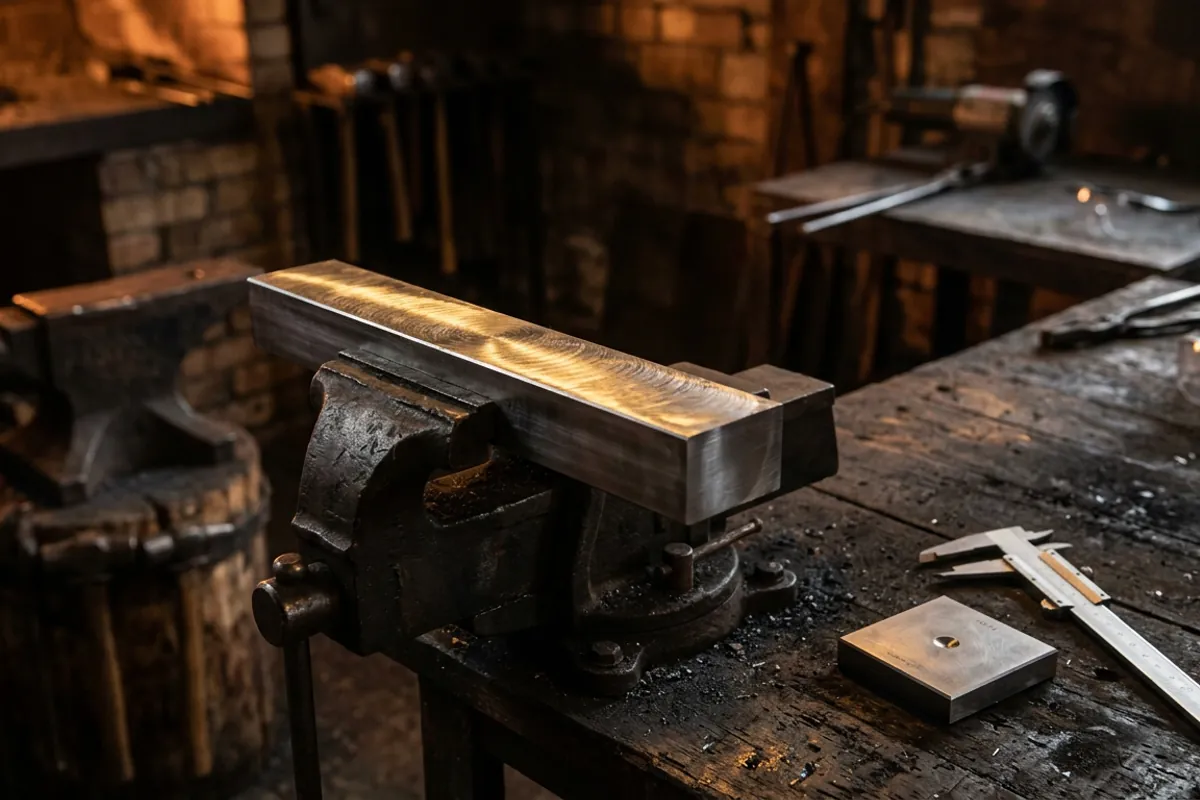
Precipitation-hardening stainless is usually delivered in Condition A, which just means solution annealed and not yet aged. In that state it is relatively soft and can be machined or worked. Then it gets aged to a named condition, and the naming is refreshingly literal. The common designations look like H900, H1025, H1075, and H1150. The number is the aging temperature in degrees Fahrenheit. H900 means the part was aged at 900 F, H1150 means it was aged at 1150 F.
The pattern is worth internalizing. A lower aging temperature, like H900, gives the highest strength and hardness but the least toughness. A higher aging temperature, like H1150, trades strength away for more ductility and toughness. So a shop chooses the condition to fit the job. For 17-4 PH, H900 lands the steel up around the mid-40s on the Rockwell C scale, while the high-temperature conditions drop it well down into the 30s. Some grades and conditions also require a sub-zero refrigeration step between solution treat and aging to force the structure to fully transform before it is aged. That deep-freeze step is one more thing the spec nails down, because skipping it leaves the part short of its properties.
I am giving you the general shape of these conditions because the designations are industry-standard and checkable, not because I have run them. I have not. If you want to go deep on the actual precipitation mechanisms and the real numbers, that is exactly the sort of thing Knife Steel Nerds covers with proper lab work rather than shop-floor guessing, and it is where I send people who want the metallurgy verified rather than asserted.
Why pyrometry is the real backbone
If you take one idea away from this whole piece, make it this one, because it is the part that actually changed how I think about my own forge. The hard core of AMS 2759/3 is not the temperatures. It is the requirement to prove the furnace hit those temperatures. That proof lives in a companion specification, AMS 2750, the pyrometry standard, and 2759/3 leans on it completely.
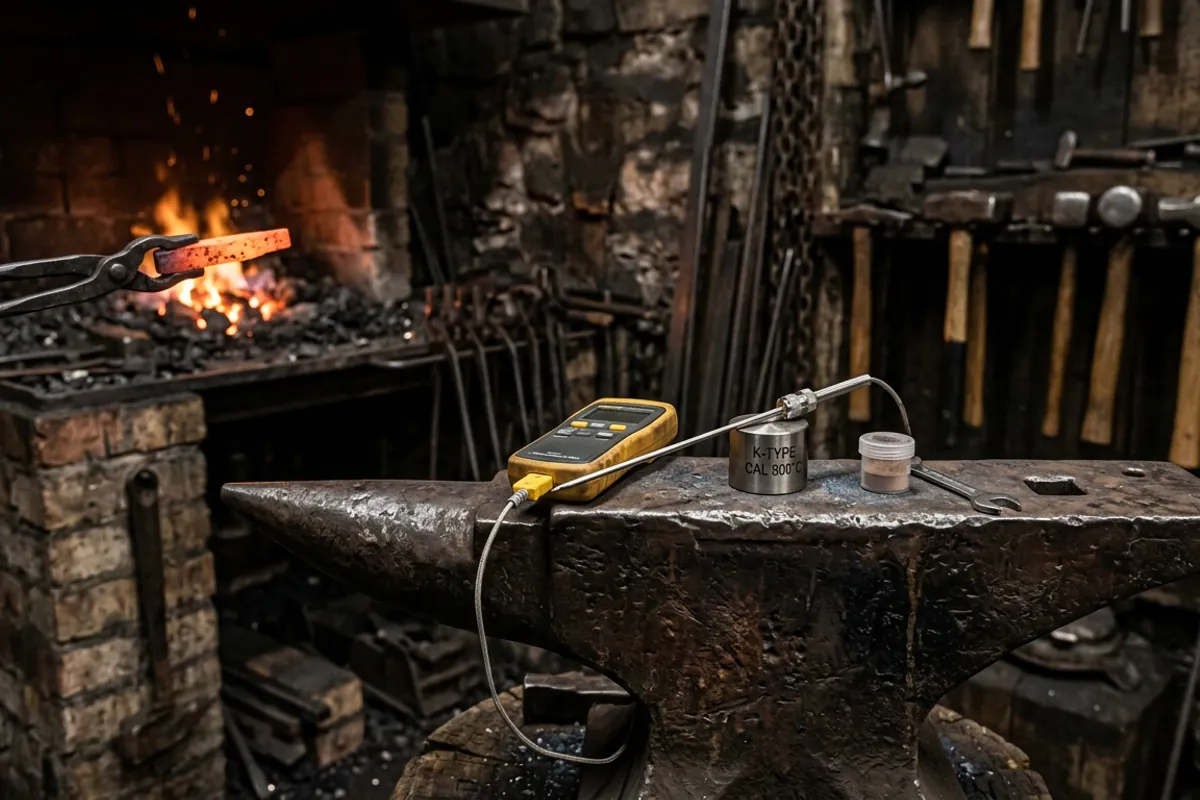
Pyrometry is just the science of measuring temperature accurately. AMS 2750 sorts furnaces into classes by how tightly they hold temperature uniformity across the whole working zone, running from roughly plus or minus 5 F at the tightest class down to plus or minus 50 F at the loosest. It sets rules for the thermocouples: what types are allowed, how often they get calibrated, how long they can stay in service before they drift. It requires a system accuracy test, where a known reference is used to check that the furnace's own instrument is telling the truth. And it requires a temperature uniformity survey, where thermocouples are placed throughout the empty working volume and the furnace is proven to hold every corner within tolerance before real parts ever go in.
Sit with that for a second. Before an aerospace part is treated, somebody has already proven the furnace is uniform to within a handful of degrees, proven the sensor is accurate, and documented all of it with dates and signatures. Now think about how most of us judge heat at home: color by eye, maybe a magnet for a rough transformation check, maybe a cheap infrared gun that reads surface and lies about anything shiny. There is nothing wrong with that for a lot of shop work, and a good smith develops a genuinely useful eye. But it is worth being honest that the gap between the two worlds is enormous, and it is the pyrometry, not the recipe, that makes the difference.
What this actually has to do with a home shop
Nothing, in the direct sense, and I want to be plain about that so nobody wastes money. You will not be running AMS 2759/3. You do not have a surveyed furnace, calibrated thermocouples, a documented system accuracy test, or the sub-zero equipment some of these conditions call for. Precipitation-hardening stainless and maraging steel are also poor choices for the kind of forge-and-file work most of us do, both because they need that tight thermal control and because they are expensive and unforgiving of a sloppy process.
Where the idea earns its keep at home is as a mirror. The spec makes explicit every source of error a home heat treat quietly ignores. Uneven furnace temperature. A hot spot near the burner. A soak that was too short because the part had not actually reached temperature all the way through. An instrument that reads confidently and wrongly. When my results on a batch of blades come out inconsistent, the AMS 2750 checklist is a useful way to think about why: was my heat even, did I actually hold long enough, do I trust my measurement. You do not need aerospace gear to apply aerospace questions.
The other honest takeaway is respect for what commercial heat treaters sell. When a shop runs to AMS 2759/3, you are not just buying an oven cycle, you are buying the documented proof that the cycle was controlled and verified. I walked through what that commercial service really buys you in what commercial steel heat treating actually does for a smith, and the short version is that the paperwork is the product as much as the heat is.
Where a smith actually runs into this spec
For most of us, the encounter is on paper, not in the fire. You will see AMS 2759/3 cited on a material certification if you buy certified stainless bar, or on a drawing if you ever do contract work to someone else's print, or in the fine print of a supplier's catalog listing a grade in a particular H condition. When you see it, you now know what it means: this steel is a precipitation-hardening stainless or a maraging grade, and if it is called out in a condition like H1025, it has been aged to that specific temperature to hit a specific strength.
Knowing the vocabulary keeps you from two mistakes. The first is buying precipitation-hardening stainless expecting to heat treat it like a carbon blade steel, then wondering why your normal quench does nothing useful. The second is paying for a certified, aged condition you do not need, or conversely buying Condition A stock and forgetting it still needs to be aged before it reaches its rated properties. If you are choosing a steel for an actual project, the plainer decision-making I use lives across the steel and metallurgy topic hub, and that is a better starting place than a maraging grade for almost any home job.
The honest limits of doing this at home
I will close where I started, because it is the safety-serious point. AMS 2759/3 exists because getting these steels to their rated strength is genuinely hard, and because parts made from them often carry loads where failure is not a scratched project but a real hazard. That is the whole reason the spec is so heavy on proof rather than recipe. A home shop can learn a great deal from the way it thinks, the insistence on even heat, honest measurement, and adequate soak, and those lessons carry straight over to the carbon and alloy steels we actually do work. But treating the spec itself as a home procedure would be pretending to a level of control you do not have, and with high-strength steel that pretense is exactly the kind of thing that gets someone hurt.
So use it as a teacher, not a target. Let it sharpen the questions you ask about your own fire. And when a job genuinely needs a precipitation-hardening stainless or a maraging steel treated to spec, send it to a commercial heat treater who runs a surveyed furnace and hands you the paperwork to prove it, the same way you would send a critical metallurgy question to real testing rather than settle it by argument on a forum.