80CrV2 steel is what I reach for when I want a blade that will take abuse without me babysitting the quench. It is a simple low alloy carbon steel, close cousin to the 1080/1084 family, with a little chromium and a little vanadium added. That small change does two useful things: it buys a bit of hardenability so the quench is less of a coin flip, and it pins the grain so a forge heat that runs a touch hot does not wreck the steel. It is not stainless, it is not a powder steel, and it will not hold an edge like the modern high alloy stuff. What it will do is bend before it breaks, and for choppers, camp knives, and anything with a handle long enough to swing, that is the trade I want.
This is a reference piece, not a sales pitch. I have forged and heat treated plenty of it in a home shop with a propane forge, a warm oil tank, and a toaster oven, and everything below is written from that floor. Where I am passing along what other smiths report rather than what I have done, I say so. For the deeper metallurgy, I point you at real published testing rather than making up numbers.
1084 with a vanadium safety net
80CrV2 is a German designation. The material number is 1.2235, and the name itself is a recipe if you know how to read it. In the European low alloy naming system, the leading number is carbon multiplied by 100, so 80 means about 0.80 percent carbon. The letters name the alloying elements in order of importance, chromium and vanadium here. The trailing 2 applies to the chromium and gets divided by 4, so about 0.5 percent chromium. The vanadium is present in small enough quantity that it gets no number of its own.
Typical published composition runs about:
- Carbon 0.75 to 0.85 percent
- Chromium roughly half a percent (published as 0.40 to 0.60 by one stockist and 0.40 to 0.70 by another)
- Vanadium 0.10 to 0.20 percent
- Manganese 0.30 to 0.50 percent
- Silicon 0.15 to 0.35 percent
Those are ranges, not a promise. Every bar comes out of a specific heat, and the mill certificate for that heat is the only document that tells you what you actually bought. If your supplier will give you the cert, keep it with the bar. I write the steel and the heat on the bar with a paint pen the day it arrives, because an unlabeled offcut in a rack is scrap metal with delusions.
In industry this steel and its neighbors show up in band saw blades, springs, and cold work tooling. The knife world picked it up because it sits in a genuinely useful spot: enough carbon to get properly hard, enough alloy to be forgiving, and not so much of either that a home shop cannot heat treat it well.
What the chromium and the vanadium are actually doing
This is the part people get wrong, so it is worth being blunt about it.
The chromium is not there for rust resistance. Half a percent of chromium does essentially nothing for corrosion. A steel needs somewhere around 11 to 13 percent chromium dissolved in the matrix, not tied up in carbides, before it starts behaving like stainless. 80CrV2 will rust in a humid shop overnight if you leave it wet. What the chromium does is slow down the transformation from austenite to pearlite during the quench. That is hardenability, and it means you have a slightly longer moment to get the steel from critical temperature down past the nose of the curve before it turns soft on you. Practically, that shows up as fewer soft spots and fewer failed quenches than an equivalent carbon steel with no chromium at all.
The vanadium is there for grain. Vanadium forms very hard, very stable carbides that resist dissolving at forging and hardening temperatures. Those undissolved carbides sit at the grain boundaries and physically get in the way of grain growth. Fine grain is most of what toughness is in a simple carbon steel, and a steel that resists coarsening when you overshoot a heat is a steel that forgives an ordinary home forge. There is a small wear resistance benefit too, but at a tenth or two of a percent, the grain pinning is the real prize.
If you want the theory behind carbide formation and grain size in more detail than a gear site should be handing out, go read Larrin Thomas at Knife Steel Nerds. He does actual tested metallurgy, publishes the method, and will tell you when the data disagrees with the folklore. I do not run a lab. I run a forge, and I take my numbers from people who run labs. The topic hub at Steel and metallurgy collects the rest of what I have written on this side of the craft.
Forging 80CrV2
It forges like a well behaved carbon steel. Nothing exotic.
I bring it up to a bright orange, call it roughly 1900 to 2100 F, and work it down. It moves easily at the top of that range. Below a dull red, around 1500 F and under, I stop hitting it and put it back in the fire. Forging cold steel is how you open cracks you will not see until the quench, and in a blade that means a broken tip six months after you gave the knife away.
Two things to watch:
Do not cook it. Simple carbon steels start burning above roughly 2300 F, and burned steel is scrap. Sparklers coming off the bar in the forge means you are past saving that heat. The vanadium buys you tolerance for grain growth, not immunity to burning.
Budget for decarburization. Any carbon steel sitting in an open, oxidizing forge atmosphere loses carbon at the surface. That skin will not harden the way the core does. I leave enough stock on a forged blade that the grinding takes the decarb layer off completely, usually well past where a soft edge could survive. If you grind a blade to a whisper before heat treat, you are hardening a piece of steel whose surface is no longer the steel you bought.
Thickness matters here too. Shallow hardening steels want a thin edge to quench properly, but a paper thin pre heat treat edge warps and can crack. I take blade edges to roughly the thickness of a dime before quench and grind the rest afterward. That is the compromise most makers land on and it has served me fine.
Normalizing and thermal cycling
Forging beats the grain around. Some areas got hot, some did not, and the structure across the blade is uneven. Normalizing evens it out and refines the grain, and skipping it is the single most common reason a beginner's blade snaps.
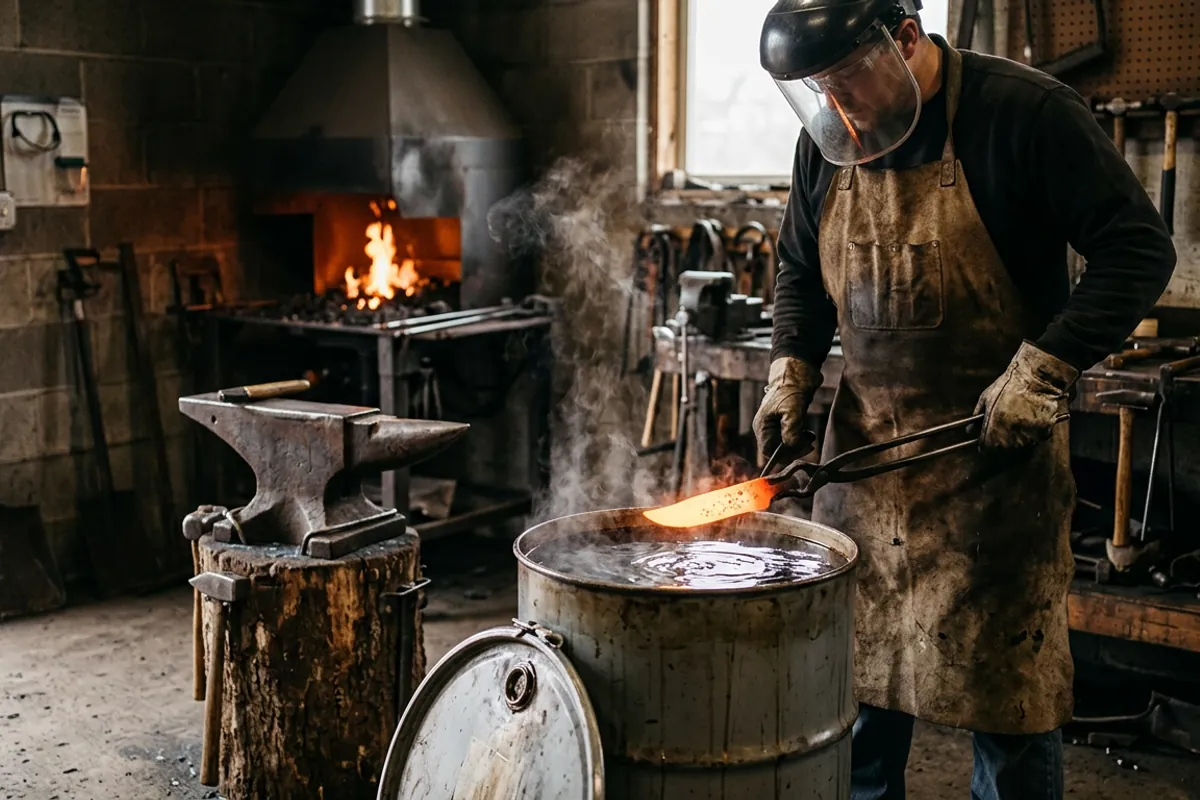
My routine on 80CrV2, after the forging is done and before hardening:
- Heat to about 1600 F, hold until the whole blade is at temperature, then air cool on a rack until it loses color and is black.
- Heat to about 1500 F, air cool the same way.
- Heat to about 1450 F, air cool again.
Each descending cycle produces finer grain than the last. That is the common shop teaching, and it is disputed: I laid out the published disagreement over cycle counts and temperatures in normalizing steel, cycles and temperatures. From there I either go straight to hardening if the steel will be ground and drilled quickly, or I anneal it if I need it dead soft for drilling and filing. For a full anneal, the practical home shop version is to heat to critical, then bury the piece in vermiculite or wood ash and let it cool overnight as slowly as possible. I wrote up the whole process in What annealing steel actually does, and the general background lives in Heat treating steel, explained from the forge floor.
Hardening: the quench
Published guidance for 80CrV2 lands at 1525 F for austenitizing with a 10 to 20 minute soak depending on thickness, followed by a fast oil quench. That is the target I use. Alpha Knife Supply lists higher, 1545 to 1615 F, which is 20 to 90 F above the tested figure and identical to its own 52100 numbers, so I would look at that spread with some skepticism.
A few things about hitting that number honestly:
A magnet does not tell you what you think it does. Steel loses its magnetism at the Curie point, about 1414 F, which is below where you want to be for hardening. Non magnetic means you are close to critical, not that you have arrived. In a forge with no temperature control I go by non magnetic plus a bit more heat and accept the imprecision. A kiln or an oven with a controller and a thermocouple is what actually gets you repeatability, and for a maker producing knives for other people, that is the upgrade that matters most.
The oil needs to be fast and it needs to be warm. Fast commercial quench oils formulated for shallow hardening steels are the right tool. Canola oil works, is what plenty of hobby makers start on, and is slower than the commercial stuff, which means it is less tolerant of a thick spine or a fumbled transfer. Vegetable oils are usually run warm, around 120 to 130 F, because warm oil is thinner and pulls heat out faster than cold oil. Commercial oils have their own specified operating range printed on the data sheet, and that sheet is the authority, not me.
Water is not an option here. Do not water quench this steel. The added hardenability from the chromium means you do not need it, and a water quench on a 0.8 percent carbon blade is a very effective way to make two pieces of steel out of one.
After the quench, before tempering, I test with a sharp file. A properly hardened blade skates the file with a glassy feel. If the file bites, something went wrong and the answer is to fix it now, not to keep grinding on a soft blade. Quenched and untempered, 80CrV2 typically comes out in the mid 60s HRC, and it is as brittle as glass at that point. Do not drop it, do not flex it, and get it into the tempering oven promptly.
Tempering, and where the hardness lands
Two tempering cycles of two hours each, with a full cool to room temperature between them, is the standard practice and what I follow.
Roughly what the temperatures buy you:
- Around 400 F: high hardness, right for slicers and smaller knives where you want edge holding
- Around 425 to 450 F: the middle ground, and where most general purpose blades live
- Around 450 F: peak toughness in the published testing, and where I go for choppers and anything long. Going past 450 F costs toughness rather than buying it, which is tempered martensite embrittlement and is measured rather than theory
Published data sheets from the steel suppliers give specific hardness numbers for each of those temperatures. I do not want to hand you a number to three significant figures that I have not personally verified on your heat of steel with a calibrated tester, because that is exactly the kind of made up precision that gets repeated across the internet forever. Get the sheet for the bar you bought, then verify. If you are serious, a hardness tester is worth more to your knives than another grinder.
A kitchen oven is not accurate enough for tempering without checking it. Mine ran 30 degrees off out of the box. Put an oven thermometer inside, learn the offset, and let it stabilize before the blade goes in. The mechanics of what tempering does to the structure are covered in How to temper steel by heating and cooling and Tempering of metal, explained.
One more note: some makers report getting a hamon on 80CrV2 with clay, and it can be done, but the same chromium that makes the quench forgiving works against a hard, active hamon line. The shallow hardening steels give a far more dramatic result. If a wild hamon is the whole point of the project, this is the wrong steel for it. That is owner consensus from the forums and from makers who chase hamons, not something I have run a controlled comparison on.
How it compares to the other steels you are choosing between
This is really the only question that matters when you are standing at a supplier's website with a cart open.
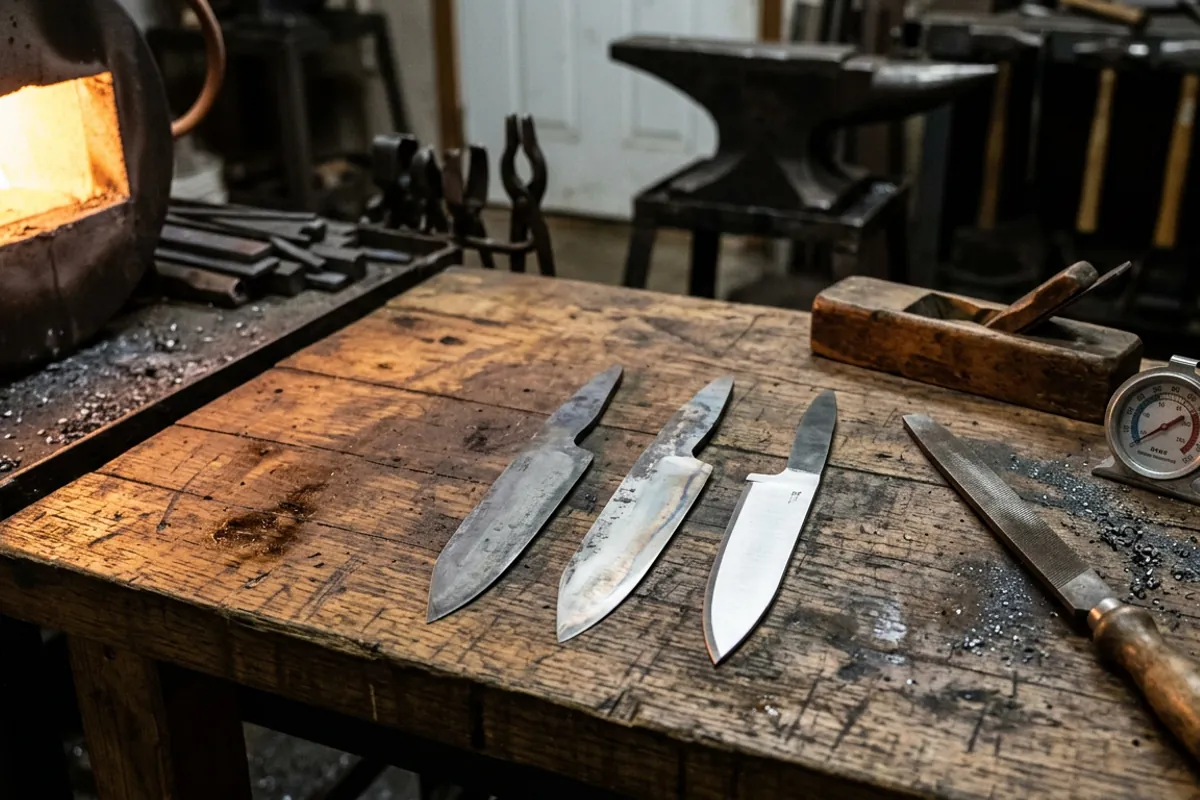
Against 1084. 1084 is the simplest heat treat in bladesmithing and a fine place to learn. It is also shallow hardening and unforgiving of a slow quench or a thick blade. 80CrV2 gives you more margin in the quench and finer grain, at the cost of a slightly less foolproof recipe and a little more money per bar. For a first knife, 1084. For a first knife you intend to keep, 80CrV2.
Against 5160. 5160 is a leaf spring steel at roughly 0.60 percent carbon. It is genuinely tough and it is cheap, but the lower carbon caps how hard you can get it and therefore how well it holds an edge. 80CrV2 has the carbon of a knife steel with much of the toughness attitude of a spring steel. That is the whole appeal.
Against 52100. 52100 has about one percent carbon and one and a half percent chromium, with fine carbides that give it noticeably better wear resistance. It also wants longer soaks at temperature and rewards careful control. If you have a kiln and patience, 52100 makes a better slicer. If you have a forge and a coffee can of oil, 80CrV2 is the more likely success.
Against 15N20. 15N20 is mostly a pattern welding partner, chosen for how bright it stays after an etch. Different job entirely.
Against the stainless steels. If corrosion resistance is a requirement, none of this family is the answer. Go read What AEB-L steel actually is for the fine grained stainless case and MagnaCut steel, explained for what the modern powder metallurgy stainless steels actually solved. Both of those need proper equipment to heat treat, which is the real dividing line, not the price of the bar.
If you want to walk the trade offs yourself rather than take my word, the steel selector lays them out side by side.
What it is good for, and what it is not
I use 80CrV2 for the blades that get treated badly. Camp knives, big belt knives, hawks, machetes, anything a person is going to baton through a knot or pry with when they should not. That toughness bias is why it also shows up constantly in sword and large blade work, where a snapped blade is a genuinely dangerous failure rather than an inconvenience.
Where I do not use it:
- Kitchen slicers, if edge retention is the priority. It sharpens beautifully and takes a very fine edge, but it will not hold that edge as long as a high alloy steel, and it will patina against acidic food.
- Anything wet or coastal. It rusts. Full stop.
- Blacksmith tooling that gets struck. Punches, drifts, and hot cut hardies want a steel built for impact at temperature. That is a different family, and How I heat treat 4140 covers where I actually go for that work.
For beginners in particular, this is a steel you can graduate to rather than start on. If you are still working out what the whole path from bar stock to finished edge looks like, Bladesmithing, from a bar of steel to a blade that holds an edge walks the sequence before the steel choice matters much.
Rust, patina, and living with it
Assume it will rust, and then it never surprises you. A blade in 80CrV2 that gets used and wiped down develops a grey patina that is mostly protective and, to my eye, looks like a working knife should. A blade that gets put away wet grows orange pits that are permanent once they are deep.
My habit: wipe after use, oil the blade before it goes in a drawer, and never store a carbon steel knife long term in a leather sheath. Leather holds moisture and the tanning chemistry is not kind to steel. In a damp shop, bare steel stock on the rack gets a wipe of oil too. Rust in a rack is a slow tax you pay in grinding time later.
Safety, and I am not being polite about this
Two hazards in this steel's process line will actually hurt you.
The quench tank. Early on I quenched a blade in oil that was too cold, standing right over the tank in a cotton shirt with no face shield. The oil flared and took my eyebrows off. I kept my eyesight by luck alone, and that is not a thing I get to be casual about. What I do now: a steel container with a lid that fits, sitting on concrete with nothing flammable within reach; enough oil volume that the blade does not overheat it; the oil warmed to its intended temperature so it is not sluggish; face shield over ANSI Z87.1 rated safety glasses; natural fiber clothing, because synthetics melt onto skin; and a dry chemical extinguisher within arm's reach, never water. I stand to the side and enter the blade spine first, edge down, in one motion. If it flares, the lid goes on the can. That is the whole plan and it has never needed a second one.
The grinder. Grinding hardened steel throws hot particles and fine metallic dust. Eye protection is not optional at the grinder, and a respirator matters more than people admit, especially with a belt that is also shedding abrasive. Long hair tied back, no gloves on a contact wheel, no loose sleeves. My full list of what earns its place is in Blacksmith safety gear: what matters and what to skip.
Neither of those hazards is exotic. Both of them are boring right up until the moment they are not, which is exactly why the habits have to be automatic.
How I would decide
If you want a steel that survives a home forge, forgives an imperfect quench, and makes a blade that bends rather than shatters, 80CrV2 is a good answer and a well understood one. If your priority is edge retention on a kitchen knife or a blade that lives outdoors in the wet, look elsewhere in the steel and metallurgy guides. And when the question gets deeper than "how do I heat treat this in my shop," take it to Knife Steel Nerds and read the actual test data. Steel questions have real answers, measured by people with real equipment, and the craft is better off when we quote them instead of each other.