Heat treating with a magnet is the first temperature tool most of us ever pick up, and for good reason. A magnet costs almost nothing, it works in a dark shop where color is unreliable, and it gives you a yes or no answer instead of a shade you end up arguing with yourself about. I have used one for most of the roughly twenty five years I have been forging. What I had wrong for a long stretch of those years was the reason it works. The explanation I repeated, and the one you will still hear at every club forge, is that steel loses its magnetism at the Curie point, that the Curie point sits a little below hardening heat, so you go a shade hotter and then quench. For the steels most of us actually forge, that has the order backwards. Knife Steel Nerds lists it as a myth, and once you understand what the magnet is really detecting, it changes what you do with it in your hand.
What the magnet is actually telling you
Steel at room temperature is a body centered crystal structure, and it is ferromagnetic. Heat it far enough and it changes structure to austenite, which is face centered, and austenite is not ferromagnetic at forging heat. That structural change is the whole point of hardening. You are trying to get carbon into solution in austenite so that a fast quench traps it as martensite.
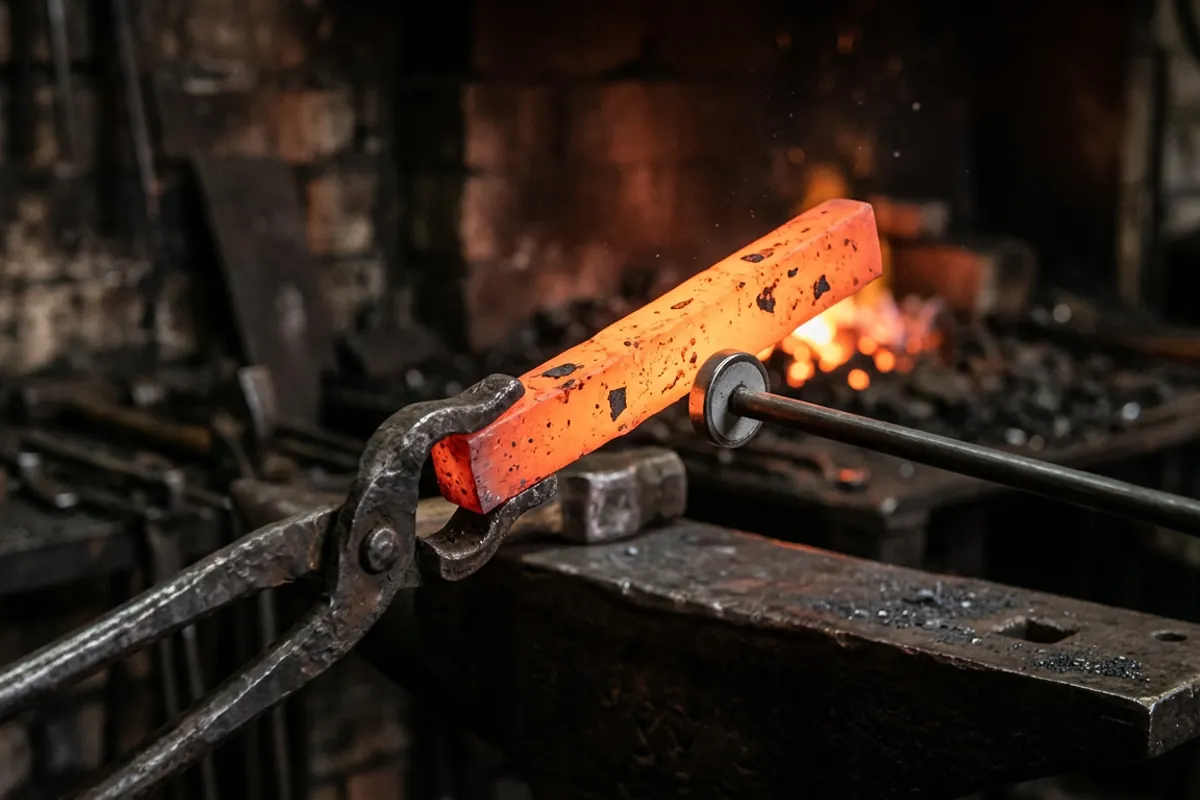
So when the magnet stops sticking to a plain carbon or low alloy blade, what it is reporting, in the normal case, is that the steel has transformed to austenite. It is not reporting that you crossed the Curie temperature of iron. Those are two different events, and for the steels a home shop forges, the transformation happens first.
That distinction is not academic. If the magnet is announcing the Curie point, then you have not necessarily austenitized yet and you need to keep climbing. If the magnet is announcing austenite, then you are already where you need to be and every extra minute of climbing is spending something. Same tool, opposite instruction. The general walkthrough in heat treating steel, explained from the forge floor describes the older version of this mechanism, and the correction is the one above.
The Curie point is real, it is just not what your magnet found
People call this the curie point magnet test, and the name is part of why the myth is so sticky. The Curie temperature is a genuine physical property. Above it, a ferromagnetic material stops being ferromagnetic without any change in crystal structure at all. It is also specific to the material, not a universal number. Knife Steel Nerds gives iron at 770 C (1420 F) and nickel at 354 C (670 F). Two ferromagnetic metals, two very different Curie temperatures.
Pure iron with nothing else going on would indeed lose its pull on a magnet at 770 C. Carbon steel does not get the chance, because it has already turned into austenite on the way up. The magnet drops off, you correctly conclude something happened, and then the wrong story gets attached to it.
The numbers that are actually checkable
I try to only hand out figures that somebody measured and published. Here are the ones worth carrying:
- Iron's Curie temperature is 770 C (1420 F). Nickel's is 354 C (670 F).
- For low alloy steels, Knife Steel Nerds puts the non magnetic temperature significantly lower than iron's Curie point, usually somewhere in the range of 1350 to 1380 F, precisely because austenite forms before the Curie transition.
- Eutectoid steels like 1075 and 1080 begin transforming to austenite around 727 C (1340 F).
- For 5160, the Ac3, the temperature where transformation to austenite is complete, is about 765 C (1410 F).
That last pair is the whole argument in two lines. The transformation numbers sit below iron's Curie number, so the magnet lets go for the useful reason.
I am deliberately not giving you Ac1 and Ac3 figures for other steels. They are not all published, and inventing them would be worse than useless. 80CrV2 is a good example: it is one of the better forge steels going and it has no published Ac numbers I can point you at, which is exactly why the magnet is the practical answer there rather than a spec sheet. What that steel is and where it fits is in what 80CrV2 steel actually is, and when I reach for it.
Why hotter is not a free move
The habit that grew out of the old explanation is to go past non magnetic before quenching. On plain carbon steel, that habit points the wrong way, and it has a real cost.
Knife Steel Nerds reports that above about 0.6 percent carbon in solution, martensite starts shifting from the lath type to the plate type, and plate martensite is brittle and prone to microcracks. More heat means more carbon in solution, which means you march toward the brittle version of the thing you are trying to make. That is not a small effect either. For 5160 at ASM's recommended 1525 F, Knife Steel Nerds points out that overheating by only 25 F can lead to a significant drop in properties.
Twenty five degrees. In a forge. That should tell you how much precision you are actually claiming when you say you went a shade hotter. You do not have twenty five degrees of control at the forge mouth, so the honest move is to stop at the event you can actually detect rather than to guess at an offset from it.
The steels where the magnet earns its keep
Knife Steel Nerds recommends a specific short list for forge heat treating, and it lines up with what I see work in home shops: 5160 and 8670 for choppers, 1084 and 80CrV2 as general purpose steels, and O1 and 1095 for fine cutting knives. All of them are plain carbon or low alloy. All of them transform to austenite below iron's Curie point, which is the condition that makes the magnet meaningful.
52100 is the exception worth flagging early. Knife Steel Nerds calls it the most difficult of the bunch to heat treat in a forge from the spheroidized annealed condition, and it has enough chromium to break the magnet's logic, which is the next section. High alloy steels, stainless and high speed steels are not recommended for forge heat treating at all.
The steels where the magnet will lie to you
Chromium is the wrecking ball here. Knife Steel Nerds puts it plainly: chromium additions raise the austenite transformation temperature so that it is higher than the Curie transition. Flip the order and the magnet flips meaning. It drops off at the Curie point, while the steel has not austenitized yet and is nowhere near ready to quench. Quench there and you get a soft blade and no idea why.
That effect shows up at about 3 percent chromium and above, which covers the air hardening tool steels and the high speed steels, and it is emphatically true at the 12 percent chromium minimum that defines a martensitic stainless. Even 52100, at only 1.5 percent chromium, has to be heated substantially beyond non magnetic.
So do not use the magnet as your quench signal on 52100, A2, D2 or any stainless. For those steels the old rule, that non magnetic is well below hardening heat and you must go past it, is correct, and heat treating A2 tool steel, from the forge floor is right for its steel for exactly this reason. The rule is not wrong everywhere. It is wrong when applied to plain carbon steel, which is where most beginners apply it.
Mystery steel
Unknown steel is the worst case for a non magnetic steel heat treat, because you do not know which of the two mechanisms your magnet just tripped. An old file might be plain high carbon, or it might have alloy in it. That is one of several reasons I usually buy a known bar instead, which I go through in how to make a knife from a file, and why I usually buy a bar instead.
How I run a magnet heat treat at the forge
The sequence Knife Steel Nerds gives for forge heat treating is short and I follow it:
- Normalize first. Their guidance is 1550 to 1700 F for 10 minutes and air cooled, steel specific. The published cycle ladders disagree with each other and I am not going to pretend otherwise here; the argument is laid out in what normalizing steel actually takes, and why the schedules disagree. The related soft state work is in what annealing steel actually does, and how I do it.
- Heat to non magnetic. Move the piece in the forge and check more than one spot. A forge is not a uniform box, and a magnet only tells you about the square inch you touched.
- Quench from there, and this is Knife Steel Nerds' wording, regardless of the temperature where that has actually happened. Do not add an offset you cannot measure.
- Quench in a fast oil for these steels. Parks 50 is the usual answer and what it does is in what Parks 50 quench oil actually does, and when I use it.
- Temper. Their forge example tempers at 400 F (205 C).
A few floor habits. I keep the magnet on the end of a long rod or clamped where I can bring the steel to it, so my hand never goes into the forge mouth. Heat is hard on magnets, so I touch and pull rather than parking it against hot steel. And for normalizing or thermal cycling, New Jersey Steel Baron's 5160 sheet gives the practical reset: once the knife has cooled to black and magnetic, it can be cycled again. The magnet is as useful on the way down as on the way up.
I am not going to print color to temperature figures here. Colors depend on your shop light and your eyes, and they get their own treatment in heated steel, explained from the forge floor.
What one real forge test showed
Knife Steel Nerds ran forge heat treats on 1/8 inch coupons and compared them against furnace treated references, and the results are worth knowing because they are measured rather than asserted. 5160 and 8670 matched the furnace. 1095 and O1 came out with hardness somewhat higher than the 1475 F furnace reference, with a similar balance of properties. 1084 was the variable one: two of the coupons had lower toughness than the third, traced to a hot spot.
That is one test on thin coupons, not a guarantee about your forge and your blade. But it says two useful things. A careful forge heat treat on the right steel can land where a furnace lands, and the failure mode when it does not is uneven heat, which is exactly the thing a magnet cannot warn you about if you only check one spot.
Where the magnet stops being enough
The honest limit is temperature control, not detection. New Jersey Steel Baron says it directly on their 5160 data sheet: forge heat treating without PID temperature control limits accurate means of maintaining temperature. You can find the transformation with a magnet. You cannot hold a soak at a chosen temperature with one.
Knife Steel Nerds' own verdict, after running the tests, is worth carrying verbatim rather than paraphrasing into something softer. "I greatly prefer heat treating with a furnace." And: "Furnace heat treating is just easier."
I would not argue with either sentence. The magnet is the right tool when a furnace is not in the shop yet and the steel is one of the forge friendly ones. It is not the tool for chromium steels, for stainless, or for anything where you need to hold a real soak. For a chromium moly steel like 4140 I do not make the temperature call with a magnet at all; how I run that one is in how I heat treat 4140, from the forge floor.
Safety, because this test puts your hand near the fire
Eye protection rated ANSI Z87.1, every time you are at the forge, and natural fibers next to your skin. Synthetics melt onto you instead of burning away, and forge work throws sparks and scale without warning.
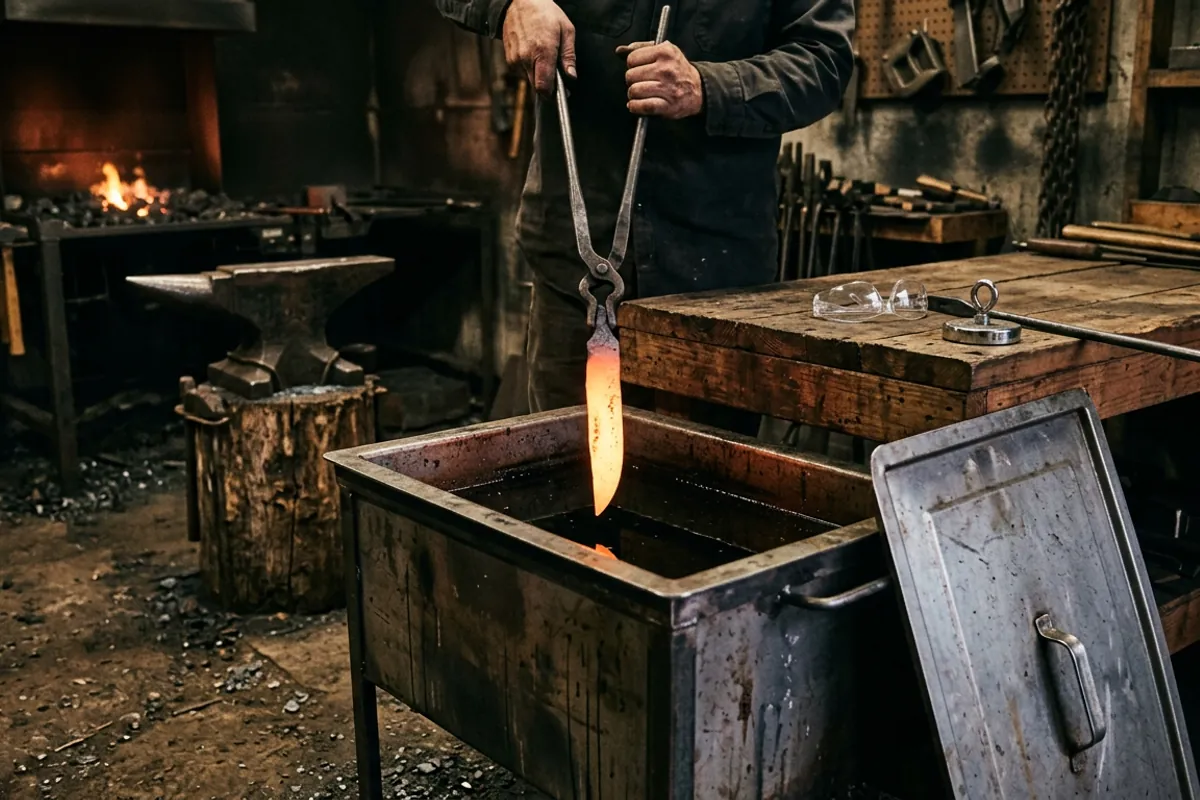
The magnet test specifically tempts you to lean toward the forge mouth to check a piece. Bring the steel out to the magnet instead of putting your face and hand into the heat. And when you go from non magnetic straight into oil, treat the quench tank as a fire hazard, because it is one. Oil that is too cold flashes, oil in a shallow container flashes, and a blade going in edge first with your face over the tank is how people get hurt. Keep a lid that fits within reach, keep the tank clear of anything that will burn, and stand so that a flare goes up and away from you rather than into you.
What I would tell a beginner holding a magnet
The magnet is a transformation detector, not a thermometer. On 1084, 80CrV2, 5160, 8670, O1 and 1095, it drops off because the steel became austenite, somewhere in the range of 1350 to 1380 F for low alloy steels, below iron's Curie point of 770 C (1420 F). That is the moment to quench, not the moment to start climbing. On anything with 3 percent chromium or more, and on every stainless, the magnet drops off for the other reason and will hand you a soft blade if you trust it.
That is the whole correction. It costs you nothing to apply, it makes the cheapest tool in the shop more accurate, and it explains why so many first knives skated the file after a heat treat that looked textbook. More of the steel side of the craft is collected in steel and metallurgy, and for the deep metallurgy behind any of this, Knife Steel Nerds is where I send people, because they test it instead of repeating it.