If you have ever looked at a pattern welded blade and wondered how the maker got the bright lines to stay bright after the etch, the answer is almost always 15N20 steel. It is a Swedish band saw steel with roughly two percent nickel in it, and that nickel is the entire trick: it shrugs off ferric chloride while the plain carbon steel welded next to it goes dark. I keep a stack of it on the rack in thin flat bar, and I reach for it for exactly two jobs, damascus billets and thin kitchen blades. What follows is the plain version, owner to owner, of what this steel is, what it is genuinely good at, and where smiths get themselves in trouble with it.
The band saw steel that turned into damascus
Nominally, 15N20 runs about 0.75 percent carbon, about 2 percent nickel, a small amount of manganese, and a trace of silicon. There is no meaningful chromium in it. If you want the shortest honest description: it is roughly a 1075 carbon steel with nickel added.
That one addition changes three things that matter to a smith. Nickel adds toughness, particularly at low temperatures. Nickel adds a little hardenability, so the steel is slightly less frantic in the quench than a bare 1075, though it is still a shallow hardening steel and still wants a fast quench. And nickel does not dissolve into a ferric chloride etch the way iron does, which is why the layer stays silver.
The designation comes from the Swedish mill that produced it as band saw stock. You will see sellers list it loosely as L6, and you will see 8670 mentioned in the same breath. Those steels are relatives, not the same steel. L6 and 8670 both carry chromium, and 8670 carries molybdenum as well, which changes hardenability and heat treat behavior. Treat them as family, not as substitutes, and heat treat each to its own recipe. If you want a broader map of how this steel sits against the rest of the rack, the steel and metallurgy hub collects the rest of them.
The lack of chromium is not a shortcoming here. It is the reason 15N20 forge welds as easily as it does. Chromium forms a stubborn oxide that fights a clean weld, which is why welding stainless into a billet is a controlled atmosphere job and welding 15N20 into one is a Saturday morning.
Where it comes from, and what you can actually buy
15N20 was made for saw blades, so it comes to you thin. Knife supply stock is typically somewhere in the range of 0.060 to 0.125 inch thick and an inch and a half to two inches wide. Thick bar is rare, and when a supplier does have it, you pay for the privilege. That single fact governs everything you will do with this steel: you either stack it into a billet, or you use it thin and let the thinness be the point.
The other source is salvage from old carbon steel sawmill band saw blades, and this is where I want to be careful, because I do not scrap hunt these much and I am not going to pretend otherwise. What I can tell you is what the guys who do it consistently say. Modern bimetal band saw blades are not this steel at all. They are a spring steel back with high speed steel teeth welded on, and the two halves behave nothing alike. Only old carbon steel mill blades are candidates, and even then you are trusting a chain of custody you cannot verify.
If you cannot confirm the source, treat it as mystery steel. Spark testing will not reliably separate two similar carbon steels, whatever anyone tells you. Cut coupons, quench them the way you intend to quench the blade, break one and look at the grain, and run a file across another. That tells you whether the stuff hardens at all and roughly how fine it is. It does not tell you the alloy, and it will not tell you how the nickel etches, which is the whole reason you wanted it.
Why it is the standard bright layer in pattern welded steel
Two properties make 15N20 the default partner for damascus, and both are worth understanding rather than just repeating.
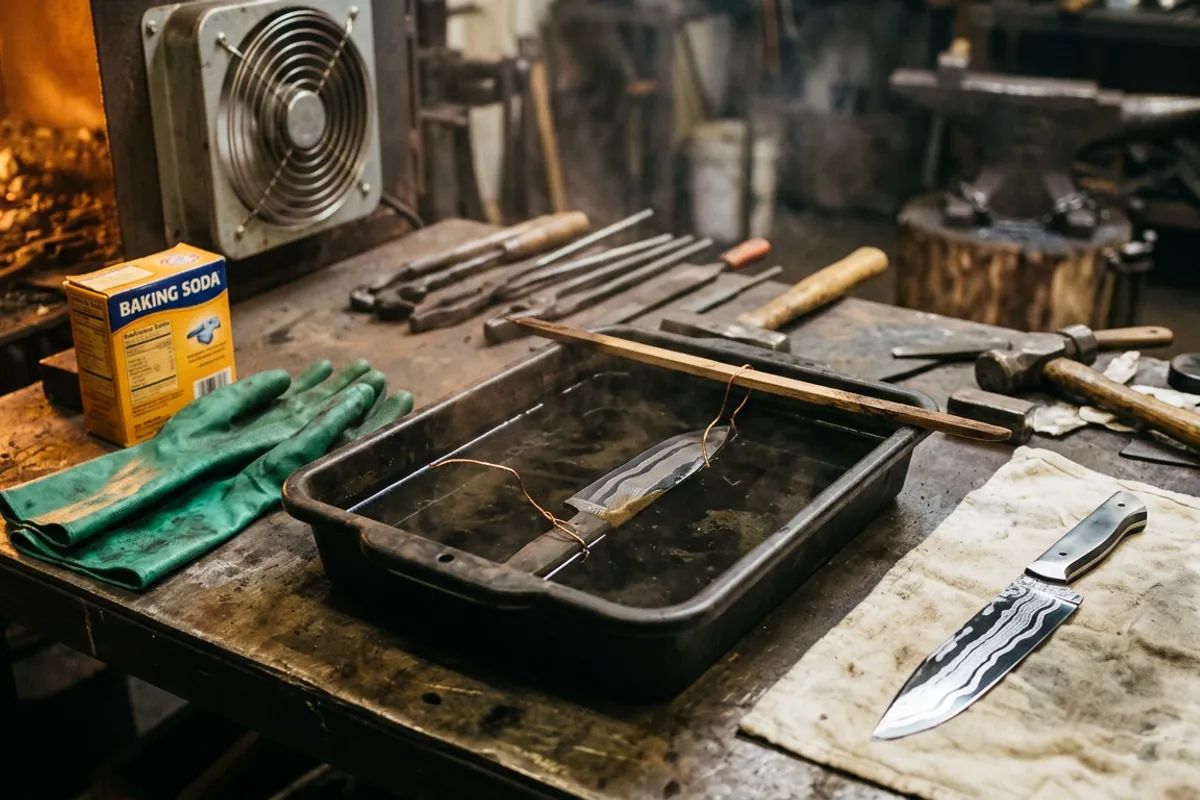
The first is the etch. Ferric chloride attacks the iron rich carbon steel and leaves the nickel bearing layer comparatively alone. Stack 15N20 against 1084 or 1080 or 1095, etch it, and you get bright against dark with almost no effort. Some makers deepen the contrast by etching longer and then knocking the oxide off the high layers, but the base contrast comes free from the chemistry.
The second is that nickel stays where you put it. Carbon migrates across a weld interface at forging temperature, which is why a high layer count billet eventually reads as one uniform hardness rather than hard layers alternating with soft ones. Nickel does not move anything like as readily. That is why a 300 layer billet still shows its pattern crisply even though the carbon has largely evened out across the whole thing. You keep the picture and you lose the hardness banding, which is exactly the trade you want.
There is a practical reason for the specific pairing with 1084, too. At about 0.85 percent carbon, 1084 sits close enough to 15N20 that carbon migration does not gut either layer. Both weld at the same heat, both flux with plain borax, both respond to the same austenitizing temperature and the same quench, so the finished blade heat treats as one piece rather than as a compromise.
One thing to keep straight: pure nickel sheet damascus is a different animal. Pure nickel does not harden. It gives you a very bright line and a soft layer, which is fine for a decorative piece and wrong for a working edge. 15N20 hardens right alongside its partner.
Forging and forge welding it
On the anvil it behaves like the plain carbon steel it mostly is. I work it from a bright orange down through a medium orange and stop before it goes dull red, because past that you are just beating on cold steel and starting cracks. Welding heat is a bright yellow, call it around 2300 F, right where the flux runs like water and the surface starts to look wet. Push much past that and you are burning it, and burned steel in the middle of a billet is a delamination waiting to happen three grinding hours later.
The thinness is the thing that catches people. A 0.070 inch piece in a propane forge goes from black to sparking in a few seconds of inattention. In my coal fire it is worse, because the hot spot is smaller and hotter. When I am setting a billet I stack, tack weld the ends, and put a handle on it, both because loose thin plates shift and because I want one thing in the tongs instead of nine.
Decarburization is the other tax on thin stock. Surface carbon burns out fast at welding heat, and a percentage loss that is trivial on a half inch bar is a real fraction of a 0.070 inch plate. On a billet it does not matter much, since the outer surface becomes grinding dust. On a mono steel blade forged from thin stock, plan to grind past the decarb layer, or heat treat in stainless foil and skip the problem.
After the billet is drawn and cut and rewelded as many times as you have patience for, normalize it. Several cycles at descending temperatures refine the grain that all those welding heats coarsened, and grain size is the quiet difference between a blade that snaps and one that bends. I go through the thermal cycling in more detail in the piece on what annealing actually does, and the same logic applies to a billet as to a bar.
Heat treating 15N20 in a home shop
This is a shallow hardening steel and it wants a fast quench. That is the headline, and everything else follows from it.
Knife Steel Nerds publishes 1475 F for 15N20 with a 10 minute soak; Alpha Knife Supply publishes 1480 F. That is a real supplier against researcher gap rather than something to average away, and 1500 F, which you will see quoted, is the figure for L6 and 8670 rather than for this steel. Then a fast oil quench. I use a fast commercial quench oil, and I would not run this steel in canola if I could avoid it. Canola will harden thin stock in a pinch, but it is slower, it is inconsistent batch to batch, and the margin on a shallow hardening steel is not wide enough to hand away. I wrote up why the fast oils behave the way they do in the piece on Parks 50.
Two specific cautions with this steel.
Nickel is an austenite stabilizer. Soak it too long or too hot and you leave retained austenite in the blade, which costs you hardness now and can transform later and move your geometry. Short soak, correct temperature, no wandering off to answer the phone.
Thin stock warps. It warps in the quench, it warps when you grind after heat treat, and it warps if you clamp it crooked in the temper. Plate quenching between aluminum blocks is an option for very thin blades. So is clamping straight in the tempering oven, which will take a small bend out permanently. Trying to bend a fully hardened, untempered thin blade straight on the bench mostly produces two pieces of steel.
For tempering, 350 to 400 F is the published range, and 400 F is where I go for anything that will see lateral load. Do not reach past it toward 450 F chasing toughness: the tested data shows toughness dropping there rather than rising, which is tempered martensite embrittlement. Two tempers, an hour each, cooling to room temperature in between. The mechanics of why are in tempering by heating and cooling.
Now the honest part. I can tell you what works on my bench with my forge and my oil, and I can tell you what the recipe consensus is among the makers I trust. I cannot tell you the tested hardness and toughness curves for this steel, because I have never run a Charpy bar or a calibrated Rockwell series in my shop, and neither has almost anybody writing about it online. Larrin Thomas at Knife Steel Nerds does that work with actual instruments and publishes the data. Go read what he has published on this steel and its relatives before you trust any number you got from a forum, including mine.
Using it as a mono steel blade
15N20 makes a genuinely good knife on its own, and the thin stock steers you straight at the blades that want to be thin. Kitchen slicers, fillet knives, boning knives, thin paring knives. It takes a fine edge, it sharpens easily on anything, and the nickel gives it more toughness than a plain carbon steel of the same carbon content.
It is not stainless. There is no chromium in it worth counting, so it will rust if you leave it wet, and it will take a patina from anything acidic. A forced patina from mustard or hot vinegar is not a gimmick on this steel, it is maintenance. If you want a stainless kitchen blade instead, AEB-L is the one I would point a maker toward, and it is a different steel with a different heat treat, not a drop in swap.
Where 15N20 is the wrong steel
Reference articles that only list strengths are advertising. Here is where I would not use it.
- Thick chopping tools. Axes, hatchets, hammers, heavy camp knives. The stock is not there in the first place, and shallow hardening means a thick section will not harden through anyway. 80CrV2 is the steel I actually reach for on choppers, and 4140 for hammers and struck tools.
- Anything that has to be stainless. No amount of good heat treat puts chromium into a steel that does not have any.
- Anything that needs high wear resistance over a long cut. The carbides here are ordinary iron carbides, not the vanadium carbides that give a modern powder steel its edge retention. This steel cuts beautifully and dulls at the pace a good carbon steel dulls. If that comparison is what you are chasing, MagnaCut sits at the other end of that spectrum.
- A first solo heat treat. Not because the recipe is hard, but because thin stock in a fast quench is unforgiving, and a beginner's first warp is discouraging out of proportion to the actual mistake.
Safety, and I mean this part
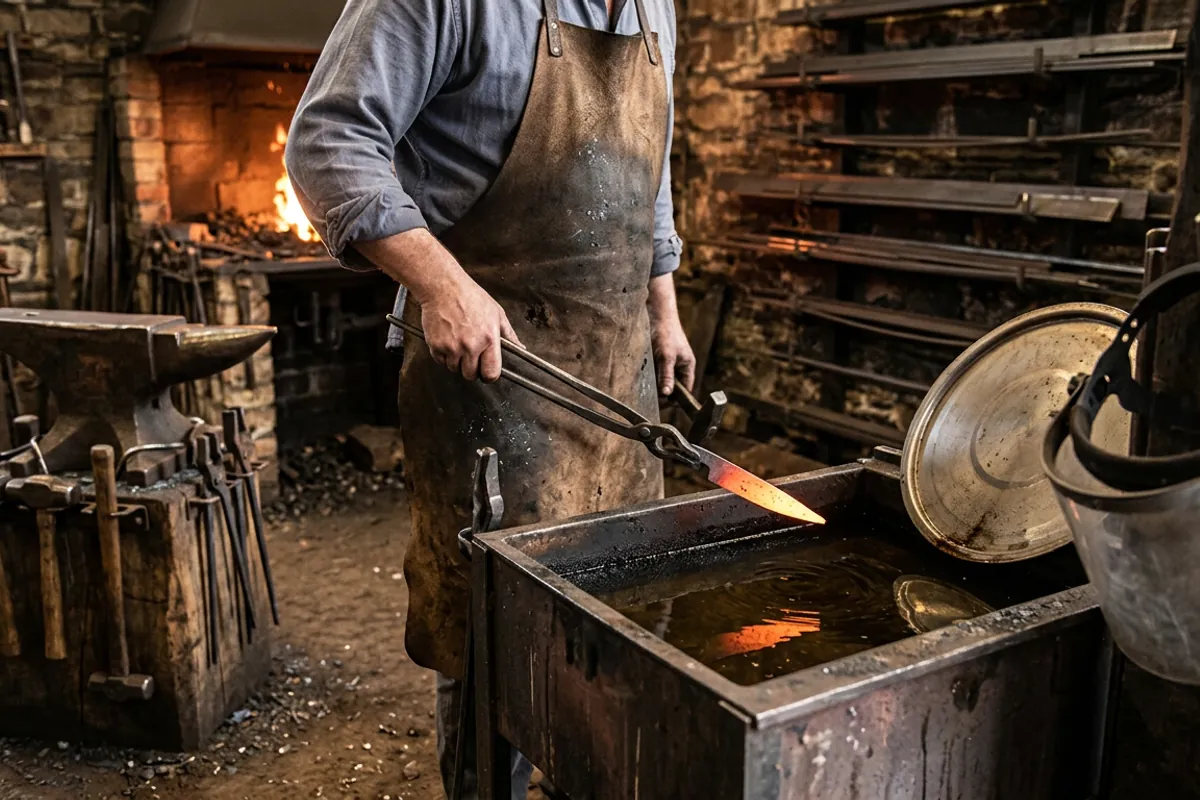
Quench oil first, because this one is personal. Early on I quenched a blade in oil that was too cold, standing over the tank in a cotton shirt with no face shield, and the oil flared and took my eyebrows off. I kept my eyesight by luck and nothing else. Use enough oil that it does not boil over, run it at the temperature your oil maker specifies rather than whatever it happens to be, hold the work in tongs and never in your fingers, stand to the side rather than over the tank, and keep a lid within reach because a lid smothers an oil fire and water turns it into a fireball. Face shield over ANSI Z87.1 rated glasses, natural fibers only, because synthetics melt onto skin. The full kit list is in blacksmith safety gear.
Grinding this steel deserves its own mention. Grinding dust from any steel is bad to breathe, and nickel is a well documented skin sensitizer on top of that. Grind with dust collection or wet, wear a fitted respirator rather than a paper mask, and keep the dust out of your clothes and off your skin. Eye protection at the grinder is not negotiable at any time, ever, for any pass.
Ferric chloride is an acid and behaves like one. Gloves, eye protection, ventilation, and never mix it with anything else. Neutralize the etched blade in a baking soda solution afterward. Spent etchant carries dissolved metal and does not belong in a drain or on the ground; check what your local household hazardous waste facility takes.
Where to send the deep questions
Everything above is what a working hobby smith can tell you from the floor: how the stuff forges, how it welds, what it does in an etch, and what recipe reliably produces a good blade. The moment your question becomes a number, meaning exactly how much toughness you lose at a given tempering temperature or precisely what hardness a given soak produces, that question belongs to someone with a hardness tester and an impact rig. Knife Steel Nerds is where I send those, and it is where I go myself before I change a heat treat I have been using for years.
If you are trying to decide between this and something else for a specific blade, the steel selector will narrow it faster than reading five more articles, and the steel and metallurgy hub has the rest of the rack laid out. For 15N20 specifically, the summary is short: buy it thin, weld it to 1084, quench it fast, and keep it dry.