Heat treating stainless steel is where a lot of new knife makers hit a wall, and it is worth understanding why before you spend money on a bar of it. Stainless is not just carbon steel that resists rust. The chromium that keeps it from rusting also changes how the steel hardens, and it pushes the whole process past what a coal forge and a bucket of oil can do well. I run mostly carbon steel in my own shop, and I am honest about that. But I have watched enough beginners ruin good stainless in a home forge that I want to lay out plainly what the process actually asks for, what your shop can and cannot do, and where the real numbers live.
If you want the broader map of how hardening, quenching, and tempering fit together across all steels, start with heat treatment of metals explained and the steel and metallurgy topic hub. This piece narrows in on the stainless problem specifically.
What makes stainless different from carbon steel
The short version: chromium. Stainless knife steels carry somewhere around 12 percent chromium or more, and that chromium is why they resist rust. But chromium loves carbon. When you heat the steel to harden it, the chromium wants to grab carbon and lock it up as chromium carbides. If that carbon stays tied up in carbides, it is not dissolved into the steel where it belongs, and the steel will not reach full hardness. It also is not floating around free to keep the chromium doing its rust-fighting job.
So heat treating stainless is a balancing act the smith never has to think about with a simple carbon steel like 1084. You have to get the steel hot enough, and hold it there long enough, to dissolve the right amount of carbon and chromium into solution, without dissolving so much that you cook the grain or leave a bunch of soft austenite behind. Carbon steel forgives a lot. You bring it to nonmagnetic, quench, temper, and you are close. Stainless does not forgive, and the window is narrower.
That is the whole reason this article exists. The chemistry is doing more work, so the process has to be more controlled.
The temperatures stainless actually needs
Here is the first hard fact. Martensitic stainless steels austenitize at much higher temperatures than carbon steel. Where a simple carbon steel hardens somewhere in the neighborhood of 1475 to 1550 degrees F, common stainless knife steels want to be taken well above 1900 degrees F, and some run right up toward 2000 degrees F. The exact number depends entirely on the alloy, and I am not going to hand you a single figure to memorize, because using the wrong one is how you ruin a blade.
The place to get the real number is the steel maker's data sheet for the exact alloy you bought, cross checked against the testing work at Knife Steel Nerds, which has run controlled hardness data on most of the popular stainless knife steels. Larrin Thomas over there does the actual metallurgy with equipment none of us have in a home shop, and he publishes it. When someone on a forum tells you "just get it orange and quench," that is carbon-steel thinking applied to a steel that will punish it.
Those higher temperatures matter for two reasons. First, most propane forges struggle to hold a stainless austenitizing temperature evenly. A forge that runs a knife blade cherry red for carbon steel is nowhere near hot enough for stainless, and pushing a forge to that heat unevenly leaves you guessing. Second, at those temperatures scale and decarburization happen fast, which brings us to the next problem.
Soak time and why an even hold matters
Getting stainless to temperature is only half of it. You then have to hold it there, evenly, for a set soak time so the carbon and chromium fully dissolve into solution. Depending on the alloy that hold can run from a few minutes to fifteen minutes or more at temperature. A carbon steel blade you can pull the moment it is evenly nonmagnetic. Stainless you cannot rush.
This is where a home forge really shows its limits. A forge heats by flame and radiation, and it heats unevenly. The tip of a blade sees different heat than the ricasso. You cannot easily see the exact temperature, you cannot hold it flat for ten minutes, and every minute at that heat is a minute the surface is scaling and losing carbon to the air. Trying to eyeball a precise, even, ten minute soak at 1950 degrees F in a propane forge is a losing game for most of us.
A heat treating oven with a controller solves this. It holds a set temperature, you set the soak timer, and the whole blade sits in even heat. That is the tool the job actually wants, and it is why serious stainless makers own one and forge smiths who dabble in stainless usually do not.
Protecting the surface: foil, scale, and decarb
Because stainless soaks hot for a long time, the surface takes a beating from the air. Two things happen. You get scale, and you get decarburization, which is the surface layer losing carbon. Decarb on a knife blade is a real problem, because a decarburized edge will not harden, and you can grind through a lot of steel chasing it.
The common fix, and the one you will see every stainless maker use, is stainless foil. You wrap the blade in a pouch of high temperature stainless tool wrap, fold the seams tight, and the pouch holds a pocket of still air that greatly slows scaling and decarb. Some makers tuck a scrap of paper in the pouch so it burns up the free oxygen. The foil is not optional insurance the way it sometimes is with high alloy carbon steels. With stainless soaking that hot for that long, going bare surface is asking for scale and a soft skin.
That foil then changes the quench, which is the part most home smiths get most wrong.
The quench: most stainless is air hardening
This is the big one. A lot of stainless knife steel is air hardening, or close to it. You do not dunk it in oil. You quench it in moving air or, better, between two aluminum or steel plates that pull the heat out fast and flat. When you pull that hot foil pouch from the oven, you set it between two plates, often with a fan blowing or a clamp squeezing, and let the plates draw the heat.
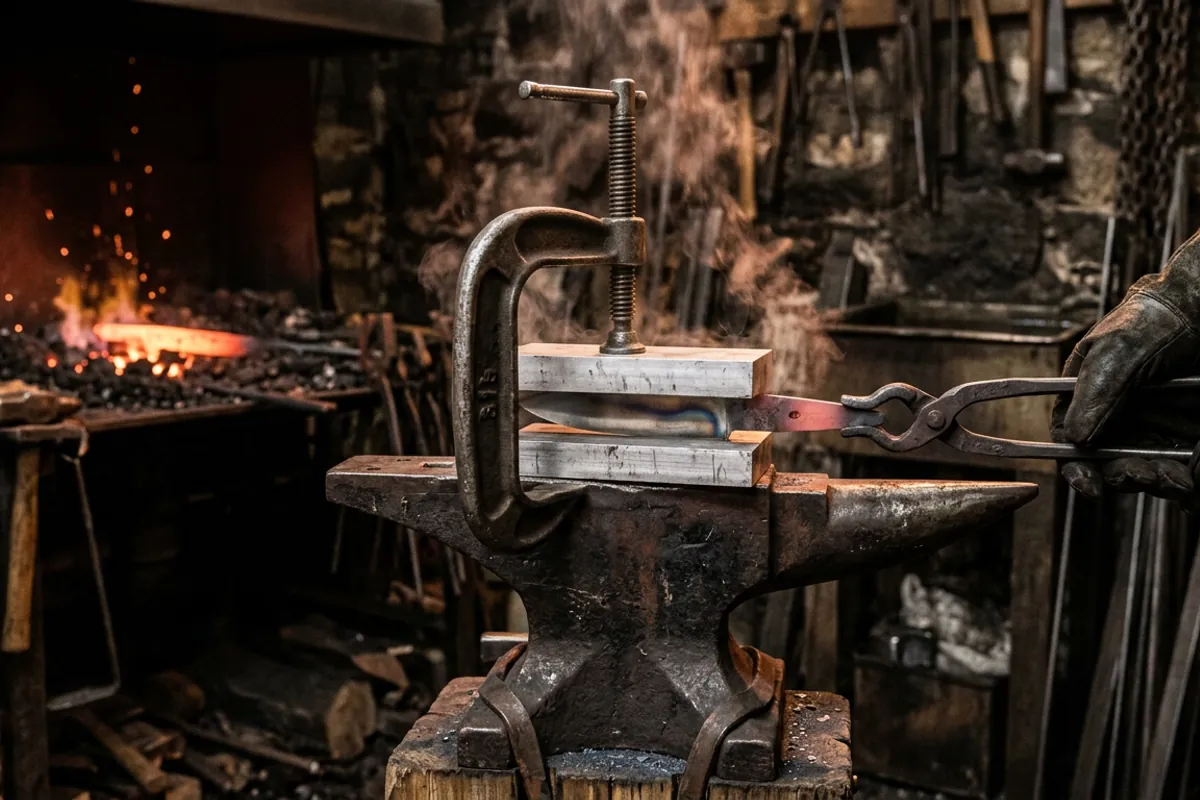
Plate quenching does two jobs at once. It cools the steel fast enough to form martensite, and it keeps the thin blade flat while it hardens, which cuts down on the warping that oil quenching a thin blade loves to cause. Get the timing right and you pull a hard, mostly straight blade.
If you take a stainless steel that is meant to be plate or air quenched and you drop it in oil like a carbon blade, you can crack it, warp it badly, or just get inconsistent hardness. This is exactly the kind of place where carbon-steel habits fail on stainless. If you have only ever quenched in oil or water, read what commercial steel heat treating actually does for a smith to see why sending it out is the honest answer for a lot of people.
Retained austenite and the cryo question
Here is a wrinkle carbon steel mostly spares you. When you harden stainless, not all of the austenite converts to martensite. Some of it stays behind as retained austenite, which is soft and can cause dimensional problems and lost hardness later. The higher alloy stainless steels tend to retain more of it.
The fix is cold. A sub-zero or cryogenic treatment, done right after the quench and before tempering, drives more of that retained austenite over to martensite. At the hobby level that often means dry ice and a solvent bath, which gets you well below zero, or liquid nitrogen for a deeper treatment on steels that call for it. Whether a given steel needs it, and how much it helps, is again alloy specific and measured, not guessed. Knife Steel Nerds has published hardness data with and without cryo on several stainless steels, and that is the source to trust over shop lore. Skipping cryo on a steel that wants it leaves hardness and edge stability on the table, but adding a hard freeze to a blade with internal stress can also crack it, so the sequence matters.
Tempering stainless
After the quench and any cold treatment, stainless still has to be tempered, same as any hardened steel, to trade a little hardness for toughness so the blade does not chip or snap. The tempering temperatures for stainless are their own subject and, once again, alloy specific. Some stainless steels have what is called a secondary hardening range, where tempering hot actually raises hardness rather than lowering it, and some have a temperature band you specifically avoid because it wrecks corrosion resistance. That is very different from a plain carbon steel, where you generally just pick a temper by the color and the hardness you want.
If the general idea of trading hardness for toughness is new to you, tempering of metal explained walks through it on simpler steel first, and annealing steel explained covers the softening side. Learn the moves on carbon steel where mistakes are cheap, then carry the discipline to stainless where they are not.
Can you do this in a home shop honestly
Here is where I will be straight with you, owner to owner. Most home smiths, myself included, are not set up to heat treat stainless well. The job wants a temperature controlled oven that holds an even soak, stainless foil, plates or forced air for the quench, and often a cold treatment step, followed by a proper temper. A coal forge and a quench bucket, the setup that hardens carbon steel beautifully, is the wrong tool here.
That is not me talking you out of stainless. It is me telling you the two honest paths. One, buy or build the oven and the rest of the kit, learn one specific stainless alloy deeply, and follow the data sheet and the tested numbers exactly. Two, forge and grind your stainless blade, then send it to a commercial heat treater who runs your exact steel every week and has a certificate to show for it. Plenty of good knife makers do the second, and there is no shame in it. Ask ten makers and the common thread is that the ones getting consistent results either own real equipment or send it out, and the ones fighting soft blades and warps are the ones trying to eyeball stainless in a forge.
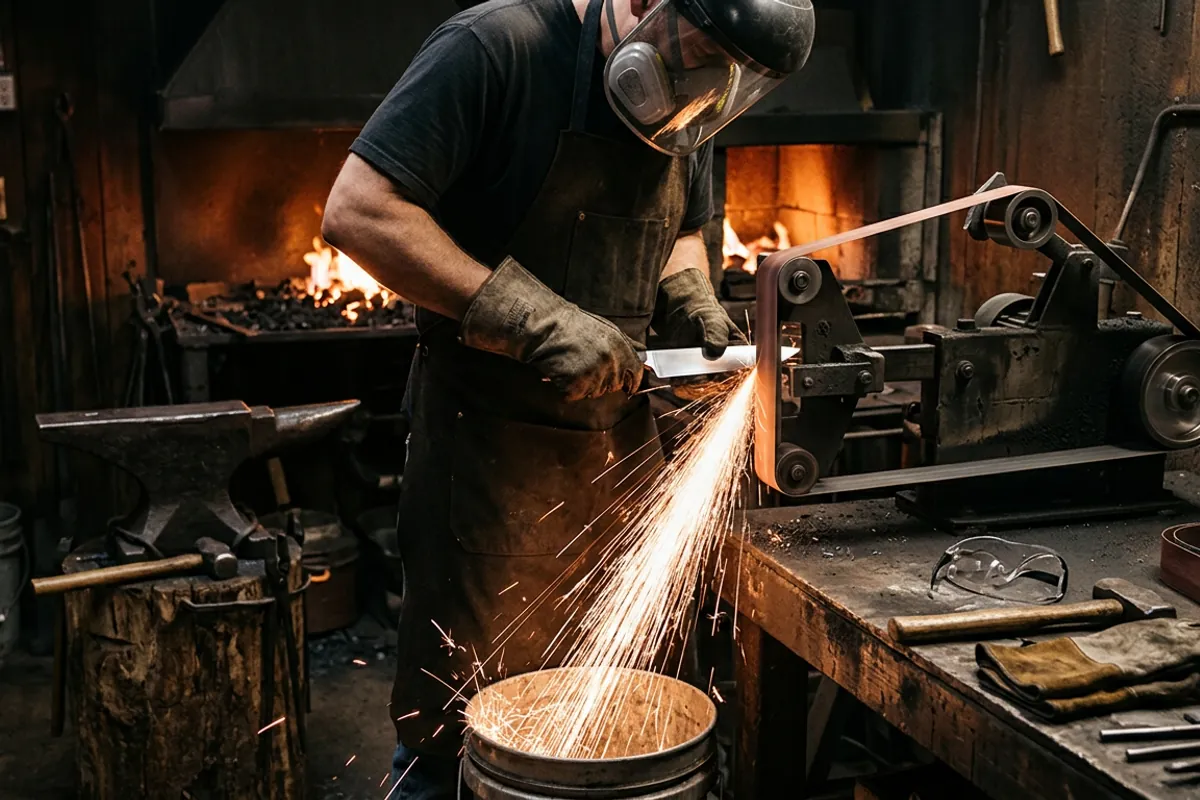
If you are choosing your first steel and this all sounds like a lot, it is worth stepping back to knife making explained and considering a simple carbon steel like 1084 or 80CrV2 to learn heat treat on before you take on stainless. And whatever steel you land on, the grinding that comes after hardening will ask for real equipment too, which is why I point beginners at the 2x72 belt grinder for knife making once they are past their first few blades.
The safety pieces people skip
None of this changes the shop safety rules, and a couple of stainless specifics are worth calling out. Grinding hardened stainless throws dust and grit, and you want a respirator and eye protection rated to ANSI Z87.1 at the grinder, not just for stainless but for any steel. Cold treatments are their own hazard. Dry ice and liquid nitrogen can freeze skin instantly and can displace oxygen in a closed shop, so you handle them with proper gloves, in ventilated space, and you never seal them in a sealed container where pressure can build.
And the oven work runs hot enough to matter. I lost my eyebrows early on standing too close to an oil quench in a cotton shirt, and I have been safety-serious ever since. Natural fibers over synthetics near heat, a face shield when you are pulling glowing steel and slamming it between quench plates, and tongs that actually hold the work. Stainless does not care about your eyebrows any more than carbon steel did.