When a new smith types "erie steel treating" into a search bar, they are almost never looking for a history lesson. They are holding a finished blade or a batch of tools, and they have hit the part of the process that scares people the most: the heat treat. The name they land on is a commercial heat-treating outfit, the kind of shop that hardens and tempers steel for a living with equipment no home forge will ever match. This article is about that world, why a home smith would ever send steel out to it, and what you need to understand before you do. I run my own heat treats at the forge for most of what I make, so I will tell you plainly where the home shop is fine and where a commercial treater actually earns its fee.
Heat treat is the step that turns a shaped piece of steel into a working tool. Everything before it is geometry. You can grind the prettiest blade in the county, but if the steel is soft it will roll on the first cut, and if it is brittle it will chip or snap. Getting hardness and toughness balanced is the whole game, and a commercial heat treater exists because that balance is easier to hit repeatably with a controlled furnace than with a forge and a magnet. If you want the underlying theory, I have written it up separately in heat treatment of metals, explained from the forge floor. Here I want to stay practical.
What "erie steel treating" actually points to
A search like "erie steel treating" is a stand-in for a category, not a single answer. It points to commercial heat-treating companies: industrial shops that harden, temper, anneal, normalize, case harden, and stress relieve steel parts as a service. Some are enormous operations serving aerospace and automotive suppliers. Some are small regional shops that will happily run a knifemaker's blade alongside a pallet of gears. The exact company behind any one name changes by region, so I am not going to invent details about a specific business I have not walked through. What matters to you as a smith is what these places do and whether your part belongs on their bench.
The short version: a commercial treater sells process control. They own furnaces that hold a set temperature across the whole chamber to within a few degrees, they can hold that temperature for a precise soak time, and many of them can do it in an atmosphere or a vacuum that keeps oxygen away from your steel. That last part is the piece a home forge simply cannot copy without a lot of specialized gear. When you austenitize a blade in an open propane forge, the surface is fighting scale and decarburization the whole time. A vacuum furnace does not have that fight because there is nothing there to react with.
What a commercial heat treater does that a home forge can't
Three capabilities separate a commercial shop from my forge, and it is worth being honest about each one.
The first is temperature uniformity and control. My propane forge is a wonderful tool, but it heats unevenly, and I judge austenitizing temperature by color and by a magnet losing its grip on the steel. That works, and it has worked for smiths for centuries, but it is an eyeball estimate. A commercial furnace is set to a number and holds it. For a simple carbon steel like 1084 that is forgiving, my forge is plenty. For an air-hardening tool steel or a stainless blade steel that wants a tight soak at a specific temperature, that control is the difference between a blade that reaches full hardness and one that does not.
The second is atmosphere. Open-air heat treat oxidizes the steel surface and can pull carbon out of the outer layer, which is called decarburization. On a blade you grind that skin off, so it is manageable. On a part with a finished surface, or on a batch where every piece has to come out identical, a controlled atmosphere or a vacuum furnace protects the surface and the chemistry. Some parts come out of a vacuum furnace bright and clean, ready to use.
The third is repeatability at volume. If you need forty identical parts hardened to the same spec, a commercial shop with a data-logging furnace will give you forty identical parts. My forge will give you forty parts with forty slightly different histories. For one knife, that variation does not matter. For a production run, it does.
Cryogenic treatment is worth naming here too. Some steels, especially high-alloy and stainless blade steels, keep a fraction of soft retained austenite after quenching, and a deep cold soak converts more of it to hard martensite. Commercial shops do this in liquid nitrogen as a routine step. You can approximate a shallow version at home with dry ice, but the real cold soak is a service you buy.
The steps from your annealed bar to a hardened part
Whether the furnace is in an industrial shop or my garage, the sequence is the same, and understanding it tells you what you are actually paying a treater to do.
It starts with the steel in a workable state, usually annealed so it is soft enough to shape and drill. If you want to understand that starting point, I wrote up what annealing steel actually does, and how I do it. You shape the part, drill your holes, and get the geometry close to final before hardening, because hardened steel is a pain to machine.
Next is austenitizing. The steel is brought up to a temperature where its internal structure changes to austenite and dissolves its carbon evenly. Each steel has its own target, and the soak time at that temperature matters as much as the temperature itself. This is the step where furnace control pays off.
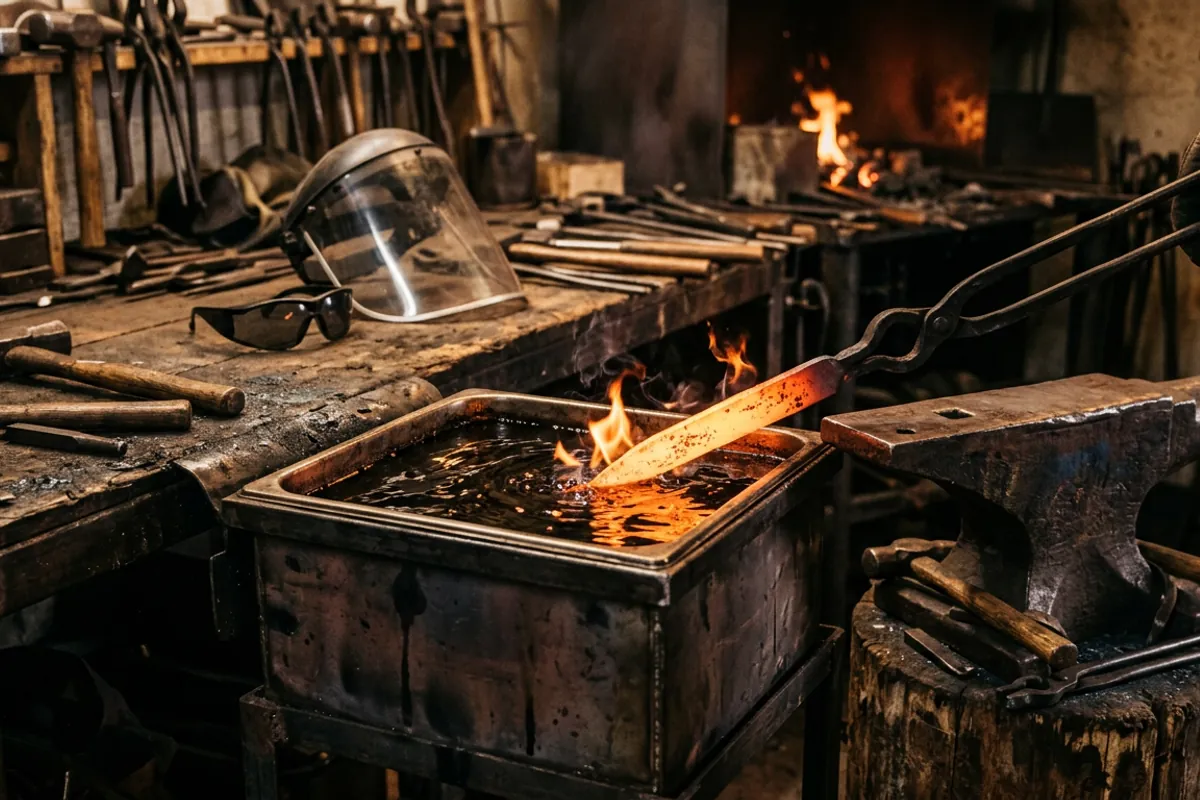
Then comes the quench, a fast cool that traps the steel in its hard martensitic form. The quench medium is matched to the steel: some want oil, some want a fast oil or brine, some are air-hardening and cool in still air or a gas quench. Get the quench wrong and you either miss full hardness or you crack the part.
Right out of the quench the steel is at its hardest and also its most brittle, brittle enough that a blade can crack sitting on the bench. So the last step is tempering: a lower-temperature bake that trades a little hardness back for toughness. This is where the tool gets its working balance, and I go deep on it in tempering of metal, explained from the forge floor. A commercial shop tempers in a controlled oven to a target hardness, usually stated in Rockwell C. Most knife steel lives somewhere around 58 to 62 HRC depending on the blade and the maker's preference.
When it is worth sending steel out
Here is where I will save you money, because most of the time a home smith does not need a commercial treater.
Send steel out when the steel demands control you do not have. Air-hardening tool steels, high-alloy stainless blade steels, and anything with a tight austenitizing window are hard to do right in an open forge. If you are working D2, or a powder stainless like one of the CPM steels, a commercial heat treat with a real furnace and a cryo cycle will get you a better, more consistent result than a forge and a magnet. Plenty of serious knifemakers who could do it themselves still send those steels out because the result is measurably better.
Send steel out when you need repeatability. A batch of identical parts, a run of tools that all have to hit the same hardness, a customer who wants a spec on paper: that is what a commercial shop is built for.
Send steel out when surface finish matters and you cannot afford scale or decarb. A vacuum-treated part comes back clean.
Do not send steel out for a single simple-carbon-steel blade you can absolutely do at home. 1084, 1075, 5160, and similar plain carbon and low-alloy steels are forgiving and were made to be hardened with basic equipment. Learning to heat treat these yourself is one of the most useful skills you will build, and it is a big part of knife making, explained from the first bar of steel. Paying to have a 1084 blade treated is like paying someone to tie your shoes.
What to send with your steel
If you do decide to use a commercial treater, do not just drop off a mystery bar. They are running a process to a spec, and they need to know the spec.
Tell them the exact steel. Not "carbon steel," the actual grade: 1084, 80CrV2, AEB-L, D2, whatever it is. The whole process is built around that number, and guessing gets your part treated wrong. This is one more reason to buy known steel from a real supplier and keep it labeled rather than forging from scrapyard mystery metal. If you want help matching a steel to a job before you buy, the steel selector tool is a decent starting point.
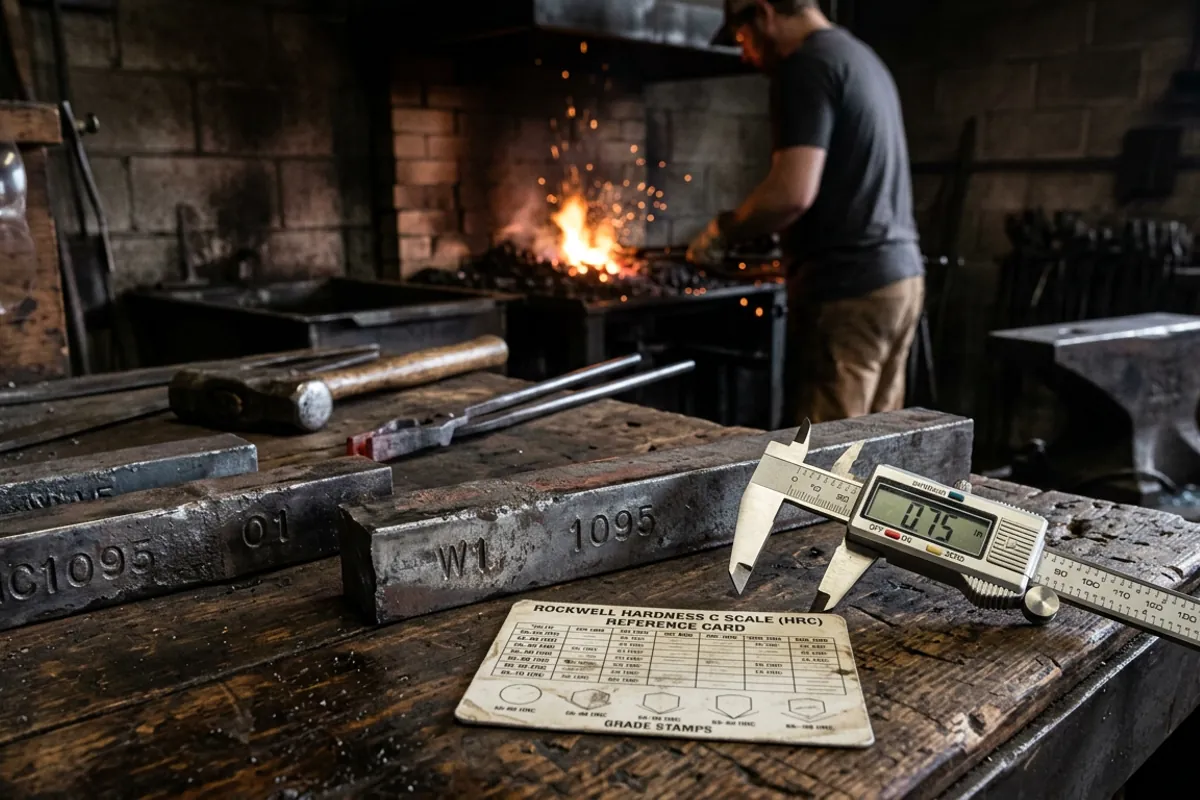
Tell them the target hardness. For a knife, give them the Rockwell number you want, or describe the use and let them recommend. A chef knife, a chopper, and a straight razor do not all want the same hardness.
Tell them the part's job and its thin sections. A treater who knows they are hardening a thin blade will handle the quench and any straightening differently than they would a chunky die block.
And ask what they return. Some shops return a part in the white, cleaned up. Some return it with scale you will grind off. Knowing that ahead of time changes how much stock you leave on before you send it.
What you still control at home
Sending steel out for the hardening cycle does not hand off the whole job. The parts that decide whether a blade is any good are still yours.
Geometry is yours. Heat treat cannot fix a bad grind or a blade that is too thin at the edge and will chip no matter how well it is hardened. Get the shape right first.
Steel selection is yours. Nobody at the treater picks your steel for you. Matching the steel to the tool is a decision you make before the part ever exists, and it is worth reading up on before you commit. The steel and metallurgy hub collects the pieces I have written on that.
Final sharpening, finishing, and any post-treat grinding are yours, and you have to do the grinding without ruining the temper. Hardened steel held against a fast belt gets hot fast, and if you let a thin edge turn blue you have just annealed the exact part you paid to harden. Keep a bucket of water at the grinder and dip often, or run the belt slow.
Where this fits with the heat treating you already do
The honest way to think about commercial heat treating is as a tool in the same rack as your forge, not a replacement for learning. I still heat treat the great majority of what I make on my own bench, because the steels I use most were chosen partly because they forgive an open-forge heat treat. When I reach for a steel that does not forgive it, or when a job needs a spec I can prove, that is when a commercial treater earns its keep.
If you are chasing the last few points of performance out of a high-alloy steel, the person to trust is not me and not a company's sales page. It is real, published metallurgical testing. Knife Steel Nerds runs controlled experiments on heat-treat protocols and steel behavior and publishes the data, and for the deep questions about soak times, cryo, and edge retention on specific steels, that is where I send people. A commercial heat treater executes a known process well. Understanding which process your steel wants is still homework you have to do, and doing that homework is what turns a search for "erie steel treating" into a decision you actually understand.