Every home shop I know has a corner of mystery steel. Mine is stacked behind the coal forge: half a leaf spring somebody pulled off a truck, two bearing races, a length of round bar that came home from a farm sale, and a coffee can of drops that all had a story attached until I forgot every one of them. Mystery steel is any steel you cannot name from a mill certificate or a supplier's label, and the honest place to start is that you cannot name it. You can narrow it to a class, you can find out whether it hardens and roughly how hard, and you can decide whether it is worth an afternoon. What you cannot do is throw a spark stream, squint at it, and announce a grade. I have watched people do exactly that for twenty five years, and I have watched their knives come out soft.
What mystery steel actually is
Steel gets its name from chemistry, and chemistry is documented at the mill. Once a bar leaves the supply chain and lands in a scrapyard, on a swap meet table, or under somebody's truck, that documentation is gone and it does not come back. The bar did not change. Your knowledge of it did.
That matters more than most beginners expect, because the same part is not the same steel across manufacturers, decades, or markets. A leaf spring off one truck and a leaf spring off another are two separate unknowns that happen to look alike. Two bearing races out of the same parts bin can be different alloys if they came from different suppliers. When someone tells you "leaf springs are 5160" or "bearings are 52100," they are stating a tendency as a fact, and a tendency will not tell you what quench to use.
So I treat every unmarked bar as its own problem. Not "what grade is this," which I cannot answer, but a shorter list of questions I actually can: is it plain carbon or alloyed, does it harden in oil, does a file skate on it after a quench, and does the broken grain look fine or coarse. Those four answers are enough to decide whether to forge a blade out of it or throw it in the practice pile. The deeper metallurgy behind them lives in the steel and metallurgy hub, and for anything involving real numbers I send people to Knife Steel Nerds, which runs actual tests instead of repeating shop lore.
Spark testing, and what it honestly does
The spark test is real, and it is useful, and it is oversold everywhere online. The clearest statement of both halves I have found comes from a US Bureau of Mines report by Larrain, Riley and Brown on spark testing in the identification of stainless steel and superalloy scrap. It found that spark testing "has proved to be fast and reliable" for sorting work. It also stated the limits plainly: "The main shortcomings of traditional spark testing are the requirement of experienced personnel and its inability to identify unknown alloys, serving mainly as a comparison method."
Read that last clause twice. A comparison method. The spark test tells you that this bar throws a stream more or less like that bar. It does not read out a number. If you have nothing known to compare against, you have learned almost nothing, which is exactly the situation most people are in when they spark test steel from a junkyard bucket.
What it does well is separate classes. Low carbon versus something with real carbon in it, plain carbon versus a high alloy or stainless, steel versus cast iron. That is genuine, and it saves time on a big pile. What it will not do is tell you 1095 from 5160 from 52100. Nobody can do that reliably by eye, and the site says the same thing in how to make a knife from a file. If you see a chart online that maps spark appearance to a carbon percentage, understand what you are looking at: a copy of a copy of a printed figure, passed hand to hand without anyone re-testing it. I do not publish one and I do not use one.
How I run a spark test
The procedure I follow is the one in the US Army's TC 9-524, Fundamentals of Machine Tools. Hold the steel stationary and touch a high speed portable grinder to the steel with sufficient pressure to throw a spark stream about 12 inches long. That length is the point. A lazy stream from a dull wheel or light pressure looks different from the same steel worked properly, and you will read the difference as a difference in the steel.
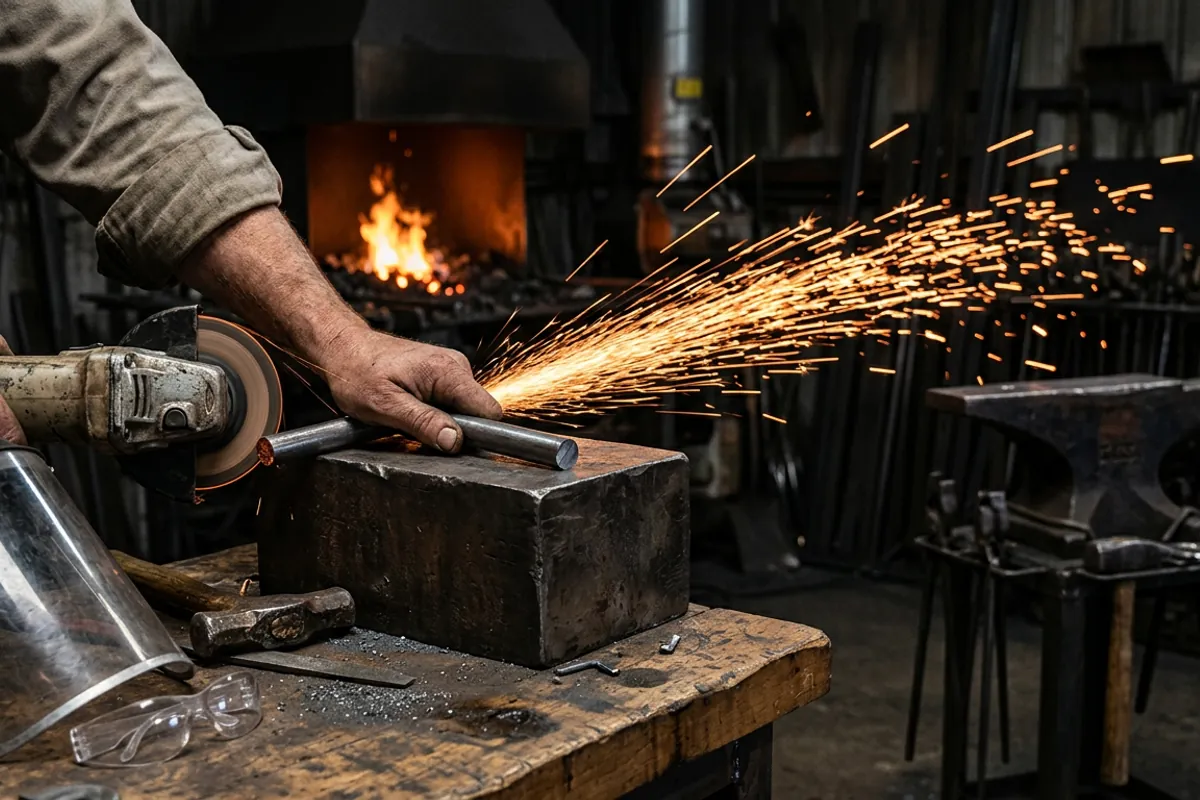
The other instruction from that manual is the one people skip, and it is the whole test: in all cases, it is best to use standard samples of metal when comparing their sparks with that of the test sample. So I keep short cutoffs of bar I bought with a label on it, mild steel, a medium carbon bar, a high carbon bar, and I spark a known one, then the unknown, then the known one again. Back to back, in the same light, with the same wheel. Any other way of doing it is guessing with extra steps.
Safety, because this is a grinder throwing hot metal at your face. Eye protection rated to ANSI Z87.1 is the minimum, and I want a face shield over safety glasses at the wheel, not instead of them. Natural fibers only; a spark stream will find synthetic sleeves and melt them into you. Clear the bench of solvent and oily rags first, because a 12 inch spark stream is an ignition source and it does not care what it lands in.
One hard rule before the wheel touches anything: never grind or heat galvanized, cadmium plated, or otherwise coated scrap, because the zinc fume will make you badly sick and heating it in a forge is worse, which is part of why shop ventilation is not optional in a working smithy. If the surface is bright and shiny and you did not put that finish there, the piece stays in the pile.
The spring pile, leaf and coil
Leaf springs are the most common piece of scrap steel for knife making in North America, and they are common for a good reason. Knife Steel Nerds puts it plainly: 5160 "has been used by many forging bladesmiths due to its good properties and also wide availability, especially in the form of leaf springs." That is a statement about why bladesmiths reach for the stuff. It is not a statement about the specific spring in your hand, and I want that distinction to stick. Your spring may be 5160. It may be something else entirely. You have a tendency, not an identification.
Coil springs are worse. Every grade you will see confidently attached to coil spring stock online traces back to steel trader listings and forum repetition, not to a mill cert for your spring. I am not going to print a grade for coil spring steel, because I cannot source one honestly, and a grade you half believe is more dangerous than no grade at all: it talks you into a quench and a temper you never verified.
Springs also come with a physical caution that has nothing to do with chemistry. A leaf spring has been fatigued for a couple hundred thousand miles, and a spring with a crack in it will open that crack up under the hammer. Coil springs store energy and can move hard when you cut them. Grind or wire wheel the surface enough to see what you have before you commit, and if there is a visible crack, that section becomes practice stock or a hardy tool blank, not a blade.
The realistic plan for a spring is this: spark it against your knowns to confirm you are in medium to high carbon territory, then cut a coupon and find out what it actually does. Nothing before the coupon is knowledge.
Bearings and races
Bearing steel is the one case where the odds genuinely are in your favor, and it is still not a certainty. H. K. D. H. Bhadeshia at the University of Cambridge, writing on bearing steels, notes that the 1C-1.5Cr composition, the family that includes 52100, makes up the majority of the six million tonnes of bearing steel manufactured per annum. Majority is the right word and I am keeping it. It describes world production tonnage. It does not promise anything about the specific race sitting on your bench, which may be a case hardened part, a tool steel, or a stainless grade depending on what it was built for.
The same source gives the numbers that explain why bearing scrap behaves the way it does. Bearing hardness runs in the range 59 to 66 HRC, standard austenitization is around 840 degrees C, and the temper is approximately 160 degrees C. That is why a race comes to you glass hard and why it will not touch a file or a bandsaw until you anneal it. Cut it hard and you will lose a blade in the process.
Knife Steel Nerds explains the connection to knives directly: 52100 "was developed for bearings and its common use in bearings meant it has been a ready source for knife steel for decades." Their tested recommendation is to austenitize at 1500 to 1525 degrees F for 15 minutes followed by a fast oil quench, and to temper between 300 and 400 degrees F, with cryo worth about a 0.5 Rc increase. A fast oil matters here, and I have written up what Parks 50 actually does rather than guessing at motor oil.
But run that recipe only on a bearing you have confirmed by coupon behaves like 52100. If you have not cut and tested a piece, that recipe is a recipe for someone else's steel. Go to the coupon first.
The coupon that actually settles it
This is the workflow the whole article exists to hand you, and it is the site's standard for any unknown bar.
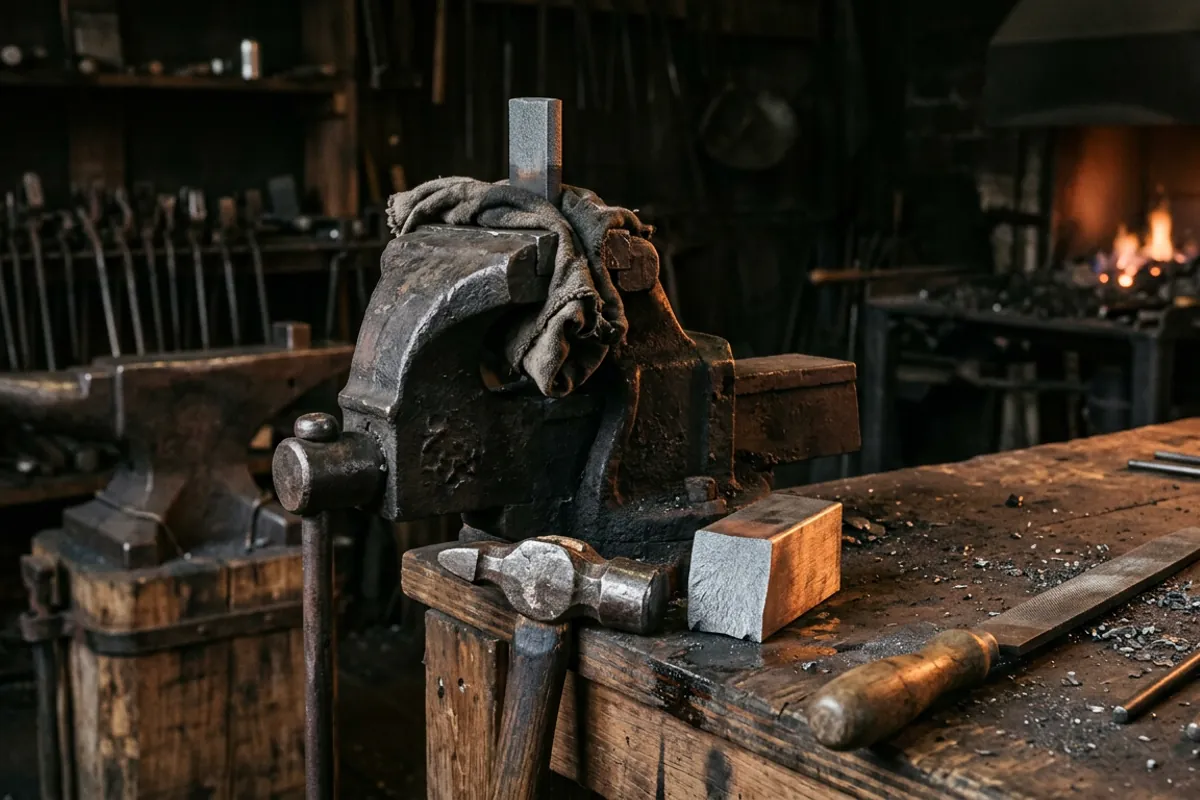
Spark it against a known sample so you know roughly what class you are in. Then cut a coupon off the end, a few inches is plenty. Normalize it so you are testing the steel and not the abuse it took in service or under your hammer, and there is more on that in normalizing cycles and temperatures. Bring the coupon up to non magnetic and quench from there, which is the practical field method covered in heat treating with a magnet. I start unknowns in a fast oil. If nothing hardens in oil and the steel is clearly high carbon by spark, that tells you something too.
Then test what you made. Run a file across the quenched coupon: if the file skates, it hardened; if it bites, it did not. Then break the coupon and look at the fracture. Fine, even, gray grain says a steel that responded well and was not overheated. Coarse and sparkly says grain growth or a steel that does not want what you gave it. Do that in a vise, wrapped in a rag, with a face shield on, because a hardened coupon comes apart into fast, sharp pieces.
Be clear about what you have learned. The coupon does not tell you the grade. It tells you whether the bar hardens, roughly how hard, how it broke, and therefore whether it is worth forging a blade from. That is the honest ceiling on mystery steel, and it is enough to work with. What it will never give you is the confidence that comes with a labeled bar and a published heat treat, which is why the knives I actually give away start from known steel.
The scrap I leave in the pile
Railroad spikes look like free knife steel and they are not. They sit around 0.10 to 0.30 percent carbon with almost no hardenability, which is covered in full in the railroad spike knife. They forge beautifully and make good hooks and bottle openers. They do not make a knife that holds an edge, and the HC stamp does not change that.
Files are their own conversation, and making a knife from a file owns it. The short version I repeat here: the grade is unsourced, and cheap imported files are often case hardened, so you grind through the hard skin into soft core and never find out until the blade fails.
Old wrought iron shows up in junkyard steel and in barn finds, and it is genuinely worth having for the right project, but it is not a hardening steel and telling it apart from mild steel is a skill of its own. That is in wrought iron versus steel.
Anything plated or galvanized goes in the scrap bin, not the forge, for the zinc reason above. Anything that might be a pressure vessel, a cylinder, or a sealed tube stays whole and goes away. And anything I spark test that reads high alloy or stainless, I leave alone, because home shop stainless heat treat is a different animal with a different set of requirements.
What junkyard steel is really worth
Here is the part nobody selling scrap wants said out loud. A short bar of labeled, known steel with a published heat treat costs about what a decent lunch costs. An afternoon of spark testing, cutting coupons, hardening, breaking and filing costs an afternoon, and at the end of it you still do not know the grade. Priced by the hour, mystery steel is not free steel.
What it is good for is real, though. It is excellent practice stock: drawing out, tapering, punching and drifting do not care what alloy you are moving. It is where I learned to read a fracture, and reading a fracture made me better at every heat treat I have run since. It teaches the habit of testing instead of believing, which is the actual skill under all of this. And once in a while a spring or a race comes through that tests well and becomes a working knife you trust because you proved it, not because a forum told you what it was.
My rule after twenty five years is simple. Practice, tooling and hooks come out of the mystery pile. Anything with an edge that somebody else is going to use comes out of a bar I can name. If you want a shortcut past the whole problem for your first few blades, buy known steel, learn its heat treat properly, and let the pile in the corner be where you experiment on purpose rather than by accident.