Every so often someone hands me a knife blank that came out of the quench soft and asks what went wrong. Most of the time it is not the oil. The tenth time it is, and that is the conversation where Parks 50 quench oil comes up, usually as a name somebody heard on a forum without any explanation of what it does or why it exists. So here is the whole thing, plainly: what Parks 50 is, what problem it was built to solve, which steels actually need it, how I run a tank of it in a home shop, and the ways it can hurt you if you treat it casually. I have run a tank of it for years. I am a hobby smith, not a metallurgist, and where the answer requires real cooling curve data I will say so and point you at people who measure it.
A fast oil, and what fast means here
Parks 50 is a petroleum based, accelerated quench oil. "Accelerated" is the part that matters: the base oil is doing the cooling, but an additive package is doing the work that makes it fast. It carries the Parks name from Park Metallurgical and is sold now under Heatbath, and the 50 is a product designation. It is not a speed rating, not a temperature, not a viscosity grade. People read meaning into that number that is not there.
It is thin, light colored when it is new, and fairly odorless in the pail. It comes in five gallon pails and fifty five gallon drums, and the freight on it routinely surprises people who priced only the oil.
The thing worth understanding is that this is an industrial quenchant. It was formulated for production heat treating shops running racks of parts through automated lines, not for one guy quenching a paring knife on a Saturday. Knifemakers adopted it because it happened to match the needs of shallow hardening carbon steel better than anything else easy to buy. The maker publishes a technical data sheet with the operating temperature range, flash point, and viscosity on it. That sheet governs. Anything I write here is context for it, not a replacement.
Why quench speed is the whole point
When you drop a glowing part into oil, cooling happens in three stages, and they are worth knowing by name because every quench problem lives in one of them.
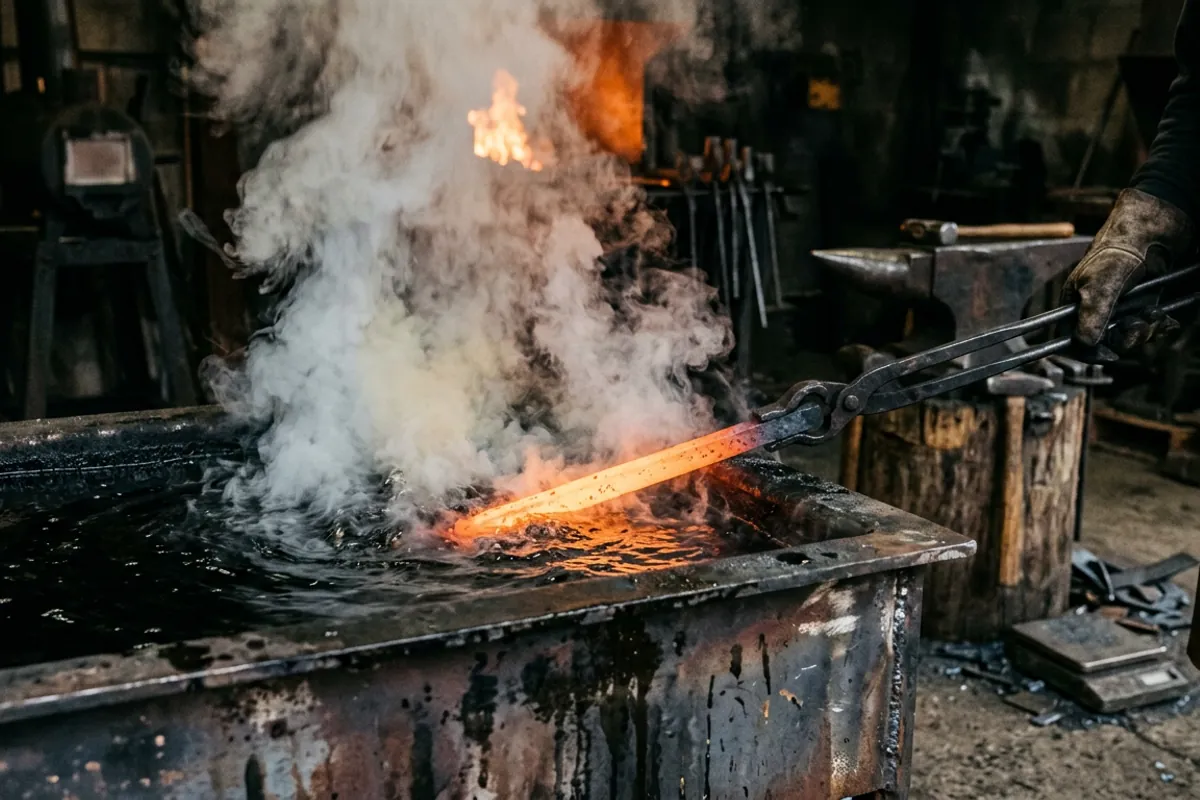
First is the vapor blanket, sometimes called film boiling. The oil touching the steel vaporizes instantly and wraps the part in a jacket of its own vapor. Vapor is a lousy conductor, so during this stage the part is insulated and cooling is slow. Worse, it is uneven, because the blanket clings to some areas longer than others. Soft spots and warps are born here.
Second is nucleate boiling, where the blanket collapses and oil makes real contact with the steel. This is where most of the heat leaves, fast.
Third is convection, the slow tail after the oil stops boiling, where the part cools by simple heat transfer into the bath.
An accelerated oil like Parks 50 has additives whose job is to break that vapor blanket early and evenly. That is the entire trick. It is not that the oil is magically colder or thinner, it is that the first stage gets cut short.
Why does that matter? Because turning austenite into martensite means outrunning the transformation. Plain high carbon steel with almost no alloy in it has a pearlite nose on its transformation diagram that sits brutally close to the temperature axis. You have a fraction of a second to get the steel from its austenitizing temperature down through the roughly 900 F to 1000 F region. Miss it and pearlite forms, pearlite is soft, and no amount of tempering afterward will undo it. Alloying elements like chromium, manganese, and molybdenum push that nose to the right and buy you time, which is exactly why alloy steels tolerate slower quenchants.
If you want the real numbers, cooling curves, and comparative quenchant testing, Larrin Thomas at Knife Steel Nerds has done more honest measurement on this than anyone else writing for knifemakers, and that is where I send people who want data rather than my impressions. Broader background on what heat treating is doing to the steel lives in the steel and metallurgy hub and in heat treating steel, explained from the forge floor.
The steels Parks 50 is built for
This oil earns its keep on shallow hardening steels. In practice that means the plain carbon grades and the very lightly alloyed ones: 1075, 1080, 1084, 1095, W1, W2, 26C3, and their relatives.
1084 is the forgiving one and it is what I start beginners on, because its composition sits near eutectoid and it does not need a long precise soak. 1095 is a step less forgiving. It wants a real soak at temperature to get carbon into solution, and it punishes a slow quench with soft results. If you are running 1095 out of a propane forge without a controller, a fast oil is doing you a genuine favor.
W1 and W2 are water hardening steels by name and by history. Plenty of people quench them in fast oil instead, accepting less hardening depth and a different hamon in exchange for a much lower crack rate. That is a legitimate trade, not a compromise to be embarrassed about.
80CrV2 sits at the edge of this group. It has enough chromium and vanadium to be a bit deeper hardening than 1084, and it does fine in a fast oil, though it is not as dependent on one.
One thing Parks 50 will not do is make a steel harder than its carbon content allows. It gets you the hardness the steel already has in it. If you quench mild steel in it, you get a wet piece of mild steel.
The steels that do not need it, and the ones it will hurt
5160, 52100, O1, A2, and 4140 all harden fine in a medium speed oil. Worth knowing this one is contested: New Jersey Steel Baron's own 5160 sheet suggests Parks AAA, while Knife Steel Nerds' 5160 testing ran in Parks 50. The warp and crack argument is real for a deep hardening steel in thin section; the broader claim that a fast oil is inherently damaging is not what the testing shows. A2 will harden in still air in thin sections. Running a fast oil on a deep hardening steel does not buy you hardness, because you were never in danger of missing the nose. What it buys you is warp and crack risk, and that risk goes up sharply in thin cross sections, in blades with a distal taper, and anywhere there is a sharp internal corner for a crack to start in.
I have watched a guy split a 52100 blade lengthwise in a fast oil because he had read that faster is better. Faster is not better. Matching the quench to the steel is better.
Stainless is not part of this conversation at all. Hardening stainless means high austenitizing temperatures, foil wrap to control scale and decarb, and a plate or gas quench rather than a dunk in oil, often with a cryo step after. AEB-L and MagnaCut both live in that world. A tank of Parks 50 does nothing for either.
How I set up and run a quench tank
The tank is steel. Not plastic, which fails in exactly the situation you least want it to. Not galvanized, because zinc fumes when it gets hot and zinc fume fever is real. Not a drum that used to hold something flammable. Tall and narrow beats short and wide for blades, because you want to go straight in vertically. Mine has a fitted steel lid that sits within arm's reach whenever the tank is open.
On volume, the rule of thumb that circulates among knifemakers is about one gallon of oil per pound of steel quenched. That is owner consensus, not a published spec, but the reasoning behind it is sound: the oil has to absorb the part's heat without the bath climbing toward its flash point. A small tank plus a heavy part is exactly how oil gets hot enough to burn.
Parks 50 is one of the few oils that is meant to run at or near room temperature. Most quench oils want to be preheated into the 120 to 140 F range to thin out and perform as specified. Check the data sheet that came with your container for the actual published range, because that is the number that matters and it belongs to the product, not to my memory of it. What I will say from running it: in an unheated shop in January, oil at 40 F is thick and sluggish and does not behave the way it does in July. I warm the tank into its range before I quench anything I care about, and I keep an eye on the bath temperature across a session, because a run of parts walks it upward.
Motion matters. In edge first, straight down, and then move the blade along its own length, spine to tip, not side to side. Sideways sloshing is how straight blades come out bent. Keep the part fully submerged with oil well above it. I leave it in until the boiling stops and the part has come down to where the oil is no longer working, then it goes straight to the temper.
Straight to the temper is not a figure of speech. As quenched martensite is glass. Blades crack sitting on a bench with nobody touching them. Get it into the oven, and verify your oven with a separate thermometer because household dials lie by fifty degrees without shame. The mechanics of that step are in how to temper steel by heating and cooling.
Before tempering, a new mill file across the edge tells you most of what you need to know. A properly hardened blade skates. A file that bites means something upstream went wrong.
Fire, and the part I am not going to soften
Years ago I quenched a blade in oil that was too cold, standing far too close, in a cotton shirt with no face shield. The oil flared. It took my eyebrows off and I kept my eyesight on luck alone. The cotton shirt was the one thing I had right. Everything else about that setup was an accident waiting for a date.
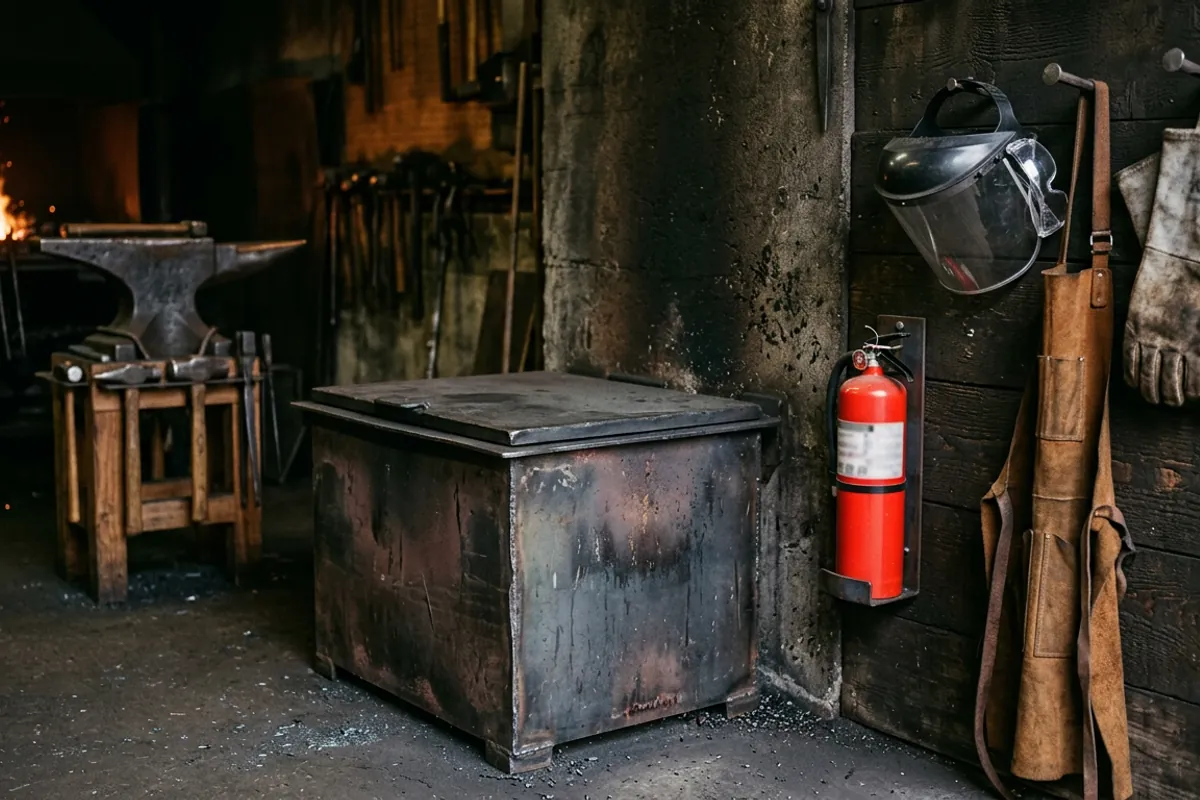
So here is the list, and I do not treat any of it as optional.
A steel lid sized to your tank, within reach, every single time the tank is open. Smothering is how you put out an oil fire. A Class B rated extinguisher on the wall as backup. Never water. Not a bucket, not a hose, not a water extinguisher. Water on burning oil turns a fire into an explosion.
A face shield worn over ANSI Z87.1 rated safety glasses, not instead of them. The shield stops the splash, the glasses stop what gets around it.
Natural fibers only. Cotton, wool, leather. Synthetics melt into skin and turn a burn into a graft. Gloves you can shake off your hand in a hurry rather than gauntlets you have to peel.
Water in the oil is the hazard that gets underestimated most. A cup of water sitting under the oil at the bottom of a tank will flash to steam under a hot part and throw burning oil out of the tank. Keep the lid on. Do not store the tank outdoors uncovered. Do not top it up with anything you have not verified.
Ventilate. Quench smoke is thick and it is not something to be breathing. Keep the floor around the tank clear and know where you are walking before you pick up a hot part. The rest of my thinking on shop protection is in blacksmith safety gear.
What Parks 50 cannot fix
Oil is the last link in a chain of five, and it cannot compensate for the four ahead of it.
It cannot fix the wrong austenitizing temperature. Too low and carbon never gets into solution. Too high and you grow grain and retain austenite. It cannot fix no soak, which is what most propane forge heat treats amount to when the part is swung in and out of a hot spot.
It cannot fix decarb. The skin of the steel that lost carbon in the forge will quench soft no matter what it lands in, and the only cure is grinding past it.
It cannot fix uneven heat, where half a blade transformed and half did not. It cannot fix a forged blade that never got thermal cycled, where the grain grew coarse during forging and stayed that way. Normalizing before hardening is not an optional refinement, and I cover the related process in what annealing steel actually does.
It also cannot fix heat treating by magnet alone. The Curie point sits a bit over 1400 F, and for most of these steels the austenitizing temperature is above it. Non magnetic is a floor, not a target.
The substitutes people ask me about
Canola oil is the honest one. It will harden 1084 in thin sections and a great many first knives came out of a coffee can of it. Its problems are consistency and longevity: it polymerizes into a varnish on parts and tank walls, it goes rancid, its cooling behavior is not published and varies batch to batch, and it smokes heavily. It is a stopgap while you get set up, not a plan.
Used motor oil is a no. It carries combustion byproducts and metals, the additive package is unknown, and the smoke is genuinely toxic. Nothing about the money saved is worth it. Automatic transmission fluid gets suggested for the same reason and fails for the same reasons.
Water and brine are historically correct for W1 and W2 and they are genuinely fast. They also crack modern blade geometry at a rate that will discourage you. People who chase hamons do it anyway and accept the losses knowingly.
Within commercial quenchants there are slower siblings in the same family, Parks AAA being the one most often named, and those are what deeper hardening steels get run in. Picking between a fast oil and a medium one is a question about your steel, not about which product is better. And do not mix two oils in one tank. You end up with a quenchant whose speed nobody can tell you.
Keeping the oil good, and knowing when it is finished
Oil in a home shop dies of contamination long before it dies of use. Scale falls off parts and settles. Dust gets in. Oil leaves on every part you pull out, which is called drag out and is why the level drops. And water finds its way in through condensation if the tank sits uncovered.
I keep the lid on except during the quench itself, let the tank settle between sessions, and skim or decant off the scale that builds up in the bottom. Sludge is a normal part of aging oil; a thick layer of it is not.
The signs that a bath is finished are darkening well past its original color, a sour or varnish smell, and parts starting to come out softer or less consistently than the same steel used to. Oxidized oil quenches slower than fresh oil. A production shop sends samples out for analysis. A home shop goes on those symptoms, and in fairness most of us quench so little steel that a pail lasts years.
When it is done, it goes to a waste oil recycler. Not down a drain, not on the ground for dust control, not in the burn barrel.
Whether it belongs in your shop
If you forge blades out of 1084, 1095, W2, or similar shallow hardening steel, a fast oil is the correct tool and this is the one most people around the craft run. If your work is hooks, hardware, tongs, and tooling out of mild steel and 4140, you do not need it and never will. If you make a knife or two a year, a modest quantity of any proper commercial quenchant still beats canola on repeatability, though the freight math on a five gallon pail is worth doing honestly before you order.
The order of operations is what I would leave you with: decide the steel first, then pick the quenchant that steel needs. Doing it the other way around is how people end up cracking 52100 in a fast oil and blaming the oil. If you are still working out which steel suits what you make, the steel selector is a reasonable place to start, and the rest of the metallurgy writing lives in the steel and metallurgy hub.
Get the temperature right, get the soak right, grind past the decarb, and then let the oil do the one job it is actually good at.