S7 tool steel is what I reach for when a tool is going to spend its whole life getting hit. The S in the designation stands for shock resisting, and the steel was worked out for things like pneumatic chisels and jackhammer bits long before hobby smiths started making top tools out of it. If you have ever had a punch split down the middle, a hot cut chip a half moon out of its edge, or a struck tool mushroom into a flower after one weekend, the odds are good the steel in it was chosen for hardness and nothing else. S7 is the other answer. I keep a couple of lengths of it on the rack, and most of the struck tools in my shop that have outlasted everything else came off those bars. What follows is the plain version: what is in it, how it forges, how it heat treats, and where it stops being the right steel. If you want the wider view of how steels get picked, the steel and metallurgy hub collects the rest of it.
Why S7 exists, and what it was built to survive
S7 sits in the shock resisting group of the AISI tool steel families, alongside S1 and S5. Those families are shorthand for design intent, not for quality. W steels want a water quench, O steels an oil quench, A steels air harden, D steels are loaded with chromium and carbide for wear, H steels are built to work hot, and S steels are built to eat impact without cracking.
The odd thing about S7, and the thing that makes it so pleasant to use, is that it is a shock steel that also air hardens. Data sheets put full hardness in air out to sections around 2 1/2 inches thick. That means no quench tank for most tool work, no oil fire, and very little movement in the part. For a home shop that is a real advantage. A big S7 punch comes out of the oven, sits on a wire rack, and hardens through while you clean up.
The tradeoff is written into the carbon content. S7 runs about half a percent carbon, which is roughly half what a simple blade steel carries. Less carbon means less carbide, less carbide means less wear resistance, and less wear resistance is exactly the price you pay for toughness. S7 is not trying to hold an edge for a long time. It is trying to survive.
What is in the bar, and what each element is doing
The published spec range for S7, the one you will find on any mill certificate, is roughly 0.45 to 0.55 percent carbon, 3.00 to 3.50 percent chromium, 1.30 to 1.80 percent molybdenum, with modest manganese and silicon and sometimes a small vanadium addition. Nominal is usually quoted as about 0.50 carbon, 3.25 chromium, 1.40 molybdenum. Your bar's actual chemistry is on the cert, and if the seller cannot produce one, see the buying section below.
Here is the honest short version of what each of those does.
Carbon sets the ceiling on hardness. Half a percent gets you to about 60 HRC as quenched and nothing higher, no matter what you do.
Chromium and molybdenum together buy hardenability. That is why S7 hardens all the way through in still air instead of needing a violent quench, and it is also why a forged piece left on the bench overnight can crack. Those two also give the steel its resistance to softening when it gets tempered back or when it sees heat in service.
What is missing matters as much as what is there. There is very little vanadium and not much carbon, so there is not much hard carbide floating in the matrix. You get a tough, uniform, medium carbon martensitic structure. That is the whole design. If you want to go deeper than that on carbide volume and toughness testing, Knife Steel Nerds publishes actual measured data rather than shop lore, and it is worth reading before you argue with anyone about toughness rankings.
What I actually make out of S7
Everything in my shop that gets struck, or that strikes hot steel, and that I care about lasting.
Hand punches and slot punches. Drifts. Hot cuts and cold chisels. Hardy tools, especially anything that takes a hammer blow while the hot steel is between it and the anvil. Top tools like fullers and set hammers. Bolsters and guillotine dies. Anything shaped like a tool that will get hit ten thousand times.
Power hammer dies are the other classic use, though I should be straight that I am going on the consensus of the shops that run hammers rather than my own bench. Ask ten hammer owners and you will hear S7 and H13 named over and over for dies, S7 for its toughness when the die sees cold or barely warm stock, H13 when the die sits in heat all day.
There is one habit worth building early. On a struck tool, only the working end gets hardened. The end you hit stays soft, either by never taking it to temperature or by drawing it back deliberately afterward. A fully hardened S7 punch struck by a hardened hammer face is how chips of tool steel end up in eyes.
Forging S7, and the crack that comes free with it
S7 forges well, but it wants to be treated with more patience than mild steel.
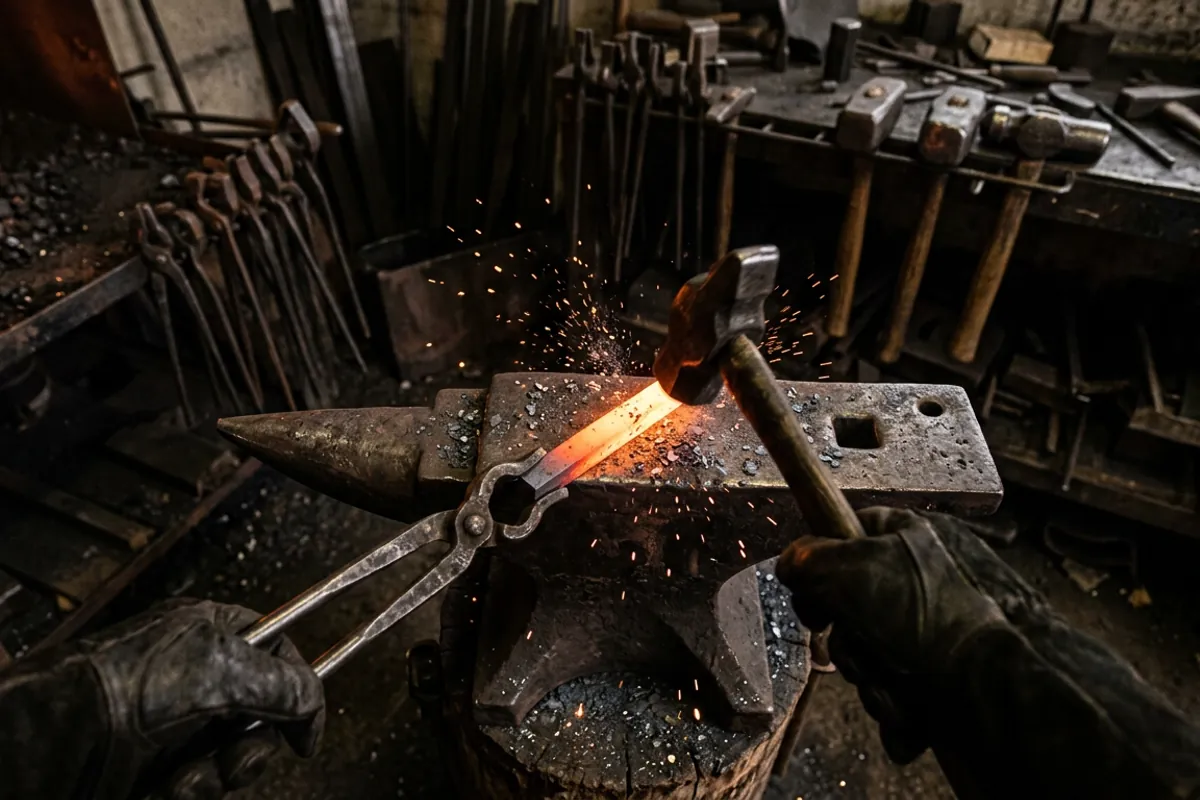
Heat it slowly and evenly. Thick sections of alloy tool steel do not like being shoved into a roaring forge cold. Work in the range the data sheets give, which is generally starting around 2000 F and stopping before the piece drops below about 1700 F. Below that you are beating on steel that is stiffer than it looks, and you can open cracks you will not see until heat treat.
Now the part that catches people. S7 air hardens. That property that makes heat treating easy makes forging dangerous, because a hot forged piece set down on the bench to cool is being air quenched whether you meant it or not. It will harden, it will be full of forging stress, and thick sections with a stress riser in them will crack, sometimes hours later. I have heard a piece let go in a quiet shop and it is not a sound you forget.
So when the forging is done, do not just set it down. The right answer is a proper anneal: back to roughly 1500 to 1550 F, then a slow controlled cool, no faster than about 50 F per hour down to around 1000 F, then air cool. That lands you near 190 to 220 Brinell, soft enough to drill and machine. If you do not have a furnace that can crawl down that slowly, burying the piece in dry vermiculite or wood ash straight from forging heat will usually slow the cool enough to keep it from cracking, but be clear with yourself that it is a crack prevention measure and not a true anneal. If you want the mechanism behind all of this, I laid it out in what annealing steel actually does.
Heat treating S7 in a home shop
This is where I have to be blunt, because a lot of internet advice on S7 is wishful.
The numbers I work from
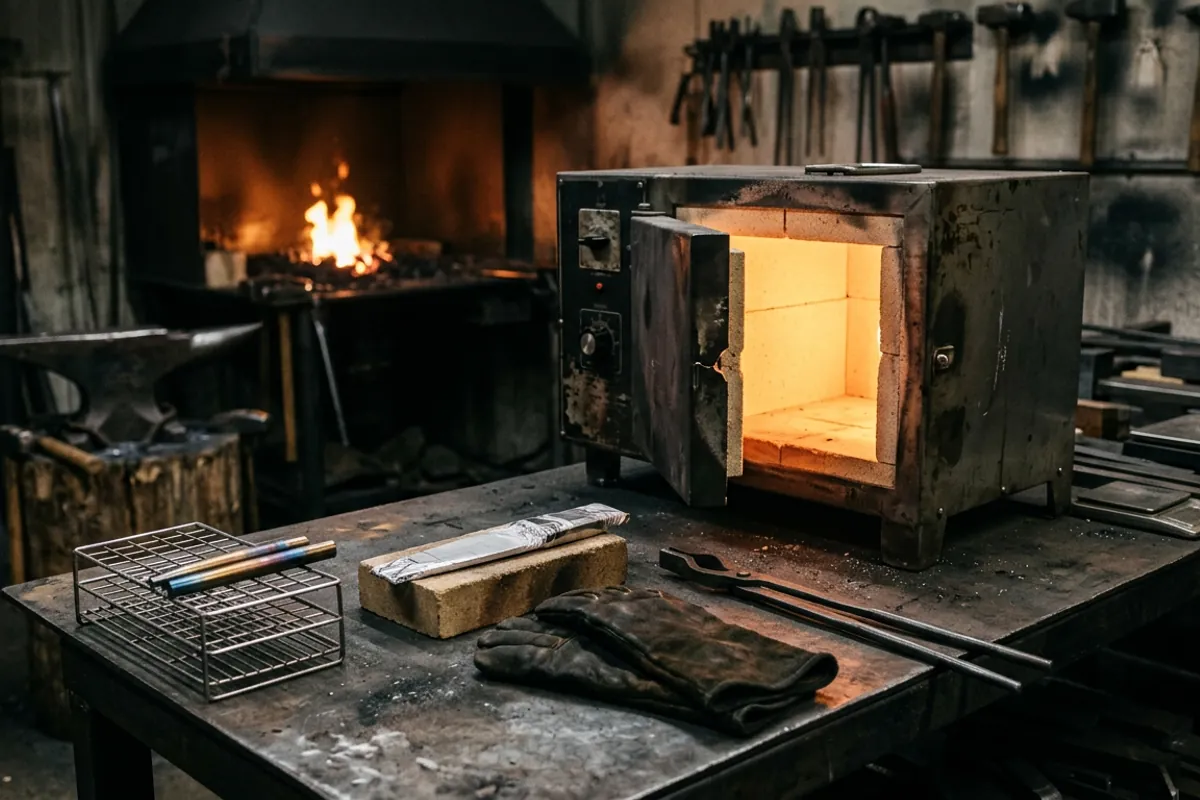
Preheat around 1200 to 1300 F and let the part equalize. Then take it up to the austenitizing range, commonly published as 1700 to 1750 F with 1725 F as the usual target, and hold it there long enough for the whole section to soak, which for typical tool sections means something on the order of half an hour. Air cool to about 150 F, hand warm, and temper immediately. Do not let it sit hard overnight before tempering. Follow the specific data sheet for the bar you bought, because suppliers vary their recommendations slightly and the sheet beats my memory.
Why your forge is probably not enough
You cannot get to 1725 F by color and a magnet. Steel loses its magnetism around 1414 F, so by the time your magnet stops sticking you are still hundreds of degrees short of where S7 needs to be, with no further signal to guide you. Judging that last stretch by eye, in the varying light of a forge, with the part heating unevenly, is guessing. Some smiths do it anyway and get tools that work. What they do not get is repeatability, and they usually do not know whether they overheated and coarsened the grain.
If you are going to make S7 tools regularly, a small electric heat treating oven with a thermocouple is the tool that actually unlocks the steel. Failing that, a commercial heat treater will run a batch of your tools for less than most smiths expect. Either beats hoping. The general principles behind all of it are in heat treating steel, explained from the forge floor.
One more practical note: an air furnace at 1725 F will pull carbon out of the surface. If the finished surface matters, wrap the part in stainless foil or leave grinding stock on it and take the decarburized skin off afterward.
Tempering S7 to match the job
As quenched, S7 lands around 60 HRC. Nobody uses it there. Untempered martensite in a struck tool is a crack waiting for an excuse.
The published temper curves for S7 run roughly like this. Around 400 F you land in the high 50s HRC. Around 500 to 600 F you are in the mid 50s. The curve then flattens through the middle range and still holds around 50 HRC up near 900 to 1000 F, and Crucible's own data shows impact toughness climbing across that band rather than falling. Past about 1100 F hardness drops off fast.
Two hours minimum at temperature, and two tempering cycles rather than one is standard tool steel practice. It is cheap insurance.
How I pick the temperature is simple. For cold work, punches, drifts and chisels that only ever see room temperature steel, I temper low, in the 400 to 500 F neighborhood, and accept the higher hardness because toughness is still excellent there. For anything that will be in contact with hot steel, a hot cut or a hot punch, I temper up in that 900 to 1000 F range. The logic is that a tool tempered at 450 F and then held against 2000 F stock is getting tempered again in service, by the work, uncontrolled. Temper it above the heat it will see and it stays where you put it. The general behavior of steel under tempering is covered in tempering of metal.
Where S7 is the wrong steel
Knives. S7 will take an edge and it will not break, but with half a percent carbon and almost no carbide it will not hold that edge against abrasion. A dedicated blade steel outperforms it badly on cutting. If you want the contrast, look at what 80CrV2 actually is, a simple steel with far more carbon doing a job S7 was never built for. There are impact tools shaped like blades, brush hooks and heavy choppers, where S7 makes a defensible choice, but a kitchen knife out of S7 is a novelty, not an upgrade.
Sustained hot work. S7 has decent hot hardness and handles intermittent contact with hot stock fine. Dies that live in the heat, hour after hour, are H13 territory. Do not talk yourself into S7 for a forging die that never gets to cool down.
Anything where wear is the failure mode. Shear blades cutting abrasive material, dies wearing on scale, punches going through hundreds of pieces. That is what the high carbide cold work steels are for.
Cheap and cheerful. S7 costs real money. A hammer body, a simple bick, a jig, a fixture, none of that needs S7.
How S7 compares to the other bars on my rack
Against 4140, S7 is the more capable tool steel by a good margin. 4140 is cheap, forgiving, widely available and completely adequate for hammer bodies and tooling that does not need high hardness, and I use plenty of it. It does not reach S7's combination of hardness and impact toughness. I wrote up how I heat treat 4140 separately.
Against A2, the swap is toughness for wear. A2 also air hardens, holds a working edge better, and is more prone to chipping under a heavy blow. If you want the process side of a cold work air hardening steel, heat treating A2 tool steel walks through it.
Against O1, S7 wins on toughness and on not needing an oil quench. O1 wins on availability in small sizes and on edge holding.
Against H13, S7 wins on impact, H13 wins on anything that stays hot.
Against the simple carbon steels, 1084 and its relatives, it is not a fair comparison in either direction. They are edge steels, S7 is an impact steel. If you are trying to sort out which is which for a project you have in mind, the steel selector is a faster way through it than reading nine articles.
Buying S7 without buying mystery steel
S7 is a commodity industrial steel. It is sold as new bar by steel suppliers and knife supply houses in round, square and flat, normally in the annealed condition, and it usually comes with or can be traced to a mill certificate. That certificate is the only thing that actually tells you the chemistry.
Which brings me to the thing I get asked constantly. Jackhammer bits and paving breaker tools are frequently made from shock resisting steel, and some of them are genuinely S7. Others are S5, or 4140, or 4340, or something proprietary. You have no way to tell by looking. A spark test will tell you it is alloyed and nothing more useful than that. A file will tell you what it was heat treated to at the factory, not what it is. If you use scrapyard steel, treat it as unknown and prove out a heat treat recipe on a test coupon from the same bar before you trust it in a tool you swing.
Buy a bar of known S7 in the sizes you actually use, and be honest that a lot of a hobby smith's tooling does not need it. One 3 foot length of 3/4 or 1 inch round has made a shelf full of punches and drifts here.
Working safely around S7 tools
Two hazards deserve the plain version.
The first is struck tool failure. Any hardened tool that is hit repeatedly develops a mushroomed head, and the rolled over lip of that mushroom eventually breaks off at speed. Dress the struck end back to a slight crown with a grinder as soon as it starts to spread, keep the struck end soft rather than hardened, and never hit a hardened surface with a hardened hammer face. ANSI Z87.1 rated eye protection is not a suggestion here. Chips of hardened tool steel travel faster than you can blink.
The second is heat treatment. S7 mostly avoids the oil quench, which quietly removes the worst hazard in home heat treating. When a section is heavy enough that a supplier calls for oil, respect that oil properly. Early on I quenched a blade in oil that was too cold, standing too close, in a cotton shirt, with no face shield. The oil flared and took my eyebrows off, and I kept my eyesight on luck alone. Warm oil, enough volume, a lid within reach, a face shield, natural fibers, and no synthetics anywhere near the tank. The rest of the kit I actually wear is in blacksmith safety gear.
Grinding is the quiet third one. Hardened S7 grinds hot and throws dust with chromium in it. Eye protection at the wheel, dust off your lungs, and do not grind on a wheel you have not inspected.
The short version
S7 tool steel is a medium carbon, air hardening, shock resisting tool steel built to be hit. It forges in the ordinary range but must be annealed or slow cooled after forging or it will harden and crack on your bench. It wants a real austenitizing temperature around 1725 F, which realistically means an oven or a commercial heat treater, then air cooling and an immediate temper chosen to match the service heat: low for cold work, up near 1000 F for anything touching hot steel. It is not a knife steel, it is not a hot die steel, and it does not need to be in every tool you own. But for punches, drifts, hot cuts, chisels and struck tooling, it is the steel I keep coming back to, and the tools I have made from it are still here.