Wrought iron vs steel is almost never an academic question by the time it reaches my shop. It arrives as a bar. Somebody pulls a section of old porch railing off a house, or cuts a gate loose, or finds a wagon tire hanging on a barn wall, and it lands on my bench, because people who know I burn coal assume I can tell them. Nobody wants a lecture on puddling furnaces. They want to know what the stuff is, whether it will forge weld, whether it will harden, and whether it is worth the fuel. That is what this article is for: telling the two apart on the piece in front of you, with an honest account of which tests can actually carry the weight we put on them.
I will give you the punchline first, because it is the reason I wrote this. The single most repeated identification test in the hobby, nick a bar, snap it, and read a fibrous break as wrought iron and a crystalline one as steel, was put through a formal investigation a hundred years ago and did not survive it. Smiths still teach it as gospel, including smiths I like. It does not do what we say it does, and the paper that showed why is specific enough to be useful rather than just discouraging.
The three materials, and the numbers that separate them
Wrought iron is iron that was worked out of a pasty mass rather than poured, with the slag from that process left physically mixed through the metal in long threads. If you want the history of how it was made and what a smith's iron supply actually looked like before the steel mill, I covered that ground already in what a medieval blacksmith actually did all day, and I am not going to retell it here.
The numbers matter more for identification than the history does. The National Park Service, in Preservation Brief 27, The Maintenance and Repair of Architectural Cast Iron, describes wrought iron as almost pure iron, with less than 1 percent carbon and usually 0.02 to 0.03 percent. That same brief puts cast iron at at least 1.7 percent carbon and usually 3.0 to 3.7 percent. Steel sits in the gap between them, and where it sits in that gap is the whole subject of heat treatment.
The slag is the other number worth carrying. NPS publishes slag as varying between 1 and 4 percent of wrought iron's content, and describes it as existing in a purely physical association rather than being alloyed into the metal. That physical association is the key to everything below: the slag is not part of the iron chemically, it is stuff trapped inside it, drawn out into threads by rolling and hammering. You will also see a figure of roughly 10 percent quoted around the internet as though it applied to all puddled iron. It traces back to a metallographic study of one nineteenth century structure, the Simon Bolivar bridge in Arequipa, Peru, built from Phoenix Iron Company stock. It is a real measurement of one bridge, on a different basis, and it is not a general figure for the bar in your hand. Do not mix the two.
Wrought and puddled iron are also characterized by high phosphorus and sulphur compared to modern steel. What that does to hot and cold working behavior is a real metallurgy question, and the honest answer is that it varies with the specific iron. If you want to go deep on how residual elements affect a steel's behavior, read the people who run actual tests, Knife Steel Nerds among them, rather than taking a forum answer or mine.
The nick and snap test, and why I stopped trusting it
The test as it is normally taught goes like this. Nick the bar with a hacksaw or a hot cut, break it, look at the fracture. Long fibers like a broken green stick mean wrought iron. A bright sugary crystalline face means steel, or means somebody sold you steel as iron.
That test was investigated by the Bureau of Standards and published as Technologic Paper No. 252, The Nick-Bend Test for Wrought Iron, by Rawdon and Epstein, dated 29 February 1924. It is not a blog post, it is a systematic study, and its own count of the sample set is worth quoting exactly: "twelve materials in all were tested." I am careful with that phrasing because the paper's abstract and body describe the breakdown of those materials differently, so the safe statement is the direct one.
The conclusion in the abstract is blunt. The results, it says, show that the test "can not be depended upon to show the presence of steel in wrought iron nor to give results by which the phosphorus content may be judged." I flag that this line lives in the abstract rather than in the numbered conclusions, because that is where it is, and you should be able to find it where I say it is. Note the second half of it too: the test does not read phosphorus. If anyone tells you a nick-bend fracture reveals phosphorus content, they are past what the source supports.
The finding that changed how I think about the whole thing is about how you break the bar. The paper states that the rate of application of the stress used in rupturing the nicked bars is one of the most important factors which may affect the results of the test. And then the demonstration: all but one of the grades of wrought iron successfully passed inspection when slowly or only moderately stressed, whereas under shock all showed crystalline areas in the fractures, several to an extent which would warrant rejection under many current specifications.
Read that twice. The same bar of the same known material passes as wrought iron when you bend it slowly or moderately, and fails as suspect when you whack it. The fracture is not reporting the material. It is reporting how fast you loaded it. Every shop demonstration I have watched, my own included, used a hammer.
Why a broken bar lies to you
The paper gives the mechanism, and once you have it, the myth is hard to keep believing. Prominent slag streaks often permit longitudinal separations to occur during testing, thus giving rise to a fibrous appearance. The fibrous look is not the iron behaving like wood fiber. It is the break running along the slag threads and splitting the bar lengthwise as it goes. The flip side is stated just as plainly: open hearth iron, in which such slag threads are lacking, gave very prominent crystalline fractures with nearly all methods of fracturing used. So a low carbon iron with no slag in it reads as crystalline, which the folklore would have you call steel.
The paper also notes, and I have never seen this repeated anywhere in the hobby, that the crystalline area on the compression side, which is often the larger and more conspicuous of the two, does not necessarily indicate any characteristic features of the unstressed material. The biggest and most obvious sparkly patch on your broken bar, the one everybody points at, is the one that tells you the least.
And the general caution, in their words: although crystalline areas are not necessarily indicative of steel in the iron. Crystalline does not mean steel. Fibrous does not reliably mean wrought. The test's whole reputation rests on two inferences the study will not support.
How to break a bar without lying to yourself, or losing an eye
I still break bars sometimes, because a break tells you other useful things, like whether the piece is laminated, whether it has a hidden weld line, and how it tears. If you are going to do it, do it in the only way that produces a meaningful result, and dress for it.
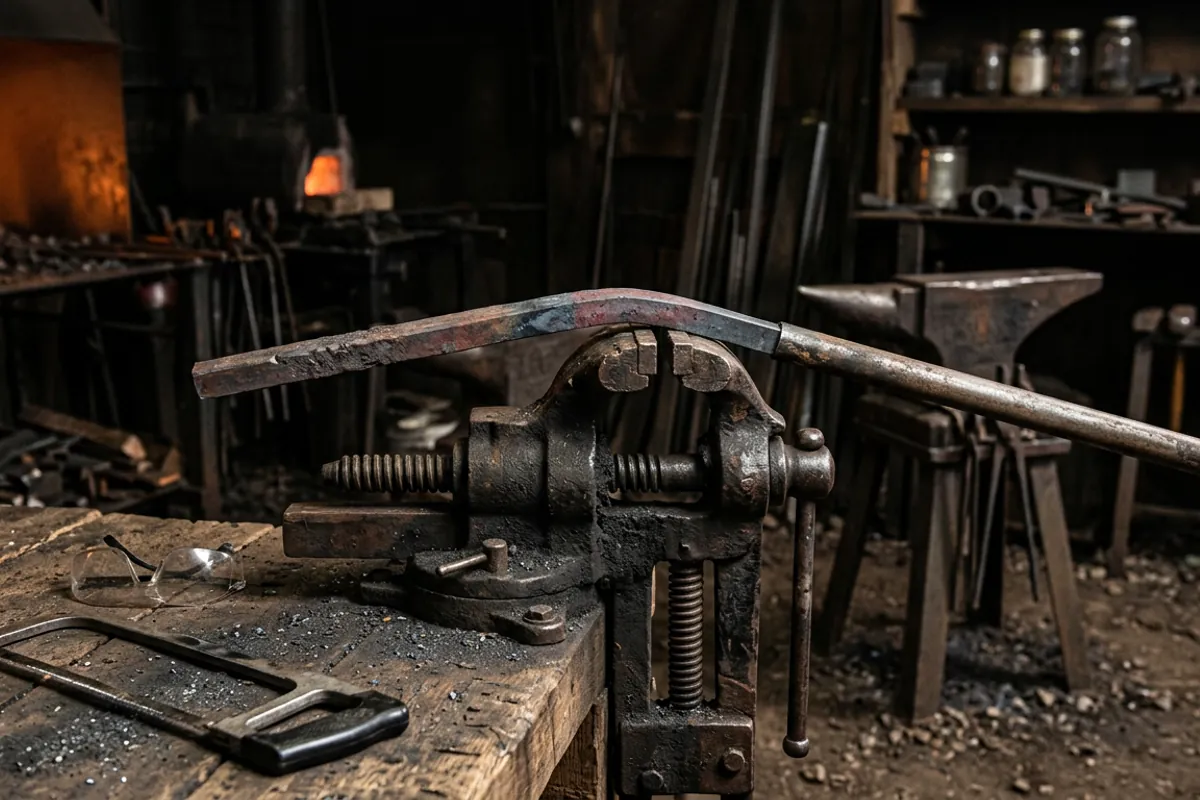
Put the nicked bar in the post vise and bend it slowly with a cheater bar, or bend it under steady press or bench vise pressure. Do not hit it. Shock loading is exactly the condition the Bureau's work showed drives false crystalline fractures, and it is also the condition that turns a fragment into a projectile. Eye protection rated to ANSI Z87.1 goes on before the bar goes in the vise, and it stays on. Cotton or wool sleeves, not a fleece. Anything you break cold can come apart with more energy than you expected, and a fragment leaving a vise does not care that you were only testing.
What a slow bend gets you is a fracture that is at least honest about itself. What it does not get you is a verdict on wrought iron vs steel. Treat it as one observation, not an answer.
The woodgrain tell, and how far it actually goes
The most useful field observation is the one I already wrote up in the vintage blacksmith tongs guide: on a worn or broken spot, wrought iron often shows a woodgrain like strand pattern, forged steel rings when you tap it, and cast iron thuds and can snap. That holds up as a first pass on old tools, and it is free.
Here is the limit, and it is the same limit as the fracture test. The woodgrain is the slag showing itself. Where the slag is coarse and the surface is corroded or worn, it shows plainly, and a rusted wrought iron gate picket that has weathered fifty years is about as clear a specimen as you will ever handle, because corrosion eats the iron and leaves the slag threads standing proud. Where the iron was well refined, or the surface is clean and unworn, you can look at a genuine wrought bar and see nothing at all. Absence of woodgrain is weak evidence. Presence of it is good evidence. Never treat the two as symmetrical, which is the mistake the nick-bend folklore makes.
That asymmetry is the whole practical skill here. Some tests can confirm and cannot rule out. Knowing which is which is worth more than knowing another test.
Polish and etch, the test I actually trust on the bench
If I want a real answer on a bar, I sand a flat on it and etch it. File or grind a flat, work up through abrasives until the surface is uniform and bright, degrease it, and swab it with a dilute acid. Ferric chloride cut with water works, and plain white vinegar works if you are patient with it. Wrought iron shows its slag stringers as dark lines running the length of the bar, often in a distinct directional pattern, because the rolling drew them out that way. Mild steel etches to a comparatively uniform gray field with no stringers to speak of. On a piece with a forge welded joint, an etch will often show you the weld line too, which is a bonus when you are looking at an old tool.
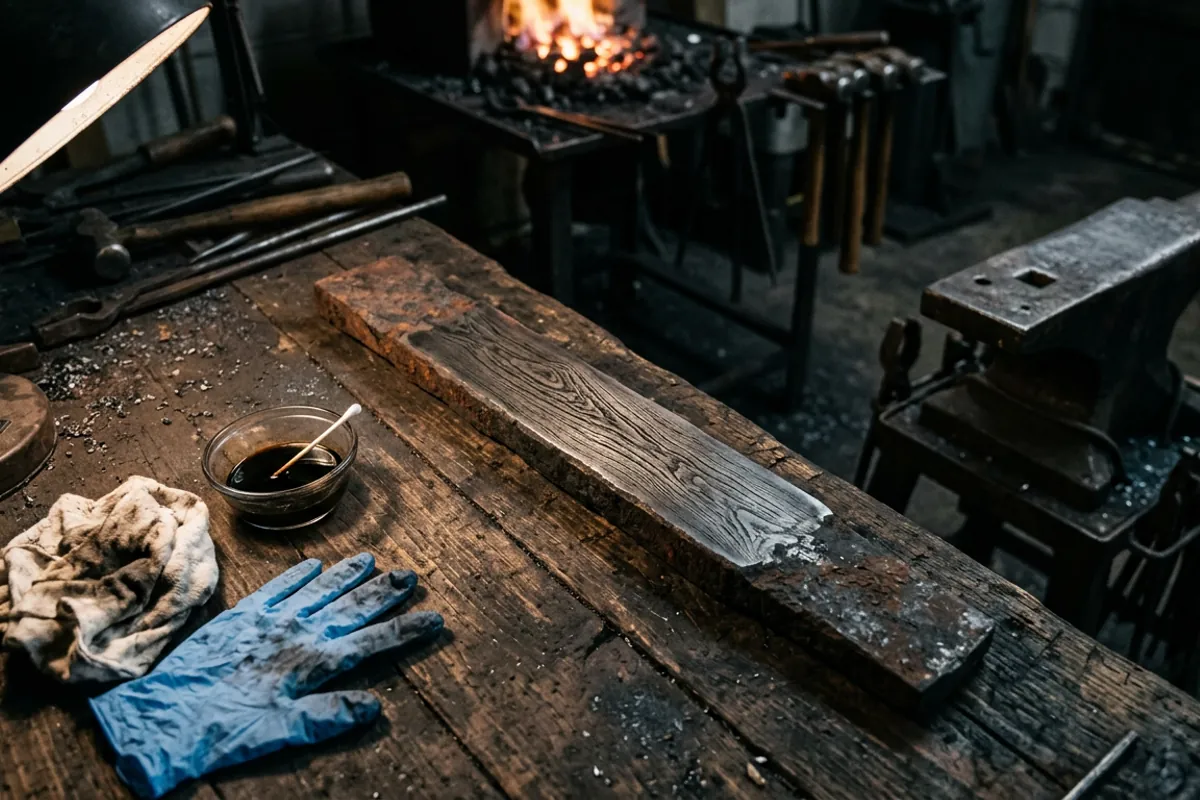
Two honest caveats. First, this is smith practice, not a standard test, and I am describing what I do, not a specification anybody publishes. Second, it is a chemistry job in a dirty shop. Eye protection and gloves, ventilation, acid into water and never the reverse, and keep it well away from the forge and any hot steel. Neutralize and rinse when you are done. A shallow etch is enough; you are not trying to carve the bar.
Polish and etch is where the steel and metallurgy side of this hobby stops being folklore and starts being observation. It is the only bench test on this list where I know what physical feature I am looking at and why it is there.
Where the spark test stops being useful
Spark testing gets brought up whenever this question comes around, and I want to be careful. Sorting steels roughly by carbon at the grinder is a real practice, and what smiths are reading is the character of the spark stream, with higher carbon generally producing more branching bursts than low carbon stock. It is a comparison test, not an absolute one: it only means anything if you are grinding a known sample right beside the unknown one, on the same wheel, with the same pressure, in the same light.
For wrought iron specifically I am not going to hand you a spark signature, because the most technical spark testing reference I could actually check does not cover wrought iron at all, and inventing a description of something I cannot verify is exactly how bad information gets into the hobby. If you spark test an unknown bar and it behaves like very low carbon material, that is consistent with wrought iron and equally consistent with mild steel, which is to say it has not answered your question.
At the grinder, the safety rules do not relax because you are only testing. Eye protection to ANSI Z87.1 as a minimum, a face shield over it, no synthetic clothing, and nothing in the spark path that can smolder. A grinder throwing a spark stream at your bench rag is a shop fire waiting for a slow afternoon.
Cast iron, the third thing in the pile
Half the people who ask me about wrought iron vs steel are actually holding cast iron, so it is worth a paragraph on its own. NPS Preservation Brief 27 covers cast iron directly, and it puts the carbon at at least 1.7 percent and usually 3.0 to 3.7 percent. That is enough carbon to change the material's whole personality: it will not forge, it does not bend, and it breaks.
The brief also draws a useful contrast for anyone identifying architectural pieces. Wrought iron elements are generally simpler in form and less uniform in appearance than cast iron elements, and contain evidence of rolling or hand working. Cast iron elements are often bolted or screwed together, whereas wrought iron pieces are either riveted or forge-molded. That single observation, look at how the joints are made, sorts more salvage than any fracture test. Repeated identical ornament with crisp detail and screwed joints is a casting. Slightly varying members with rivets and hammer marks is wrought work.
The practical stake is safety. Cast iron under a hammer, hot or cold, can let go in pieces. If a heavy salvage piece has me guessing, I treat it as cast until proven otherwise. It is the same reasoning I use when checking whether an old anvil is worth buying, which I go through in more detail in the antique anvils buying guide.
What the difference actually changes at the fire
Two consequences matter, and only two, for most home shop work.
The first is hardening. With carbon down around 0.02 to 0.03 percent, there is essentially nothing in wrought iron for a quench to work with. Heat it, quench it, file it: it files. That is not a technique failure, it is the composition. If you want a working edge, you need carbon steel, and the whole business of getting hardness and toughness out of it is the subject of heat treating steel. Old wrought iron makes good hooks, hinges, straps, scrolls, and railings. It does not make a knife that holds an edge, whatever the bar's history.
The second is behavior in the fire, and I will keep it to the recap it deserves because I have said it three times elsewhere on this site: it delaminates along the grain, and it tolerates a welding heat that would burn steel. Both of those are the slag talking again. The delamination is the same longitudinal separation the Bureau paper described in a broken bar, just showing up under the hammer instead. The wide welding range is the reason old wrought iron has such a reputation among smiths who forge weld, and it is worth understanding alongside what flux is actually doing, which I get into in the forge welding flux guide.
If you are trying to decide what steel to buy for a project rather than identify a mystery bar, the steel selector is a faster route than any of this.
What I do with a mystery bar
Here is my order of operations, cheapest and least destructive first.
Look at how the piece was assembled and how it wears. Rivets, hammer marks, uneven members, and a woodgrain pattern on corroded or worn areas all point to wrought iron. Screws, bolts, crisp repeated ornament, and a chalky gray break point to cast iron. This costs nothing and settles more cases than anything below it.
Sand a flat and etch it. That is the test that shows me the actual feature that defines the material, slag stringers, rather than a proxy for it. If I see stringers, I am done.
Heat a short piece and work it. A bar that takes a very high heat without falling apart, and that starts to split along its length under the hammer, is telling me something consistent with wrought iron. A bar that burns and throws sparks at that heat is steel, and I have learned what I needed to know at the cost of one end.
And if I break something, I bend it slowly in the vise with my glasses on, and I read the fracture as one clue among several rather than a verdict. A hundred years ago two people at the Bureau of Standards took the trouble to test the test we all repeat, and found that how hard you hit the bar changes the answer it gives you. The least I can do is stop hitting it.