Normalizing steel gets talked about as if it were annealing with a shorter nap, and it is not the same job. Annealing is what you do to get a bar soft enough to drill, file and machine. Normalizing steel is what you do to put the grain back in order after you have hammered a bar around at forging heat: up above critical, hold, then cool in still air. Different temperature, different cooling, different reason to bother. I am not going to redefine the terms from scratch here, because what annealing steel actually does already sets out where each operation sits and what the structure looks like afterward, and heat treating steel covers the order the whole sequence runs in.
What none of those pages answer, and what beginners in my shop ask me every single time, is the operational part: how many cycles, and at what temperature. That question does not have one published answer. It has two, from two of the sources a home smith is most likely to land on, and they openly disagree. You cannot follow both, so you may as well know what each one is and where it came from.
The two schedules people actually follow
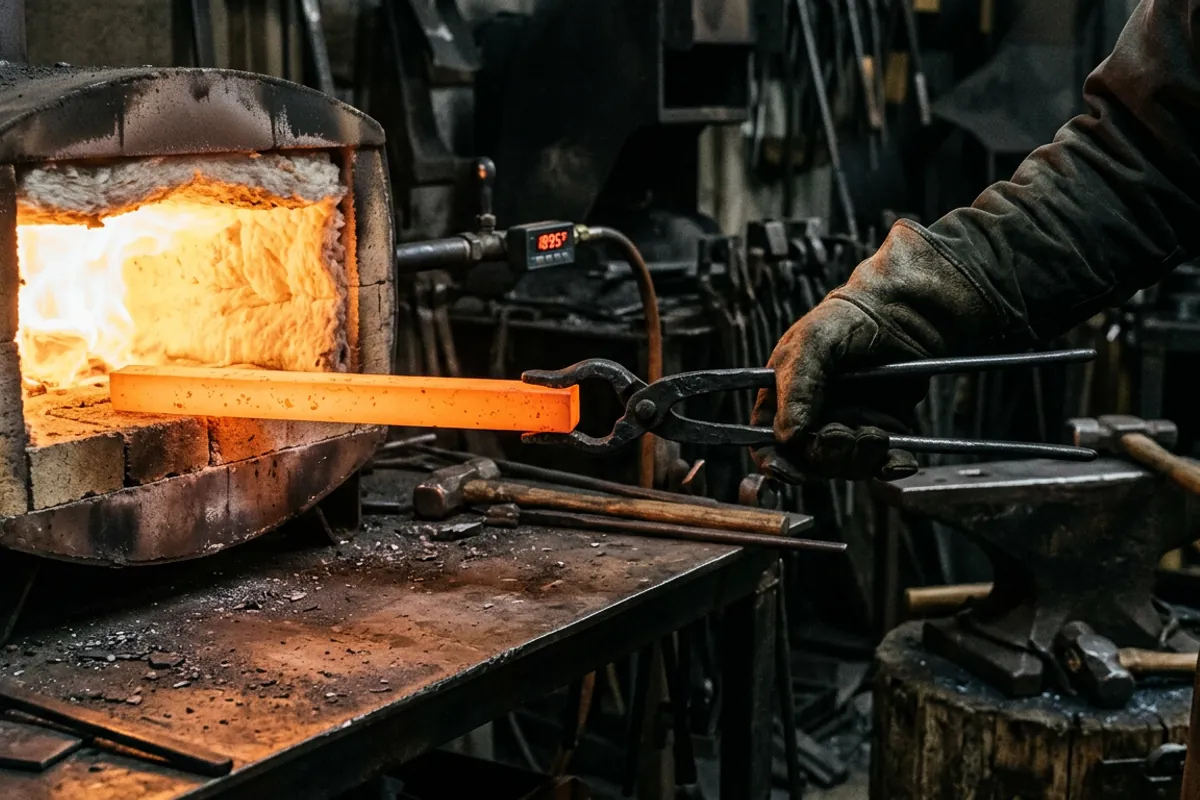
The first comes out of the Knife Steel Nerds testing work. It is one normalize, at a temperature specific to the steel, held 10 to 15 minutes, then cooled in still air. The published numbers for the steels most of us buy: 1084 normalizes at 1550 F, 1095 at 1575 F, 5160 at 1550 F, and 52100 at 1675 F. If you go on to do grain refining cycles after that, those are a separate step run from a lower temperature, something in the 1400 to 1450 F range, not another pass at the normalizing temperature.
The second is the descending ladder. The clearest published version of it is the New Jersey Steel Baron data sheet for 5160, which is the sheet a lot of people get pointed at when they buy the bar. It calls for three cycles: a first cycle at 1650 F / 898 C for 10 to 15 min, a second cycle at 1500 F / 815 C for 10 to 15 min, and a third cycle at 1350 F / 732 C for 10 to 15 min. The same sheet carries hardening and quench steps too. I am deliberately not reproducing those here, because a quench schedule comes with its own hot oil and hot steel cautions attached and this article is about normalizing.
Put those side by side on one steel and the gap is obvious. For 5160, one source says a single hold at 1550 F. The other says three holds that bracket it, starting 100 F above and finishing 200 F below. They agree on exactly one thing: 10 to 15 minutes at temperature.
Where each schedule gets its authority
This is the part that actually helps you decide, and it is the part nobody puts in front of beginners.
The Knife Steel Nerds position rests on published testing, including Charpy impact data, run and written up by a metallurgist. Whatever you think of any single result, that is a body of measured numbers you can go read.
The New Jersey Steel Baron schedule is a supplier data sheet. Not a hostile source, and not a fly by night vendor either; they sell good steel and plenty of very good smiths buy from them. But a data sheet is a recommendation, not a published experiment. And Knife Steel Nerds went after those sheets directly, in its introduction to knife steel heat treating written by a metallurgist, published in 2024. That article says the 1650, 1500, 1350 normalizing steps are not standard and cannot be found in any other datasheet, that the 1350 F step in particular could be skipped entirely as it would not really do anything, that many of the New Jersey Steel Baron datasheets seem to have these same recommendations regardless of the steel, and that he would avoid these datasheets.
I am not going to pick a winner for you, and I want to be straight about why. Those two things are not the same kind of evidence. One is measured and published; the other is a supplier recommendation that the first source alleges is boilerplate repeated across different steels. That asymmetry is real and you should weigh it. It is also not the same thing as a head to head test of the two schedules, which is what would actually settle it, and I have not seen one published.
What the toughness testing actually covered
There is a Knife Steel Nerds result that gets stretched further than it goes, and I have seen it misquoted in three different forum threads, so let me pin it down.
The result is about grain refining cycles on 1084, run at that lower 1400 to 1450 F range. The finding was that the toughness was no different whether the grain refining cycles were done or not, and that adding extra grain refining cycles is not necessary for a fine grain size and led to no improvement in toughness.
That is a real, useful, measured finding. It is not a test of the descending normalizing ladder. Different temperatures, different step in the sequence. If somebody tells you Knife Steel Nerds tested the 1650, 1500, 1350 schedule and found it did nothing, they have welded two separate claims together. The criticism of that ladder is an argument about data sheets, made in the article I described above. The no improvement result is an experiment about grain refining cycles. Keep them apart, including when you quote me.
A grain refining cycle is not free
Here is the part that changed how I think about stacking cycles, and it has nothing to do with whether they help.
In that same work, the grain refining cycle cost something. The hardness was somewhat reduced compared with the original normalized steel, and the steel had partially spheroidized even after only one grain refining cycle. Spheroidizing is the carbide in the steel drifting toward rounded particles instead of staying where a normalize left it. It is the condition you deliberately chase when you want a bar soft and easy to machine. It is not what you want as your starting point going into hardening.
So the honest framing is not "extra cycles help or they do nothing." It is that an extra cycle is a withdrawal, not a deposit. If it buys you nothing measurable and it softens the structure a little, it is a step you paid for twice: once in propane, once in the condition of the steel. That is enough reason for me to stop adding cycles as insurance, without needing to believe that anybody running three of them is destroying their blades.
What the rest of this site says, and why it is still standing
I am not going to pretend AnvilTalk speaks with one voice on this, because it does not, and quietly editing the disagreement out would be worse than leaving it visible.
Six pages here teach the descending ladder as normal practice. What 80CrV2 steel actually is gives an explicit 1600 to 1500 to 1450 F ladder and says each descending cycle produces finer grain than the last. Bladesmithing, from a bar of steel to a blade that holds an edge says to do it a few times, dropping the temperature slightly each round, and calls three cycles common home shop practice. What 15N20 steel actually is says several cycles at descending temperatures refine the grain. Blade smithing, explained calls three cycles, each a little cooler than the last, the common recipe for simple carbon steels. Heat treating steel says you often do this two or three times, each from a slightly lower heat. Even the annealing page describes two or three cycles at descending temperatures.
That is the practice as it is taught in most home shops and at most club forges. It is what I was taught, and it is what I wrote. The published criticism of it is newer, it is specific, and it comes from someone running impact tests rather than from someone with an opinion. I would rather you see both and know which is which than have me go back and silently rewrite four pages so the site looks tidier than the evidence is.
The steels with a published number, and everything else
Four steels above have a published normalizing temperature I am willing to repeat: 1084 at 1550 F, 1095 at 1575 F, 5160 at 1550 F, 52100 at 1675 F, each held 10 to 15 minutes and cooled in still air.
For anything else, go to the maker's data sheet for that specific steel. I will not interpolate a number off carbon content and hand it to you as if it were measured, and you should be suspicious of anyone who does. The steel and metallurgy hub collects the steel by steel pages here, and the steel selector will at least get you to a known alloy with a published sheet instead of a mystery bar.
One hard limit: stainless and the high alloy tool steels are not normalized. Do not apply any of this to them. Those go strictly by the maker's hardening instructions, and the way they harden is a different world from a simple carbon steel; hardening stainless covers why. Guessing on a stainless is how people ruin an expensive bar and never find out which step did it.
How I run it after a forging session
For a 1084 blade, which is what most of my weekend beginners are working, here is the actual sequence on my floor. I bring the whole piece up to an even heat, not a hot tip and a cool tang, and hold it there 10 to 15 minutes. Then it comes out of the fire with tongs and sits on the steel rack until it is black and cool to the eye.
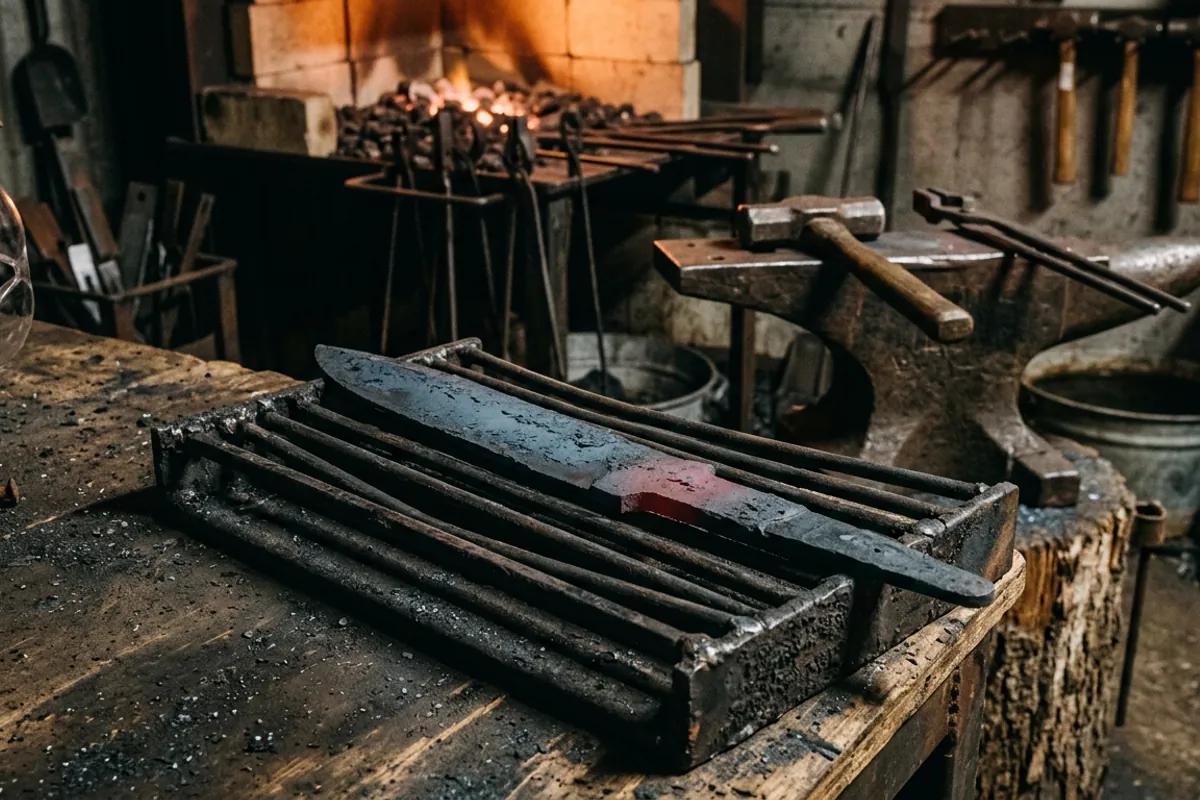
I run this in the propane forge, and that is not incidental. A ten minute hold at a steady temperature is what propane is good at. Holding an even 1550 F across a whole blade in a coal fire for ten minutes takes more fussing than most people expect: the fire has a hot heart and cooler edges, and a blade parked in the wrong part of it comes out with a grain gradient you cannot see. I run coal for heavy stock and forge welding, and propane for anything where the number on the pyrometer matters. If coal is your only fire, work the piece through the heat rather than letting it sit in one spot.
Still air means still air. Set the piece on a rack where air can get at both sides, not flat on a cold steel plate, which pulls heat out of one face faster than the other. Do not put a fan on it, do not quench it, and do not lay it on damp concrete; trapped moisture in concrete flashing to steam under hot steel can throw chips. Shop lights come down so I can judge color honestly, and the Z87.1 glasses stay on anyway, because dim is when people forget them.
How many cycles do I run? One, at the published temperature for the steel in my hand. If the piece got worked hard and unevenly, a heavily drawn tip on a thick blade, say, I will run a second. I stopped stacking a third out of habit.
Normalizing outside the knife shop
Blade work dominates the conversation, but normalizing earns its keep on the general forging side too, and none of that shows up in a knife article.
Stress relief after heavy forging. Drawing, upsetting and bending leave a piece with worked structure and locked in stress that vary from one end to the other, especially if you finished cold or worked it too cool. A normalize evens that out before the part goes on to anything else. On a forged bracket or a hardy tool blank, that is the difference between a part that stays where you put it and one that moves on you later.
Machinability. As forged steel machines unpredictably: hard spots where a section cooled fast, soft where it cooled slow, and scale over the top of both. A normalized part gives the drill and the file a consistent structure to cut. Worth knowing that softest is not always best here. In plain low carbon steel a fully annealed bar can go gummy and tear rather than cut cleanly, and the normalized condition often behaves better under a drill. In high carbon steel, annealing is still what you reach for when you need it truly soft.
The weld heat affected zone. Weld a part up and the band alongside the bead has been taken above critical and cooled fast by the surrounding cold metal. What you get is coarse grain in part of that band and a hard, brittle zone nearer the fusion line, in a part that otherwise looks fine. Normalizing the whole piece afterward puts a uniform grain back through it. I do that on shop made tooling and on decorative work. Anything structural, anything holding a load over a person, is not a place for me to freelance: that work runs on a qualified welding and heat treatment procedure, not on a hobby smith's judgment.
What normalizing will not do
It will not fix decarburization. Carbon that burned out of the surface in a long, oxidizing heat is gone, and running the piece through another cycle does not put it back. You grind past the decarb layer, and you avoid making more of it by not parking steel at high heat longer than the job needs.
It will not straighten a warp. A bent part comes back straight by being straightened, not by a thermal cycle.
It will not undo a bad quench. If a blade came out of the oil with problems, normalizing is not a reset button that erases what happened; it is one operation in a sequence, and the sequence still has to be run right.
And it will not tell you what your mystery steel is. A normalizing schedule is steel specific by definition. Running an unknown bar through a temperature you read on someone else's data sheet is guessing with extra steps.
Where I land
One normalize, at the published temperature for that steel, held 10 to 15 minutes, cooled in still air. A second cycle if the piece got worked hard and unevenly. No stack of refining cycles added as insurance, because the published testing on 1084 showed no toughness improvement from them and showed a hardness cost and partial spheroidizing from even one.
That is my practice, not a verdict. If you are running the three step descending ladder off a supplier sheet, your steel is not ruined and your knives are not junk; plenty of good work has come off that schedule. But you should know that it is a supplier recommendation rather than a published experiment, that a metallurgist has publicly said those steps are not standard and that the 1350 F step in particular would not really do anything, and that the counterargument to him is currently tradition rather than data. Hold both of those in your head, pick the one you can defend, and spend the attention you save on the steps that actually decide how the blade comes out.