Every few months somebody at the club forge asks me what a medieval blacksmith would make of my shop, and the honest answer is that he would recognize about half of it and be baffled by the rest. The hammer, the tongs, the way you read a heat by color in a dim room: he would pick all of that up and use it without a word from me. The propane burner, the angle grinder, the rack of identical mild steel bar: those are the parts that would stop him cold. I have been at this about twenty-five years as a hobby smith, not as a historian, so I am going to be careful here about what is well documented, what is reasonable inference, and what is shop legend. There is a lot of shop legend attached to this subject, and most of it makes the medieval smith sound either like a wizard or like an idiot. He was neither. He was a working tradesman with a much harder material supply than you have and a much better eye for heat than most of us.
What a medieval blacksmith actually was
There was no single job called blacksmith across five hundred years and a whole continent. In a village, the smith was the generalist. He made and repaired the iron parts of everything the community used: plow shares and coulters, harrow teeth, scythe and sickle blades, axe heads, chains, hinges, hasps, door hardware, cooking irons, cart fittings, nails. Most of a village smith's week was repair, not creation. Iron was expensive enough that broken tools got fire welded back together rather than replaced, and a smith who could not make a clean weld could not hold a customer base.
In towns, the work split up, and the guilds enforced the split. Farriers shod horses. Locksmiths made locks and keys. Cutlers made and hafted knives. Armourers worked plate. Nailers made nothing but nails, in staggering volume, often as piecework. Whitesmiths did the filing and finishing, the bright work, in contrast to the blacksmith who worked iron hot and black. A bladesmith in a town of any size was a specialist who bought his bar stock rather than smelting it.
You can still read how common the trade was in surnames. Smith, Smyth, Schmidt, Faber, Lefebvre, Ferraro, Herrero, Kovacs, Kowalski. When a job produces that many family names in that many languages, it tells you there was one in nearly every settlement.
The iron he had to work with
This is the part modern smiths underrate, and it explains almost everything else about how medieval work was done.
Through most of the medieval period, iron came from a bloomery. Ore and charcoal go into a shaft furnace, air goes in through a tuyere, and the iron is reduced in the solid state. The furnace never gets hot enough to melt iron. What comes out is a bloom: a hot, spongy mass of iron particles shot through with slag. Somebody then beats that bloom under a hammer, over and over, folding and welding, to squeeze out the slag and consolidate it into usable bar. That labor is why iron cost what it cost.
The product of that process is wrought iron, and it is not the same material as the mild steel in your rack. It is very low in carbon, so it will not harden by quenching, no matter what you do to it. It carries slag stringers all through it, which give it a grain like wood. It splits along that grain when abused, and it forge welds so readily that a smith who learned on wrought iron and then tries modern mild steel usually thinks he has forgotten how to weld. He has not. The material changed.
Steel, meaning iron with enough carbon to harden, was scarce and precious. Medieval smiths got it two ways. They sorted the harder, higher carbon portions out of a bloom by testing and by feel, or they made it by carburizing: packing wrought iron in charcoal, sometimes with bone or leather, sealing it and holding it hot for a long time so carbon migrated into the surface. Either way you had a small amount of good steel and a large amount of iron.
That scarcity drove composite construction, and composite construction is the signature of medieval toolmaking. An axe gets an iron body with a steel bit welded in. A chisel gets a steel tip. A knife gets a steel edge welded to an iron spine. You put the expensive material only where it does work. When you see that on a surviving artifact, you are not looking at decoration, you are looking at a budget.
The blast furnace changed the supply side late in the period. Dating varies by region and the archaeology keeps getting revised, but the shift is generally placed from around the twelfth century in Sweden, spreading through parts of Europe over the fourteenth and fifteenth centuries. A blast furnace runs hot enough to produce liquid cast iron, which is high in carbon, hard and brittle and useless to a smith as it comes out. It then gets decarburized in a finery forge to make bar iron. What that changed for the smith at the anvil was volume and price, not technique.
The forge and the fire
The fuel was charcoal, in most places for most of the period. Charcoal burns clean and low in sulfur, which matters enormously, because sulfur in the fire makes iron hot short: it cracks and crumbles at forging heat. Mineral coal was used where it was cheap and local, England's sea coal being the usual example, but its sulfur made it a poor choice for fine work unless it was good coking coal used carefully. Coke as an industrial fuel is an eighteenth century development and sits outside this story entirely.
Charcoal has consequences you feel in the shop. It is light and bulky, so you burn a big volume of it. It gives a large, soft, forgiving fire that is easy to get a long heat in and easy to waste fuel in. It is also the reason charcoal supply, not iron, was often a smith's biggest running cost, and why ironworking clustered near woodland.
The European forge was commonly a side blast: air enters horizontally through a tuyere at the side of a shallow hearth, rather than up through a firepot in the table. If you learned on an American style bottom blast firepot, a side blast fire behaves differently, runs a deeper heart, and wants a clay or water cooled tuyere so the blast pipe does not burn back. Neither is better in the abstract. They are different geometries for the same problem, which is getting controlled air into a controlled depth of fuel. That problem has not changed at all, and it is still the whole argument behind picking a first forge today. If you are weighing fuels for your own shop, I went through it in detail in coal or propane: which first forge makes sense.
Air came from bellows worked by hand or foot, often paired double bellows so one chamber delivered while the other filled and the blast stayed continuous. Larger ironworks used water power, with documented water driven bellows and trip hammers in Europe from around the twelfth century onward. A water powered hammer is the medieval equivalent of a power hammer, and it exists for exactly the same reason yours would: drawing out heavy stock by arm is a young smith's game and a short career.
The anvil, and why it did not look like yours
Here is the correction I find myself making most often. The anvil in your head, the London pattern with a long horn at one end, a cutting step, a flat face, a square hardy hole and a round pritchel hole, is not a medieval object. That pattern is generally dated to the eighteenth and nineteenth centuries. Bessie, my 148 pound Trenton, is an industrial age tool through and through.
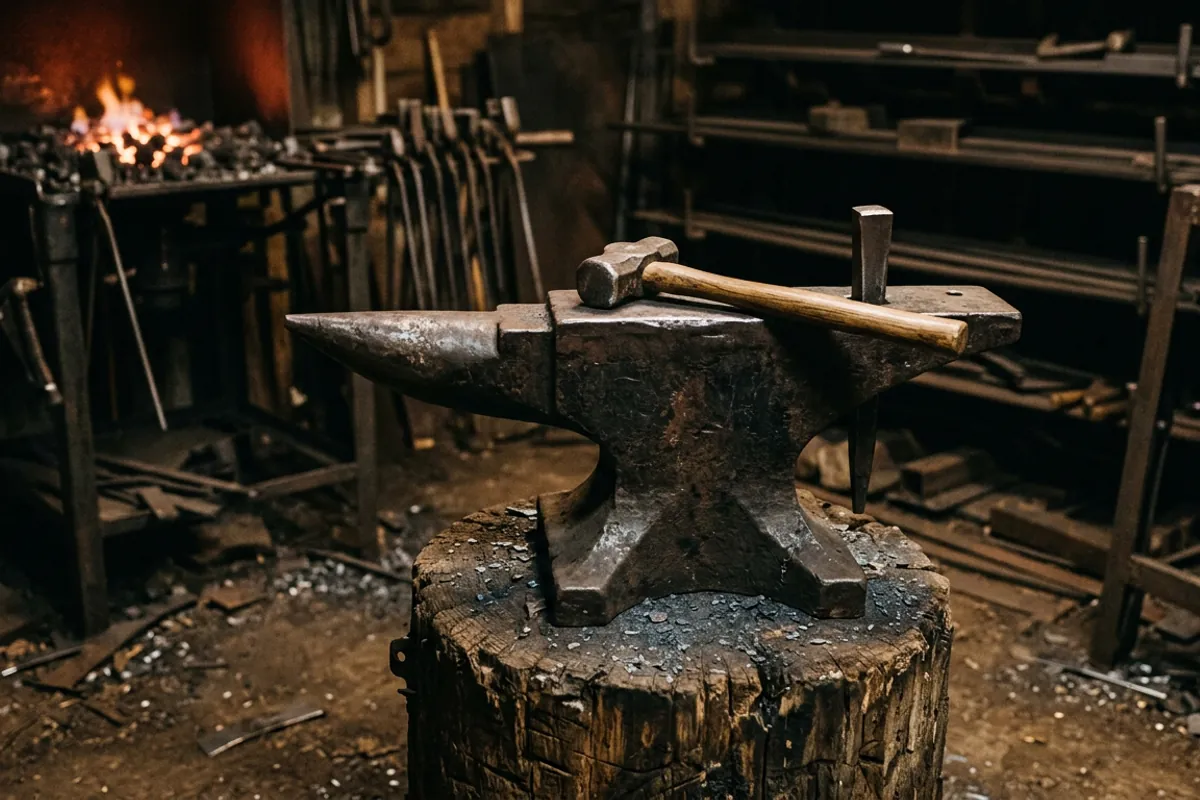
Medieval anvils, from what survives and from what shows up in manuscript illustration, were much more often simple blocks, sometimes with a single bick or beak, mounted on a stump or a heavy timber. Stake anvils were everywhere: a working surface on a spike driven into wood, cheap to make, easy to replace, easy to have several of for different jobs. Many had no hole at all, and hardy tools were held other ways or the shape was cut over the edge and finished with a set tool held by a striker.
Two things follow from that. First, the medieval smith worked with less anvil mass than modern beginners think is required, because his stock was mostly small and his power was muscle, not a fifty pound sledge. Second, he cared intensely about the one thing that still matters most, which is a dead solid connection between the anvil and the ground. A small anvil bedded properly on a stump outperforms a big anvil sitting on a wobbly stand, then and now. I laid out how I think about mass and mounting in what size anvil do you actually need, and what to actually check when you go look at one in how to buy an anvil without wasting your money.
Hammers, tongs, and everything else he made himself
A medieval smith bought very little of his tooling. He made it. Tongs were made to fit specific stock, so a working shop had a wall of them, most of them for one job. Punches, drifts, chisels, fullers, swages, top and bottom tools, nail headers, hardies: all shop made, all from the same scarce steel he was rationing for customer work, and all resharpened and reworked until they were used up.
Files were a genuine exception. Cutting file teeth by hand with a chisel is skilled, tedious work, and files were bought, valued, and worn out reluctantly. Anything that saved filing time was worth doing at the fire instead.
The practical carryover is that the traditional first projects for a new smith are still the right ones. Make a punch, make a hot cut, make a pair of tongs. Not because it is quaint, but because tool steel shapes teach you heat control and because tooling you made fits your hand and your hardy hole. My short list of what a beginner actually needs is in blacksmithing tools: the short list that actually matters, and most of it would have been familiar to a smith in 1300.
Heat treating by eye, and the folklore that came with it
No thermocouple, no pyrometer, no oven with a controller. Medieval hardening was done by color, judged by eye, which is exactly why smithies were kept dark and why a lot of modern shops are still lit badly on purpose. You cannot read a critical heat in a room with skylights. Move your quench work to the dimmest corner you have and you are working the same way.
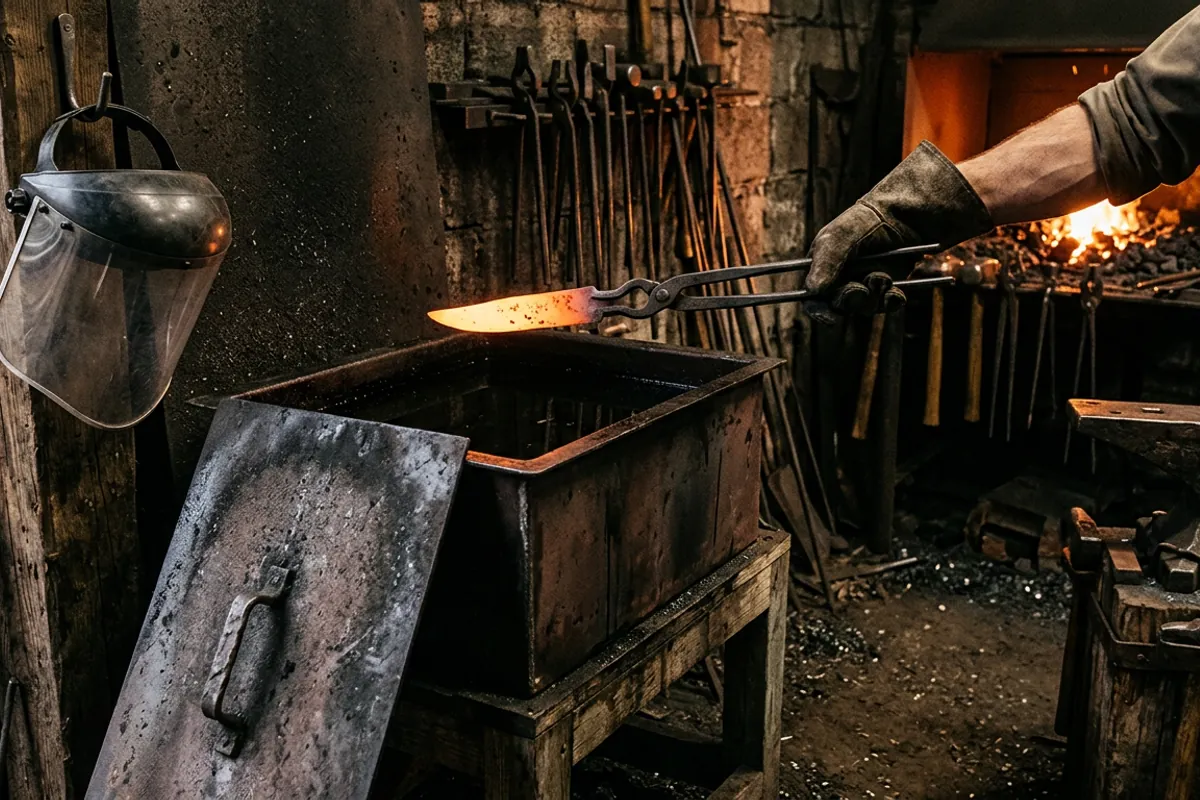
Water and brine were the common quenchants. Oils and animal fats were used where available and where a slower quench suited the steel. Differential hardening was understood in practice: quench only the edge, or insulate the spine, so the working edge is hard and the body stays tougher.
The folklore is where people go wrong. Period sources really do contain strange recipes. Theophilus, a monk writing a treatise on the crafts in the twelfth century, gives hardening instructions involving things like the urine of a small red-headed boy and the juice of certain plants. That is a real historical text, and it is worth reading as history. It is not a heat treat recipe, and I want to be blunt about that, because I see it repeated online as though a medieval smith knew something we lost. He did not. He had a good eye, real skill, and a completely wrong theory of why any of it worked.
If you want to know what actually happens in a quench, what austenitizing temperature and soak time a given steel wants, and how quench speed interacts with alloy content, go to real testing. Knife Steel Nerds is the place I point people to for that, because it is published, repeatable metallurgy with hardness numbers attached. None of that knowledge comes from medieval sources, and pretending otherwise gets beginners hurt and gets blades that crack.
Pattern welding, swords, and the myths worth killing
Pattern welded blades are genuinely medieval, mostly early medieval and migration period. Rods of iron and steel are twisted, stacked, and forge welded into a core, an edge is welded on, and when the surface is etched the twisted layers show as pattern. Under a bloomery supply, this was a sensible way to build a long blade out of inconsistent material and get decent toughness. As reliable bar steel became available, roughly through the tenth and eleventh centuries, pattern welding as a structural technique largely fell away and survived as decoration.
The folding count myth needs to die. Each fold doubles the layer count. Twenty folds is over a million layers, which in a half inch billet means each layer is thinner than anything you could resolve or that means anything metallurgically. When you see huge fold counts advertised, that is marketing, not metallurgy.
The Ulfberht blades come up constantly. Some blades carrying that inscription have been found to be made of steel with unusually low slag content and high carbon, and there is an ongoing and genuinely unsettled academic argument about where that steel came from and whether crucible steel from further east is involved. I am not going to pretend to settle it. What is fair to say is that the quality varies a lot across surviving examples bearing the name, which suggests the inscription was being copied by other makers.
And medieval swords were not magic and were not crowbars. They were carefully engineered composite tools, distal tapered, balanced, made to cut what they were expected to meet. That is a higher compliment than the magic version.
The trade: apprentices, guilds, and the economics
A medieval smith was made by apprenticeship, years of it, living in the master's household and starting at the bellows and the sledge. Striking for a master is how you learn to hit accurately before you are allowed to place a blow of your own. Then journeyman work, then in a guild town a master's piece and admission to the guild if the guild would have you.
The guilds set standards, restricted numbers, regulated quality and often price, and dealt with disputes. That sounds bureaucratic until you remember that a badly welded plow share or a lame horse from a bad shoeing had real consequences in a subsistence economy.
Two practical facts about the shop itself. Fire risk meant smithies were often placed at the edge of settlements or given specific locations by town rule. And charcoal, as I said above, was frequently the largest ongoing cost. A shop's location was a fuel supply decision as much as a customer decision. If you want the modern version of that same layout thinking, I wrote about how a working home shop actually gets arranged in blacksmith shops, explained from the floor of one.
What the medieval smith got right, and what he did not
The habits worth stealing are real ones.
He worked in natural fibers. Linen, wool, leather. That is still exactly right. Synthetics melt, stick to skin, and turn a small burn into a bad one. When I tell people at the club to wear a cotton shirt and a leather apron, I am giving advice a fourteenth century smith would have thought was too obvious to say.
He kept the shop dark so he could read steel. He kept the fire small, deep and clean rather than big and loose. He worked hot and let the heat do the work, with fewer and better placed blows, because every heat cost charcoal he had to pay for. He made his own tooling. He kept water at hand near an open fire. All of that transfers directly.
Now the part where the romance ends, and I am not going to soften it.
He had no eye protection. None. You do, and there is no excuse: safety glasses rated to ANSI Z87.1 as the floor, and a full face shield over them for grinding, for wire wheeling, and for quenching. I learned that one badly. Early on I quenched a blade in oil that was too cold, standing too close, in a cotton shirt with no shield. The oil flared, took my eyebrows, and I kept my eyesight by luck rather than by judgment. Warm your quench oil, stand off to the side, have a lid you can smother the tank with, and wear the shield.
He had no hearing protection either, and hammer work on an anvil will take your hearing over years. Plugs or muffs, every session.
And ventilation. Charcoal and coal fires produce carbon monoxide, which is colorless, odorless, and kills people who never noticed anything was wrong. Medieval smithies were open sided, drafty, and often barely enclosed, and that is a large part of why they were survivable. A modern closed garage is not. If you burn solid fuel, you need a real hood and chimney with genuine draw and real makeup air, and you do not run that fire in a sealed space, ever. The same applies to a propane forge, which produces carbon monoxide too. I go through the full kit and what is worth spending on in blacksmith safety gear: what matters and what to skip.
Bringing the medieval part into a modern shop
If reading about this makes you want to work closer to the old way, there is a sensible version of that and a silly version.
The sensible version: burn solid fuel and learn fire management properly. Try a side blast hearth if you are building your own. Make your tongs and your hardy tools instead of buying them. Learn to forge weld, which was an everyday competence then and is treated as an advanced trick now. Work more with hand tools and fewer with the grinder, and see how much cleaner your hammer control gets when the grinder is not there to fix things. Keep the shop dark and learn colors until you can call a critical heat without thinking.
The silly version: quenching in something because a twelfth century manuscript mentioned it, skipping eye protection for authenticity, or believing that a medieval blacksmith had metallurgical knowledge that modern testing has not surpassed. He had skill we should respect and a material supply we should be grateful to have escaped. Take the craft, keep the science, and wear the face shield.
More reference pieces like this one live on the More from the shop hub, and if you are earlier in the process and still sorting out what any of this gear is for, start with blacksmithing, explained plainly by a smith who still lights the forge.