A rusty mill file is the cheapest blade steel in most shops, and the question that follows it is always how to make a knife from a file. It is one of the oldest starter projects in the craft, the stock is usually free, and I have made a few myself. It is also the project where I have to give an answer nobody enjoys hearing: you do not know what that steel is, and neither does anyone else, including the company that made it. That one fact drives every decision downstream, from how you soften the bar to whether you dare quench it. So this is not a recipe article. It is the article about what you can honestly know, how to find out the rest with a cutoff piece instead of a finished blade, and why I usually point a new smith at a bar of known steel first.
What a file is actually made of, and what nobody publishes
Here is the part that surprises people. Go looking for the grade and you will not find it. Nicholson's own current guide to files and filing, the document everyone assumes is the source, does not state a steel grade, a carbon content, an alloy, or a Rockwell number anywhere in it. I am not aware of any file maker that publishes the grade of its steel. The grade citations you see in craft blogs and forum threads trace back to other craft blogs and forum threads, not to a datasheet.
What can be said honestly is narrow, and it is still useful. A well made file is plain high carbon steel in the neighborhood of 1 percent carbon, hardened into the low 60s HRC, because that is what it takes for a tool to cut steel. Ask ten smiths what grade it is and most will tell you W1 or 1095. That is craft consensus, and I will pass it along as craft consensus, but it is not a published fact and I will not print it as one. You will also run into a very specific version of the story: that Nicholson used W1 before the 1960s and 1095 after. I have never found a Nicholson document that says that. It is smith folklore, repeated often enough that it has started to sound like a spec sheet.
For metallurgy that has actually been measured, Knife Steel Nerds is where I send people: hardness curves, toughness numbers, real heat treat data. It is worth noticing that they have nothing at all on file steel. There is nothing to test when nobody can tell you what is in the bar.
The case hardened file, and why old files get hunted
The second thing every source agrees on, and again I am reporting consensus rather than a datasheet, is that a lot of cheap imported files are not through hardened at all. They are low carbon steel that has been case hardened: a thin hard skin over a soft mild steel core. That makes a perfectly serviceable file for a while, and it makes completely useless blade stock. Grind through the skin, which you will do in the first minute of shaping a bevel, and you are now working a bar of mild steel that will never harden no matter what you do to it.
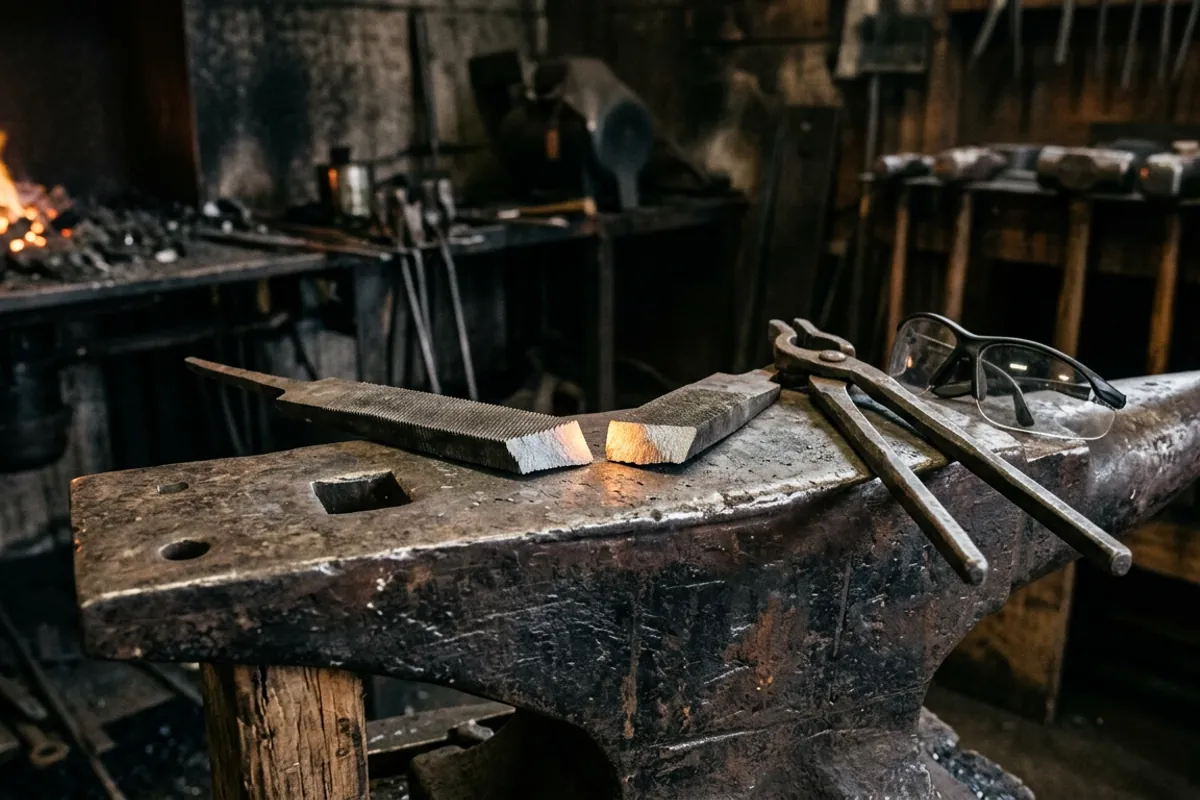
Smiths agree on the reason, too. Case hardening is cheaper than hardening a bar of good tool steel all the way through. That is the whole story behind the preference for old files, and why you see people digging through flea market bins and estate sale coffee cans for worn out American brands from decades back. They are not being romantic about the patina. They are betting that an older file is more likely to be through hardened high carbon steel.
It is a bet, not a certainty. Which brings us to the only honest way to settle it.
Why I usually tell a beginner to buy a bar of known steel
Before the testing, the recommendation, because I would rather be blunt than clever. If your goal is a knife, buy a bar of known steel. A stick of 1084 or 80CrV2 costs less than filling a propane tank, arrives with a published composition, and has a heat treat that other people have run and written down. You will spend your evening learning bevels and heat treat instead of running detective work on a mystery bar, and when the blade comes out wrong you will know which variable to change.
I have written up what 80CrV2 actually is over in 80CrV2 steel explained, and the steel selector will walk you to a grade that suits what you want to make. The knife making kit buying guide covers rolling your own starter kit around a known bar, and notice that in that piece the file appears as a tool for shaping and cleaning up, which is what a file is genuinely excellent at. The rest of the path from bar to finished edge lives on the knife making hub.
If you already know all that and you still want to make a knife from a file, good. Plenty of us have. Just go in knowing you have signed up for an identification problem, not a shortcut.
Spark testing does not tell you which steel you have
Somebody will suggest you touch the file to a grinder and read the sparks. Spark testing is a real technique and it does something real: it narrows a broad class. It does not identify a grade, and it never has.
The publishable statement, the one the reference literature actually supports, is that the spark test cannot be depended upon for identifying steels of unknown composition, and that such determinations can be made only by chemical analysis. The mechanism is easy to understand once you hear it. The bright bursts in the spark stream come from carbon, and alloying elements change how that carbon presents. Nickel suppresses the burst. So two steels with the same carbon content can throw visibly different spark streams, and two steels with different carbon can look similar enough to fool you.
Sparks will tell you the difference between a mild steel bar and something with real carbon in it. That is worth knowing and it is where the usefulness stops. Anyone who tells you they sparked a file and identified it as 1095 is telling you what they expected to see.
The test coupon, and how to read it
This is the part I actually care about, and it is the step almost every version of this project online skips. Do not find out what your steel does on a finished blade. Find out on a piece you were going to throw away.
Cut 1 to 2 inches off the tang end of the file. That is your coupon. Harden the coupon exactly the way you intend to harden the blade, then run three checks on it.
Does it skate a file? Draw a sharp new file across the quenched coupon. If it bites and cuts, the piece did not harden and you have your answer already. If it skates across with a glassy feel, something hardened.
What does the fracture look like? Clamp the coupon in a vise and snap it. A through hardened high carbon piece breaks with a fine, uniform, almost velvety grey grain across the whole section. A case hardened piece tells on itself immediately: a bright thin hard rim around a coarser, duller, obviously different core. That rim is the entire hardness of the tool, and it is thinner than your bevel.
Does the grain look coarse? Very coarse, sparkly, crystalline grain says the piece was taken too hot. That is a heat treat problem you can correct, but you want to learn it from a coupon.
Wear ANSI Z87.1 rated eye protection for the snapping. Hardened high carbon steel does not bend before it breaks; it lets go all at once and the pieces go somewhere.
One more habit worth having: I do not assume the tang and the body of a file are in the same condition. Treat the whole bar as unknown, and if the blade is going to come out of the far end from your coupon, it is not unreasonable to test both ends.
Getting an unknown file soft enough to work
You cannot forge a file in the condition it arrives, and drilling a pin hole through low 60s HRC steel is a bad afternoon. So it has to be annealed first. The method, the critical temperatures and the magnet caveat all live in annealing steel explained, and I am not going to restate that here.
The file specific problem is this: annealing schedules are written per grade, and you do not have a grade. So you anneal conservatively. Get it up to temperature and then cool it as slowly as you possibly can, buried in vermiculite or left in a shut down forge overnight, and accept that you may not land at full spheroidized softness on the first try. Check it with a file afterwards. If it still skates, cycle it again rather than fighting it at the drill press.
Stock removal or forging, and what hardened steel does under a hammer
Two routes from here. Stock removal means you grind the shape out of the flat bar and never forge it. Forging means you anneal, draw the bevel and the tip with a hammer, then normalize and harden. Both work. Both have a trap.
For forging, the trap is obvious and dangerous: never bring a hammer down on a file that is still hardened. Hardened steel at that hardness is brittle by design, and struck cold it chips and throws fragments hard enough to embed. Eye protection is not the answer here, avoidance is; the eye protection is what covers the mistake you did not plan on.
For stock removal, the trap is quieter. If you never heat treat the blank, you have inherited the file's factory hardness, and that hardness was chosen for a tool that gets pushed across a workpiece in one direction. A knife gets dropped, pried with, twisted in a cut and levered out of wood. A blade left at file hardness with no tempering behind it is glass in a knife shape. At minimum, run a tempering cycle on it before you put an edge on and hand it to somebody.
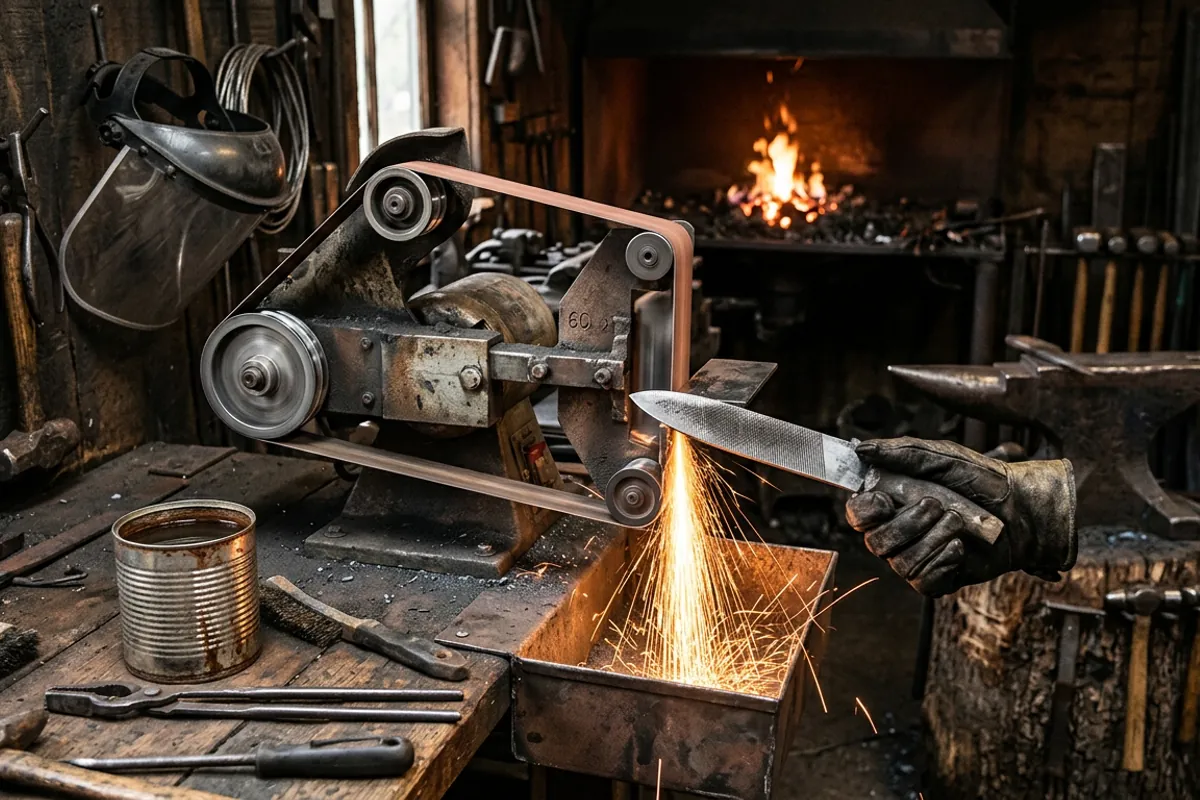
The other stock removal trap is heat at the grinder. It is easy to blue a thin edge on a belt, and that blues the temper along with it. Keep a can of water beside you and dip often. Grinding hardened steel also throws fine metal dust, so wear a respirator and eye protection, not just one of them. If you want the grinder conversation itself, it is in the 2x72 belt grinder for knife making.
Whichever route you take, grind the teeth off completely before heat treat. Every tooth root is a sharp notch, and sharp notches concentrate stress. A quench crack has to start somewhere, and a row of little notches down the spine of your blade is an invitation.
Hardening a blade when you cannot name the steel
Here is where I part ways with almost every article that ranks for this search, and I want to explain why rather than just refuse.
I am not going to publish an austenitizing temperature, a soak time, a quench medium or a tempering temperature for "a file", because there is no such thing as a heat treat for "a file". The grade is unsourced. The two grades smiths name behave differently in the quench: W1 is a water hardening tool steel, while 1095 is shallow hardening and the knifemaking literature quenches it in a fast oil. And W1's own specification is not one recipe either; its carbon range runs roughly 0.7 to 1.4 percent depending on what was ordered. So even if somebody handed you a certificate saying W1, you still would not have a recipe. A number printed next to the word file is somebody's guess wearing a lab coat.
Which means the sequence is: coupon first, blade second. Whatever quench you have set up for your known steels, prove it on the cutoff before you commit the blade.
Two hard limits inside that.
First, do not reach for water. If there is any chance that bar is 1095, water quenching it is a known crack risk, and a blade that cracks in the quench often does not show it until you are polishing. Start conservative on the coupon and let the coupon tell you whether you need more speed.
Second, do not use "heat to bright cherry red and dip it in oil" as your instruction, which is exactly the line that dominates search results for this project. Color judgment shifts by hundreds of degrees with ambient light. The same steel that looks bright cherry in a dim shop looks dull in a garage with the door open at noon, and that gap is the reason behind most beginner cracked blades and most soft ones. If you use color at all, treat it as a rough indicator and confirm it: a magnet stops sticking at the Curie point, which is a physical event rather than an opinion about a shade of orange, or use an oven you can actually control and verify. The general principles are in heat treating steel explained.
Quench oil deserves its own sentence of respect. Oil that is too cold flares, and a flare comes up out of the tank and into your face. Keep a lid within reach, wear a face shield over your safety glasses, and wear natural fibers, because synthetics melt onto skin. What quench oils actually do is covered in Parks 50 quench oil explained.
Tempering is the step that keeps a fragment out of your eye
Do not skip this and do not defer it. A roughly 1 percent carbon blade fresh out of the quench is somewhere near 65 HRC and it is glass brittle. It can crack sitting on the bench as it finishes cooling, and it can shatter in use. A knife that comes apart in somebody's hand throws hardened fragments, which is the failure mode that turns a fun weekend project into an eye injury.
So: temper it, and temper it as soon as it is cool enough to handle. Two cycles, with a full cool between them. Use an oven whose temperature you have verified against a separate thermometer, because kitchen and toaster oven dials are routinely off by enough to matter.
I am not giving you a temper temperature for an unknown file, for the same reason I did not give you a quench. What I will say is that when you cannot pin the steel, err toward the hotter, softer side. A slightly soft blade dulls sooner and you sharpen it. A slightly hard blade chips, and a chip has to go somewhere. The temper steel by heating and cooling guide covers the mechanism plainly.
How this is different from the railroad spike knife
People lump these two projects together as scrap knife projects, and they are opposite problems.
A railroad spike is roughly 0.10 to 0.30 percent carbon. There is almost no hardenability in it. You can do everything right and end up with a blade that will not take or hold an edge, because the carbon simply is not there, and that is why I treat the spike as a forging exercise with a knife shaped result. That whole argument is in the railroad spike knife.
The file is the reverse. File steel will harden, and it will harden hard. Nothing about the outcome is in doubt in that sense. What you do not know is what you are hardening, which means you do not know the correct temperature, the correct quench speed, or the correct temper. The spike problem is a shortage of carbon. The file problem is a shortage of information.
That is also why the file version is worth doing and the coupon is worth cutting. You are not fighting physics, you are doing identification work, and identification work has an answer at the end of it.
What I usually do with a good old file
Honest ending: when I find a heavy, sharp, old American file at a sale, I usually keep it as a file. A good file is a genuinely useful tool at the vise and around the anvil, and there are far more of them going dull in drawers than there are people who need mystery blade stock.
But if it is already worn smooth, or you want the project for the project's sake, go ahead. Cut the coupon, snap it, read the grain, and let the steel tell you what it is before you spend a weekend shaping something you cannot heat treat. Do that, temper what you harden, and you will end up with a working knife and a real understanding of why knowing your steel is worth paying for. The broader path from bar to edge is laid out on the knife making hub when you are ready for the next one.