I have everything verified: five live ASINs matched to their listings, maker spec pages for DeWalt (DWE402, DCG413B) and Metabo, and real forum threads (BladeForums, KnifeDogs) plus a Knife Steel Nerds article for the heat section. Writing the article now.
If you are getting into knife making and cannot yet justify a belt grinder, a knife making angle grinder is the first power tool I would put in your hands. The one I would hand a brand new maker is the corded DeWalt DWE402: eleven amps, a paddle switch, cheap enough that you are not afraid to learn on it, and common enough that discs for it hang on every hardware store shelf. Before I go any further, here is the honest framing this site runs on. I have spent years behind a grinder, but I have not bench tested every model in this guide side by side. What follows leans on published specs, on what owners report across the knife forums, and on plain shop experience with what a 4-1/2 inch grinder is actually good and bad at when there is a blade blank in the vise.
What a knife making angle grinder actually does, and what it does not
An angle grinder is a hogging and shaping tool, not a finishing tool. For a stock removal maker it does three jobs well. With a thin cutting disc it profiles the blank, meaning it cuts the outline of the knife out of the bar faster than a hacksaw ever will. With a grinding wheel it hogs off the big waste and knocks down forge scale. With a flap disc it starts your rough bevels and blends the transitions. That is a real amount of work, and for a lot of makers it is the difference between finishing a knife this month or never.
What it does not do is give you clean, flat, symmetrical bevels the way a proper belt setup will. A 4-1/2 inch disc spinning at eleven thousand RPM in your hands is a freehand tool, and freehand on a curved disc leaves a slightly hollow, slightly wandering surface. You can get a working knife out of it, but you will finish the bevels and the flats by hand with files and sandpaper, or you will move up to a belt sander. If you already know you are serious, read the 2x72 belt grinder guide and the belt sander for knife making writeup so you understand what the grinder is a bridge to, not a replacement for. For the wider picture of the craft, the knife making explainer and the topic hub lay out where this tool sits in the whole process.
How I would pick one: the specs that matter
Ignore the marketing and look at four things.
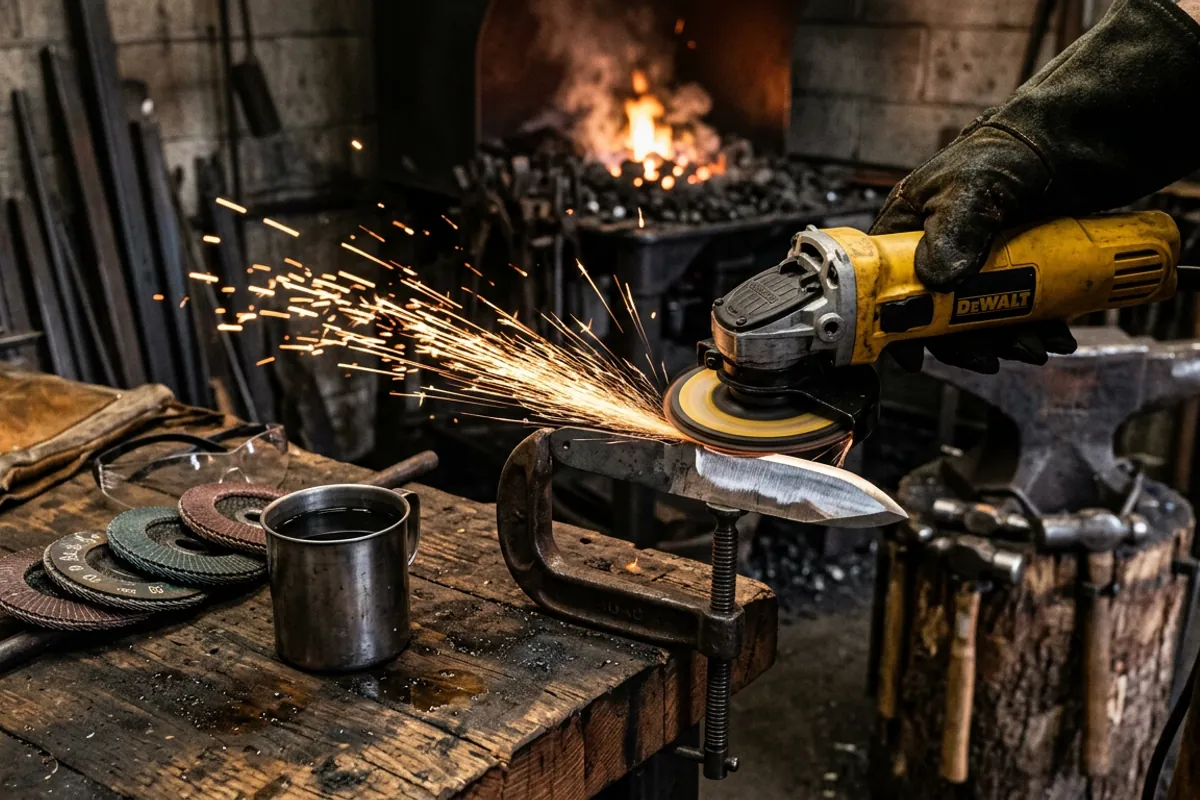
Power. For steel, more amps means the disc keeps its speed under load instead of bogging when you lean in. Anything from about 7 to 11 amps corded will do knife work. Below that you are fighting the tool.
Switch type. A paddle switch that you have to hold down is the safer design for a beginner, because the second you let go the tool wants to stop. A slide or toggle switch that latches on is convenient but stays running if the grinder gets away from you. For learning, I want the paddle.
Corded versus cordless. Corded gives you constant power for as long as you work and never dies mid cut. Cordless gives you freedom of movement and a tidy shop, at the cost of runtime and, honestly, a bit of heat in the tool on long grinding sessions. For a first grinder that is going to hog a lot of steel, I lean corded.
Disc size and spindle. A 4-1/2 inch is the standard for control on a blade. A 5 inch removes a little more but is bigger in the hand. Most North American grinders use a 5/8-11 spindle, which is what almost every disc you will buy is threaded or bored for. A few imported grinders use an M14 metric spindle, so check the thread before you buy a stack of discs.
Here is the field I would actually shop, on published specs only.
Scroll horizontally to see all columns.
| Grinder | Power | No load RPM | Disc size | Spindle | Switch / speed | Price tier |
|---|---|---|---|---|---|---|
| DeWalt DWE402 | 11 amp corded | 11,000 | 4-1/2 in | 5/8-11 | Paddle, single speed | Budget |
| Makita 9557PBX1 | 7.5 amp corded | 11,000 | 4-1/2 in | 5/8-11 | Paddle, single speed | Budget to mid |
| Metabo WEV 11-125 Quick | 1,100 W corded | 2,800 to 10,500 | 4-1/2 to 5 in | M14 (see note) | Slide, variable speed | Premium |
| DeWalt DCG413B | 20V brushless cordless | 9,000 | 4-1/2 in | 5/8-11 | Paddle, kickback brake | Mid (bare tool) |
Figures are from the makers: the DeWalt DWE402 page, the Makita 9557PBX1 page, the Metabo WEV 11-125 Quick page, and the DeWalt DCG413B page.
DeWalt DWE402: the corded workhorse I would start on
This is the grinder I point beginners at. DeWalt publishes it as an 11 amp motor turning 11,000 RPM on a 4-1/2 inch wheel, with a paddle switch and a safety lock-off. The eleven amps matter for knife work because you spend a lot of time leaning the disc into steel, and a strong motor holds its speed instead of stalling and grabbing. The paddle switch is the right shape for learning, and the whole tool is cheap enough that you will not baby it while you figure out what you are doing.
The tradeoffs are what you would expect at this price. It is a single speed tool, so on a hardened blade you have no way to dial the RPM down for gentle finishing, and you manage heat with pressure and water dips instead. The body is a fairly standard barrel, not the slimmest grip out there. None of that disqualifies it as a first grinder. It is the one I would buy again for hogging steel and never think about. This is a budget tier tool and worth every bit of it.
Check price on Amazon (paid link)
Makita 9557PBX1: the one built to hold all day
If your hands get tired, this is the one to look at. Makita publishes it as a 7.5 amp grinder at 11,000 RPM on a 4-1/2 inch wheel, weighing about 4.5 pounds, with a large paddle switch. The number that catches your eye is the lower amperage, and yes, it is a less brawny motor than the DeWalt on paper. What owners keep coming back to is the slim barrel and the light weight, which is the thing that actually matters when you are grinding for an hour and your wrist is the limiting factor, not the motor.
Makita seals the motor against grinding dust, which is the abrasive killer of cheap grinders, and that reputation for lasting is why you see so many of these in working shops. For pure steel hogging the DeWalt has more muscle, but for comfort over a long session the Makita earns its slightly higher, still very reasonable, price. Buy this one if you already know your hands are the weak link.
Check price on Amazon (paid link)
Metabo WEV 11-125 Quick: variable speed for finish control
This is the premium pick, and the reason is variable speed. Metabo publishes a no load range of 2,800 to 10,500 RPM on a 1,100 watt motor, with tool-free disc changes and a mechanical safety clutch that backs off when the disc jams. For knife making that speed range is not a gimmick. When you take a flap disc to a bevel or clean up near a finished edge, running slower gives you control and, more importantly, generates less heat in the steel. The safety clutch is a genuine benefit too, because a grabbed disc is how people get hurt.
Two honest caveats. First, this is real money, several times the cost of the DeWalt, and a beginner does not need it to make a knife. Second, the European Metabo uses an M14 spindle rather than the 5/8-11 that most North American discs are bored for, so confirm the thread and buy discs to match, or get the right adapter. Buy this if you are past the beginner stage, you finish a lot of blades, and you value being able to slow the tool down.
Check price on Amazon (paid link)
DeWalt DCG413B: the cordless option, with a caveat
If a cord genuinely gets in your way, this is the cordless I would consider. It is a 20V brushless tool that DeWalt rates at 9,000 RPM on a 4-1/2 inch wheel with a 5/8-11 spindle, and its headline feature is the kickback brake, which stops the wheel in about two seconds when it senses a pinch or stall. That brake is a real safety feature, and on a tool that can twist out of your hands it is worth having.
The caveats are the usual cordless ones and one specific one. It is sold as a bare tool, so factor in a battery and charger, which pushes the real cost up into mid tier. Runtime is finite, and hogging a lot of steel drains packs fast and warms the tool. For a maker whose main job is grinding steel down, I still start people on corded. Buy the cordless if you are already on the DeWalt 20V platform and mobility is the point.
Check price on Amazon (paid link)
Flap discs and cutting discs: where the grinder earns its keep
The grinder is only as good as what you spin on it, and this is where the money actually goes over time. For knife work you want three kinds of disc. A thin cutting disc, around 0.045 inch, for profiling the blank out of the bar. A grinding wheel for heavy scale and fast metal removal, though many makers skip it and let a coarse flap disc do that job. And flap discs, which are the workhorse for shaping and rough bevels, because the layered abrasive follows the steel and leaves a far smoother surface than a hard grinding wheel, with less gouging.
Buy flap discs in a grit spread so you can step down. A pack that runs coarse for shaping, around 40 and 60 grit, then 80 and 120 for cleaning up before you move to hand sanding, covers most of a knife. A zirconia flap disc holds up to the heat and pressure of steel better than a cheap aluminum oxide one. A variety pack like this one (paid link) is a cheap way to have every grit on the shelf so you are not stopping a build to order a single disc. Match the disc RPM rating to your grinder, and never mount a disc rated below the tool's speed.
What owners say
For gear I have not run down model by model in my own shop, I go to the forums, and the consensus on angle grinders for knife making is remarkably consistent. On BladeForums, the repeated advice to beginners is that a 4-1/2 inch grinder will get you a profile fast, that a flap disc is the friendly way to shape without the gouges a hard wheel leaves, and, said plainly, that you will not finish a knife with the grinder alone. You will still need at least a cheap belt sander or a lot of hand filing to clean it up. That matches my experience exactly.
Over on KnifeDogs, when a maker asked about rough profiling, the angle grinder answer was to run a cutting disc to rough the shape out, then a grinding wheel to get it close enough for the sander. It is worth being honest that the grinder was one option among several in that thread, with plenty of makers preferring a portable bandsaw or a bandsaw for cleaner cuts. That is the fair read: the angle grinder is the cheapest way in, not the way a production shop profiles blades. If your budget is the constraint, it is a great answer. If you can spend more, the forums push you toward a saw for cutting and a belt grinder for bevels sooner rather than later.
Safety: this is the tool that hurts people
I do not soften this part. An angle grinder puts a brittle disc spinning at eleven thousand RPM inches from your hands and face, and it is one of the most injured-on tools in any shop. I learned my own respect for heat and speed the hard way early on, quenching a blade in oil that was too cold, standing too close in a cotton shirt with no face shield. The oil flared and took my eyebrows, and I kept my eyesight by luck. That is why PPE here is not optional, ever.
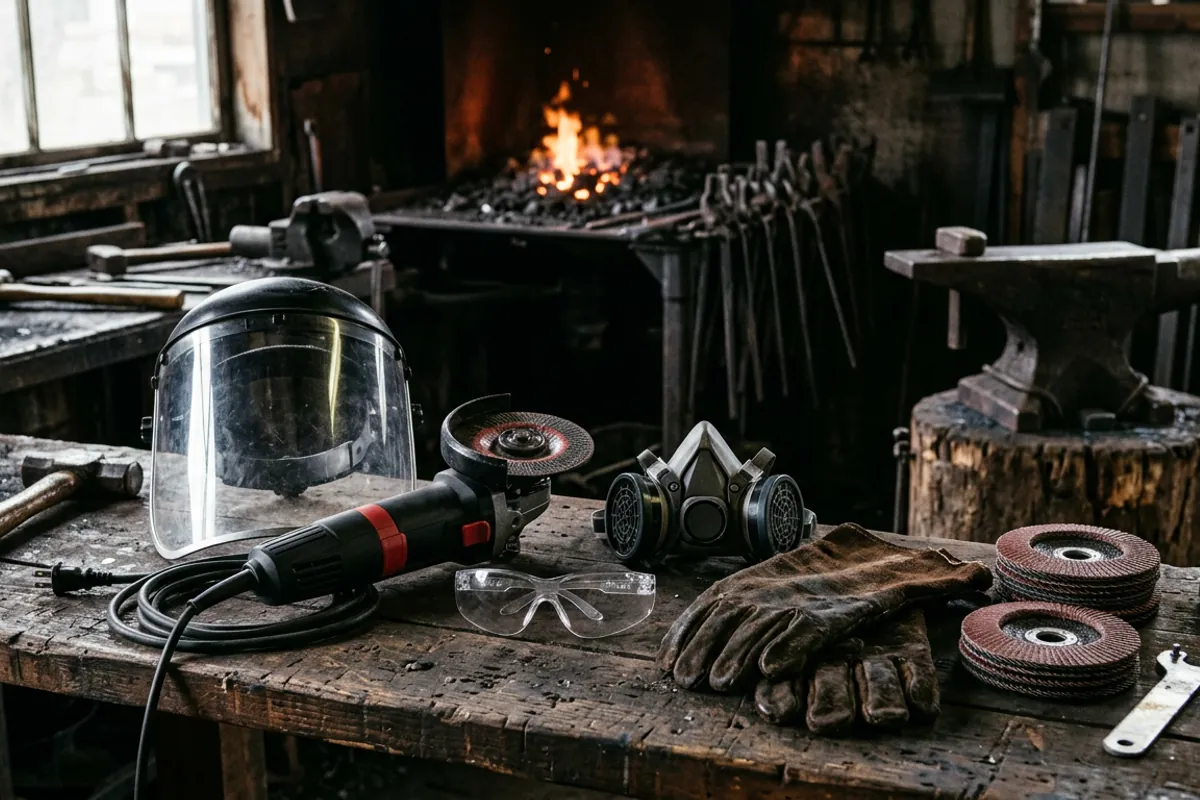
Wear eye protection rated to ANSI Z87.1, and for grinding I want a full face shield over the safety glasses, not glasses alone. A disc can shatter and it throws fragments at eye height. Keep the guard on the grinder, positioned between the disc and your body, no matter how much it seems to be in the way. Wear natural fiber clothing near the sparks, because a synthetic shirt melts to skin, and add a respirator, since grinding steel and abrasive throws a metal dust you do not want in your lungs. Inspect every disc before you mount it and throw out any that is cracked or chipped. Confirm the disc is rated for at least your grinder's RPM. Two hands on the tool, and know which way it will climb if it grabs so your body is never in that path. For the full rundown, the blacksmith safety gear guide covers what actually matters and what you can skip.
Heat is the enemy after heat treat
Once a blade is hardened and tempered, the angle grinder becomes a way to quietly ruin your own heat treat. The apex of the edge is so thin that grinding friction can heat it past your tempering temperature in under a second, and when it does you have drawn the hardness right out of the edge without seeing a thing. Knife Steel Nerds covers this directly in their piece on whether sharpening with a grinder ruins your edge: the fix is to keep a cup of water at the bench and dip the blade often, run light pressure, and never let the steel get hot enough to change color. If you see the edge turn straw or blue near the apex, you have already softened it. This is exactly why the variable speed grinder earns its keep for finishing, and why I do the last passes near a hardened edge slow, light, and wet.
What I would tell a friend
Buy the corded DeWalt DWE402 and a variety pack of zirconia flap discs, and you can profile and rough shape knives this weekend. If your hands tire fast, spend a little more on the Makita for the slimmer, lighter body. Skip the cordless as a first grinder unless mobility is truly the point, and save the variable speed Metabo for when you are finishing blades in volume and want to slow the tool down. Whatever you buy, wear the face shield and keep the guard on, and once you are hooked, start saving toward a real belt grinder, because the angle grinder is the door in, not the whole shop.