The 2x72 (or its 2x82 import cousin) flat belt grinder is the honest answer to the best belt grinder for knife making, and if you already know you are staying with knives, that is the machine I would tell you to save for. But most people asking me this question have made zero to five knives, and for them I would not lead with the biggest grinder in the room. I would start smaller, prove the hobby sticks, and step up once the machine is the thing holding you back instead of your hands. Below is how I sort the field, from a benchtop 1x30 you can buy tomorrow to a real 2 horsepower variable speed grinder. Fair warning up front: I have run plenty of steel across belts over about twenty five years, but I do not own every machine here. Where I am leaning on published specs and what smiths report on the forums rather than my own bench, I say so plainly.
What actually matters in a knife grinder
Three things decide whether a belt grinder is any good for knives: belt size, power, and speed control.
Belt size is surface. A 1 inch belt is fine for handle contours and edge finishing, but hogging a bevel down a 10 inch blade on a 1 inch belt is slow and leaves you chasing a flat you never quite get. A 2 inch by 72 inch belt is the knife shop standard for a reason: the long belt runs cooler, lasts longer, and gives you flat platen real estate to grind a clean bevel. The 2x82 you see on import machines is the same idea with a slightly longer belt, and belts in that length are easy enough to source.
Power is how fast you remove steel without the motor bogging. A 2 amp benchtop unit will grind, but it stalls if you lean on it, and you will burn through belts because a struggling belt is a dull belt. A half horsepower to 2 horsepower motor is the difference between shaping a blade in an evening and fighting it all week.
Speed control matters more than beginners think. Full speed is for heavy stock removal. Slow speed is for finish work and, critically, for keeping heat out of a thin edge. Once a hardened edge goes past a light straw color from grinding heat, you have drawn the temper and ruined the heat treat you worked to get right. Variable speed lets you back off. If you want the why behind that, I get into it in my 4140 heat treat guide and the broader picture in knife making explained.
The field at a glance
Published specs only, cited in each section below. Where a maker does not publish a figure, it says so.
Scroll horizontally to see all columns.
| Grinder | Belt size | Motor | Belt speed | Base / build | Tier |
|---|---|---|---|---|---|
| WEN 6515T | 1 x 30 in | 2.3 amp | 3160 FPM | Cast/steel benchtop | Budget starter |
| WEN 6502T | 4 x 36 in | 4.3 amp, 1/2 HP | up to 3600 RPM | Cast iron base | Budget, more surface |
| Happybuy 2 HP | 2 x 82 in | 2 HP, variable | Variable | Steel plate, floor/bench | Real knife grinder |
Prices move around too much to quote, and the site does not print marketplace prices anyway. Think of these as budget, budget-plus, and the first tier that resembles a purpose built knife grinder.
WEN 6515T 1x30: the test-the-waters starter
This is the machine I would put in front of someone who is not yet sure knife making will stick. It is a 1 by 30 inch belt with a 5 inch sanding disc, a 2.3 amp motor, and a published belt speed of 3160 feet per minute per WEN and the retailer listings (WEN spec via Lowe's). It is a benchtop tool, not a floor grinder.
Be honest with yourself about what it is: a small, underpowered belt sander that happens to work for knives if you feed it the right belts and do not lean on it. The 1 inch belt is genuinely nice for handle work and finish sanding, and you will make real knives on it. You will also go through belts, and stock removal on a hardened or thick bar is slow. The single biggest upgrade is throwing the hardware store belts in the bin and buying zirconia or ceramic belts from a knife supplier. A cheap grinder with good belts beats a good grinder with bad belts every time.
Who it suits: the first five knives, sharpening, handle shaping, and finding out whether you want to keep going before you spend real money. That is not a knock. It is the exact path I point weekend beginners toward.
Check price on Amazon (paid link)
WEN 6502T 4x36: more surface, more base
If you want more grinding surface and a machine that sits still while you work, the 6502T steps up to a 4 by 36 inch belt and a 6 inch disc, driven by a 4.3 amp half horsepower motor rated up to 3600 RPM, on a cast iron base (WEN 6502T specs). The cast iron matters more than it sounds: a grinder that walks or wobbles fights your hands the whole time, and the heavier base kills a lot of that.
The tradeoff versus a 1x30 is the belt shape. A 4 inch wide belt is a woodworking belt first. It is great for flattening, squaring stock, and roughing, and the wide platen is forgiving. It is less natural for the plunge line and the fine work near the edge, where a narrower belt tracks a curve better. Belt selection is also narrower for knife specific abrasives in the 4x36 size than in the 2x72 world.
I would pick this over the 1x30 if your interest is broader than knives, say general blacksmithing cleanup and stock prep alongside blades, since that wide belt earns its keep on non knife work. For pure knife making, the 1x30 or a jump to a real 2 inch grinder both make more sense than the 4x36. Either way, it is a legitimate budget machine and it will not embarrass itself. For the wider question of which belt sander earns a spot in a knife shop, I laid out my thinking in the belt sander for knife making guide.
Check price on Amazon (paid link)
Happybuy 2 HP 2x82 variable speed: the real knife grinder
This is where the machine starts to look like what full time bladesmiths run. The Happybuy is a 2 horsepower, variable speed, 2 by 82 inch belt grinder that ships with multiple contact wheels and a flat platen, listed specifically for knife making. That combination, long belt, real power, and speed control, is the trio I said matters up top, in one machine.
I have not run this specific import on my own bench, so take the following as owner consensus weighed against general shop experience, not a hands on test. The category, budget import 2x72 and 2x82 grinders, is well known on the forums. The honest read is that they are a real entry into flat platen grinding at a fraction of the price of a KMG or a TW-90, and that fit and finish is hit or miss: tracking can need adjustment, welds and paint are rough, and some units want a tune before they run true. What you are buying is the format, a genuine 2 inch grinder with a long belt and variable speed, not the refinement of a US built grinder. For most hobby smiths that is a fair trade, and belts in the 2x72 and 2x82 length are cheap and everywhere.
If you already know knives are your thing, this is the tier I would save for rather than buying a benchtop twice. I go deeper on the 2 inch format, including the build it versus buy it question, in the 2x72 belt grinder for knife making I would actually start with.
Check price on Amazon (paid link)
What owners say
For the machines I have not run down myself, here is what smiths actually report, attributed to the threads I found.
On the 1x30 as a starter, the consensus on BladeForums is consistent: it will get you started, plenty of makers began on one and still keep theirs for handles and finish work, and it is cheap enough that it is not wasted money if you decide the hobby is not for you. The recurring complaint is belt consumption and slow stock removal, and the recurring advice is to buy quality zirconia belts from a knife supplier rather than hardware store belts (BladeForums: is this belt sander sufficient). I Forge Iron echoes it, with a thread full of practical mods and belt tips for squeezing knife work out of a 1x30 (I Forge Iron: tips on using a 1x30 for knife making).
On the import 2 inch grinders as a class, the forum signal is that they are a legitimate way into flat belt grinding on a budget, with the caveat that quality control is uneven and you may need to true up tracking and tension out of the box. Owner signal on any one specific import model tends to be thin and short lived because sellers rebadge the same chassis under different names, so I would trust the format more than the brand on the label. That is exactly the kind of thin, shifting owner data I would rather flag than dress up.
Safety at the grinder
A belt grinder throws a constant stream of hot steel dust and grit, and it will grab a blade out of your hands if you present it wrong. This is not a place to be casual, and I say that as the guy who lost his eyebrows to a quench flare because he thought PPE was for other people.
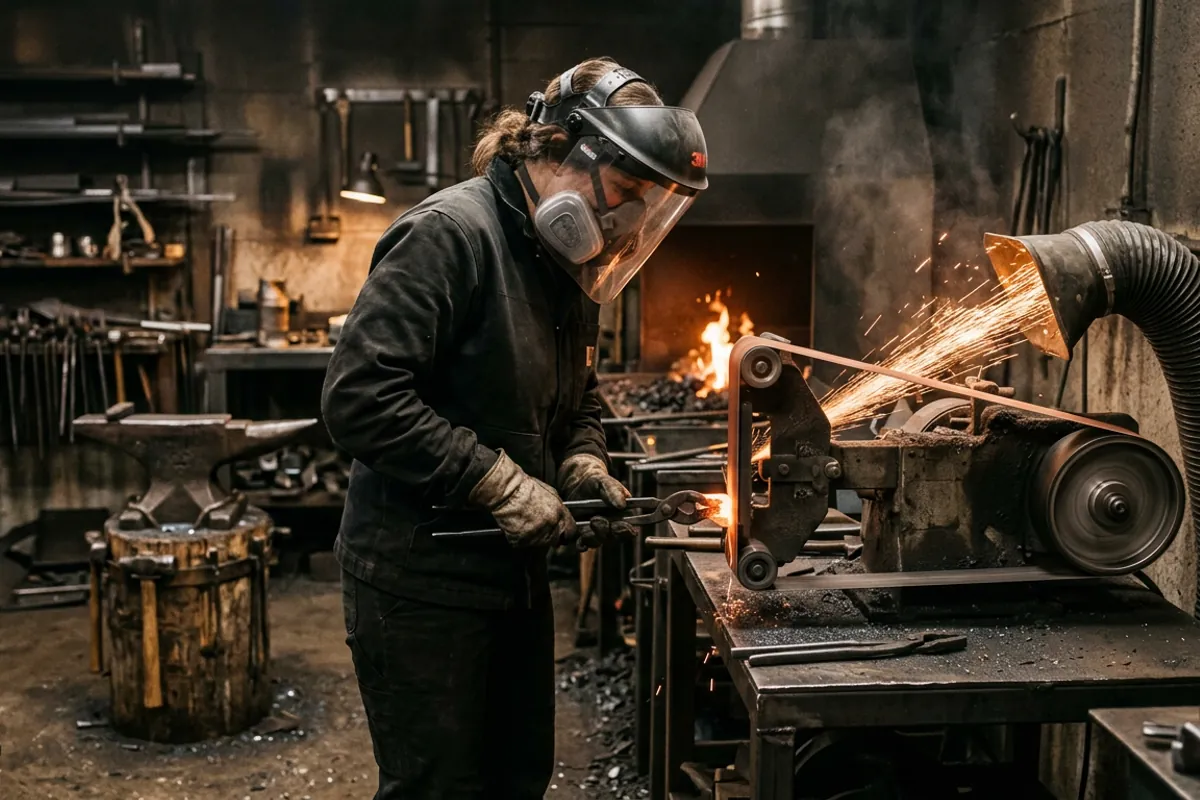
Eyes first: wear ANSI Z87.1 rated protection, and a face shield over the glasses for grinding is cheap insurance against a belt that lets go. Second, your lungs. Grinding steel makes fine metal dust, and the belt adds abrasive grit to it. Run dust collection or a fan pulling the stream away from your face, and wear a proper respirator, an N95 at the minimum and a P100 if you grind a lot. This matters double if you ever touch anything with a coating or grind non ferrous metals. Do not grind magnesium or titanium casually, the sparks and dust are a fire hazard of their own.
Dress for it: no loose sleeves, no dangling strings, and I do not wear gloves at a running belt because a glove that catches takes your hand with it. Natural fibers over synthetics, same rule as at the forge, because a spark that melts a synthetic shirt into your skin is a burn you do not walk off. And mind where the spark stream lands: grinding next to an open coal forge or a jug of quench oil is asking for a fire. My full rundown is in blacksmith safety gear, and it applies at the grinder as much as at the anvil.
What I would tell a friend
If you are not sure knife making will stick, start on the WEN 6515T 1x30, put good zirconia belts on it, and make five knives before you spend another dollar. If you already know knives are the thing, skip the benchtop ladder and save for a real 2 inch variable speed grinder like the Happybuy 2x82, understanding you are buying the format and may need to tune it. I would skip the 4x36 for pure knife work, it is a better general shop sander than a bevel grinder, though it earns its place if you do broader smithing too.
The one that gets people hurt is not the machine, it is the missing face shield and respirator. Buy those before you buy the grinder. For where all of this fits in the bigger picture, the knife making topic hub collects the rest, and the steel selector tool helps you match a blade steel to a heat treat you can actually run at home. None of these are bench tests on my part, they are published specs and forum consensus weighed against a lot of hours at the belt, and I have told you which is which the whole way down.