I have everything I need: three ASINs confirmed by direct fetch (WEN 6515T, BUCKTOOL 2x42, WEN 6502T), a fourth (Happybuy 2x82) confirmed live in search matching its product name, published specs from WEN's own pages, and three real forum threads. Writing now.
If you want one honest answer to what makes a good belt sander for knife making, here it is: buy the most belt speed and the widest, longest belt you can afford, because every other decision is a compromise around two jobs, removing steel fast and keeping the blade cool while you do it. For a first machine on a tight budget I would start a new smith on the WEN 6515T 1x30. When they are past the "is this a hobby or a phase" question, I would put the money into a BUCKTOOL 2x42 combo. And I would treat a 2 by 72 class grinder as the tool they eventually graduate into, not the one they buy on day one. I have not run every one of these machines down on my own bench, so read what follows as published specs and owner reports from the knife forums weighed against what I know about grinding steel, not as a lab test.
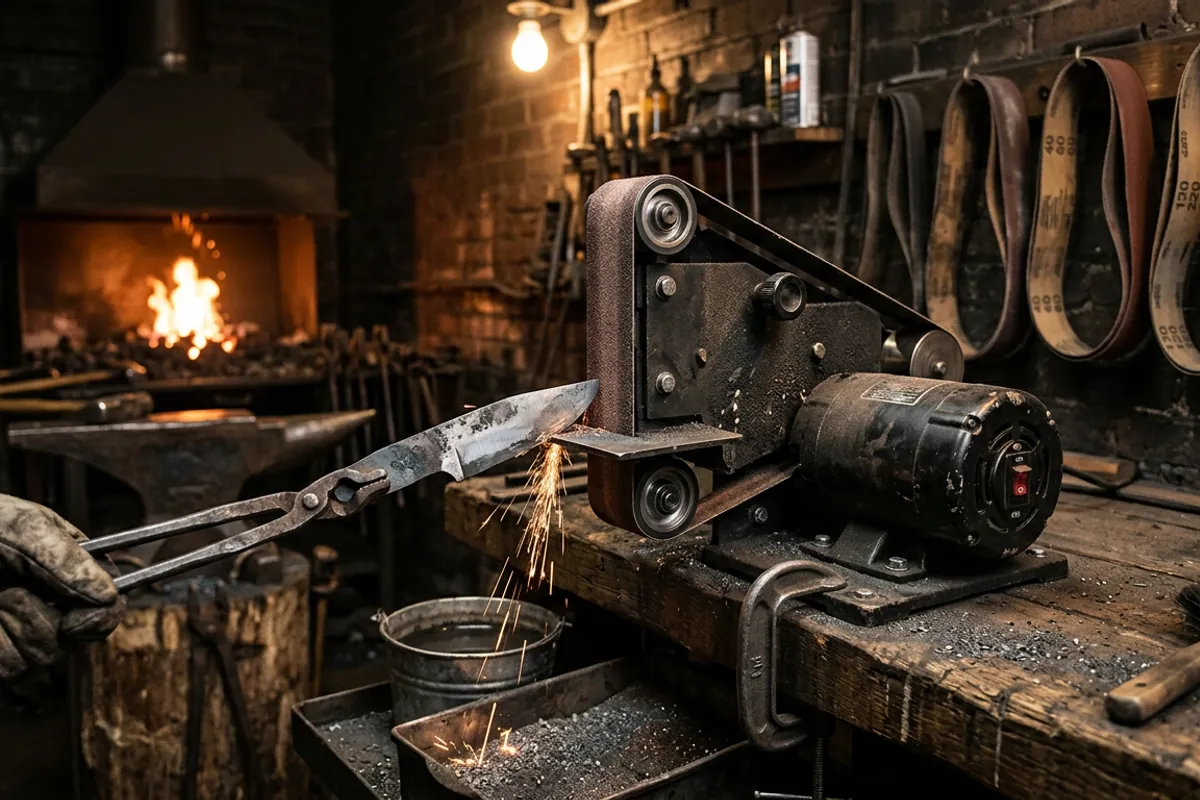
The reason this question is confusing is that "belt sander" covers two very different animals. There is the bench belt-and-disc sander built to smooth pine, and there is the belt grinder built to hog hardened steel. They look similar in a photo and behave nothing alike at the bar. Half the frustration new smiths post about is really a wood sander being asked to do a grinder's work.
What a good belt sander for knife making actually has to do
A knife-making belt sander earns its keep on three things: belt size, belt speed, and rigidity.
Belt size is the one people underrate. A 1x30 belt gives you a narrow, short contact patch, which means more passes, faster belt wear, and a harder time keeping a flat bevel flat. A 2x42 belt nearly doubles the working width and length. A 2x72 belt, the standard the whole knife trade is built around, gives you the most belt surface, the widest choice of abrasive, and the longest belt life. Bigger belts are not a luxury, they cool the work and they cut straighter.
Belt speed matters because abrasive cuts by scratching, and a faster belt makes more scratches per second. Most bench sanders run a fixed speed in the 3000 to 4500 feet per minute range. That is fine for shaping mild steel and doing rough bevels. The catch is that a fixed fast belt also builds heat fast, and on a thin edge that heat is the enemy, which I will come back to.
Rigidity is the quiet one. A light machine that flexes or walks across the bench transfers every wobble into your bevel. Cast iron bases and real tool rests are worth more than another half horsepower on a machine that dances.
If you want the full walk through the grinder side of this, I laid it out in the 2x72 belt grinder for knife making guide and in the broader knife makers belt sander buying guide. This piece is about where to start when a full 2x72 is not in the budget yet. Everything here ties back to the knife making topic hub if you want the wider context.
The field at a glance
Published specs only. Where a maker does not state a figure, it reads "not published" rather than a guess.
Scroll horizontally to see all columns.
| Machine | Belt size | Disc | Motor | Belt speed | Weight | Price tier |
|---|---|---|---|---|---|---|
| WEN 6515T | 1 x 30 in | 5 in | 2.3 A | 3160 FPM | 16 lb | Budget |
| BUCKTOOL BG2600 | 2 x 42 in | 6 in | 1/2 HP, 3.5 A | 4480 FPM | not published | Budget to mid |
| WEN 6502T | 4 x 36 in | 6 in | 1/2 HP, 4.3 A | not published | not published | Budget |
| Happybuy 2 HP | 2 x 82 in | 12 in wheel | 2 HP, variable | variable | not published | Mid to premium |
WEN 6515T specs are from WEN's own product page. WEN 6502T specs are from WEN's 6502T page. BUCKTOOL belt speed and motor are from its live listing. The Happybuy uses a nonstandard 2 by 82 inch belt, which I will flag below because it changes what abrasive you can buy.
WEN 6515T: the honest 1x30 starting point
The WEN 6515T is a 1x30 belt sander with a 5 inch disc, a 2.3 amp motor, and a belt speed of 3160 feet per minute, and it weighs about 16 pounds. That last number tells you what it is: a light benchtop tool, not a grinder. WEN also publishes that it ships with an 80 grit disc and a 120 grit belt, so plan to buy a spread of belts before you cut a single bevel.
Here is why I still recommend it as a first machine. It is cheap, 1x30 belts are sold in every hardware store, and it is enough tool to teach your hands what stock removal feels like without lighting several hundred dollars on fire before you know you will stick with knives. Plenty of good working knives have been ground on a 1x30. You can shape a profile, knock in a rough bevel, clean up a railroad spike knife, and do hardware handles on it.
The honest tradeoffs: the narrow belt makes flat grinds fussy, belts load and wear quickly, and the motor bogs if you lean on it. It will not keep up if you get serious and start grinding a knife a week. Think of it as the tool that answers the question "do I actually want to do this," and budget to outgrow it. I say the same thing in the general belt sander for knife making guide: a 1x30 is a starting line, not a destination.
Check price on Amazon (paid link)
BUCKTOOL 2x42 combo: the step that actually makes sense
If you can stretch past the entry tier, this is where I would put the money. The BUCKTOOL BG2600 pairs a 2x42 belt with a 6 inch grinding disc, runs a 1/2 horsepower 3.5 amp motor, and moves the belt at 4480 feet per minute. The 2 by 42 belt is the real upgrade here: nearly double the working area of a 1x30, a longer belt that runs cooler and lasts longer, and a size that still has broad abrasive availability, including the ceramic and zirconia belts you actually want for hardened steel.
For a home shop that wants to make knives seriously but cannot justify a 2x72 yet, a 2x42 combo is the sweet spot. The wider platen makes flat bevels genuinely achievable, the disc side is useful for squaring guards and cleaning up handle scales, and the faster belt hogs mild steel quickly. Owners on the knife forums generally treat 2x42 as the smallest belt that is truly comfortable for full knife work.
The tradeoffs are real but modest. It is still a fixed-speed machine, so heat management is on you and your water bucket. Quality control on the import combos varies, and belt tracking sometimes needs fiddling out of the box. But dollar for dollar, this is the machine I would tell most people to buy first.
Check price on Amazon (paid link)
WEN 6502T 4x36: the woodworking sander people misuse
The WEN 6502T comes up constantly in knife-making searches, so it is worth addressing head on. It is a 4x36 belt and 6 inch disc sander with a 4.3 amp 1/2 horsepower motor, a disc that spins up to 3600 RPM, and a cast iron base. On paper the wide 4 inch belt and the heavy base sound perfect for a beginner.
In practice it is a woodworking sander, and it grinds knives the way a woodworking sander does: adequately, until it fights you. The wide 4x36 belt is great for flat, broad surfaces but clumsy for the plunge line and the fine control a bevel wants, and 4x36 belts skew hard toward wood grits rather than the ceramic belts that cut hardened steel well. The cast iron base is a genuine plus, it does not walk around the bench, and for profiling stock and rough shaping it will do work.
I would not steer someone here on purpose for knife making, but if you already own one for the wood shop, it will get you started on profiling and rough grinding before you invest in a proper grinder. Just do not expect it to be the machine that teaches you clean bevels.
Check price on Amazon (paid link)
Happybuy 2 HP: stepping up toward a real grinder
At the top of this list sits the tier that actually resembles a knifemaker's grinder: a 2 horsepower variable-speed machine on a big drive wheel. The Happybuy runs a 2 horsepower motor with variable speed and multiple grinding wheels, and variable speed is the feature that separates it from everything above. Being able to slow the belt down is how you finish an edge without burning it, and how you polish without the belt skating.
One important, honest caveat: this machine uses a 2 by 82 inch belt, not the industry-standard 2 by 72. That matters. The whole knife-supply world stocks 2x72 belts in every grit and material you could want, and 2x82 is a narrower selection you will hunt for. Before you buy any import grinder, confirm what belt length it takes and that you can source belts for it in the grits you need. A grinder you cannot feed is a paperweight.
If belt supply were equal I would still tell most people to save for a true 2x72 platform, because the abrasive ecosystem is the real reason that size won. But as a big-motor, variable-speed stepping stone, this class of machine is a legitimate jump up from a fixed-speed 2x42.
Check price on Amazon (paid link)
What owners say
For gear I have not personally run down on my own bench, here is what the knife forums actually report, product by size class.
On the 1x30, the I Forge Iron thread Tips on Using a 1x30 Belt Sander for Knife Making is the honest picture: experienced smiths tell beginners that a 1x30 will absolutely make a knife, but that belt selection is the limiter and that you should buy good ceramic belts rather than the cheap included ones. The consensus is not "avoid it," it is "know what it is."
On the 1x30 versus 2x42 decision, the KnifeDogs thread 1x30 or 2x42 for the beginner leans toward the larger belt for anyone who thinks they will stick with it, for the same reasons I gave above: wider, longer belts run cooler and grind flatter. Nobody there regrets the bigger machine.
On belts, which is where these small sanders live or die, the Kitchen Knife Forums thread best 1x30 sanding belts for stock removal is worth reading before you buy any budget sander. The repeated point is that the machine matters less than the abrasive, and that ceramic belts in a spread of grits transform how a cheap sander performs. That tracks with everything I have seen at the club forge: a good belt on a modest machine beats a worn belt on an expensive one.
Owner signal on the specific import 2 horsepower grinders is more mixed than glowing. The common complaint is variable quality control, tracking that needs adjustment, and the belt-size headache. Nobody calls them junk, but people who buy them go in expecting to tune them.
Grinding heat is the safety issue nobody talks about
Two hazards live at the belt sander, and neither gets the respect it deserves.
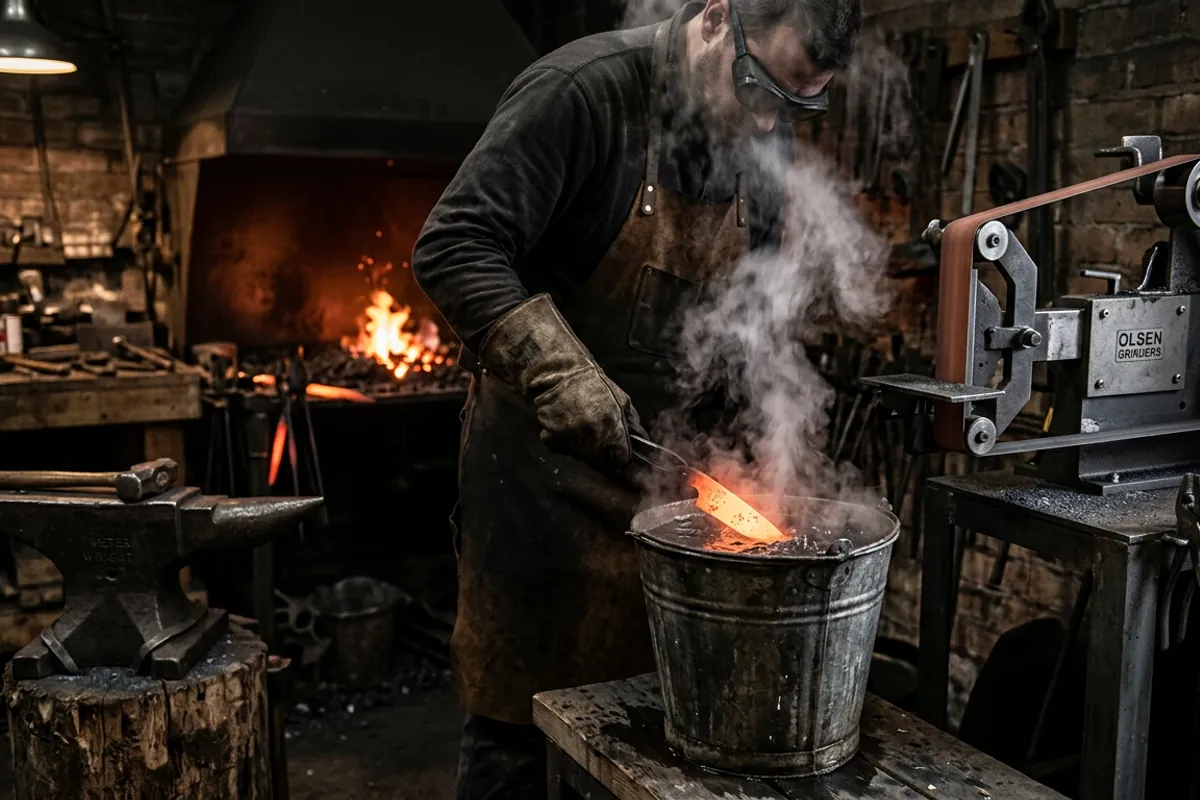
The first is your eyes and lungs. A grinder throws a constant stream of steel particles and abrasive grit straight at your face, and it aerosolizes fine metal dust that you do not want in your lungs. Wear impact-rated eye protection that meets the ANSI Z87.1 standard, every time, no exceptions, and run dust collection or a respirator when you are grinding for any length of time. I keep the safety gear rules short and specific in the blacksmith safety gear guide. Do not grind in a loose synthetic shirt either. I learned about synthetics and heat the hard way at the quench tank, and the same natural-fiber rule applies at the belt.
The second hazard is heat you cannot see, and it ruins knives quietly. When a belt heats a thin edge past its tempering temperature, you draw the hardness right back out of the steel and the edge will not hold. On a thin, already hardened bevel this happens in seconds, often before the steel even shows color. The fix is discipline: light passes, a bucket of water at the machine, and dunk the blade often, especially once the bevel gets thin. If you want the metallurgy behind why a few hundred degrees at the edge undoes your heat treat, Knife Steel Nerds is the place to read real testing rather than shop lore, and my own 4140 heat treat writeup shows how much work goes into getting that hardness in the first place. It is a shame to grind it away in a careless pass.
What I would tell a friend
Buy the biggest belt you can afford and the belts to feed it, in that order. If money is tight and you are testing whether knives are your thing, the WEN 6515T 1x30 is an honest starting line and 1x30 belts are everywhere. When you are ready to commit, the BUCKTOOL 2x42 combo is the machine I would actually put in most home shops, and it is the one I would point a friend to first. Skip the 4x36 wood sander as a knife tool unless you already own one, and treat the 2 horsepower variable-speed grinders as a stepping stone toward the 2x72 standard, checking belt availability before you spend a dollar.
Whatever you buy, the two things that will make or break your results are good ceramic belts and heat control. A cheap sander with fresh belts and a water bucket beside it will out-grind an expensive one run carelessly, and it will not burn the temper out of the blade you worked hard to harden.