content/blog/knifemakers-grinder-buying-guide.md
If you have shopped for a knifemakers grinder for more than an afternoon, you have already run into the answer the old hands give: buy a 2x72, or save until you can. That is the verdict, and I will stand behind it. The 2x72 belt grinder is the machine most serious knife work is built on, and it is where I would tell anyone with the budget to land. If the money is not there yet, the honest starter is a 1x30 belt sander like the WEN 6515T, and you can make real knives on one. What I would steer you away from is the expensive road in between: buying a 1x30, then a 4x36, then a 2x48, and finally the 2x72 you should have bought first.
A word on how I write these. I am a hobby smith, not a dealer and not a bench-test lab. I have spent plenty of hours at a grinder and I know what these machines are like to run, but the specific model picks below lean on published specs and on what owners actually report on the knife forums, weighed against shop experience. Where a spec is not published, I say so. Where the owner signal is thin, I say that too.
Why "knifemakers grinder" means a 2x72
The term is not marketing. It comes from a specific machine. Beaumont Metal Works built the first Knife Makers Grinder, the K.M.G.-1, in an Ohio garage in the 1990s, and the name stuck to the whole 2x72 category (Beaumont Metal Works). When a smith says "knifemakers grinder," nine times out of ten they mean a 2 inch wide, 72 inch long belt machine, whether it is a KMG, a Reeder, a TW-90, or a shop-built frame running the same belts.
Why 2x72 and not something smaller? Three reasons. First, belt life and cost. A 72 inch belt has a lot of abrasive to wear through, and 2x72 belts are made in every grit and material a knife maker could want, from coarse ceramics for hogging bevels to fine films for finishing. Second, the flat platen is big enough to grind a full bevel in one pass, which is where the small machines fall down. Third, the 2x72 platform takes attachments: small wheels for finger grooves, contact wheels for hollow grinds, flat platens for flat grinds. You buy the machine once and reconfigure it forever.
Most of the good ones run variable speed. That matters more than beginners expect. Slowing the belt down keeps the steel cooler, and heat is the enemy when you are thinning an edge on hardened stock. Cook the edge and you draw the temper you worked to put in. If you want the fuller picture of where a grinder sits in the whole build, the knife making topic hub collects the rest.
The field at a glance
Here is the honest field, from the cheapest thing that works to the machine you build toward. Published figures only; where a maker does not state one, I have said so.
Scroll horizontally to see all columns.
| Machine | Belt size | Motor | Speed | Voltage | Price tier |
|---|---|---|---|---|---|
| WEN 6515T | 1 x 30 in belt, 5 in disc | 2.3 A | up to 3160 FPM belt | 120 V | Budget |
| WEN 6502T | 4 x 36 in belt, 6 in disc | 4.3 A | up to 3600 RPM disc | 120 V | Budget |
| HayWHNKN 2x72 | 2 x 72 in | 1500 W, about 2 HP as listed | variable, VFD | 220 V | Mid |
| US-made 2x72 (KMG class) | 2 x 72 in | commonly 1.5 to 2 HP | variable | 120 or 240 V | Premium |
Read that table for what it does not say as much as what it does. Amp draw is not horsepower, and a 2.3 amp motor is a small motor. The jump from any of the small machines to a true 2x72 is not a small upgrade, it is a different class of tool. I will take them one at a time.
The honest starter: a 1x30 belt sander
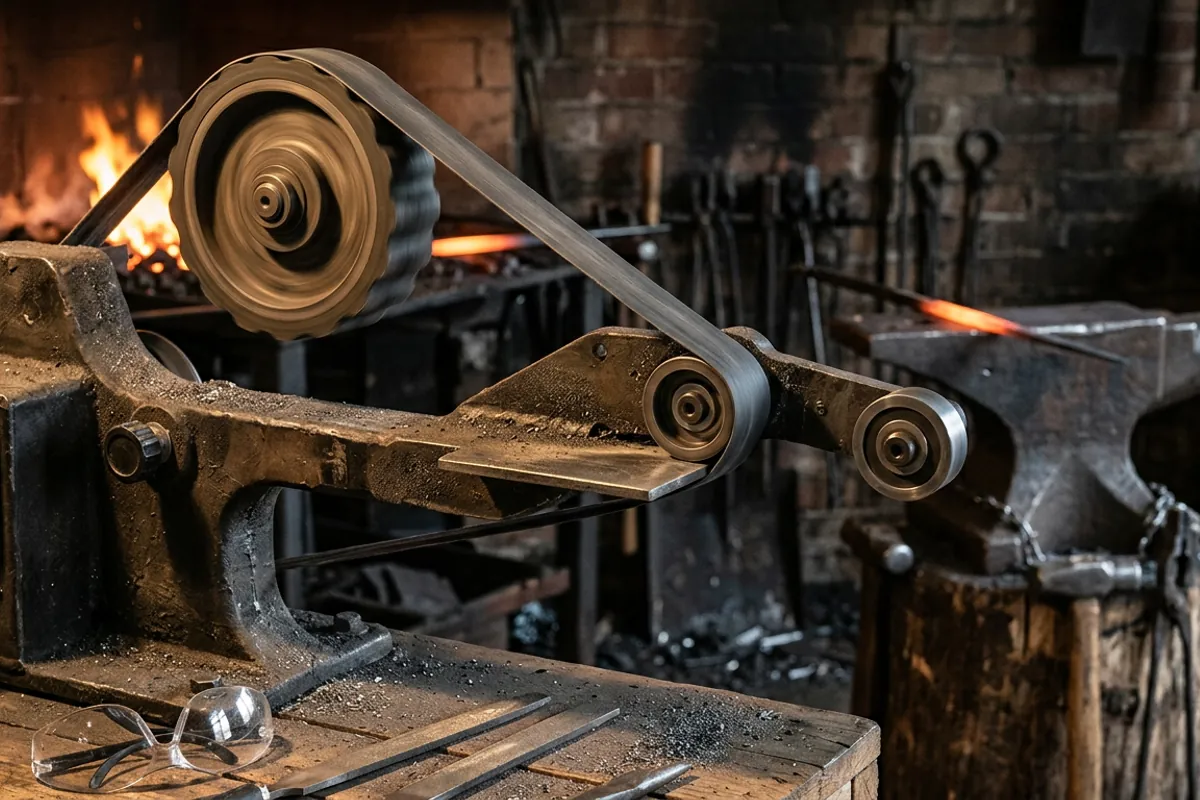
If your budget is tight and you want to make a knife this month, a 1x30 belt sander is the honest entry. The WEN 6515T runs a 1 x 30 inch belt and a 5 inch disc off a 2.3 amp motor, with belt speed up to 3160 feet per minute, per WEN's own spec page (WEN 6515T). 1x30 belts are cheap and sold everywhere, which lowers the cost of learning to grind, and learning to grind is most of the game early on.
The limits are real and you should hear them before you buy. The platen is small and the motor is small, so you cannot hog metal fast, and you should not run belts coarser than about 60 grit on a machine this size or you will bog and stall it. Wide blades are a fight because the working surface is narrow. It is a starter, and a good one, but nobody grows old on a 1x30. For a deeper look at the small-belt machines and how far they take you, I wrote that up in the knife makers belt sander guide.
Check price on Amazon (paid link)
The 4x36 combo: more platen, still a starter
The other budget road is a belt and disc combo. The WEN 6502T pairs a 4 x 36 inch belt with a 6 inch disc on a 4.3 amp motor and a cast iron base, and the belt table tilts 0 to 90 degrees (WEN 6502T). The wider 4 inch belt gives you more platen to lay a bevel against than a 1x30 does, and the disc is genuinely useful for flattening and squaring.
Where it bites you is belt selection and geometry. 4x36 belts come in fewer grits and materials than 2x72, and the belt runs horizontally over a fixed platen, which is not the friendliest setup for freehand bevel grinding. Plenty of makers started here and made good knives. It is a woodworking sander pressed into knife service, and it does that job about as well as the 1x30, with the disc as a bonus. If you already own one, use it. I would not buy one specifically to make knives when the same money moves you toward a 2x72.
Check price on Amazon (paid link)
The import 2x72: real capability, real caveats
This is where it gets interesting, and where you have to keep your eyes open. There is a wave of import 2x72 machines on the marketplace now, and the HayWHNKN 2x72 is a representative one: a 2 inch by 72 inch belt grinder with a VFD for variable speed, an advertised 1500 watt (about 2 HP) motor, and three grinding wheels in the box. On paper that is a real knifemakers grinder for a fraction of what a US-made frame costs.
The caveats are not paper. First, and this catches people out constantly, these machines are 220 volt. If your shop only has standard 120 volt outlets, you are not plugging this in on day one, you are running a dedicated 240 volt circuit or a transformer first (the knife forums are full of exactly this problem, for example this BladeForums thread on a 220V 2x72). Second, fit and finish is a lottery. Owners report tracking that needs fettling, wheels that want truing, and work rests you will end up replacing. None of that is fatal, and a handy person fixes it in an evening, but a first-time buyer expecting plug-and-play is going to be surprised.
Bought with clear eyes, an import 2x72 is a lot of capability for the money, and it runs the same belts and takes the same style of tooling as the expensive machines. Bought blind, it is a 220 volt paperweight sitting next to a 120 volt outlet. I go deeper on the whole 2x72 decision in my 2x72 belt grinder for knife making guide.
Check price on Amazon (paid link)
The buy-once 2x72: US-made KMG class
I am not going to hang an affiliate link on a machine I am telling you to save two years for, but you should know what the top of the field looks like so you know what you are aiming at. A US-made 2x72 in the KMG class, from Beaumont, Reeder, and the like, is the machine that gets handed down. These are 2 inch by 72 inch grinders, commonly 1.5 to 2 HP, usually variable speed, built from thick steel with quick-change tooling and wheels trued true. Beaumont does not splash every number on the packages page, so I will not invent horsepower and speed figures for a specific model here, but the class is well understood.
The reason to want one is not bragging rights, it is that it disappears under your hands. Good tracking, a rigid frame, and a motor that does not care how hard you lean on it means the machine stops being the variable in your grinding and your hands become the only variable. That is worth a great deal once you are past the first dozen blades. It is also why the ladder of cheap machines is a false economy, which the owners will tell you themselves.
What owners say
I have not run down every one of these in my own shop, so here is what the people who own them report, attributed to the threads I actually read.
On the 1x30 as a starter, the consensus on BladeForums is consistent: it will get you going, it is far faster and easier than files, and it is cheap enough that it is not wasted money, but it is underpowered and you should not run coarse belts on it. Several makers keep their old 1x30 around for handle work long after they move up, which tells you it is a real tool, just a limited one.
On the small-machine ladder, an experienced smith on KnifeDogs put the cost trap plainly: by the time you buy a 1x30, then a 1x42, then a 4x48, then a 2x48, and finally a 2x72, you could have paid for half the 2x72 with the money you burned on the machines you outgrew. That is the single most repeated piece of advice in these threads, and it matches what I see with the beginners I teach.
On the import 2x72 machines, the owner signal is more mixed and, frankly, thinner and noisier than for the established US brands. The recurring themes are the 220 volt supply catching buyers off guard and the fit-and-finish tasks I mentioned: tracking, wheels, and work rests. When they are set up right they grind knives, and plenty of hobby shops run them happily. Just do not read the price and assume the polish of a KMG comes with it.
Safety at the grinder
I will not soften this part, because a grinder hurts people in ways a forge does not. A belt spinning at a few thousand feet per minute grabs anything loose and does not let go.
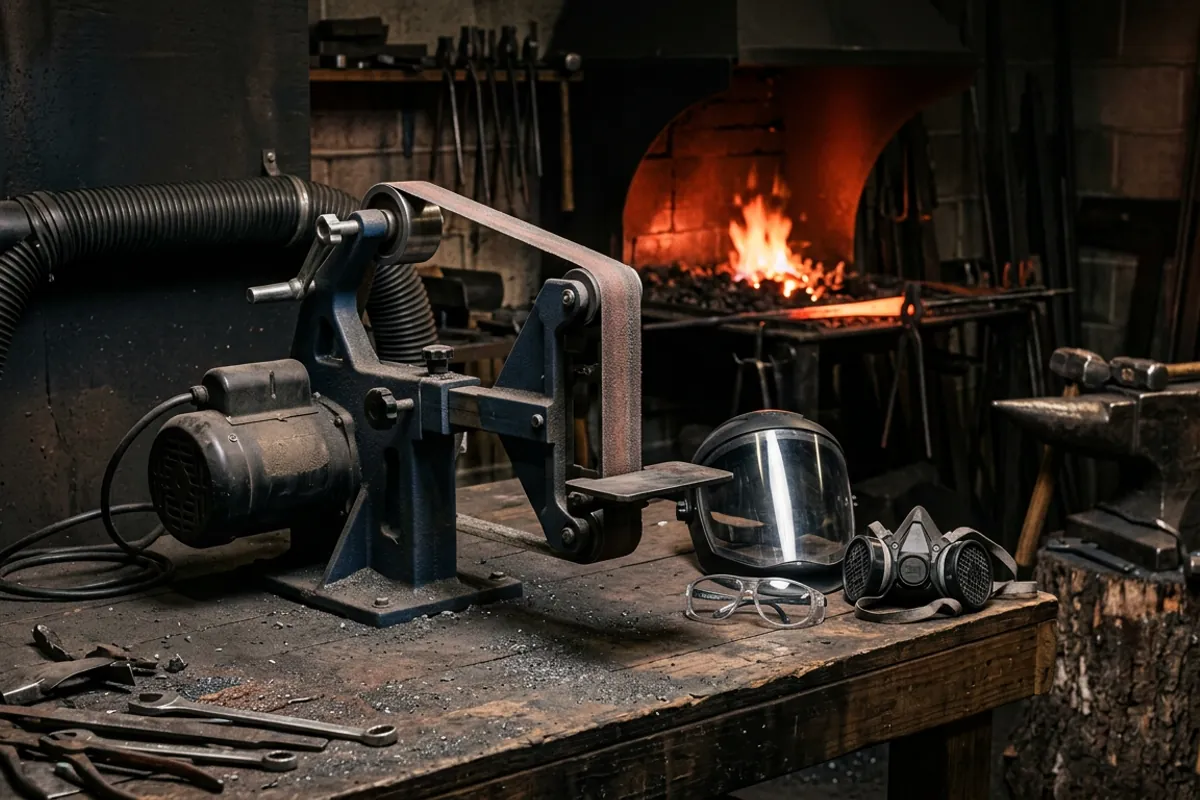
Eyes first. Wear impact-rated safety glasses rated to ANSI Z87.1, and a full face shield over them when you are hogging bevels and throwing sparks. A grit particle or a snapped belt does not give you a second chance. This is the same reason I harp on eye protection at the forge, and it is not optional here either.
Then your lungs. Dry grinding steel, and especially grinding the abrasive off a worn belt, throws fine metal and grit dust that you do not want in your lungs. Grind with dust collection or a fan pulling it away from your face, and wear a proper respirator, not a paper nuisance mask, when the dust is up. If you grind stainless, take the dust more seriously, not less.
Then everything that can get caught. No gloves that can be dragged in, no loose sleeves, no dangling drawstrings, long hair tied back and out. Natural fiber clothing, because a spark shower will melt a synthetic shirt to your skin. And respect the fire risk: steel and grinding dust is a spark source, so do not grind next to your open oil quench or a pile of rags. I laid the whole shop kit out in the blacksmith safety gear guide, and none of it matters more than the eye and lung protection at the grinder.
What I would tell a friend
Short version, the way I would say it across the bench. If you can swing it, a 2x72 is the knifemakers grinder to own, and the US-made KMG-class machines are the buy-once answer if the budget stretches. If it does not stretch that far but you have a 240 volt circuit and a little patience for setup, an import 2x72 like the HayWHNKN gets you onto the right platform for real money less. If you are broke and itching to make a knife this month, buy the WEN 6515T 1x30, learn to grind on cheap belts, and put every spare dollar toward the 2x72 instead of the next slightly bigger small machine. The one thing I would not do is climb the whole ladder of cheap grinders, because that is the most expensive way to end up exactly where you were always headed.
And whatever you buy, put the face shield and the respirator on before the belt, every time. The grinder is the tool in the shop most likely to send you to the emergency room, and it does it fast.