content/blog/good-belt-grinder-for-knife-making.md and the others are unrelated. Here's the article.
I have everything verified. Writing the article now.
There is a moment in every knife maker's shop where the tendinitis in your elbow starts making buying decisions for you, and that is usually when the phrase knife forging power hammer stops being a fantasy and becomes a real line item. If you forge much high-carbon or stainless stock, or you have any interest in damascus, a power hammer is the single tool that changes what a one-person shop can produce. If I were spending the money today and I wanted a machine that would draw out blade stock, flatten billets, and still let me feel what I am doing, I would look hard at a self-contained Anyang in the 25 kg to 40 kg class, or an Iron Kiss if I already owned a real air compressor. I do not own any of these, and I want to be straight about that up front: I run Bessie and a hand hammer, so what follows leans on published specs from the makers and dealers, plus what owners actually report on the forums, weighed against twenty-five years of watching hot steel move under a hammer.
Do you actually need a power hammer to forge knives?
Honest answer first, because a lot of people buy a hammer to solve a problem a hammer does not solve. You do not need a power hammer to forge a knife. Every blade I have ever made came off Bessie under a hand hammer, and a competent smith can forge a clean bevel by hand all day. What a power hammer buys you is volume and stamina. Drawing out a long, thin blade blank, packing a stack of damascus down into a solid billet, forging a distal taper, spreading a bolster, these are the jobs that wreck your elbow when you do twenty of them a week. The machine does the heavy repetitive blows so your body does the fine ones.
So the real question is not "will this make me a better knife maker." It will not. It will let you make more knives without destroying your arm, and it will make damascus and thick stock realistic in a home shop. If you forge a knife a month for fun, save the four to ten thousand dollars and put it into a 2x72 belt grinder for knife making and steel. If you are forging to sell, or you are chasing pattern-welded work, the hammer earns its footprint fast. For the broader case on choosing a machine for a small shop, I already laid out my thinking in the forging power hammer buying guide, and the knife-specific angle sits inside the larger knife making topic hub.
How I would size a knife forging power hammer
The number everyone fixates on is ram weight, and for blade work the useful truth is that you need less than you think. A 25 lb to 50 lb ram class hammer will forge any knife-sized stock you are ever going to hold in tongs. Where big rams matter is heavy industrial drawing, spreading four inch square stock, that kind of thing, which is not knife work. The Anyang self-contained machines are rated by their ram in kilograms, so a 25 kg hammer is a 55 lb ram and a 40 kg is an 88 lb ram, and either one is honestly more hammer than a bladesmith strictly needs.
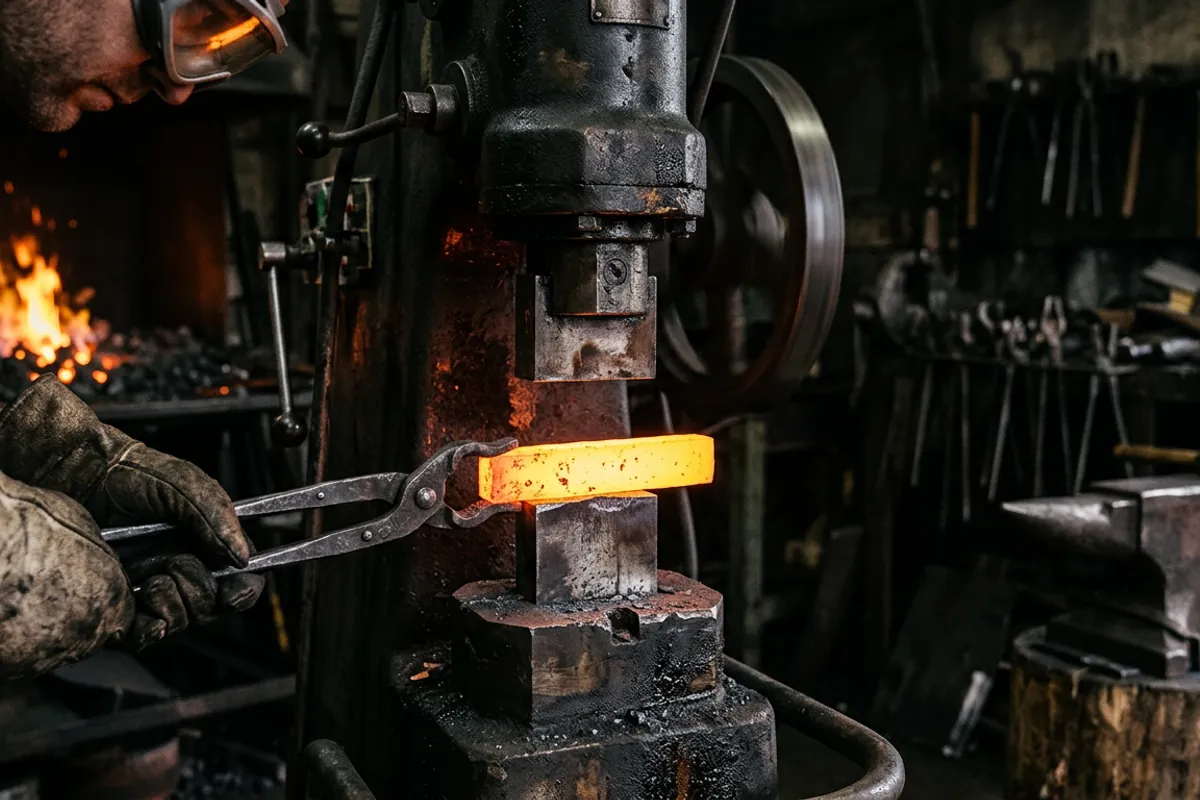
What matters more than raw mass for knives is control at the low end. You spend a lot of blade forging feathering the pedal, laying down soft taps to set a bevel or nudge a tip straight, and a hammer that only knows how to hit hard is a hammer that flattens your work. This is the single biggest reason experienced makers push you toward the better-controlled machines. A hammer you can creep down onto cold steel and just kiss it is worth more to a knife maker than fifty extra pounds of ram you will never use. If the choice is really between forging fast and forging precisely, a lot of blade smiths eventually add a blacksmith hydraulic press for the squeeze work and keep the hammer for drawing out.
The field at a glance
These are published maker and dealer specs, cited below, not my bench numbers. I have never had these machines on my floor.
Scroll horizontally to see all columns.
| Hammer | Ram weight | Blows per min | Drive | Power / air | Notes |
|---|---|---|---|---|---|
| Anyang ST 25 kg | 55 lb | 250 | Self-contained pneumatic | 3 kw / 4 hp motor | Forges up to 40 mm square |
| Anyang ST 40 kg | 88 lb | 245 | Self-contained pneumatic | Not published here | Forges up to 52 mm square |
| KA75 | 75 lb | 120 | Air, needs your compressor | 10 to 20 CFM at 100 PSI | Single-blow striker, 450 lb total |
| Iron Kiss 50 | 50 lb | Not published | Air, needs your compressor | 5 hp two-stage compressor | Norgren pneumatic parts |
Sources: the Anyang ST 25 figures are from Blacksmith Source, the KA75 figures from Coal Iron Works, and the Iron Kiss detail from a BladeForums owner thread. Where a maker does not publish a figure, I left it as not published rather than guessing.
The Anyang ST 25, the self-contained starting point
If I wanted one machine that plugs into the wall and hits without a separate air system taking up half the shop, the self-contained Anyang is the obvious starting point. Blacksmith Source lists the ST 25 kg at a 55 lb ram, 250 blows per minute, a 3 kw / 4 hp motor, and the ability to forge up to 40 mm square stock, which is far more than any blade needs. The appeal of self-contained is simple: no compressor, no big air tank, no separate machine to maintain, just electric service and a foundation. For a home shop where floor space and noise are already fights you are losing, that matters.
The tradeoff is cost and the internal design. Blacksmith Source lists the ST 25 at $9,950 for three-phase service and $10,950 for single-phase with a variable frequency drive, so this is not a cheap door to walk through, and single-phase homes pay the VFD tax. Self-contained hammers also run hotter and have more seals doing hard work than a simple air hammer does, which shows up in the owner reports below. I dug into the brand specifics in the Anyang power hammer buying guide if you want the model-by-model read. For blades, the 25 kg is plenty and the 40 kg is a luxury.
The KA75, the single-blow air striker
The KA75 is a different animal, and worth understanding before you assume all power hammers work the same. Coal Iron Works lists it at a 75 lb ram, 120 blows per minute, 450 lb total weight, a 10 inch stroke, and an air demand of 10 to 20 CFM at 100 PSI, which means you supply the air from your own compressor. It is described as a single-blow striking hammer, and that word single matters: owners note you stomp the pedal for each blow rather than holding it down for a continuous run of hits. That sounds like a downside until you have tried to set a precise bevel, at which point one deliberate blow at a time is exactly what you want.
Where the KA75 shines for a knife maker is that deliberate control and its very low air appetite for a production hammer, which is why smiths in tight shops keep coming back to it. Coal Iron lists it at $4,750, which puts it well under the self-contained Anyangs, though you have to add a real compressor and tank to that number. The BladeForums crowd is split on it: some call it too small, others say it hits like a 50 lb Little Giant and does everything a home bladesmith asks. For blade work specifically, its control is a genuine argument. If you like the striker concept but want to understand the whole category, the blacksmith power forging hammer guide covers the mechanics.
The Iron Kiss 50 and the Say-Mak, the control kings
If money were no object and I already owned a two-stage compressor, this is the tier I would want. On BladeForums, bladesmiths describe the Iron Kiss 50 as tight and orderly with no rattles, praise its square, straight dies for final sizing and damascus finishing, and note it uses standard Norgren pneumatic components so repairs do not depend on one importer staying in business. The 50 lb model is listed around $3,800, which owners point out is competitively priced by machine weight. The catch, and every honest owner says this, is the compressor: an Iron Kiss wants a 5 hp two-stage compressor running a full duty cycle, and that machine is not free, not quiet, and not small.
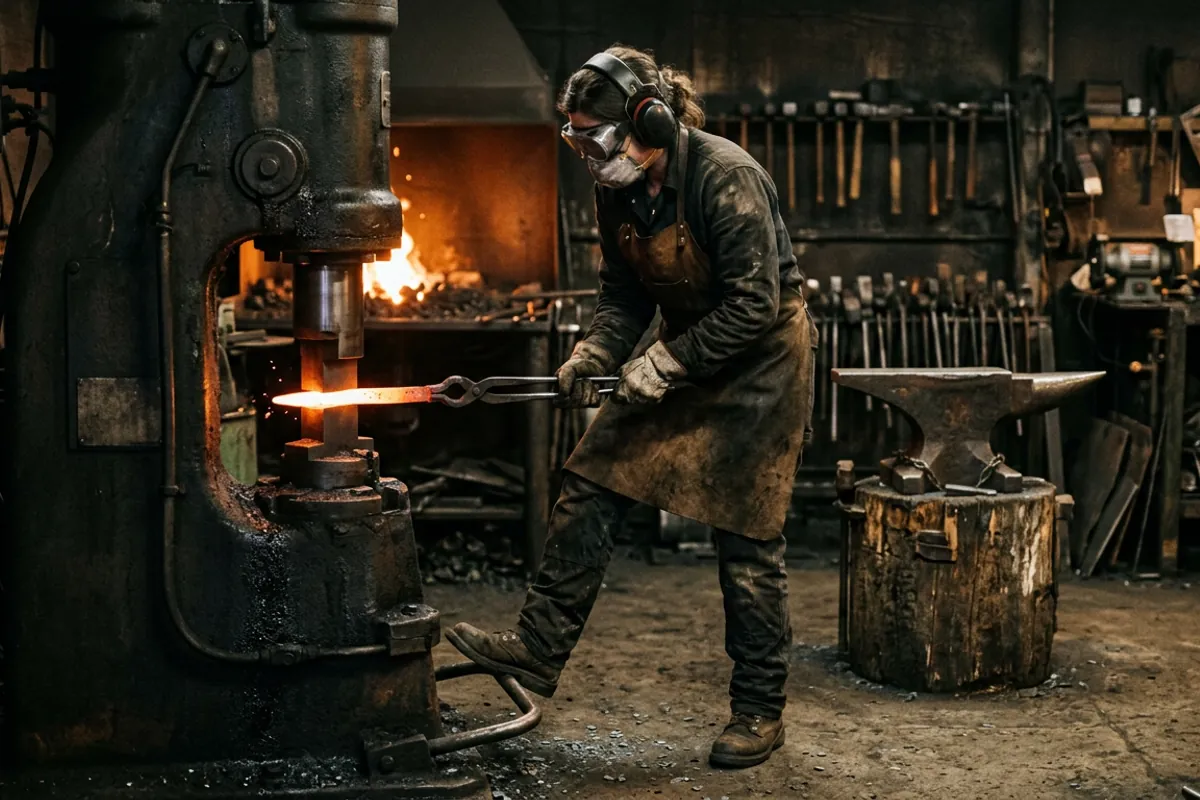
Say-Mak sits in the same conversation. One long-time smith on the forums flatly called it the Cadillac of hammers, and that reputation for smooth control is consistent across threads. These are the machines you buy when precision is the whole point, which for a serious bladesmith it often is. You are trading the plug-and-play simplicity of a self-contained Anyang for finer control and a compressor bill. There is no wrong answer here, only which compromise you would rather live with.
What owners say
I have not run these machines, so this section is forum consensus, attributed, not my testing.
On the Anyang, the most useful warning comes from a BladeForums owner thread where an owner reported the front of the hammer, near the front piston, getting hot enough to burn you after heavy use, and others mentioned replacing front seals roughly every six months under hard duty. The same thread notes parts availability improved once the machines had a responsive US representative. None of that is a dealbreaker, but it tells you a self-contained hammer is a machine you maintain, not a set-and-forget appliance.
On the KA75, the I Forge Iron discussions run the full range from "too small" to "hits harder than a 25 lb Little Giant," with the recurring practical note that it is a single-blow machine you pedal one hit at a time. On the Iron Kiss and Say-Mak, the consensus is strongly positive on control and build, with the one repeated complaint being the compressor dependency and the space, cost, and noise it adds. That is real signal: the self-contained Anyang and the air-driven Iron Kiss are solving the same forging problem with opposite compromises.
The gear you buy before and around the hammer
Here is where I get blunt, because a power hammer changes your shop's hazard profile the day it arrives. A hammer running at 120 to 250 blows per minute is loud in a way a hand hammer is not, and hearing damage is cumulative and permanent. I run over-the-ear protection any time a machine is going, and something like the 3M Peltor X5A earmuffs (paid link), rated at NRR 31, is the kind of muff that actually gets worn because it works. Cheap muffs live on the bench. Good ones live on your head.
Eye protection is not optional either, and it never was. Hot scale flies off a power hammer harder and faster than off your hand blows, and it comes off at pedal-controlled speed whether you are ready or not. A sealed goggle rated to ANSI Z87.1, like the DEWALT DPG82-11 goggle (paid link), keeps scale out from the sides where safety glasses let it in. I learned the eye-protection lesson the hard way years ago with a quench-oil flare that took my eyebrows and nearly my eyesight, and I have never treated PPE as negotiable since. There is more on the full kit in my blacksmith safety gear rundown.
And if you have read this far and quietly realized you are not ready to spend four to ten thousand dollars, that is the right conclusion for most people. Buy a good hand hammer, forge a hundred blades, and let your hands earn the machine. A solid, well-balanced striking hammer like the Estwing Sure Strike 40 oz (paid link) will forge every knife you can dream up, and it will teach you what a power hammer should feel like before you own one. You will also still need a good anvil under all of it, which I cover in the knife forging anvil buying guide.
What I would tell a friend
Short version, the way I would say it across the bench. If you want one machine that plugs in and just works, buy a self-contained Anyang in the 25 kg class and accept that you will maintain the seals. If you already own a real two-stage compressor and precision is your priority, an Iron Kiss 50 or a Say-Mak will out-control it and cost less up front, at the price of a noisy compressor running all day. The KA75 is the honest middle for a tight shop: deliberate single-blow control, low air demand, and a price under the self-contained machines. Skip the giant rams; a bladesmith does not need 100 lb of ram, and the money is better spent on control and a good grinder.
The one thing I would not let you skip is the protection. A power hammer is the loudest, fastest, most unforgiving tool most home shops will ever own, and the muffs and the goggles are the cheapest line on the whole invoice. Buy the hammer that fits your shop and your compressor situation, not the biggest one you can finance, and wear the gear every single time the pedal goes down.