Everything verified. Writing the article now.
The forge I would put in a beginner knife maker's shop is a single-burner propane forge, and for most people getting into knife making a propane forge is the right first heat source, not a coal fire. It lights in seconds, holds an even heat you can actually control, and costs less to feed for a day of blade work than you would think. I run both fuels in my own shop, a coal forge for heavy stock and a propane forge for most of the day-to-day, and when a new smith at the weekend class asks what to buy for knives, I point them at gas nearly every time.
Before we go further, the honest framing: I have not run every one of these units down on my own bench. Bessie, my 148 lb Trenton, has seen thousands of blades come off gas heat, so I can speak to what a knife maker actually needs from a forge. But the specific model picks below lean on published maker specs and owner reports from the forums, weighed against that shop experience, not a controlled test of each box. Where the owner signal is thin, I say so.
What a propane forge actually does for knife work
A knife making propane forge does two jobs. It brings your bar up to forging heat, roughly a bright orange to yellow, so you can move steel with a hammer. And, for the simple carbon steels most beginners start on, it can bring a blade up to austenitizing temperature so you can quench and harden it. That second job is where people get into trouble, because a forge is not a temperature-controlled oven.
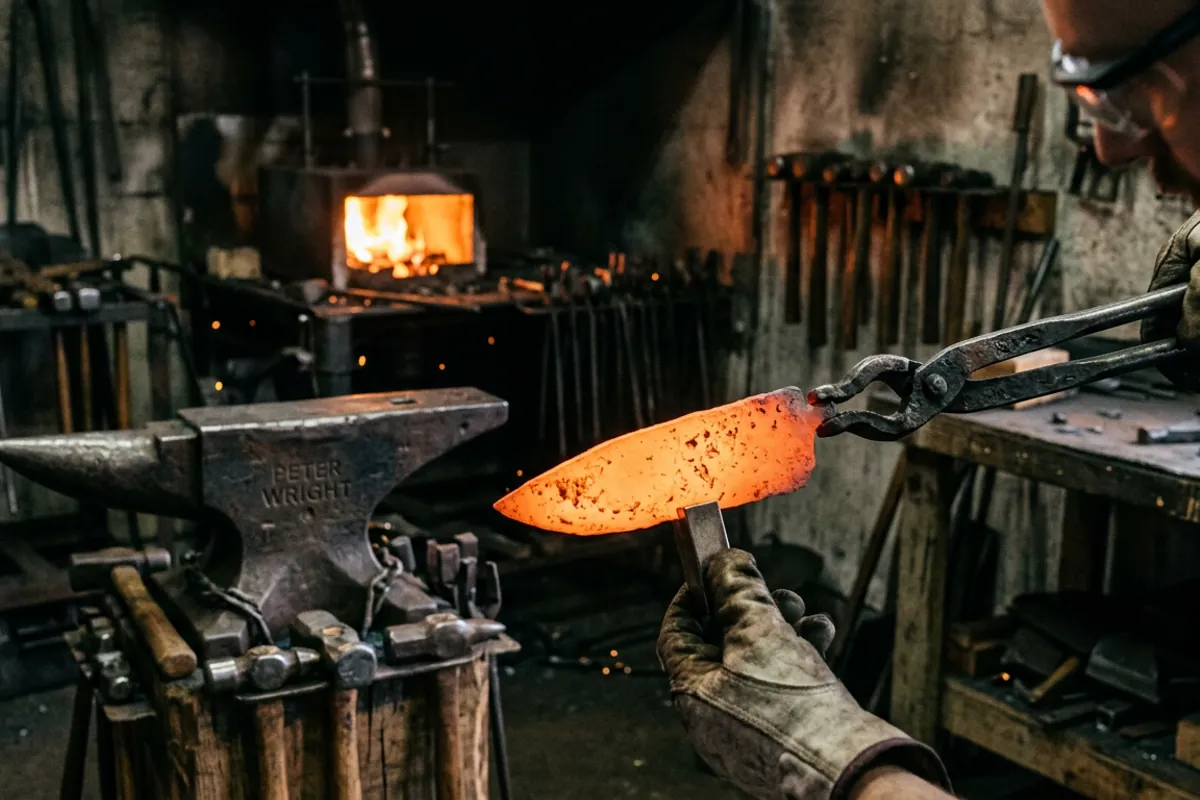
Larrin Thomas at Knife Steel Nerds is blunt about this in his write-up on heat treating knife steel in a forge: a forge has hot and cold spots and no thermostat, so you are judging heat by eye and by a magnet rather than by a dial. That works fine for low-alloy steels like 1084 and 80CrV2 if you are careful. It does not work for stainless or high-alloy steels that need a soak at a tight temperature. If you plan to run those, budget for a heat-treat oven later and read heat treatment of metals explained before you spend. The forge is for forging and for hardening simple steel, and it is very good at both.
The propane knife making forge also spares you the mess and the learning curve of solid fuel. No fire to tend, no clinker, no coal smoke to explain to the neighbors. If you are still deciding between fuels at all, I laid out the whole argument in coal or propane, which first forge makes sense. For knives specifically, gas wins for most home shops.
One safety note before any of the picks, and I do not soften this one. Propane forges run in a shop and they produce carbon monoxide. Ventilate, always, a cracked door and airflow at a minimum. Wear ANSI Z87.1 rated eye protection, keep natural fibers on your body near the heat rather than synthetics that melt to skin, and keep the forge clear of anything that burns. I lost my eyebrows early on to a quench-oil flare-up standing too close in a cotton shirt with no face shield, and I got lucky keeping my eyesight. The forge deserves the same respect.
The forges I would look at first
Here is the field at a glance. These are maker-published or maker-rated figures where the maker states them, and I have noted where a number is a marketing rating rather than something checkable. Temperature ratings on cheap forges in particular are optimistic ceilings, not what you will hold all day.
Scroll horizontally to see all columns.
| Forge | Burners | Maker temp rating | Chamber / notes | Price tier |
|---|---|---|---|---|
| Hell's Forge single (HF1) | 1 | 2300 F | Oval chamber, 1 in ceramic blanket | Budget to mid |
| Hell's Forge MAX double | 2 | 2300 F | ~100,000 BTU, 0 to 30 psi regulator | Mid |
| Simond Store single burner | 1 | 2600 F | Rectangle, brick door | Budget |
| Devil-Forge DFPROF3 | up to 3 | 2500 F | Interior 5.8 x 5.8 x 24 in, 240,000 BTU | Mid to premium |
A few things to read from that table. Burner count is not a quality score, it is a size and fuel decision. More burners heat a bigger chamber faster and let you run longer blades, but they eat propane and they are overkill for a first knife. The temperature ratings all clear what carbon-steel blade work needs, so do not chase the biggest number. And chamber size matters more than most beginners expect: a chamber that is a little too big wastes gas heating empty space, and one that is too small limits your blade length.
Hell's Forge single burner
This is the one I would hand a beginner who is sure they want to make knives and nothing much bigger. The single-burner Hell's Forge, the HF1, is a made-in-USA unit with an oval chamber, a full-size firebrick floor, and a 1 inch ceramic fiber blanket, and it is rated to reach around 2300 F. The oval shape puts your blade in the flame's sweet spot without a lot of wasted volume, which is exactly what you want for hunting and kitchen blades.
The single burner is enough for the vast majority of beginner knife work. You can forge a bar, normalize it, and harden simple carbon steel in it without a second thought. Its limit is length and mass: a long chef's knife or a chunk of thick stock will heat unevenly because you are working part of the blade outside the hot zone and sliding it through. For a first forge and a first year of knives, that limit rarely bites.
The honest tradeoff is that any single-chamber gas forge is loud and that flux will eat the ceramic blanket if you get sloppy during forge welding. Keep flux off the lining and it lasts. Check price on Amazon (paid link)
Hell's Forge MAX double burner
Step up to the MAX double burner when you know you want to make longer blades, do some general blacksmithing, or eventually try forge welding a billet for pattern-welded steel. It runs two burners firing into a larger chamber, uses an upgraded 0 to 30 psi regulator, and by the maker's own numbers generates up to about 100,000 BTU. That extra capacity is the point: more even heat across a longer piece, and enough reserve to hit welding heat when a single burner would struggle.
The cost of that capacity is propane and money. Two burners burn noticeably more gas, and you are paying for a bigger box you may not fill for a while. There is also a design quirk worth knowing that comes up constantly in owner discussion, which I will get to below: the burners fire straight down rather than at an angle, and some knife makers prefer an angled burner that swirls the flame for more even blade heat.
If you can only buy once and you already know knives are a keeper hobby that will grow into general smithing, this is the more future-proof buy. If you just want to make a few knives and see if the hobby sticks, it is more forge than you need. Check price on Amazon (paid link)
Simond Store single burner
The Simond Store single-burner forge is the budget entry that keeps coming up when a beginner wants gas heat for the least money. It is a rectangular steel forge with a brick door and a maker rating of 2600 F. The rectangular chamber and the removable brick door make it easy to run longer stock through and to close down the opening to hold heat, which is a genuinely useful feature on a small forge.
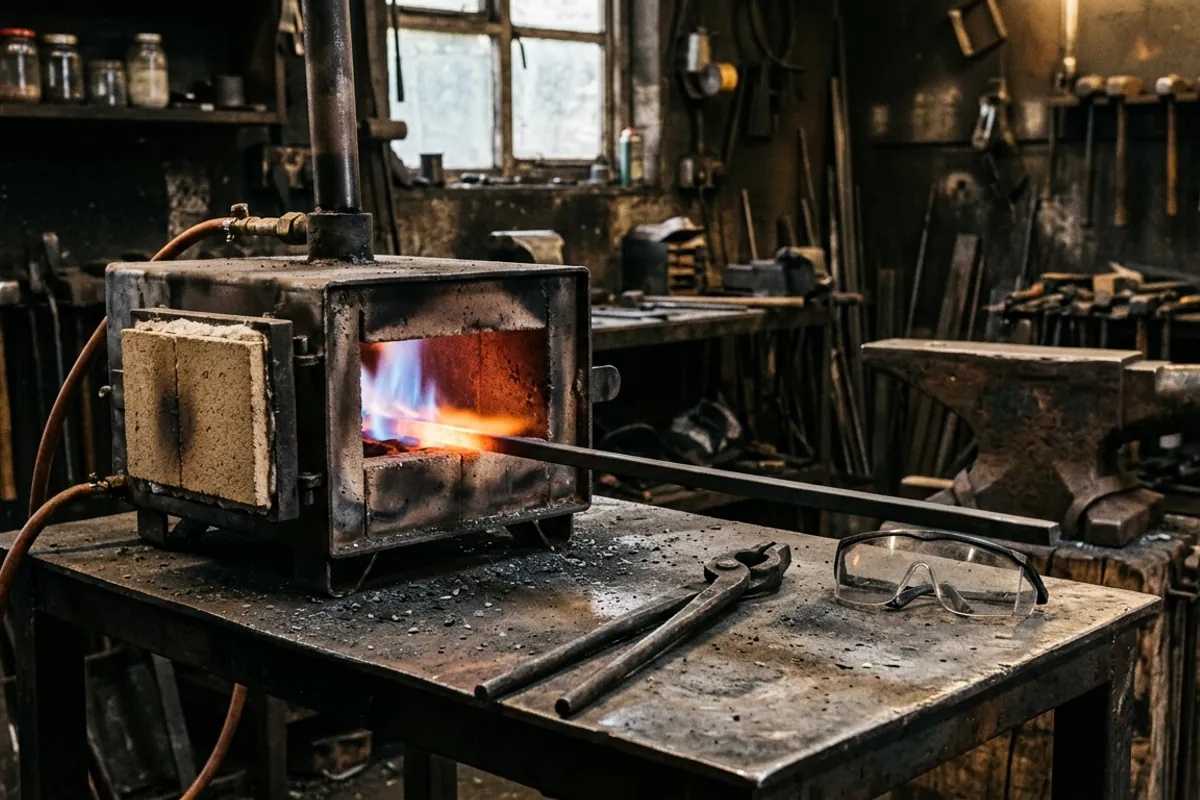
Treat the 2600 F number as a ceiling the burner can reach under good conditions, not a temperature you casually hold. That is true of every forge in this class, not a knock on this one specifically. What you are buying at this price is a functional, insulated chamber and a burner that will get carbon steel to forging and hardening heat. What you are not buying is the fit and finish or the support of a higher-priced unit.
Owner signal on the Simond forges is real but mixed, which I will cover in the owner section rather than dress up here. For a first forge on a tight budget, it is a reasonable place to start, and if the hobby takes you can upgrade the burner or the forge later without much lost. Check price on Amazon (paid link)
Devil-Forge DFPROF3
The Devil-Forge DFPROF3 is the most forge on this list, and for most beginners it is more than they need. It is a three-burner unit where the maker says you can run one, two, or three burners depending on the job, with a stated 240,000 BTU across all three, a long interior of roughly 5.8 by 5.8 by 24 inches, and a 2500 F rating. That long chamber is the appeal for anyone making full-length blades or doing serious smithing, and the ability to shut off burners you are not using is a smart touch for saving gas on small work.
The reason I list it last for beginners is exactly that capacity. A 24 inch chamber with three burners is a lot of forge to feed and a lot of forge to heat up when all you want to do is forge a paring knife. Where it earns its keep is a shop that has decided knife making is a long-term pursuit and wants one forge that will not need replacing when the projects get bigger. Ball valves on each burner and an air choke give you real control over the flame, which matters as your work gets more demanding.
If you are torn between this and a simpler forge, the general propane forge picks in the propane forge I would put in a home shop may help you place it against the rest of the market. Check price on Amazon (paid link)
What owners say
Because I have not benched each of these, here is what the forums actually report, product by product, with the thin spots called out honestly.
On burner count, the recurring consensus in the I Forge Iron thread Forge Burners 1, 2, or 3 is that beginners routinely overbuy. Experienced smiths there repeatedly tell newcomers a single well-tuned burner does far more than people expect, and that a bigger multi-burner forge just wastes propane on small work. That matches what I see: a first knife does not need three burners.
On Hell's Forge specifically, the common report is that it is a solidly built starter forge that reaches welding heat and holds temperature well, with two consistent complaints. One is noise, which is true of nearly all venturi forges. The other, raised in an owner review of the Hell's Forge double burner, is that the vertically firing burners are not every knife maker's preference and that flux will damage the ceramic blanket if you are careless welding. Neither is a dealbreaker, but both are worth knowing before you buy.
On the budget Simond and Devil-Forge units, owner signal is thinner and more mixed. Discussions like the KnifeDogs gas forge thread show plenty of makers running import forges happily, alongside reports of burners that need tuning out of the box and refractory that benefits from an added rigidizer and coating. Take the printed temperature ratings on the cheapest units with a grain of salt. They are ceilings under ideal conditions, not held working temperatures.
One cross-cutting point from the metallurgy side is worth repeating. Knife Steel Nerds' comparison of factory versus custom heat treating shows how much toughness you can lose by overheating steel without temperature control. That is not an argument against a forge, it is an argument for learning to read heat by color and magnet, and for sending demanding steels to a controlled oven. Your forge choice does not fix that. Your technique does.
What I would tell a friend
Buy the single burner. For a first knife making propane forge, the Hell's Forge single burner or a budget Simond single burner will forge and harden simple carbon steel all day, cost the least to feed, and teach you everything you need before you know whether you even want a bigger box. Step up to the Hell's Forge MAX double or the Devil-Forge DFPROF3 only when you already know you want longer blades or general smithing, not on the theory that more burners is more better.
The one to skip is whatever forge you buy because the temperature number was the biggest. Those ratings are ceilings, and the forge is only half of a good blade anyway. Spend the saved money on a decent belt grinder and on real eye protection instead.
And the safety note that matters most, because it is the one that hurts people: ventilate for carbon monoxide, every session, no exceptions, and wear Z87.1 eye protection at the forge and the grinder both. If you are brand new to the whole process, start with knife making explained from the first bar of steel and the rest of the knife making topic hub. The forge is the easy part. Learning to use it well is the hobby.