Verified my ASINs and specs. Writing the article now.
I have three live-verified Amazon products (WEN 6515T B07KL4BQF5, WEN 6502T B07KL4QGSQ, Happybuy 2x82 B07KF3SRMB) plus the Grizzly T32459Z for a non-marketplace citation. The curated VEVOR refs are both anvils, so none genuinely belongs in a belt-sander guide; I'm leaving the placeholder out.
If you want a belt sander for knife making, here is the short version before the detail: for a first machine on a tight budget I would put a WEN 1x30 on the bench, and the moment you are serious about grinding blades you should skip straight to a 2x72 belt grinder instead of any of the bench sanders here. Everything below leans on published specs and what owners report on the forums, weighed against my own years at the grinder. I have run plenty of belts, but I have not personally bench-tested every one of these exact models, so I will tell you what is spec, what is my experience with the class of tool, and what is owner consensus.
That honesty matters here more than on most gear, because the phrase "best belt sander for knife making" hides a fork in the road. A cheap benchtop belt-and-disc sander and a real knife grinder are different animals with different jobs, and the wrong one wastes either your money or your time. Let me lay out the field.
What a belt sander for knife making actually has to do
Grinding a knife is stock removal plus finish. You are hogging off steel to set a bevel, then walking up through grits to a clean finish, and you are doing all of it without letting the thin edge get so hot it ruins the heat treat. That last part is the whole game. A blade edge is thin enough to turn straw-yellow in a second against a fast belt, and once you draw the temper back on an edge you already hardened, no amount of sanding fixes it.
So the traits that make a belt sander good for blades are: enough belt length to shed heat and run cool, a flat platen to grind a straight bevel against, belt speed you can keep under control, and a frame that does not walk across the bench when you lean on it. Belt length is why serious makers talk about 2x72 machines. A longer belt spreads the work and the heat over more abrasive. The bench sanders in this guide use shorter belts, which is fine for learning and for smaller work, but it is why they run hotter and why you dunk the blade in water more often.
If you want the full argument for going straight to the big machine, I made it in the 2x72 belt grinder for knife making I would actually start with. This guide is for the reader who wants a real answer on the smaller, cheaper machines first, so here they are.
The field at a glance
Published specs only. Where a maker does not state a figure, I have written "not published" rather than guessing. Prices stay qualitative on purpose, and none of these are bench-test numbers from me.
Scroll horizontally to see all columns.
| Machine | Belt size | Motor | Belt speed | Disc | Price tier |
|---|---|---|---|---|---|
| WEN 6515T | 1 x 30 in | 2.3 amp | up to 3160 FPM | 5 in, 3450 RPM | Budget |
| WEN 6502T | 4 x 36 in | 4.3 amp | not published | 6 in | Budget |
| Grizzly T32459Z | 2 x 42 in | 1 HP variable | variable, not published | none | Entry knife grinder |
| Happybuy 2Hp | 2 x 82 in | 2 HP (1.5 kW) variable | variable, not published | 12 in wheel | Mid |
Belt-speed figures for the WEN 1x30 come from WEN's own product page; the Grizzly figures come from Grizzly's listing for the T32459Z. Where I could not find a published belt-speed-in-feet-per-minute number, I left it out rather than convert a wheel RPM into a fake belt speed.
WEN 6515T: the 1x30 I would start a beginner on
The WEN 6515T is a benchtop belt-and-disc sander with a 1 by 30 inch belt and a 5 inch disc, driven by a 2.3 amp motor, with the belt running up to 3160 feet per minute. That is the machine I point new smiths at when the budget is tight and the goal is to learn to grind before spending real money.
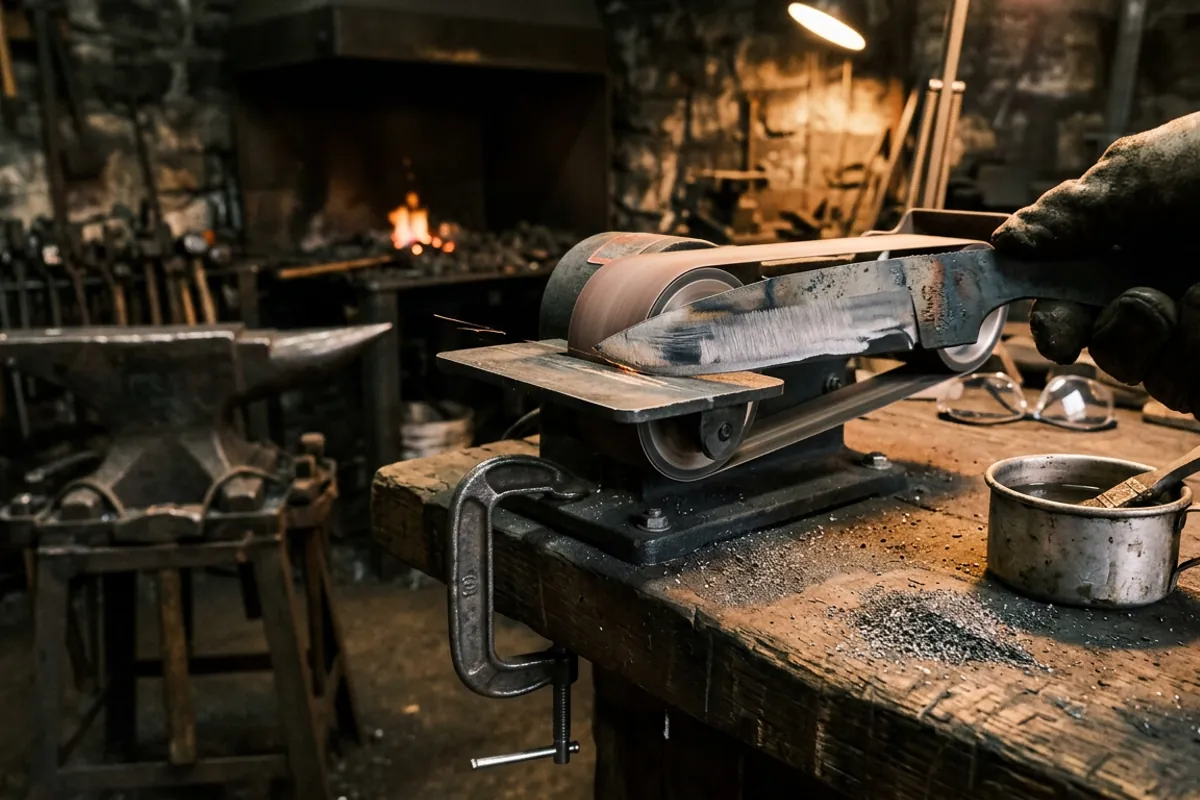
Here is the honest read. A 1x30 is a small machine. The belt is short, so it heats a blade faster than a longer belt does, and you will be quenching in a cup of water constantly to keep the edge cool. The motor is a light-duty universal motor, not an induction motor, so it bogs under a hard push and it is louder. The upside is that 1x30 belts are cheap and available everywhere in every grit, which for a beginner burning through belts while learning is a genuine advantage. You can make real knives on this. Plenty of people have. It teaches your hands the motion without a big outlay.
What I would not do is expect it to hog a full-flat-grind on a thick bar of high-carbon steel without patience. It is a starter, and it earns its keep as one.
Check price on Amazon (paid link)
For a broader look at this class of machine, I wrote up the knife makers belt sander I would buy first and the belt sander for knife making I would actually start with, which cover the same tradeoffs from a slightly different angle.
WEN 6502T: the 4x36 for more surface and disc work
The WEN 6502T runs a 4 by 36 inch belt and a 6 inch disc off a 4.3 amp motor on a cast iron base. On paper it looks like more machine than the 1x30, and in some ways it is: the wider belt gives you more surface, the cast iron base keeps it planted, and the 6 inch disc is genuinely useful for flattening and for squaring up a tang or a guard.
But wider is not automatically better for blades. A 4 inch belt is a flat-work belt. It is great for sanding a slab of wood or leveling a scale, and it will grind steel, but you cannot get into tight curves or grind a plunge line cleanly against a 4 inch flat platen the way you can against a narrow belt with an exposed contact area. Knife makers who own one tend to use it for handle work, for flattening, and for rough shaping, and reach for a narrower belt or a real grinder for the bevels.
So I would frame the 6502T not as a knife grinder but as a shop sander that also does some knife work. If your bench already needs a disc sander for general work and you want it to pull double duty on handle material and rough profiling, it makes sense. If the only reason you are buying is to grind blade bevels, the narrow-belt machines below serve that job better.
Check price on Amazon (paid link)
Grizzly T32459Z: the 2x42 built for knife makers
This is the first machine on the list that was actually designed for our work rather than adapted to it. The Grizzly T32459Z is a 2 by 42 inch belt sander driven by a variable-speed 1 HP motor on 110 volts, and Grizzly built in the features knife makers actually ask for. The sanding frame pivots 90 degrees so you can bring the tip, edge, heel, and tang to the belt at a workable angle. The tool rest swivels, moves in and out, and tilts. The platen is graphite-coated to cut friction and heat, and it takes 2 by 48 inch belts as well as 2 by 42.
The two things that matter most here are the variable speed and the 1 HP induction-class motor. Variable speed is not a luxury on a knife grinder, it is the difference between grinding and burning. Being able to slow the belt down lets you finish and refine near a hardened edge without cooking the temper, which is exactly where the cheap fixed-speed 1x30 fights you. A 2x42 belt is also longer than a 1x30, so it runs cooler, and 2 inch belts open up a much wider selection of knife-specific abrasives than 1 inch belts do.
The tradeoff is that 2x42 belts, while common, are not as universally stocked as 1x30, and this is still a bench machine, not a full 2x72 with interchangeable contact wheels and attachments. It is discontinued and re-released in a couple of versions over the years, so check that the listing you are looking at is the current T32459Z. Grizzly lists a one-year factory warranty. For a beginner who knows they are serious and wants a purpose-built knife sander without jumping to full 2x72 money, this is the one I would look at hardest.
Grizzly sells the T32459Z direct rather than through Amazon, so I am not dropping an affiliate link on it. Buy it from Grizzly or a tool retailer that carries it.
Happybuy 2Hp 2x82: the cheapest way into a real grinder
If you have decided you want a genuine grinder and cannot stretch to a name-brand 2x72, the import 2x82 machines are the budget door in. The Happybuy 2Hp is a 2 by 82 inch variable-speed belt grinder with a 2 HP (1.5 kW) motor, a 12 inch contact wheel, and a flat platen, sold specifically for knife making.
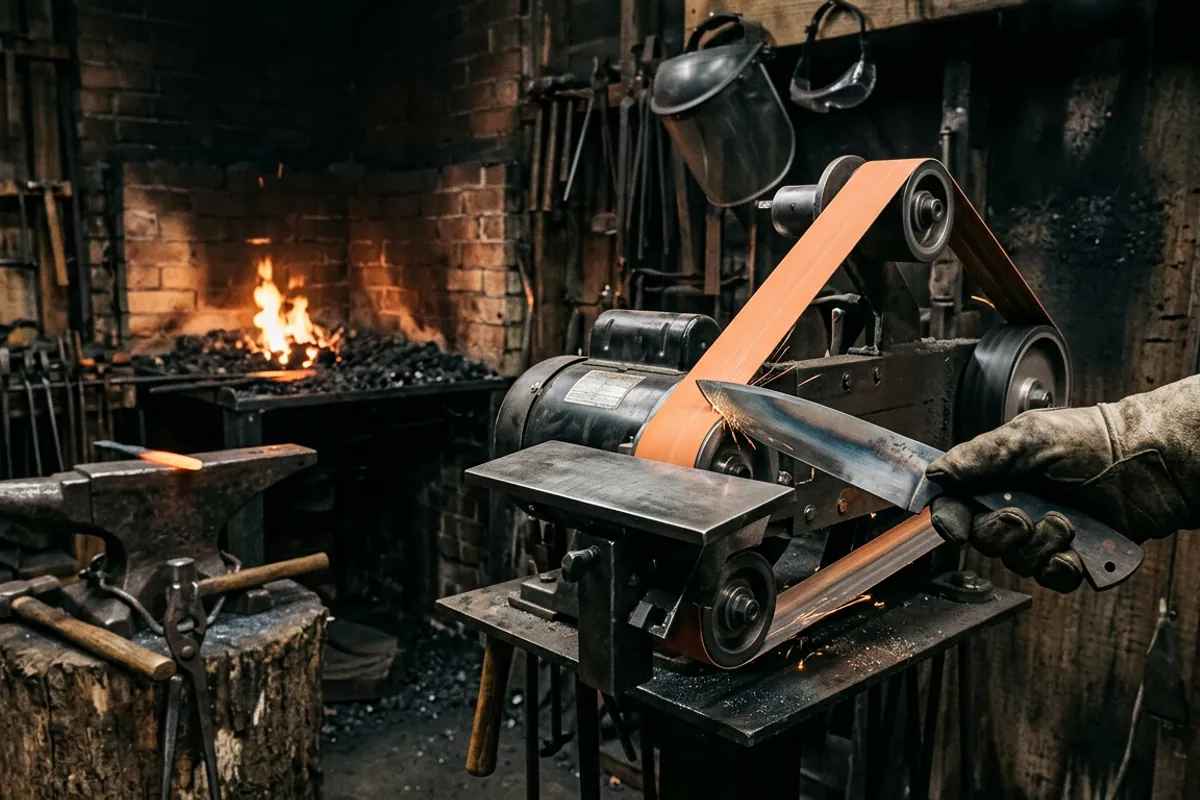
This is a lot of machine for the money, and that is exactly why you should go in with clear eyes. The forums are full of both camps. People who tune these machines up love them: real power, a long belt that runs cool, variable speed, and the ability to grind full bevels the way you cannot on a 1x30. The complaints are consistent too, and they are about quality control rather than the concept: tracking that needs adjustment out of the box, contact wheels or platens that are not dead flat, wiring you should inspect, and belts in the odd 2x82 length that are harder to source than 2x72. Some owners are effectively finishing the build the factory did not.
So my honest framing is that a Happybuy 2x82 is a project machine with real capability, not a plug-and-play tool. If you are handy, willing to true up a wheel and dial in tracking, and you want to grind serious knives without spending name-brand money, it is a defensible buy. If you want to open a box and grind clean bevels that afternoon, the extra you would spend on a well-regarded 2x72 buys you that certainty. I lay out the full grinder-versus-sander argument in the best belt grinder for knife making and the belt grinder I would buy for knife making.
Check price on Amazon (paid link)
What owners say
I have run belts for years, but I have not personally bench-tested each of these exact models, so here is what the people who own them report, attributed so you can go read it yourself.
On the beginner question generally, the BladeForums "best belt sander for a beginner" thread lands where I do: experienced makers push people toward an affordable 2x42 like the Craftsman or Grizzly and tell them to upgrade the platen, with one maker saying he had made around seventy knives on his in a year. The recurring wisdom in that thread is worth more than any spec sheet: buy for what you actually need, start affordable, and keep the small machine for detail work when you move up. One maker put it bluntly, that most quality makers grind better on a Grizzly than a beginner does on a top-tier machine. Skill first, tool second.
On the 1x30, the consensus is that it is a real step up from hand filing in both speed and finish, that WEN's two-year warranty and low price make it a sane first machine, and that its limits are heat and power, exactly as the spec sheet implies.
On import 2x82 grinders, the split I described above is the honest picture: strong value and real grinding capability, dragged down by out-of-the-box tracking and fit-and-finish issues that owners fix themselves. If owner signal on any specific import unit looks thin or suspiciously glowing, treat it as thin, because these listings turn over and the reviews do not always follow the same machine. A general primer on the category that squares with the forum consensus is Red Label Abrasives on choosing a knife-making belt grinder.
Heat, belts, and PPE: the stuff that actually matters
Two things will do more for your results than which of these machines you buy.
First, control the heat. Keep a container of water at the grinder and quench the blade often, especially once it is hardened and you are near the edge. The thinner the steel and the faster the belt, the faster it cooks. This is the single biggest reason variable speed is worth paying for, and it is why I keep steering people who are serious toward longer belts. If you want to understand why a drawn temper is permanent damage and not something you sand out, read how to temper steel by heating and cooling.
Second, protect yourself, and I do not soften this. A belt sander throws a constant stream of hot steel grit and abrasive, and belts do occasionally snap. Wear eye protection rated to ANSI Z87.1, full stop, not fashion safety glasses. Wear a respirator rated for the dust, because grinding steel and especially certain handle materials puts particulate in the air you do not want in your lungs, and grinding is a bigger dust hazard than most beginners expect. Keep long sleeves and gloves off the moving belt, and tie back anything that can get grabbed. I lost my eyebrows early on to a quench-oil flare because I stood too close in a cotton shirt with no shield, and I got lucky keeping my eyesight. Do not run your luck the way I ran mine. More on the gear that earns its place is in blacksmith safety gear.
Belts themselves are the cheap consumable that makes or breaks the experience. Fresh, sharp ceramic or zirconia belts cut cool and fast; worn belts drag, heat the steel, and tempt you to push harder, which is when accidents happen. Budget for belts, and change them before they are dead.
What I would tell a friend
If money is tight and you just want to learn to grind, buy the WEN 6515T 1x30, keep a water cup at the machine, and accept that it is a starter. If you already know you are serious about knives and want a purpose-built machine without full 2x72 money, the Grizzly T32459Z 2x42 with its variable speed and knife-specific frame is the smarter buy, and it is the one I would spend on. If you want genuine grinder capability at the lowest price and you are handy enough to tune a machine, the Happybuy 2x82 will get you there, with the honest caveat that you are finishing what the factory started.
The one I would skip for pure blade work is the 4x36: it is a fine shop and handle sander, not a bevel grinder. And whatever you buy, the two rules do not change. Keep the steel cool, and wear the eye protection every single time. For where all of this sits in the larger craft, start at the knife making topic hub.