Body is researched and ASINs verified live. Writing the article now.
When people say they are hunting for antique blacksmith tools, they usually mean one of two very different things. Some want a wall hanging: an old pair of tongs to rust quietly over the mantel. Others want working iron, the stuff that was made better in 1920 than most of what you can buy new today, and they want to put it back to work. This guide is for the second group. I have spent about twenty-five years at the anvil, most of it on Bessie, my 148 lb Trenton that started life somebody else's tool long before it was mine, and I can tell you that the best old tools are worth every hour you spend cleaning them up. The junk will cost you money and teach you nothing.
Here is the honest framing before we start. I do not own every product below, and I am not going to pretend I ran a bench test on a wire brush. The picks lean on published specs, on what smiths report on the forums, and on my own years of dragging rusty iron out of barns and getting it usable again. Where I am speaking from consensus rather than my own bench, I will say so. The one thing I will not do is soften the safety part, because rust, grinders, and old steel all bite.
What antique blacksmith tools actually means, and what is worth chasing
The core of a smithy has not changed in two hundred years: an anvil, a vise, tongs, hammers, and a way to make heat. The tools from the golden era of American toolmaking, roughly the 1880s through the 1950s, were forged from good wrought iron and tool steel by companies that expected them to outlive the buyer. That is why an old post vise or a Trenton anvil is still a real recommendation and not just nostalgia.
The tools worth chasing, in rough order of how often the old ones beat the new ones:
- Post vises (leg vises). This is the antique tool I tell people to buy first. A forged post vise sends the shock of your hammer blows down the leg to the floor instead of into a cast lead screw. Old American ones are astonishingly good, and you can still find them for a fair price. I go deeper on picking one in my blacksmith vise buying guide.
- Anvils. A sound wrought-body anvil with a steel face, London pattern, is a tool you will hand to your grandkids. But the field is full of chipped faces and cast-iron doorstops, so buy carefully. My antique anvils buying guide and the used anvils for sale piece both walk through the rebound and ring checks that separate a keeper from a boat anchor.
- Tongs. Good old tongs are worth having, but bad ones are a trap. Beautiful Iron, a well-known old-tools reference site, puts it bluntly: do not buy flea-market tongs unless they are in near-perfect shape and cheap, because mismatched or badly bent tongs were often thrown out for a reason (Beautiful Iron on buying tools). My antique blacksmith tongs guide covers what to check at the reins and boss.
- Hammers. An old cross-pein or rounding hammer with a good face is a joy, but a mushroomed or chipped face is a hazard, not a bargain. See the antique blacksmith hammer guide for what a dangerous face looks like.
What is generally not worth chasing as an antique: hardy tools, drifts, punches, and the like. Those are consumables you can forge yourself, and a worn old one has no advantage over one you make in an afternoon.
The rest of this guide is the gear that actually turns a rusty find into a working tool, plus the one case where I would tell you to skip the antique entirely and buy new. This is the part where "antique blacksmith tools" stops being about the tool and starts being about the supplies that rescue it.
The restoration and care kit at a glance
These are the three products I keep on the bench for bringing old iron back and keeping it from rusting again. Only published specs are in the table, and I have cited each one below. Prices stay in tiers because that is the honest way to talk about it: street prices move, and I am not going to print a figure that is wrong by the time you read this.
Scroll horizontally to see all columns.
| Product | Type | Size | Key spec | Price tier |
|---|---|---|---|---|
| Evapo-Rust ER012 | Chelating rust remover | 128 oz (1 gallon) | Water-based, non-toxic, reusable | Budget |
| DEWALT DW4916 | Knotted wire cup brush | 4 in | 5/8 in to 11 arbor, .020 in wire | Budget |
| Renaissance Wax | Microcrystalline wax polish | 200 ml | Museum-grade metal and wood preservative | Mid |
None of these is exotic. That is the point. You do not need a chemistry set to save an old anvil, you need a bath, a brush, and a wax, used in that order and with the right protection on your face and hands.
Evapo-Rust, the rust bath I start with
For anything I can submerge, I start with a chelating rust remover rather than a grinder. Evapo-Rust is the one most smiths reach for, and I use it on hardware, hammer heads, tong bits, and small hand tools. It is a water-based bath: you drop the part in, leave it, and the chemistry pulls the iron oxide off without eating the good steel underneath. The maker lists the ER012 as a 128 oz (one gallon) container, water-based, non-toxic and biodegradable, and reusable until it is spent (Evapo-Rust product line).
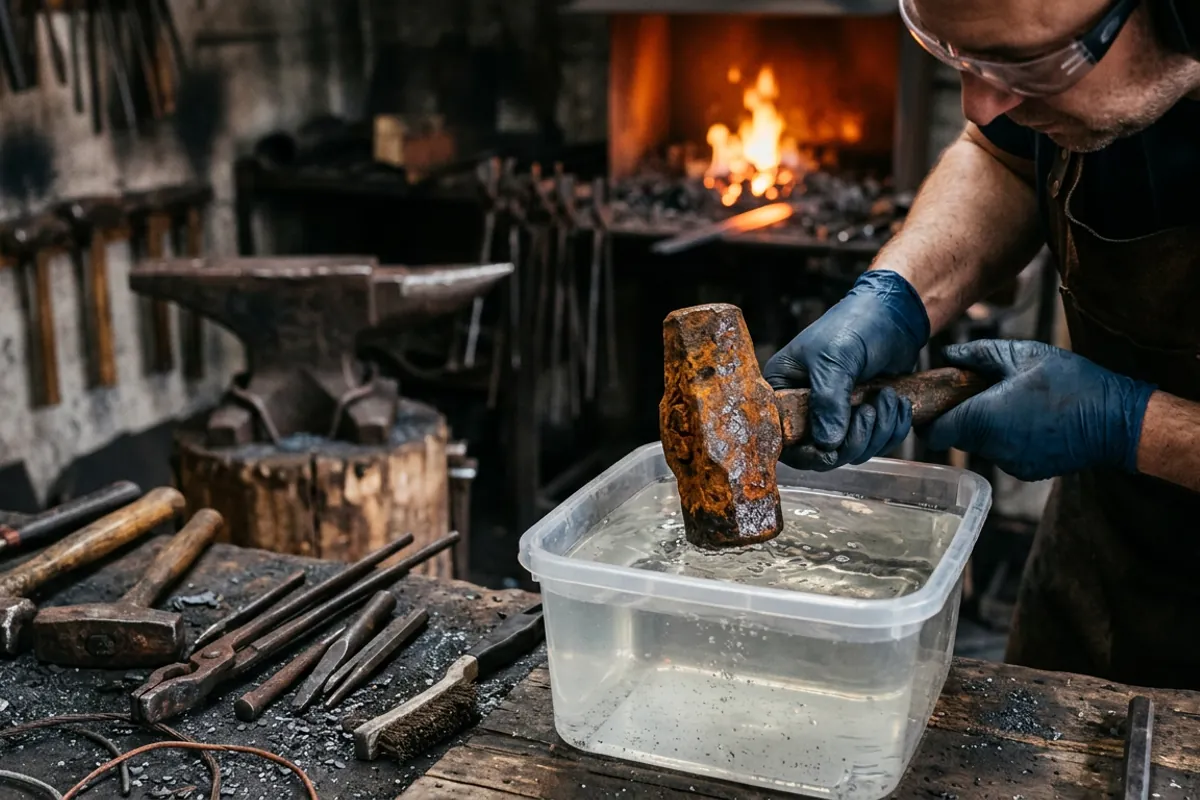
Why I like a bath over a grinder for the first pass: it does not remove metal. On a tool where the surface detail or the maker's stamp matters, or on anything you might grind too far, the bath is the safe move. A knotted wire cup brush takes off metal and character both. The chemistry only takes the rust.
The tradeoff is time and volume. A gallon soaks small parts fine, but an anvil is not going in a jug. For big pieces you either buy the bigger pails or you switch to mechanical cleanup. And it is a soak, not a dip: a heavily scaled piece can want a full day or two, sometimes a second bath, which the forums back up (more on that below).
One safety note that is easy to skip: it is still a chemical bath. Wear nitrile gloves, work with ventilation, and keep it off your bare skin and out of your eyes. Rated eye protection to ANSI Z87.1 is not optional around any of this, and it costs almost nothing next to an eye.
Check price on Amazon (paid link)
The wire cup brush for the heavy scale
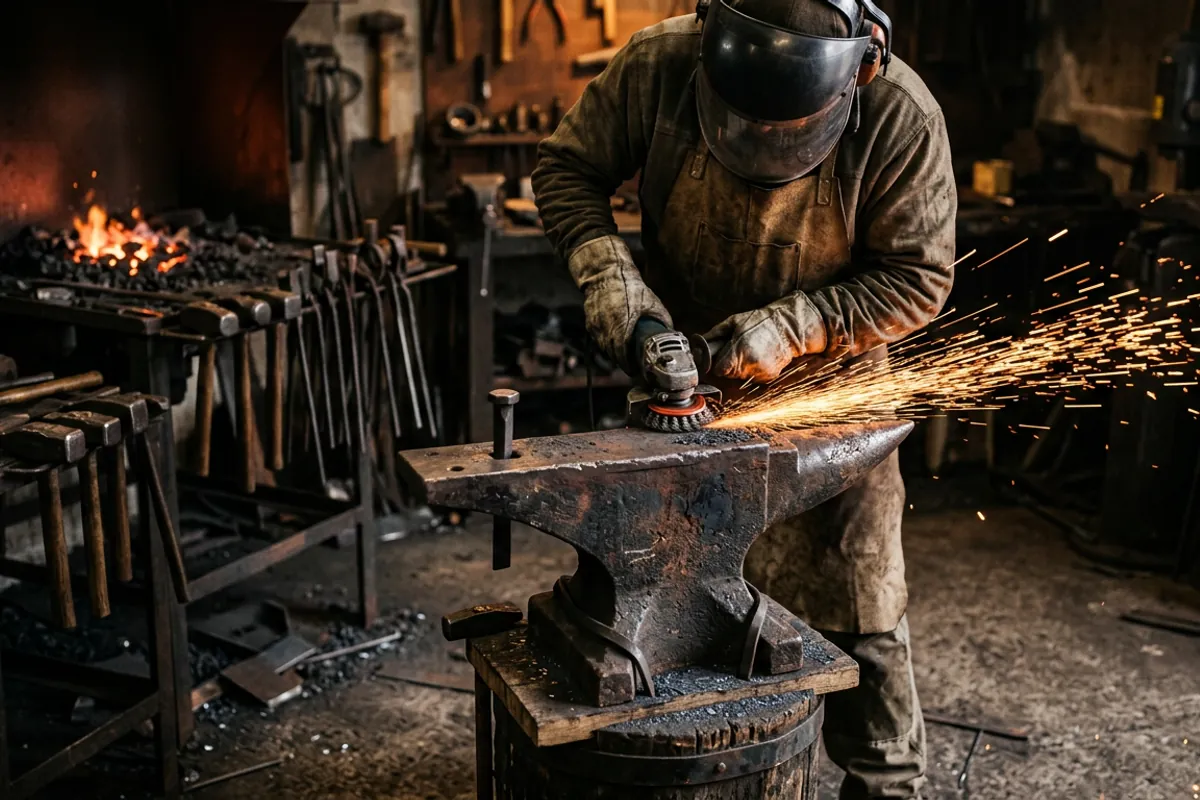
When a bath is not practical, or when I want to knock heavy flaking scale off before a soak, I go to a knotted wire cup brush on an angle grinder. The DEWALT DW4916 is a standard 4 inch knotted cup with a 5/8 in to 11 arbor and .020 in wire, built with an internal holding plate for balance (DEWALT accessory listing). Knotted wire is more aggressive than crimped, which is what you want for real forge scale and old paint.
This is the tool that will hurt you if you are careless, so I am going to be plain about it. A knotted wire wheel throws wire. It flings hardened wire bristles off at speed the whole time it runs, and they will bury themselves in your forearm, your neck, or your eye. When I run one I wear a full face shield over ANSI Z87.1 glasses, a leather apron, and heavy gloves, and I keep my body out of the line the wheel would throw. Cotton or wool, never a synthetic shirt that melts, same rule as at the forge. I lost my eyebrows to an oil flare early on because I stood too close in a cotton shirt with no face shield, and I have never treated flying debris casually since.
The other rule is grinder discipline: two hands, a side handle, let the wheel do the work, and keep it moving so you do not gouge. On an anvil face, this is for cleaning only. You are lifting rust and grime, not reshaping the tool.
Check price on Amazon (paid link)
Renaissance Wax, keeping the rust from coming back
Cleaning old iron is half the job. If you leave bare steel bare in a humid shop, it will flash-rust in a week and you will be back where you started. The traditional finish is to heat the part and quench it in oil, which leaves a black rust-resistant surface, and that is fine for working parts you do not mind darkening. For the surfaces I want to stay clean and readable, I use a microcrystalline wax.
Renaissance Wax is the one museums have used for decades to protect metal, wood, and leather from corrosion and handling (Renaissance Wax product site). It goes on thin, buffs to a low sheen, and leaves a moisture barrier that does not gum up or go sticky the way some oils do. A 200 ml tin lasts a long time because you use very little. On an anvil face I would not wax the working surface, since it will burn off under hot steel anyway, but on the body, the horn, a vise, tong reins, and hammer handles-to-head areas, it keeps the rust off between sessions.
Is wax strictly necessary? No. A wipe of oil does the same job for less money on working tools. But on a nice old tool you want to keep looking like a nice old tool, the wax earns its keep. That is an owner-preference call, not a rule.
Check price on Amazon (paid link)
When an antique is a paperweight, buy a new anvil instead
Here is where I break from the romance. Not every old anvil is worth saving, and some of the tools sold as antiques are cast iron that was never any good. The classic trap is a Vulcan or a hardware-store cast anvil with a thin tool-steel plate: grind through that plate and you have exposed dead cast iron and ruined it forever. A smith on I Forge Iron says it about as flatly as it can be said, that you never grind down or machine an anvil flat, because on some of them the hardened top is only about a quarter inch thick (I Forge Iron, restoring old anvil).
If the old anvil you found rings dead, has poor rebound, or has a face that is delaminating, walk away. You are better off putting that money into a new anvil with a known hardness and a warranty than into a hundred-year-old mystery. For a beginner or a second shop anvil, a modern cast single-horn is a reasonable starting point, and the VEVOR line is the budget end of that market. I would not call it a lifetime tool, but it is a real anvil at a price that lets you start forging today instead of chasing barns.

I cover the modern-anvil field in more detail in the VEVOR anvil buying guide, and the general how-to-not-overpay logic in the antique anvils buying guide. The short version: buy the antique when it is sound and priced right, buy new when the antique is a gamble.
What owners say
Since most of this is restoration gear rather than a single anvil model, the useful owner signal is about method more than brand, and it lines up well with what I do in my own shop.
On rust removal, the consensus from restoration threads is the same routine I described: a wire wheel for the worst of it, then a soak in Evapo-Rust for a day or more, wash and brush, and repeat the soak if rust remains. That comes up again and again in tool-rescue discussions, and it matches how the maker says the product works. The complaint you will hear is time: heavy rust wants patience, and a single overnight soak is often not enough. Nobody reports the bath eating good steel, which is exactly why it beats a grinder as a first pass.
On post vises, the KnifeDogs restoration crowd is worth reading before you buy one, because they show what a proper cleanup looks like and where the failure points are, usually a bent screw box or a cracked leg (KnifeDogs post vise restoration). The through-line from those threads and from Beautiful Iron is the same: old American vises and tools were built to a standard we would call extraordinary now, so a sound one is worth restoring, but abused iron with misaligned jaws, bent handles, and heavy pitting is a pass.
On tongs and hammers, the forum consensus is skeptical of flea-market prices, and I share it. Know the price of a new pair before you pay collector money for a broken old one. A good new pair of tongs often costs the same or less than what a seller wants for worn-out antiques. That is not a knock on old tools, it is a knock on overpaying for the wrong old tools.
Where the owner signal is genuinely thin is on the wax. Most smiths just use oil, so you will not find long forge-forum threads comparing microcrystalline waxes. The people who swear by Renaissance Wax tend to be restorers and collectors rather than working smiths. So treat that pick as a preservation choice for tools you care about the look of, not as shop gospel.
What I would tell a friend
If you called me tonight about buying antique blacksmith tools, here is the whole thing in a paragraph. Chase the tools that were made better then than now: a sound post vise first, a good wrought-body anvil second, quality tongs and hammers where the faces and jaws are clean. Walk away from chipped faces, dead rings, mushroomed hammers, and cast-iron anvils sold as bargains. For the rescue work, a gallon of Evapo-Rust and a knotted wire cup brush will handle almost anything, and a tin of microcrystalline wax keeps the good ones from rusting back. And when the old anvil is a gamble, there is no shame in buying a new one and forging today.
The safety note that matters most: the grinder and the wire wheel are the two things in this whole process most likely to hurt you. Rated eye protection to ANSI Z87.1, a full face shield on the wire wheel, natural fibers near heat, and your body out of the throw line. I have the missing eyebrows to remind me why. Old iron is patient. It waited a hundred years for you. Take the extra minute to protect your eyes, and it will outlast you too.
For more on where these tools fit in a working shop, browse the rest of More from the shop.