If you have been shopping for gear long enough, sooner or later a name like Oleo Acres Farrier and Blacksmith Supply Inc turns up in a search, a forum thread, or on the label of a bag of coal in somebody's shop, and you find yourself wondering what a place like that actually sells a hobby smith. I will be straight with you up front: I have not spent years running invoices through that particular outfit, so I am not going to dress up a long order history I do not have. What I can do, owner to owner, is tell you exactly what a farrier and blacksmith supply is, what crosses over from the shoeing side to the forge side and what does not, and how to shop one without walking out with a box of tools built for a horse's foot instead of a bar of steel. That is a mistake I have watched new smiths make, and it costs real money.
What a farrier and blacksmith supply really is
Two trades share a name here, and they have shared a shop floor for a few hundred years. A farrier shoes horses. A blacksmith forges iron and steel. For most of history the village smith did both, because the same fire, the same anvil, and the same hammer that made a hinge also shaped and set a shoe. The trades drifted apart over the last century as horses left daily working life, so today most farriers are not general blacksmiths and most blacksmiths never touch a hoof. But the tooling never fully separated, and that is why a supplier will hang both words on the door.
A business that calls itself a farrier and blacksmith supply is telling you it serves the intersection of those two trades plus the specifics of each. On the shelves you will find the gear a working farrier needs every day, the consumables both trades burn through, and a smaller run of general blacksmithing tools. The mix leans one way or the other depending on who the owner is and who the local customers are. Out in horse country, the catalog leans shoeing. Nearer a knife-making or artist-blacksmith scene, it may lean forge. Neither is wrong. You just need to read the shelves for what they are.
What the name Oleo Acres Farrier and Blacksmith Supply Inc actually tells you
You can read a fair amount off a business name before you ever pick up the phone. Farrier comes first in Oleo Acres Farrier and Blacksmith Supply Inc, and in my experience the trade named first is usually the one the shop was built around. That does not mean a smith is unwelcome. It means the depth of the shoeing catalog probably runs ahead of the general forge catalog, so the coal and the consumables will be easy to get and the wider range of blacksmith-specific tooling may be thinner.
The word Supply tells you it is a distributor, not a maker. It buys from manufacturers and resells, which means the brands on the shelf are the same brands you would find elsewhere, at whatever margin that shop runs. The Inc tells you it is an incorporated business rather than a fellow out of his garage, which usually means a real storefront or warehouse, a catalog, and mail order. Farrier and blacksmith supplies tend to be regional and family-run, serving working farriers in a day's drive first and mail-order customers second.
Here is the honest part. Any one shop's stock, hours, shipping terms, and even whether it is still trading change over time, and I am not going to invent current details about Oleo Acres to fill space. Before you plan a drive or a big order, call them or read their current catalog directly and confirm what they carry today. Treat this article as the shape of the category and how a smith should use it, not as a live inventory list for one store.
Where these suppliers sit in the blacksmithing supply world
It helps to know your options before you decide a farrier supply is the right one for a given purchase. At the top you have the big national blacksmith houses, the Centaur Forge type of outfit, that stock deep across forges, anvils, tongs, and hardy tools and ship everywhere. At the bottom you have the hardware store and the scrap yard, which get you steel and the odd tool but nothing trade-specific. A regional farrier and blacksmith supply sits in the middle, and its real strength is the stuff that is painful to ship: coal, in particular, and other heavy consumables you would rather pick up than pay freight on. I lay out the whole landscape in more depth in my piece on where the blacksmithing store really is, and it is worth reading before you commit to a single source.
The practical takeaway is this. Use a farrier supply for what it does well, which is being close to you and stocking the heavy consumables and the shoeing-adjacent tools, and go to a dedicated blacksmith house for the deep range of forge-specific gear. Playing both to their strengths is how you keep freight down and still get the right tool.
What overlaps between farrier gear and forge gear
This is the part that makes a farrier supply worth a smith's time. A lot of what a farrier buys is exactly what you buy.
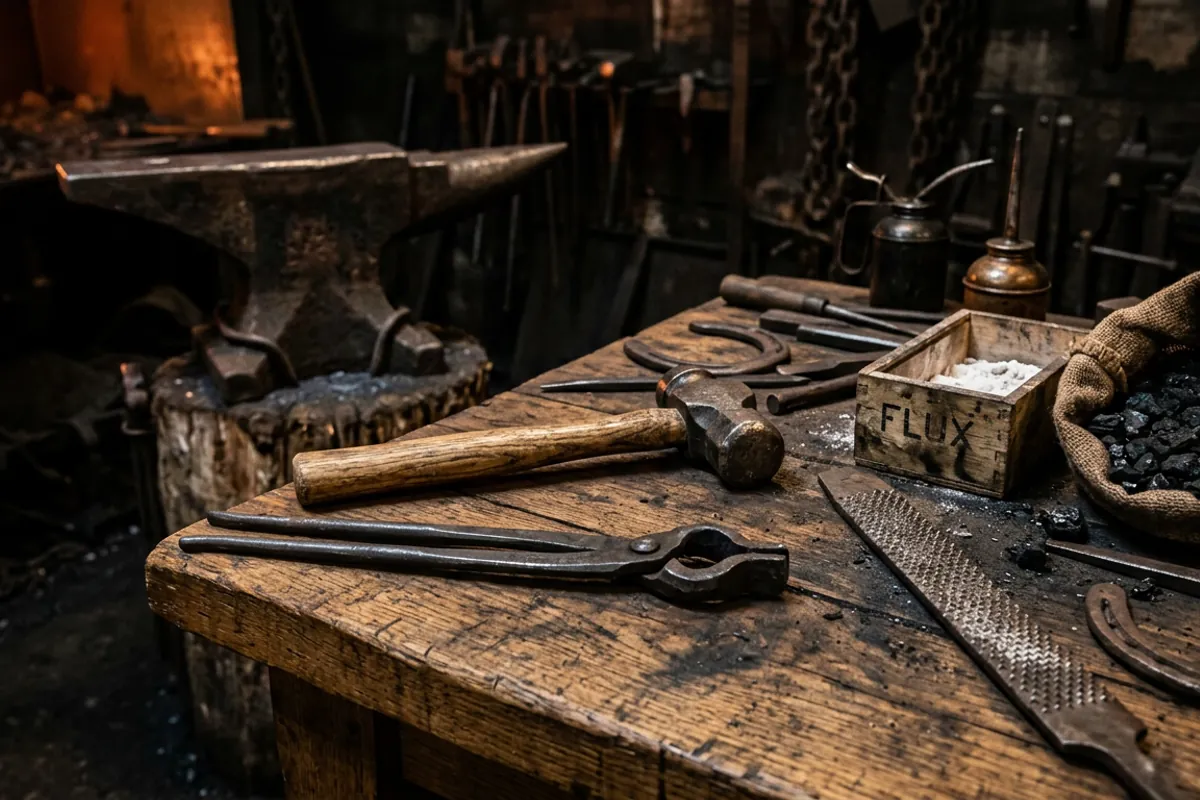
Coal is the big one. Farriers who forge their own shoes burn good bituminous smithing coal, and a farrier supply is one of the more reliable places to get it in bags you can actually lift and haul. If you are running a solid-fuel fire, this alone can justify the relationship. I go deep on what to look for in my write-up on blacksmith coal, and if you are still deciding between fuels at all, my take on coal or propane for a first forge will save you a wrong turn.
Hammers cross over cleanly. The rounding hammer a farrier uses to shape a shoe is the same rounding hammer a smith reaches for at the anvil, and the weights and handles are the same. Tongs overlap for the smaller sizes. Files and rasps overlap, though a farrier's rasp is a big coarse thing meant for a hoof and a smith uses finer files for finish work. Punches, drifts, hardy-hole tooling, borax and flux, quench oil, and abrasives all show up on both sides of the aisle. If you need a workhorse hammer or a bag of flux and the farrier supply has it in stock down the road, there is no reason to mail-order it.
What is built for the hoof, not the forge
Now the other side. A good chunk of a farrier catalog is single-purpose horse gear, and none of it does a thing for you at the anvil. Knowing the names keeps you from buying the wrong thing on a shelf that looks like tool heaven.
Hoof nippers look like heavy end-cutting pliers and trim the hoof wall. Hoof knives are curved blades for paring the sole and frog. Clinch cutters and clinchers, pull-offs, and driving hammers are all about setting and finishing nails in a shoe. Keg shoes are the pre-made horseshoes in every size, and horseshoe nails come in boxes sorted by a sizing system that means nothing to a blacksmith. Hoof stands hold the leg up while the farrier works. Shoeing chaps are leather aprons cut for the legs, meant to take a hoof and a rasp against your thigh, not sparks and scale off an anvil.
None of that is junk. It is just built for a different job. The trap for a new smith is walking a farrier supply, seeing rows of forged steel tools, and buying by the pound instead of by the purpose. Buy the shoeing tools only if you are shoeing horses.
Farrier forges and anvils, and whether they work for smithing
Two big-ticket items deserve their own look, because a farrier supply will happily sell you either and they are not the same tools a general smith would pick.
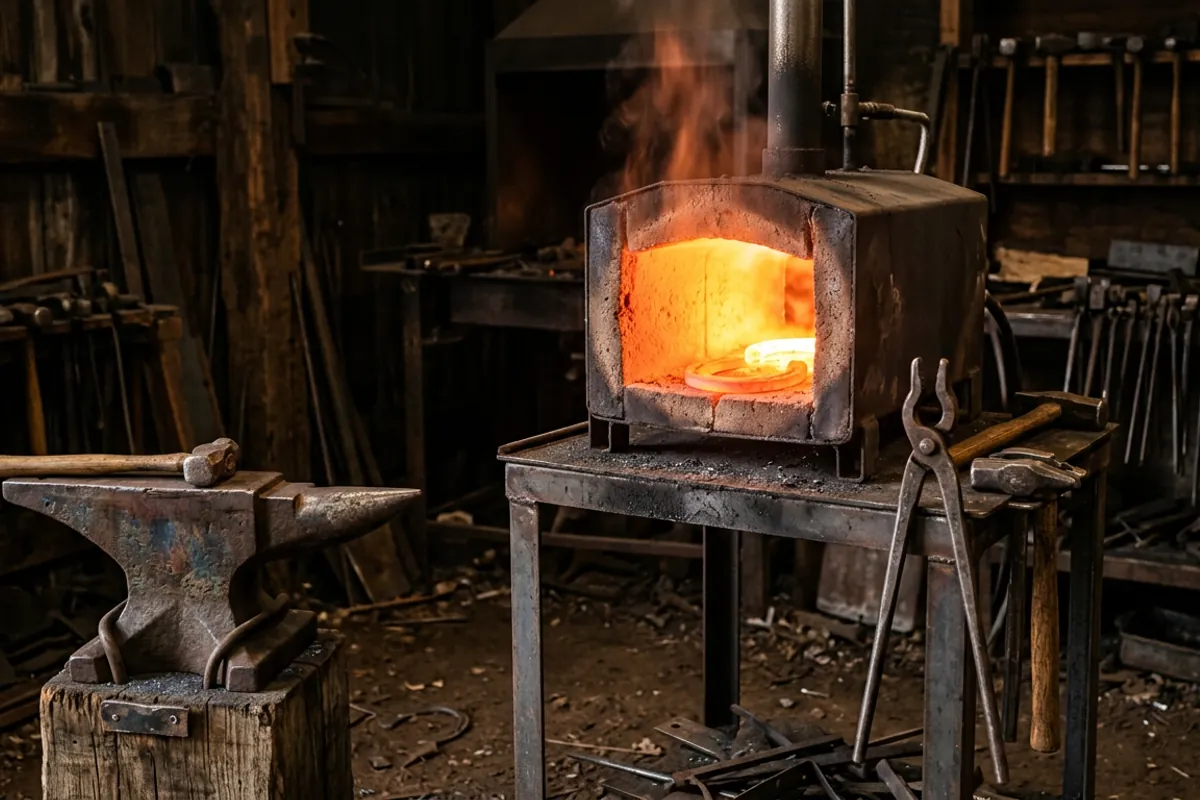
A farrier's forge is almost always a small single-burner propane forge with a chamber sized to slide a horseshoe in and out fast. It heats a shoe quickly and evenly, which is exactly its job. As a general blacksmith forge it is cramped. You can heat short work and do some knife blades in one, and plenty of knife makers get real use out of a farrier forge for exactly that reason, but the tight chamber fights you the moment you want to work longer bar stock or get a wide, even heat across a bigger piece. If a farrier forge is what is in front of you and your work is small, it can serve. Just know what you are buying and why it is shaped that way.
A farrier's anvil is a different animal from a shop anvil. It is usually lighter, often in the 70 to 150 pound range, with a turning cam and sometimes a clip horn, and it is meant to be mounted low so a farrier can work bent over a hoof. For light forging that mass is workable. For anything heavy you feel the shortage of weight right away, because an anvil returns your hammer energy in proportion to its mass and a light anvil under a big blow bounces and rings instead of driving the steel. My own anvil, Bessie, is a 148 pound Trenton, and even she is on the lighter side of what I would call comfortable for heavy stock. If you want to understand how weight really plays into the tool, I break it down in my anvil weight guide. A farrier anvil can be a fine first anvil for small work, but do not mistake the shoeing shape for a general-purpose smithing tool.
How I would shop a farrier and blacksmith supply
Here is the way I would actually use a place like this, treating it as one supplier among several rather than the answer to everything.
First, confirm what they stock right now and what their hours and shipping look like, straight from them. Second, lean on them for the heavy consumables. Coal and flux and quench oil are miserable to ship, and a local pickup saves the freight that often costs as much as the goods. Third, cross-shop the overlapping tools. A rounding hammer or a pair of tongs is the same tool wherever you buy it, so buy it wherever it is in stock and priced fair. Fourth, do not get talked into the shoeing catalog. A helpful counter person who serves farriers all day may reach for farrier answers to a blacksmith question, so know before you go whether the tool you want is a forge tool or a hoof tool. Fifth, know your sizes and the exact tool name before you call, because a farrier supply is organized around a working farrier's vocabulary, not a hobby smith's.
If you are still assembling a first kit and not sure what belongs on the list at all, my rundown of the blacksmithing supplies I would buy first is the order I would put the money in, and a farrier supply can fill a good part of it.
Safety and steel: two things I never take on faith
Two things I will not soften, because both can hurt you or cost you a project, and neither is guaranteed by the fact that a supply house sold you the item.
The first is protection. Whatever a shop stocks, your eyes are your responsibility, and the standard is real and checkable: ANSI Z87.1 rated eye protection, worn every time there is a hammer, a grinder, or a fire. Wear natural fibers near the forge, wool or cotton, because synthetics melt onto skin. I learned the fire lesson the expensive way. Early on I quenched a blade in oil that was too cold, standing too close in a cotton shirt with no face shield, and the oil flared and took my eyebrows. I kept my eyesight by luck. A leather apron off a supply shelf is good gear, but a shoeing chap is cut for the horse's job, not the forge's, so buy protection for the work you are actually doing. My full take on what matters is in my blacksmith safety gear piece, and none of it is optional.
The second is steel. A supply house will sell you bar stock, and the label may say something vague like tool steel with no alloy behind it. You cannot heat treat what you cannot identify, so verify the actual alloy before you build a knife around it, and buy from a source that will name the grade. When the question goes past what you can see on the bench, into real numbers on austenitizing temperatures, quench speeds, or edge retention, send it to real testing rather than trusting a counter conversation. Knife Steel Nerds is where I point people for steel science, because they run the tests instead of repeating shop lore. A farrier supply is a fine place to buy steel. It is not a metallurgy lab, and neither am I.
The bottom line
A farrier and blacksmith supply like Oleo Acres Farrier and Blacksmith Supply Inc is a middle-of-the-market, usually regional distributor that serves working farriers first and general smiths second, and the smart way to use one is to play to that. Buy the heavy consumables you would hate to ship, cross-shop the overlapping hammers and tongs, and leave the hoof tools for the people shoeing hooves. Read the shelves for what they are, confirm the current stock and terms yourself before you drive or order, and treat forge purchases and shoeing purchases as two different lists that happen to sit in one building. Do that and a farrier supply earns a real spot in your rotation. For more explainers like this one, my More from the shop hub collects the rest, and if you want the wider view of every place worth buying from, start with where the blacksmithing store really is.