I have everything I need: four live-verified ASINs, maker/forum/retailer specs, and real citable sources. Writing the article now.
Most forging kits sold online promise a shortcut, and most of them only get you part of the way there. If you want the short version: the smartest forging kit is the one you assemble yourself, a real heat source, a real anvil, one good hammer, and a couple of tongs, bought as separate pieces so no single weak part drags the rest down. If you insist on one box off the shelf, buy it for the tongs and the hammer, and treat the little anvil that rides along with it as a bonus rather than the tool you learn on.
I have been at this about twenty-five years, started self-taught on a chunk of railroad track clamped to a stump, and I teach weekend beginners now. The same shrink-wrapped box shows up in a lot of their trunks: a hammer, two tongs, and a cast anvil the size of a loaf of bread. Some of what rides in those kits is genuinely useful. Some of it is the exact reason a new smith fights the steel instead of moving it.
Fair warning up front. I own a coal forge, a propane forge, a drawer full of tongs, and a 148 lb Trenton I call Bessie, and I will speak plainly from that. But I have not run every one of these specific kits across my own bench, and I am not going to pretend I have. What follows leans on published specs, owner reports from the blacksmithing forums, and what I know about how these tools behave when you actually put hot steel on them.
What a forging kit actually is, and what it is not
"Forging kit" is a marketing phrase, not a fixed thing. It covers everything from a six dollar bag of tongs to a coal forge, anvil, and full tool roll that runs into four figures. When Centaur Forge sells you a "starter kit," you get a curated set with a real anvil and a hammer sized for the work, and their packages run from around 169 dollars to nearly 2,000 dollars depending on how far up you go (Centaur Forge starter kits). When a marketplace seller bundles a "kit," you usually get hand tools and a decorative anvil, and no forge at all.
That distinction matters because the forge is the heart of the whole operation. No amount of good tongs makes cold steel move. So before you buy anything with the word "kit" on it, sort it into one of two buckets: hand tools you will keep for years, or a heat source you will actually forge in. The two rarely come in the same box for a fair price, and when they do, one of them is cutting a corner. If you want the longer version of how I would spend a first budget, I wrote it up in the beginner blacksmith kit guide.
How the kits compare
Here is the field at a glance. I only list figures the makers actually publish, and I mark the rest honestly.
Scroll horizontally to see all columns.
| Kit | Type | What is in it | Key published spec | Price tier |
|---|---|---|---|---|
| Blacksmith Hammer and Forge Tools Kit | Hand-tool bundle | Hammer, wolf jaw tongs, V-bit tongs, small cast anvil | Anvil weight not published | Budget |
| Beginner Blacksmith Tongs Set (6 pcs) | Tongs set | 3/8, 1/2, 5/8 V-bit; 1/4 flat jaw; pick-up; scroll tongs | Heavy-duty steel, linseed-oil finish | Budget |
| Nelyrho 1 Burner Propane Forge Kit | Propane forge | Single burner, regulator, hose | Listed 2600 degrees F, stainless shell | Budget |
| Hell's Forge MAX Double Burner | Propane forge | 2 burners, 0 to 30 psi regulator, 2 firebricks, HELLCOTE 3000 | 2300 degrees F, interior roughly 6 by 4.75 by 19 inches | Mid, made in USA |
| VEVOR single-horn anvil (66 lb) | Cast-steel anvil | Anvil only | 66 lb, single horn | Budget |
The Hell's Forge figures above come from the maker's own listing, including the 2300 degrees F rating, the 0 to 30 psi regulator, the one inch ceramic fiber blanket, and the interior dimensions (Hell's Forge MAX specs). Where a bundle seller does not publish a hardness or a weight, I did not fill in a number. An invented spec is worse than a blank.
The all-in-one bundle: hammer, tongs, and a cast anvil
This is the box most people picture when they hear "forging kit." One I keep seeing is the Blacksmith Hammer and Forge Tools Kit (paid link), which pairs a cross pein hammer with a wolf jaw tong and a V-bit tong and throws in a small cast anvil.
Here is the honest read. The hammer and the two tongs are the part worth having. A wolf jaw tong is about the most useful first tong you can own because it grabs flat, square, and round stock, and a V-bit holds round and square deadlocked under heavy blows. Those two cover most of what a beginner reaches for. The hammer in these bundles is usually a serviceable cross pein that you may want to dress the face on with a file and some sandpaper, but it will forge.
The small anvil is the weak link, and it is the reason I would not build a shop around this box. A little cast block gives you a hard surface to peen a rivet on and not much more. If the bundle price is close to buying the tongs alone, fine, treat the anvil as a paperweight that occasionally earns its keep. Just do not expect to learn to move steel on it. More on why in a minute.
The tongs set worth buying on its own
If I were handing a new smith one thing off the marketplace, it would be a proper tong set rather than an all-in-one bundle. The six-piece Beginner Blacksmith Tongs Set (paid link) is the shape I mean: 3/8, 1/2, and 5/8 inch V-bit tongs, a 1/4 inch flat jaw, a pick-up tong, and a scrolling tong, forged from heavy-duty steel and finished in linseed oil to hold off rust.
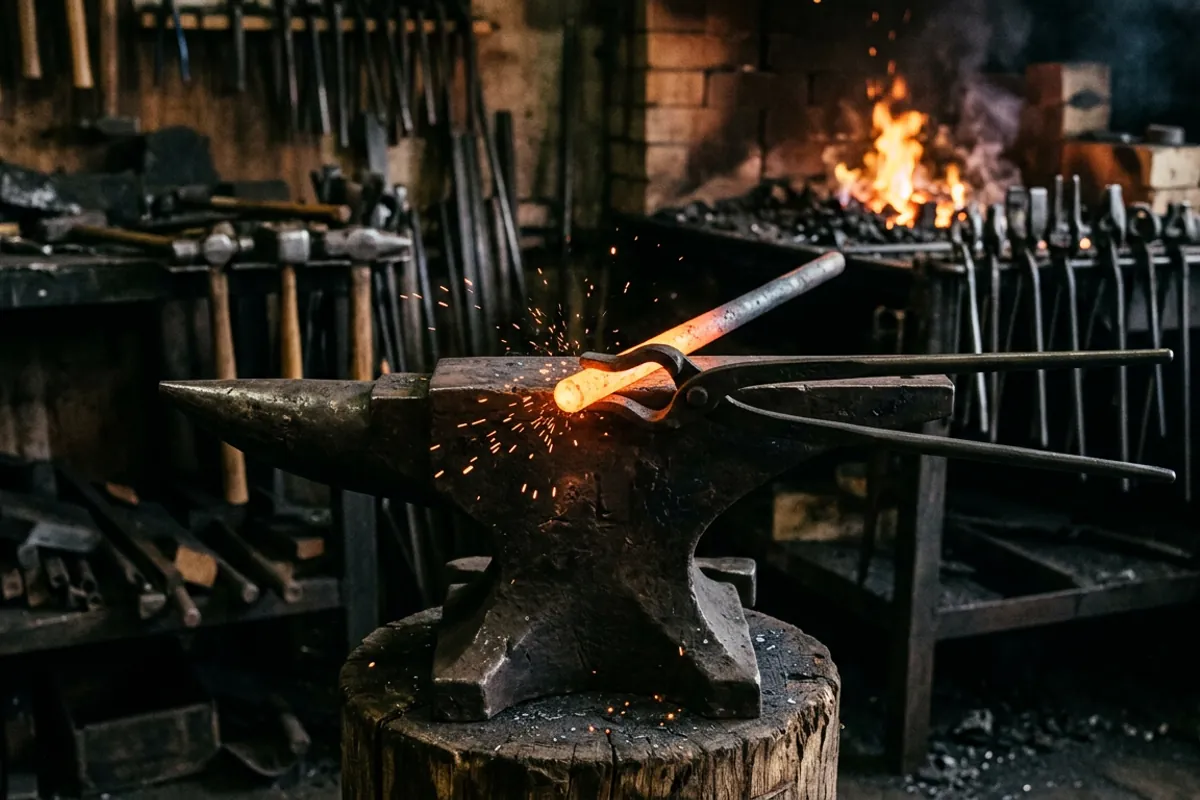
Why start with tongs instead of an anvil or a hammer? Because tongs are the tool a beginner most often lacks and most often improvises badly, and hot steel slipping out of a bad grip is how people get burned. A set like this spans the common bar sizes so you are not trying to hold 3/8 round in a jaw cut for 5/8. Expect to spend a little time tuning them: heat the reins and adjust the bite so the jaws meet flat on your stock. That is normal even on tongs I have made myself, and it is a good first lesson in how a tong is supposed to grab. If you want to understand what separates a good pair from a frustrating one, I go deeper in the blacksmith tongs buying guide.
The budget propane forge kit
A forging kit without a forge is a box of tools waiting for heat. The cheapest honest way into that heat is a single-burner propane forge like the Nelyrho 1 Burner Propane Forge Kit (paid link), which ships with a burner, regulator, and hose, and whose listing claims 2600 degrees F out of a stainless shell.
I run both fuels, and propane is the right first forge for most people: it lights fast, holds an even heat, and does not ask you to learn fire management before you learn to forge. A single burner in a small chamber will get a knife blade or a small project to a working orange without much fuss. What it will not do is heat a long bar evenly, and the common complaint on the forums about small single-burner units is that they struggle on a cold day and cool off fast when you open them up. Treat the listed 2600 degree figure as a ceiling in ideal conditions, not a promise.
One thing I will not soften: a propane forge is a combustion appliance, and carbon monoxide is invisible and odorless. Run it outdoors or under a wide-open door with real cross ventilation, never in a closed garage. And put on eye protection rated ANSI Z87.1 before you ever open the forge, along with natural-fiber clothing, no synthetics near that heat. I learned the fiber lesson the hard way years ago quenching a blade in cold oil in a cotton shirt with no face shield, the oil flared, and it took my eyebrows. I kept my eyesight on luck alone. That is why I do not treat any of this as optional. If you are still weighing fuels, read coal or propane first before you spend.
The forge kit I would grow into
If your budget can stretch past the bargain tier, the forge I would point a serious beginner toward is the Hell's Forge MAX Double Burner (paid link). It is made in the USA, runs two burners off a 0 to 30 psi regulator, and ships with two firebricks and a container of HELLCOTE 3000 refractory you apply yourself. The maker lists a 2300 degrees F rating, a one inch ceramic fiber blanket, and an interior of roughly 6 by 4.75 by 19 inches (Hell's Forge MAX specs).
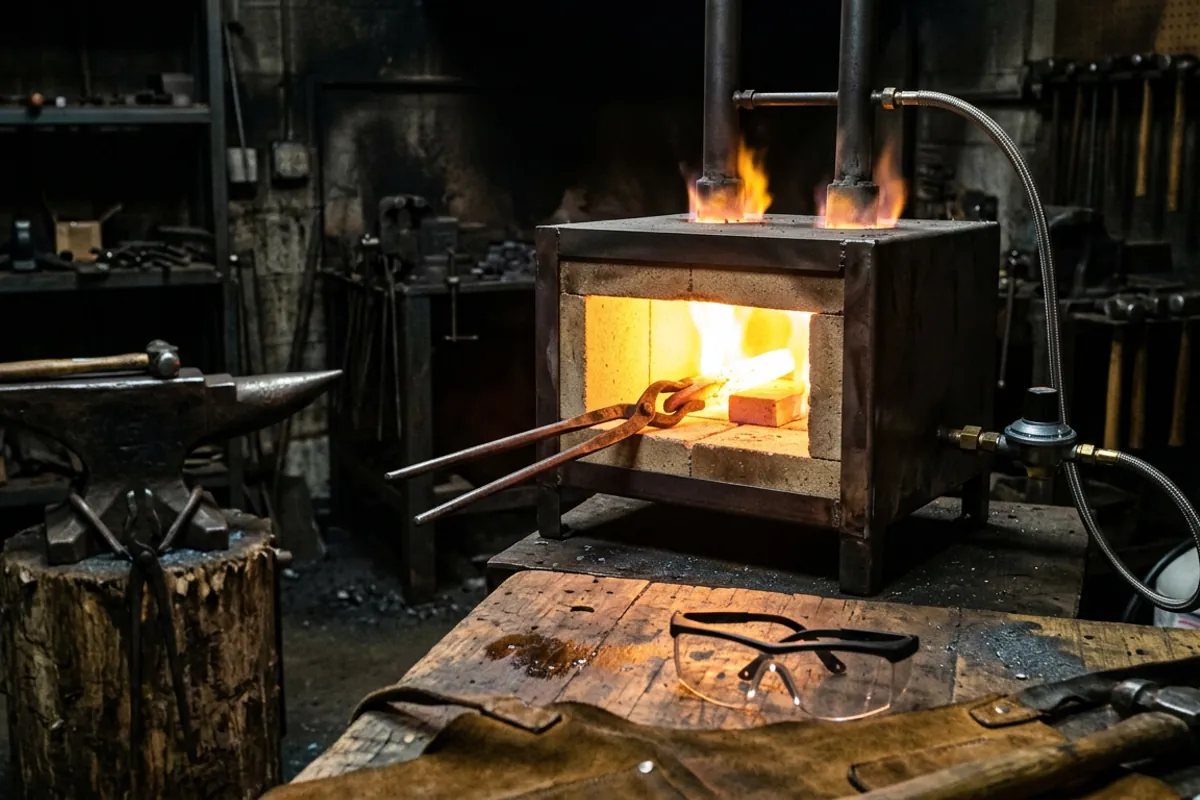
Two burners and a longer chamber are the difference between heating a two inch section and heating enough of a bar to actually draw it out. That is the upgrade that matters most as you move from bending hooks to forging blades. Owners tend to respect the build on this one, and it is the unit I see recommended again and again when someone asks what to buy after they outgrow a single burner. The tradeoff is real too: two burners eat propane faster, and you are still applying that refractory coating and curing it correctly before the first hard use. Do that step right, because bare ceramic fiber is not something you want to be breathing.
The anvil most kits get wrong
Here is the part I care about most, because it is where the money gets wasted. The little anvil in a bundle kit is almost always cast iron, and a cast iron anvil is what smiths call an ASO, an anvil-shaped object. It looks the part and forges like a sandbag.
I am not just being a snob about it. On the classic ASO thread at I Forge Iron, the owner consensus is blunt: a cast anvil is lucky to have any rebound, most are dead, and cast iron will not take a pounding without cracking or chipping. One member describes forging on a soft anvil for a stretch and giving himself elbow trouble that lasted a couple of years, because a dead face throws the energy of every blow back into your arm instead of into the steel. The forums land in the same place I do: an ASO is only worth having for occasional light duty if you genuinely cannot afford a real one yet.
The real fix is not expensive anymore. A cast-steel anvil, even a budget import, has the hardness and rebound to actually return your hammer blow. If you are buying at kit prices, a small cast-steel single-horn anvil with a proper horn, face, hardy hole, and pritchel hole is the honest step up from an ASO:

A 66 lb anvil is light for heavy work, so bolt it down solid and it will serve for knives and small projects. If you can swing the weight and the money, step up to 100 to 150 pounds and you will not outgrow it soon. I sorted out what these budget anvils do and do not do in the VEVOR anvil guide, and how to think about weight in the anvil weight guide.
What owners say
For gear I have not run down in my own shop, I lean on what the forums report, and I try to pass along the complaints as honestly as the praise.
On the bundled cast anvils, the read is not ambiguous. The I Forge Iron ASO thread is years of smiths saying the same thing: little rebound, poor ring, and a real risk of chipping under a hammer. That is the single most consistent owner signal in this whole category, and it is why I keep hammering on the anvil point.
On the tongs, the common read across the blacksmithing forums is that budget import tongs arrive usable but need tuning, the reins and jaws often want a little adjustment so the bite sits flat on your stock. Ask ten smiths and most will tell you that is fine for a first set, and that learning to dress a tong is part of the trade anyway.
On the propane forges, owners generally like the Hell's Forge build and treat the single-burner units as a squeeze for anything longer than a knife. That tracks with the physics, not just opinion. If your projects are small, a single burner is enough; if you want to forge blades, the double burner earns its keep.
One metallurgy note, because a forging kit is only as good as the steel you feed it. For a first forged blade, stick to a simple carbon steel. The people who actually test this at Knife Steel Nerds put 1084, 1095, 5160, and 52100 among the simplest steels to forge, and 1084 in particular is forgiving to heat treat without a controlled furnace. Do not start on a stainless or a high-alloy air-hardening steel, you will spend more time fighting the heat treat than learning to forge.
What I would tell a friend
If a buddy asked me how to spend a first forging-kit budget, here is the whole thing in a breath. Do not buy the all-in-one bundle for its anvil. Buy tongs and a hammer as your hand tools, a real cast-steel anvil rather than a cast iron ASO, and a propane forge sized to the work you actually plan to do. A single burner is plenty for knives and hooks; a double burner like the Hell's Forge is the one to grow into if you are serious about blades.
The one to skip is any kit selling a decorative cast anvil as the centerpiece. The tongs and hammer in those boxes can be worth the money on their own, but the anvil will teach your elbow bad habits.
And the note I will not let go of: eye protection rated ANSI Z87.1 goes on before the forge lights, natural fibers only near that heat, and propane forges run outdoors with real airflow. A forging kit is supposed to start a hobby, not a trip to the emergency room. For more from the shop on getting set up right, browse the rest of More from the shop.