All three ASINs are now confirmed live via web search with matching product names (Amazon's HTTP 500 was bot-blocking automated fetches, not a dead listing). The search also surfaced published specs that let me tighten two accuracy points: the budget burner is maker-rated at 100,000 BTU and ships as a bare burner with a brass needle valve, not a full regulator kit. Here is the corrected article:
If you are building or rebuilding a gas forge, the burner is the part that decides whether you get an even, hard-working heat or a spitting, roaring mess that eats propane and never quite reaches temperature. Good propane burners for forge work are not complicated machines, but there is a lot of confusion around them, most of it sold by people who have never had to tune one in a cold shop. I run a propane forge for most of my day-to-day work next to a coal forge I keep for heavy stock and forge welding, so I have spent real hours listening to a burner and adjusting it. What follows is how these burners work, what separates a good one from a loud one, and which ones I would actually put money on. I want to be straight up front: except for the general venturi burner I have run in my own forge, these picks lean on published specs and owner reports weighed against shop experience, not on me bench-testing every model.
How a propane burner actually works
Almost every off-the-shelf forge burner is a venturi, also called a naturally aspirated burner. Propane comes out of a small jet under pressure and shoots down a tube. As it goes, it drags air in through openings at the top, mixes with it, and burns at the far end. There is no fan. The gas pressure does all the work of pulling air in, which is the whole trick and also the whole limitation.
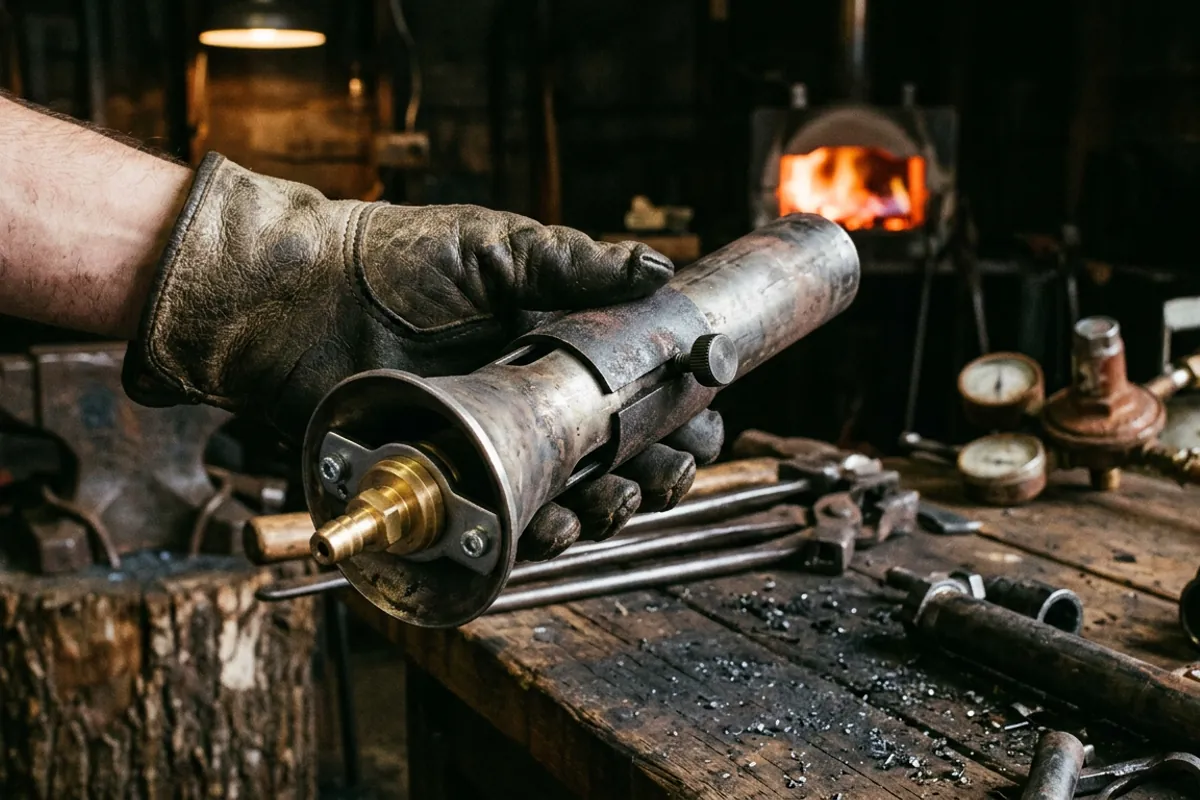
The number you tune for is the fuel-to-air ratio. Too much air and the flame runs lean, blue, and loud, and it will actually cool your work and scale it badly. Too little air and it runs rich, with lazy orange dragon's breath licking out the door and carbon monoxide you cannot see. A well-tuned burner sits in between: a soft, even roar, a slightly reducing atmosphere with a little blue flame at the door, and steel that comes up to an even yellow without a lot of scale.
Two things set that ratio. The jet size, which is the propane orifice, and the air openings, which good burners let you choke down with a sliding sleeve. That air choke matters more than people think. Without it you are stuck with whatever ratio the maker guessed at, and every forge, chamber size, and altitude is a little different. A burner you can adjust is a burner you can live with.
Naturally aspirated or blown: pick your headache
Before you buy a venturi burner at all, it is worth knowing the other option exists. A blown, or forced-air, burner uses a small fan to push air in, so gas pressure only has to supply fuel. Blown forges are more fuel-efficient when they are built right, they hold a stable flame at very low pressure, and they get to forge welding heat more easily. The tradeoff is more parts, a fan that needs power, and a setup that some smiths find fussier to dial in.
Naturally aspirated burners win on simplicity. No fan, no cord, nothing to fail but the burner itself, and you can run one off a tank in a field. The honest complaint you hear over and over on the forums is that a venturi burner will get you to a bright forging heat all day but only just barely reaches forge welding temperature, and only in a well-insulated forge. On the I Forge Iron gas forge board, the modified Reil, Frosty T, and Zoeller sidearm designs are the ones smiths keep pointing new builders toward because they are proven and forgiving. If forge welding is your whole reason for building a forge, read up on blown burners before you commit. For general forging, heat treating, and knife bevels, a good venturi burner is the right amount of tool. If you are still deciding between fuels at all, I wrote a longer piece on coal versus propane for a first forge that covers the tradeoffs.
Spec comparison
Here is the field I would actually shop, with the figures the makers publish. Where a maker does not state a number, I have said so rather than guess. BTU ratings are the manufacturer's own, and BTU is a rough measure of maximum output, not of quality or efficiency.
Scroll horizontally to see all columns.
| Burner | Type | Rated output | Air choke | Notes |
|---|---|---|---|---|
| Generic 1 inch venturi burner | Naturally aspirated | 100,000 BTU | Yes | Bare burner, brass needle valve, 8 in feed tube |
| Devil Forge DFP burner | Naturally aspirated | 80,000 BTU | Yes | 304 stainless nozzle, 35 mm, maker rates 1 to 25 PSI |
| Devil Forge DFC burner | Naturally aspirated | 180,000 BTU | Yes | 304 stainless nozzle, 50 mm, for big chambers or furnaces |
| Hybrid Burners T-Rex | Hybrid venturi | Not published | Yes | Premium, direct order only, no Amazon listing |
One thing that table cannot show you is build quality, and that is exactly where the money goes. A budget burner and a premium one might both be rated at similar output, but the premium one holds its tune across a wider pressure range and does not need babysitting.
The budget bolt-on burner
If you are on a tight build and just want heat, the widely sold generic propane forge burner is the cheapest way in. This one is a bare venturi burner with a brass needle valve for fine flame control and a sliding air choke, maker-rated at 100,000 BTU with an eight inch feed tube. It is a burner, not a full kit, so plan on adding a proper adjustable high-pressure regulator and a propane-rated hose. For general forging and heat treating, plenty of home smiths run this style of burner for years without complaint.
Set your expectations at the price, though. The jets on the no-name burners are not always drilled cleanly, the air chokes can be stiff, and the tuning window is narrower than a premium burner. You may spend an afternoon with different jet sizes or a slightly different chamber to get a clean flame. That is the budget-burner tax, and if you enjoy tinkering it is no hardship.
Check price on Amazon (paid link)
The honest read: this is a fine first burner for somebody building a small single-burner forge and learning the craft. It will get a knife blade to forging heat and let you normalize and harden. It will fight you at forge welding temperature. Buy it knowing that, and you will not be disappointed.
The Devil Forge burners
Devil Forge is a European maker with a big presence on the marketplace, and their burners are a genuine step up from the no-name kits while staying well under premium money. The single-burner DFP unit is rated by the maker at 80,000 BTU, with a 304 stainless steel nozzle about 35 mm across and a published working range of roughly 1 to 25 PSI, plus the gas ball valve and air choke that let you actually tune it. Stainless at the hot end matters, because a mild steel nozzle scales and burns back over time.
Check price on Amazon (paid link)
For a single-burner forge in the common size range a knife maker uses, the DFP is a sensible middle choice: better nozzle metal and a wider tuning range than the bargain burners, without the wait and cost of a direct-order premium unit. If you are matching a burner to a forge you are still choosing, my propane forge buying guide walks through chamber volume and how many burners a given size actually wants.
If you are running a larger chamber, a furnace for melting, or a two-burner forge and want one big burner instead, Devil Forge also sells the DFC, rated at 180,000 BTU with a larger 50 mm stainless nozzle. That is a lot of burner and a lot of gas, and it is overkill for a small knife forge. Match the burner to the chamber. An oversized burner in a small forge just wastes propane and roars.
Check price on Amazon (paid link)
The premium venturi: T-Rex and Zoeller
Ask ten smiths for the best off-the-shelf venturi burner and a lot of them will say the T-Rex from Hybrid Burners, made by Rex Price. It is a machined, tuned hybrid jet-ejector burner, and the common report is that it holds a stable, clean flame from under 1 PSI up to over 25 PSI, which is a much wider usable range than a cheap burner gives you. That range is the whole point: one burner that idles down for tempering and cranks up for forging without retuning. The catch is that it is sold direct, not on the marketplace, it costs noticeably more, and there can be a wait.
The other name you will hear is Larry Zoeller, whose Zoeller Forge sells burner parts, kits, and plans for the sidearm and other proven designs. Zoeller is where a lot of DIY builders go for a jet and a flare rather than a finished burner. Neither of these ships as an Amazon listing, so I am not linking a product, just telling you they exist and why smiths pay up for them: consistency and support. When your burner comes with the builder's email address, that is worth something the night before a deadline.
Building your own burner
The dirty secret of forge burners is that a venturi is simple enough to build in an evening with pipe fittings, a drilled brass jet, and a stainless flare. The Frosty T and the modified Reil burner have been built thousands of times, and the plans are free. Ron Reil's old forge and burner design pages are still the reference a lot of us learned from, and they walk through jet sizing and flare geometry in plain terms.
I will be honest about the tradeoff. Building your own saves real money and teaches you exactly how the thing works, which pays off every time you tune it. But your first homemade burner will probably need fiddling: redrilling the jet, adjusting the flare depth, chasing a clean flame. If you like that kind of problem, build one. If you want to forge this weekend and not machine parts, buy one. Most smiths I know have done both, and there is no wrong answer. The DIY propane forge parts guide covers the fittings and refractory that go around the burner.
Whichever way you go, one number is not negotiable: the regulator. Use an adjustable high-pressure regulator rated well above your working range, and use a hose rated for propane. The little low-pressure regulators off a gas grill will not feed a forge burner, and a marginal hose near a forge is not a place to save five dollars.
Safety, because a burner is an open flame in a small room
I do not treat this as a footnote. A propane forge is a rich source of carbon monoxide, especially when the burner runs rich with that lazy orange dragon's breath at the door. You cannot smell it and it will put you down. Run a forge only with real cross-ventilation, doors or windows open, ideally outdoors or under an open shelter, and keep a carbon monoxide alarm in the shop. That alarm is ten dollars of the cheapest insurance you will ever buy.
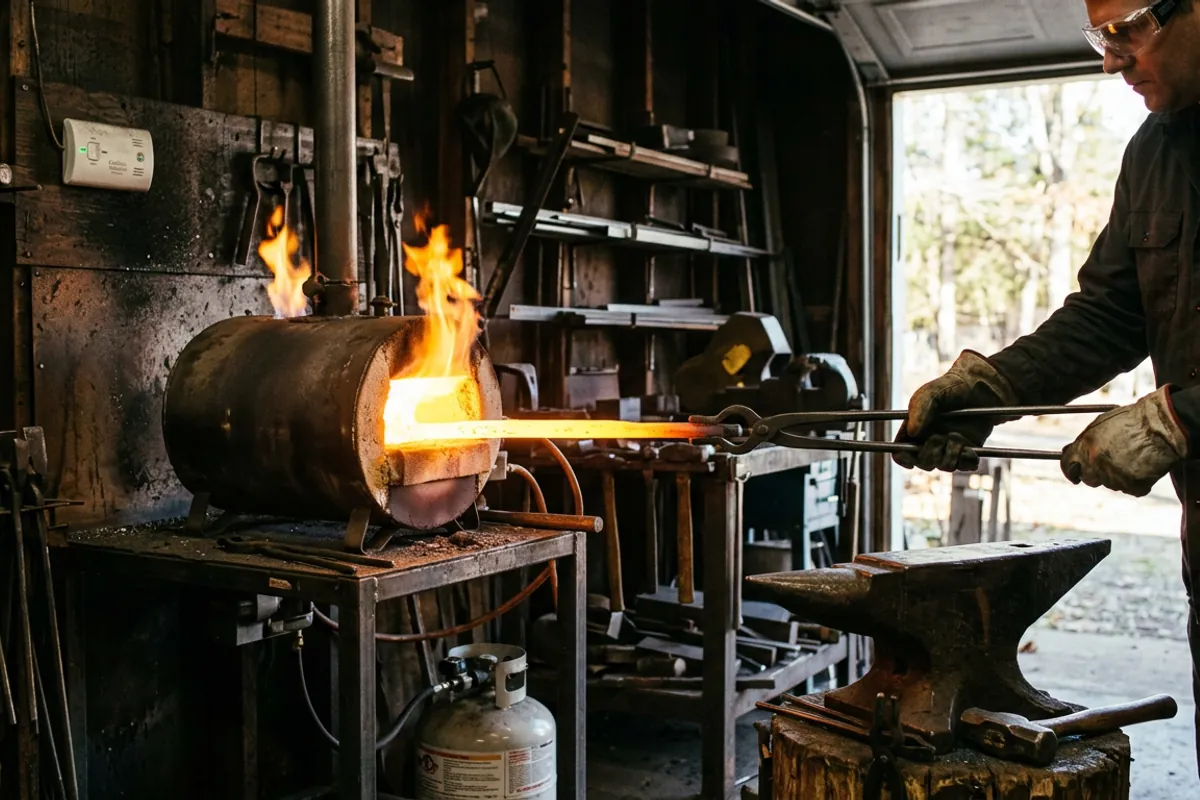
Propane itself is heavier than air, so a leak pools low and does not blow away. Check every fitting with soapy water when you build, shut the tank valve at the tank when you are done, not just the burner, and store the cylinder outside. And wear the same eye protection you would at the anvil, ANSI Z87.1 rated, because a forge throws light and the occasional spit of hot scale. I lost my eyebrows early on to a quench-oil flare because I stood too close in a cotton shirt with no shield, and I have taken PPE seriously ever since. My full rundown on what safety gear actually matters covers the rest. The forges topic hub collects the deeper builds and fuel guides if you want to go further.
What owners say
For the burners I have not run down in my own shop, here is what the forums actually report, praise and complaints both.
On the BladeForums aspirated burner thread, the T-Rex is the repeated recommendation for general forging and heat treat, with a moderator citing years of reliable use and praising how far down the pressure range it stays stable. The same thread carries the honest limitation: one owner says his T-Rex burners "just barely get there to welding heat," which lines up with the wider consensus that naturally aspirated burners reach forge welding temperature only in a tight, well-insulated forge, if at all.
Devil Forge burners draw a more mixed but generally positive read. Owners like the stainless nozzle and the value against the price, and the complaints tend to be about shipping time from Europe and the occasional need to tune the air choke to their chamber rather than about the burner failing. That matches what you would expect from a mid-tier venturi.
The budget generic burners get exactly the reviews you would guess: they work, they heat steel, and the gripes are inconsistent jet drilling and stiff chokes on some units. Owner signal on these no-name burners is genuinely thin and scattered because they turn over under many listing names, so I would not lean hard on any single glowing review. That thinness is itself the honest data point.
What I would tell a friend
If a buddy called and wanted one burner to build a general-purpose knife and hardware forge, I would tell him to get the Devil Forge DFP single burner: stainless nozzle, a real tuning range, and a fair price. If he was on a shoestring and liked to tinker, the generic budget burner will heat steel and teach him plenty, as long as he goes in knowing it will fight him at welding heat and that he still needs to add a regulator and hose. If he had the budget and hated fiddling, the T-Rex is the buy-once venturi, and if he wanted to learn the craft from the ground up, I would send him to Ron Reil's pages and let him build a Frosty T for the price of a few fittings.
Match the burner to the chamber, buy a real adjustable regulator and a propane-rated hose, and put a carbon monoxide alarm on the wall before you ever light it. Do that and any of these burners will serve you for years. Skip the ventilation and no burner is a good one.