Here is the article.
The short version, since that is what most people scrolling this actually want: if you are building a coal or charcoal forge and you want a hand crank forge blower that will move real air and last, the one I would point a beginner at is the Simond Store 8 inch cast aluminum blower. It is the size that fits a normal firepot, the gearing is sane, and the castings are heavy enough to take shop life. The tiny import blowers will light a firepot and get you forging, and the big 11 inch castings are more blower than a one person shop needs. Below is how I sort them out.
Before I go further, the honest framing. I run a coal forge and a propane forge, and I have cranked plenty of blowers at the club forge over the years, but I have not bought and bench tested every one of these specific import models in my own shop. So the picks here lean on published specs from the makers, what owners report on the forums, and general shop experience with what makes a blower worth owning. Where I am repeating what other smiths say rather than what I have run myself, I will tell you so.
What a hand crank forge blower actually does
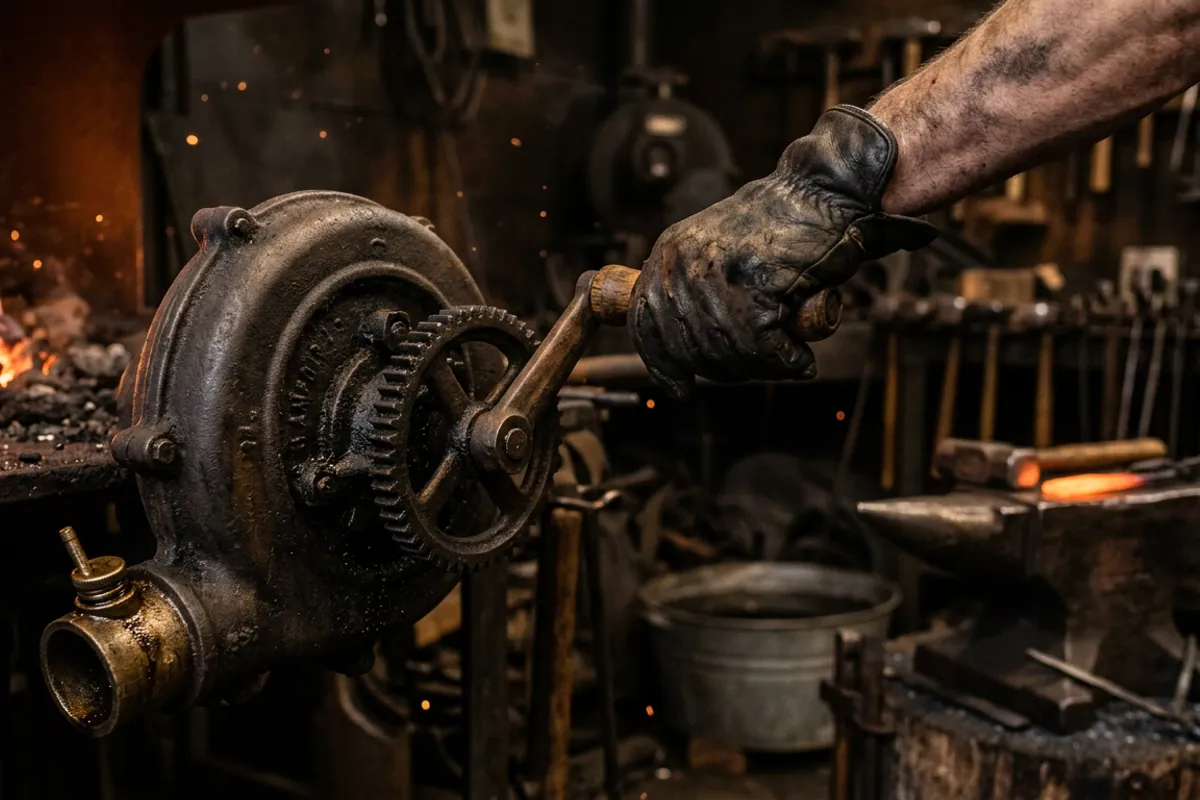
A solid fuel fire needs air pushed up through the fuel bed to get to forging heat. You can do that with a bellows, an electric blower, or a hand crank blower. The hand crank is a small centrifugal fan geared up off a crank handle, so one slow turn of your hand spins the impeller fast. Turn the crank, air goes up the tuyere and into the fire, the fire gets hotter. Stop cranking and the fire idles down.
That last part is the whole appeal. A hand crank blower gives you fine, immediate control over the fire with no dimmer switch, no gate valve, no electricity. On the I Forge Iron thread Hand Crank and Electric Blower, the recurring point from smiths who run both is that the crank gives easier and finer air control, it makes no noise, and it works when the power is out. That matches my experience at demos and club fires. You feel the fire through the handle in a way you never do with a switch.
The tradeoff is just as plain: you have one hand busy cranking, so you are working the steel one handed or cranking in bursts and letting the fire coast. For most hobby forging that is fine. If you are doing long even soaks or running a big fire all day, an electric blower frees up the hand and never gets tired. I cover that whole electric versus crank decision in more depth in my forge blower buying guide, and the fuel question that sits underneath all of this is in coal or propane for a first forge.
When a hand crank blower is the right call
A hand crank blower makes sense in a few clear cases. If you are building a coal or charcoal forge and you like the idea of no cords, a crank blower is period correct and genuinely pleasant to use. If you demo at fairs or teach outdoors where power is not guaranteed, a crank blower removes the generator from your kit. And if you just want the direct, tactile connection to the fire, nothing else gives you that.
Where I would steer you toward an electric blower instead: if you forge weld a lot and need long stable soaks, if you have arthritis or a wrist that will not thank you for hours of cranking, or if you are on a budget and already own a cheap bathroom fan or a hair dryer that will push plenty of air for a small firepot. A hand crank blower is not the cheapest way to get air. It is the nicest, and the most durable if you buy an old one.
One more note that belongs up top. A hand crank blower does nothing for a propane forge, which uses a fixed burner and needs no external air fan. This is a solid fuel tool. If you are leaning gas, see the propane forge buying guide and skip the blower entirely.
How I judge a hand crank forge blower
Four things matter, and marketing copy ignores most of them.
Gear ratio and gearbox. The ratio tells you how many times the impeller spins per crank turn. Something in the 1:25 to 1:36 range is normal and good. What matters more is whether the gearbox is real gears running in oil or a cheap plastic worm that will strip. The old Champion and Buffalo blowers ran cast iron gears in an oil bath and are still turning a century later. The good new imports copy that: cast iron gear, ground steel worm shaft, oil ports you actually fill.
Casing and impeller material. Cast aluminum for the housing and fan is fine and common. The failure point on the cheap ones is thin castings and a wobbly shaft, not the aluminum itself.
Air volume for the fire size. A little 6 inch casing blower is plenty for a small firepot burning charcoal. A deep coal fire in a big firepot wants more. You do not need Centaur numbers, but you should match the blower to the fire.
The mount and outlet. The outlet has to marry to your tuyere. A 2 inch outlet is easy to plumb; a tiny 1 inch outlet on a BBQ blower means adapters. Check this before you buy, not after.
For a sense of scale at the top end, Centaur Forge publishes real figures on their hand crank super blower: a 25 to 1 worm gear, up to 200 CFM, 18 pounds of blower. That is a serious, expensive piece built for a production coal forge. Most of us do not need that, but it is the benchmark the cheap ones are imitating.
Spec comparison
Published specs only. Where the maker does not state a figure, it says not published. I did not weigh or measure these myself; these come from the maker and retailer pages linked in each section.
Scroll horizontally to see all columns.
| Blower | Casing | Material | Gear ratio | Air outlet | Price tier |
|---|---|---|---|---|---|
| Ontihang hand crank blower | Small BBQ style | Not published | 1:36 | Small, with 20 cm extension tube | Budget |
| Simond Store 8 inch | 8 in | Cast aluminum casing and impeller, steel handle, pipe and stand | 1:28 | 2 in | Mid |
| Simond Store 11 inch | 11 in | Cast aluminum casing, cast iron gear, ground steel worm shaft | Not published | Not published | Mid to premium |
For a non marketplace reference point on what this style of blower runs, Whitlox publishes their hand crank blower as cast aluminum, a 1:28 gear ratio, 8 pounds, with a 7.5 inch diameter opening. That is very much the same class of tool as the Simond Store units, and the shared 1:28 ratio tells you this is the standard the import blowers are built to.
Ontihang hand crank forge blower
This is the small, BBQ crossover blower. It is marketed for charcoal chimneys, smokers, and firepots as much as for forges, and it comes with a 20 cm extension tube and sealing tape. The maker lists a 1:36 gear ratio, which is fine on paper.
Who it suits: someone lighting a small charcoal firepot or a JABOD style dirt forge who wants air now and does not want to spend much. For that job, a little blower like this genuinely works. The honest read is that this is a light duty tool. The castings are thin, the material spec is not clearly published, and the small outlet means you will likely be adapting it to your tuyere. Treat it as a way to get forging cheaply, not as the blower you hand down to your kid. If you are building on a shoestring, it belongs on the same shortlist as the scrap solutions in my homemade forge build guide.
Check price on Amazon (paid link)
Simond Store 8 inch cast aluminum blower
This is the one I would actually buy first for a normal coal or charcoal firepot. Simond Store publishes clear specs on their own site for the 8 inch casing blower: an 8 inch cast aluminum casing and impellers, a heavy duty steel handle, pipe and stand, a 1:28 gear ratio, a ground steel worm shaft, and a 2 inch air outlet with an oil port for lubrication. It ships with the stand, outlet pipe, handle and fasteners.
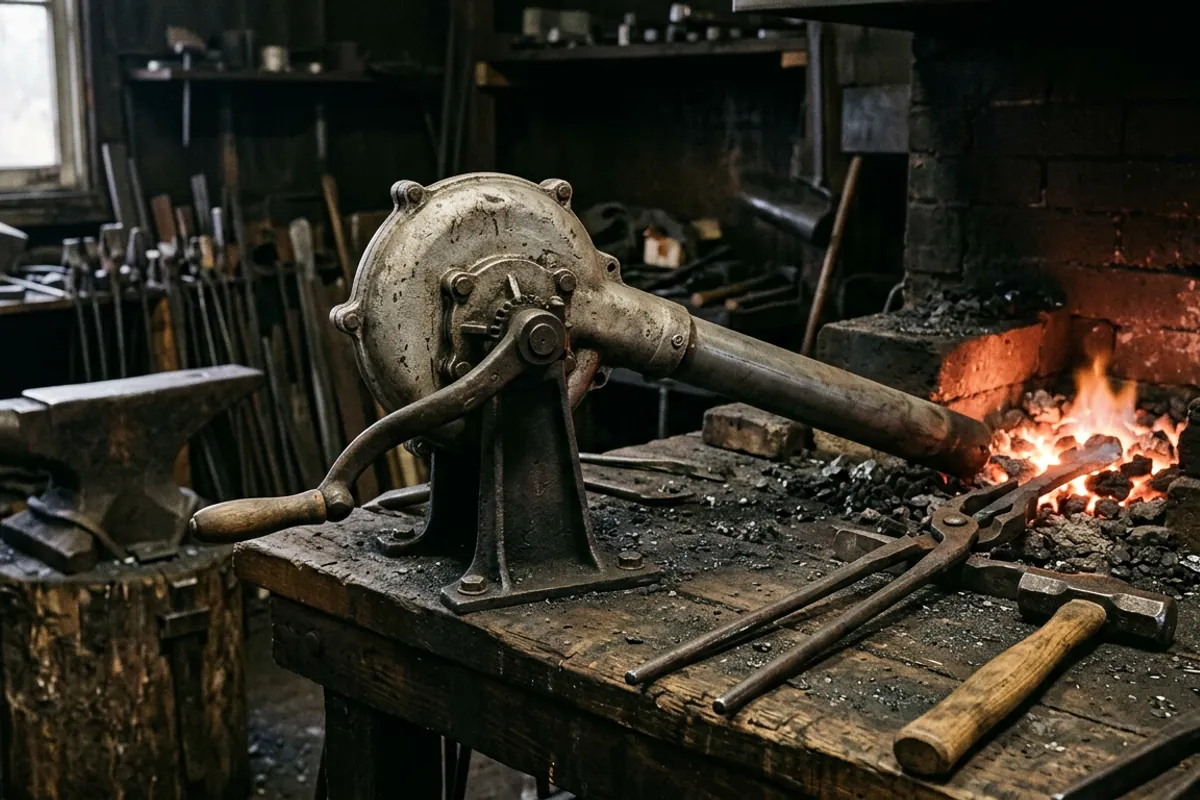
That spec sheet is what a hand crank forge blower should read like. The 2 inch outlet plumbs to a normal tuyere without a bag of adapters. The 1:28 ratio is the proven number. The steel stand means you are not fabricating a mount your first weekend. And the cast iron and ground steel in the gearbox, with an oil port you are meant to keep filled, is the part that decides whether a blower lasts five years or fifty.
The tradeoff is that it is an import, not a rebuilt Champion, so quality control varies unit to unit and you should check the gearbox turns smooth and oil the ports before first use. But for the money, this is the size and build I would put in a beginner solid fuel shop. Pair it with a firepot sized to match and you have a working fire. If you are still choosing the forge itself, my coal forge buying guide walks through the firepot and tuyere it feeds.
Check price on Amazon (paid link)
Simond Store 11 inch heavy duty blower
The 11 inch is the same family scaled up: a larger cast aluminum casing, a cast iron gear, and a ground steel worm shaft rated for the heat, with two oil ports for smooth low friction operation. Simond Store does not publish the gear ratio or outlet size for this one on the pages I found, so I have marked those not published rather than guess.
Who it suits: someone running a big, deep coal fire, a large firepot, or a forge that eats more air than an 8 inch blower comfortably feeds. For a one person hobby shop forging normal stock, this is more blower than you need, and a bigger casing is more to crank. I would only reach for the 11 inch if you already know your fire is starving the smaller unit. Most beginners will be better served, and lighter in the wallet, with the 8 inch.
Check price on Amazon (paid link)
What owners say
For gear I have not run down in my own shop, here is what the forums actually report, attributed so you can read the threads yourself.
The strongest and most consistent signal is that the vintage American blowers are the gold standard. On the I Forge Iron thread Thoughts on hand crank blowers and in Hand Crank and Electric Blower, the recurring line from experienced smiths is that a Champion 400 is about the best hand crank blower you can get, that they are no longer manufactured, and that a good used one is worth hunting for. If you can find a Champion or a Buffalo with a gearbox that spins free and holds oil, that is the buy of a lifetime, and it is why I always tell people to watch the secondhand market first. That same secondhand instinct is the one I bring to anvils in my antique anvils buying guide.
On the new imports specifically, the owner signal is thinner and more mixed, and I want to be straight that it is thinner. The praise you see on retailer reviews is that these blowers move a lot of air for little cranking and often come with a stand people did not expect. The complaints cluster around quality control: rough gearboxes out of the box, castings that need cleaning up, and the general truth that a cheap import is a cheap import. I could not find a large, settled forum consensus on any one of these exact model numbers, so I am not going to pretend one exists. Buy from a seller with returns, check the gearbox on arrival, and oil it.
The other durable owner theme is maintenance. Every long lived hand crank blower, old or new, is one that got its oil ports filled and kept full. A dry gearbox is what kills these. That is not a brand claim, it is just how a worm gear in a box wants to be treated.
Safety and setup, briefly
A blower makes the fire hotter and throws more sparks and clinker, so the same rules I harp on everywhere apply. Wear ANSI Z87.1 rated eye protection at the fire, not just at the grinder. Natural fibers only near the forge; a synthetic shirt melts to skin, and I have the missing eyebrows from an oil flare up years ago to remind me the shop does not forgive shortcuts. Keep the blower and its cord free of the fire, mount it solid so it cannot walk off the bench mid heat, and give the sparks somewhere non flammable to land. The full rundown is in my blacksmith safety gear guide.
What I would tell a friend
Buy used first. If a clean Champion 400 or a Buffalo comes up local at a fair price and the gearbox turns smooth, grab it and you are done for life. If you want new and simple, the Simond Store 8 inch cast aluminum blower is the size and build I would put in a beginner coal or charcoal shop: a 2 inch outlet that plumbs easily, the proven 1:28 gearing, and a steel stand in the box. The little Ontihang is a fine way to get a small firepot lit on a budget, just know it is light duty. And skip the 11 inch unless you already know your fire is starving.
Whatever you buy, fill the oil ports before the first crank and keep them full. That one habit is the difference between a blower that dies in a season and one your grandkids fight over. For where this tool sits among everything else a solid fuel shop needs, start at the forges topic hub and work out from there.