The first fuel most people ever burned in a forge was blacksmith charcoal, whether they knew it or not. Every smith working before the industrial age ran on it, and plenty of us come back to it when coal is hard to find or a coal fire is more than the shop needs. It burns clean, it lights easy, and you can make it in your own yard from scrap hardwood. It also eats itself alive in the fire faster than anything else you can burn, which is the catch nobody mentions when they hand you a bag of lump and tell you to have at it. I have run a charcoal fire plenty of times, mostly in a shallow brake-drum forge when I wanted to demonstrate old-style smithing or when I ran out of coal on a Saturday, and this is the honest picture of what the fuel is and how it behaves.
This is a reference piece, not a shopping list. If you want the forge to burn it in, I have written that up separately in the charcoal forge I would build before I bought one. Here I want to explain the fuel itself: what it is, how it differs from coal, what burns well and what wastes your money, and how to work a charcoal fire without cooking through a whole bag in an hour.
What blacksmith charcoal actually is
Charcoal is wood that has been cooked in the near-absence of oxygen until everything that can boil or burn off has left, and what remains is mostly carbon. That is the whole trick. Green wood is full of water, sap, resins, and volatile compounds. Burn it in open air and all of that flames, smokes, and steals heat. Cook it slowly in a sealed container with just enough air to drive the process, and those volatiles cook out and vent away, leaving behind black, light, brittle carbon that will burn clean and hot when you finally give it plenty of air.
That is why charcoal weighs so little for its size. A bag of good lump feels almost empty compared to the same volume of coal. Most of the original wood mass, the water and the volatiles, is gone. What is left is fuel that ignites easily, reaches forging heat quickly, and puts almost no smoke into the air once it is going. For a smith, the important properties are that it is low in sulfur, low in ash, and free of the tar and clinker problems that a bad coal fire throws at you. Sulfur is the enemy of forge welding because it makes steel red-short and crumbly under the hammer, and good charcoal has essentially none. That clean chemistry is the reason charcoal was the forge fuel of choice for thousands of years before anyone dug up metallurgical coal.
Lump charcoal versus briquettes
If you take one thing from this article, take this: burn hardwood lump charcoal, not grill briquettes. They are not the same product, and the difference matters in the fire.
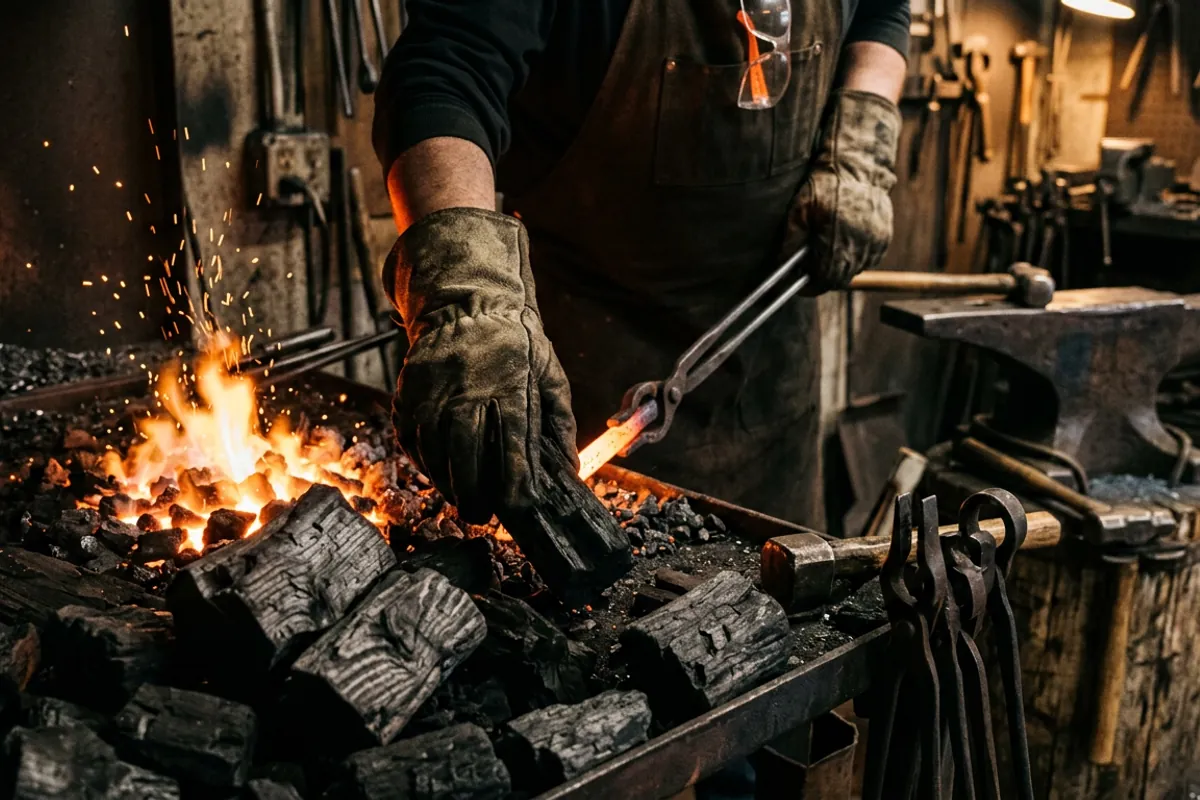
Lump charcoal is exactly what I described above, charred chunks of real wood and nothing else. You can see the grain in the pieces. It lights fast, burns hot, leaves very little ash, and when it is spent it is spent. That is what you want under a piece of steel.
Briquettes are a manufactured product built for a slow, even, predictable grill fire, which is the opposite of what a forge needs. They are ground charcoal dust pressed together with binders, and depending on the brand they can carry fillers, clay, sawdust, borax, sodium nitrate to help them light, and sometimes ground coal or coke. Some of that is inert and some of it is not, and the practical result in a forge is a lot of ash, a lower peak heat, and a fire that clogs and smothers itself as the binders and fillers pile up. The ash chokes your air supply from underneath, and you end up raking constantly instead of forging. I have watched a beginner fight a briquette fire for an hour, blaming themselves, when the problem was entirely the fuel. Buy the plain lump. It usually says "hardwood lump charcoal" on the bag with a short ingredient list, and that short list is the point.
Match-light or instant-light charcoal is worse still. It is soaked in lighter fluid or other accelerants, and you do not want those fumes coming off the fire you are leaning over all day. Skip anything labeled instant, quick-light, or self-lighting.
Charcoal versus coal in the fire
People treat "coal or charcoal" like a rivalry, but they are just different fuels with different manners, and knowing the difference tells you which one belongs in your shop. I went deep on the coal side in the coal forge coal I would actually buy, so here I will keep it to how the two feel to work.
Coal, good bituminous smithing coal, cokes. As it heats at the edges of the fire it drives off its volatiles and fuses into coke, a grey clinkered mass of nearly pure carbon that burns with intense, concentrated heat right where you pile it. You manage a coal fire by pushing green coal in from the sides and letting it coke, keeping a hollow of burning coke over your steel. It is slow to start, smoky until it cokes, and it produces clinker you have to clean out, but it holds a deep, hot, controllable fire on relatively little fuel. For heavy stock and for forge welding, a well-run coal fire is hard to beat.
Charcoal is the sprinter. It needs no coking, so it reaches heat almost immediately, and it burns wide and shallow rather than deep and concentrated. There is no clinker to speak of and very little smoke once it catches. The price you pay is consumption. Charcoal burns fast and it burns light, so you feed it constantly and you go through a lot of it by volume. A fire that a fist of coal would sustain for a good while will pull through a steady stream of charcoal in the same span. For a long session on big stock, that adds up in both bags and dollars.
If you are still deciding which way to point your whole shop, I laid the full case out in coal or propane: which first forge makes sense, and much of the coal reasoning there applies to charcoal too, with the consumption penalty added on.
Working a charcoal fire
A charcoal fire wants a different hand than a coal fire, and the two habits that trip people up are air and depth.
Charcoal is light and it burns fast, so it does not want the hard blast you would give a coal fire. Too much air and you are just accelerating how quickly the fuel disappears, throwing sparks and burning your steel while the bag empties. Ease off the blower. A charcoal fire comes up to heat on a gentle, steady airflow, and cranking it harder past a certain point costs you fuel without buying you much more heat. Learn to run it lean on air and you will stretch a bag a long way further.
Depth is the other half. Charcoal burns wide, so a proper charcoal fire is broader and shallower than a coal fire, and you keep a good bed of burning fuel under and around the steel rather than a tight deep pocket. Because it burns down quickly, you feed from the top and the edges continuously, letting fresh charcoal fall in and catch as the bed consumes itself. It is a more hands-on fire. You are always tending it. That constant feeding is normal, not a sign you are doing it wrong.
One real advantage: because charcoal has almost no clinker, you are not stopping to dig fused junk out of the firepot the way you do with coal. You rake ash, which is fine and powdery and settles out through the grate, and you keep going. For a beginner learning to read fire color and steel temperature without also fighting clinker and smoke, that simplicity is genuinely useful.
Making your own charcoal
The reason charcoal keeps its romance is that you can make it yourself from wood you would otherwise burn or throw away, and smiths have done exactly that for as long as there have been smiths. The process is the same one the commercial stuff goes through, just at yard scale: cook hardwood in a low-oxygen container until the volatiles cook off, then cut the air and let it cool.
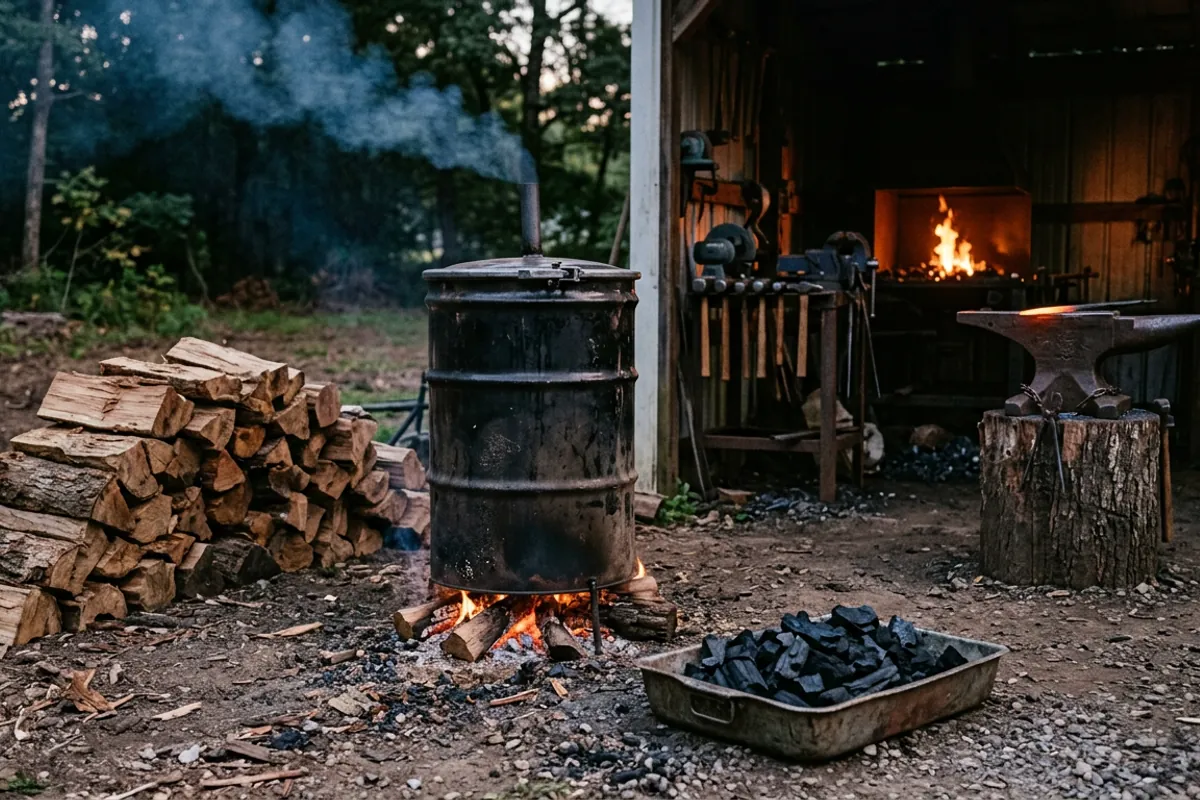
The common home method is the retort or the two-barrel setup. You pack hardwood into a sealed drum with a small vent, set it inside or over a fire, and heat the whole thing. As the wood cooks, it vents flammable gas and smoke, and that gas often burns off and helps fuel the process. When the venting slows and the smoke thins and turns from white to a faint blue, the wood has given up its volatiles and you seal the vent, cut off oxygen entirely, and let it cool completely before opening. Open it too early with air rushing in and the hot charcoal simply catches fire and turns to ash in front of you.
Use hardwood. Oak, maple, hickory, ash, and fruit woods make dense charcoal that burns hot and lasts. Softwoods like pine make light, fast-burning charcoal loaded with resin, and I would keep resinous softwood out of the retort if I could help it. Never make charcoal from treated lumber, painted or stained wood, plywood, or particle board. Those carry glues, preservatives, and chemistry you do not want to breathe or drive into your steel, and copper-based wood preservatives in particular put out fumes that are genuinely dangerous. Clean hardwood only.
Safety around a charcoal fire
Charcoal is friendly to burn, and that is exactly what makes people careless with it. Two hazards deserve real respect.
The first is carbon monoxide. Charcoal burns to carbon monoxide readily, especially a fire that is choked down or smoldering rather than roaring, and CO is colorless, odorless, and kills people every year who thought they had "enough" ventilation. A forge, coal or charcoal, belongs in a space with real airflow, ideally a hood and stack pulling combustion products up and out, and open doors are not a substitute for that on a still day. Never, ever burn charcoal to heat an enclosed space or run a forge in a closed garage. A cheap CO alarm on the wall of the shop is a few dollars of insurance against a mistake you would not live to correct.
The second is the fuel is real fire. This is the same warning I give in blacksmith safety gear: what matters and what to skip, and it holds here. Wear ANSI Z87.1 rated eye protection, because a charcoal fire throws sparks freely, more than a settled coal fire does. Wear natural fibers, cotton, wool, leather, not synthetics that melt to your skin when a spark lands. I lost my eyebrows early on to a quench flare I was too close to in a cotton shirt with no face shield, and I got lucky keeping my eyesight. Fire around a forge is patient and it will find the day you stopped respecting it. Keep water close, keep the floor clear of anything that will catch, and know where every hot thing in the shop is before you turn around with a bar of orange steel in your hand.
Where charcoal makes sense, and where it does not
Charcoal earns its place in a few clear situations. It is the right call if you cannot get good smithing coal where you live, which for a lot of people in a lot of regions is simply the reality. It is excellent for learning fire management without the smoke, coking, and clinker of a coal fire complicating things. It is the authentic fuel for old-style and demonstration work. And it is the fuel you can make yourself, which is worth something both in cost and in self-sufficiency if you have the wood and the time.
Where it struggles is sustained heavy work. The fast burn and high consumption mean a long day on big stock will run through a lot of bags, and if you are buying commercial lump that gets expensive faster than coal or propane would. For most home smiths doing a lot of general work, propane ends up being the easy everyday fuel and coal the choice for welding and heavy stock, with charcoal as the honest, capable option in between when the situation calls for it. If you want to see how all three fuels fit together across a shop, the forges topic hub collects the fuel and forge guides in one place.
None of this makes charcoal a lesser fuel. It made every blade and every hinge and every wagon tire for most of human history. It just asks you to feed it, tend it, and respect the fire, which is not a bad set of habits for a smith to build anyway.